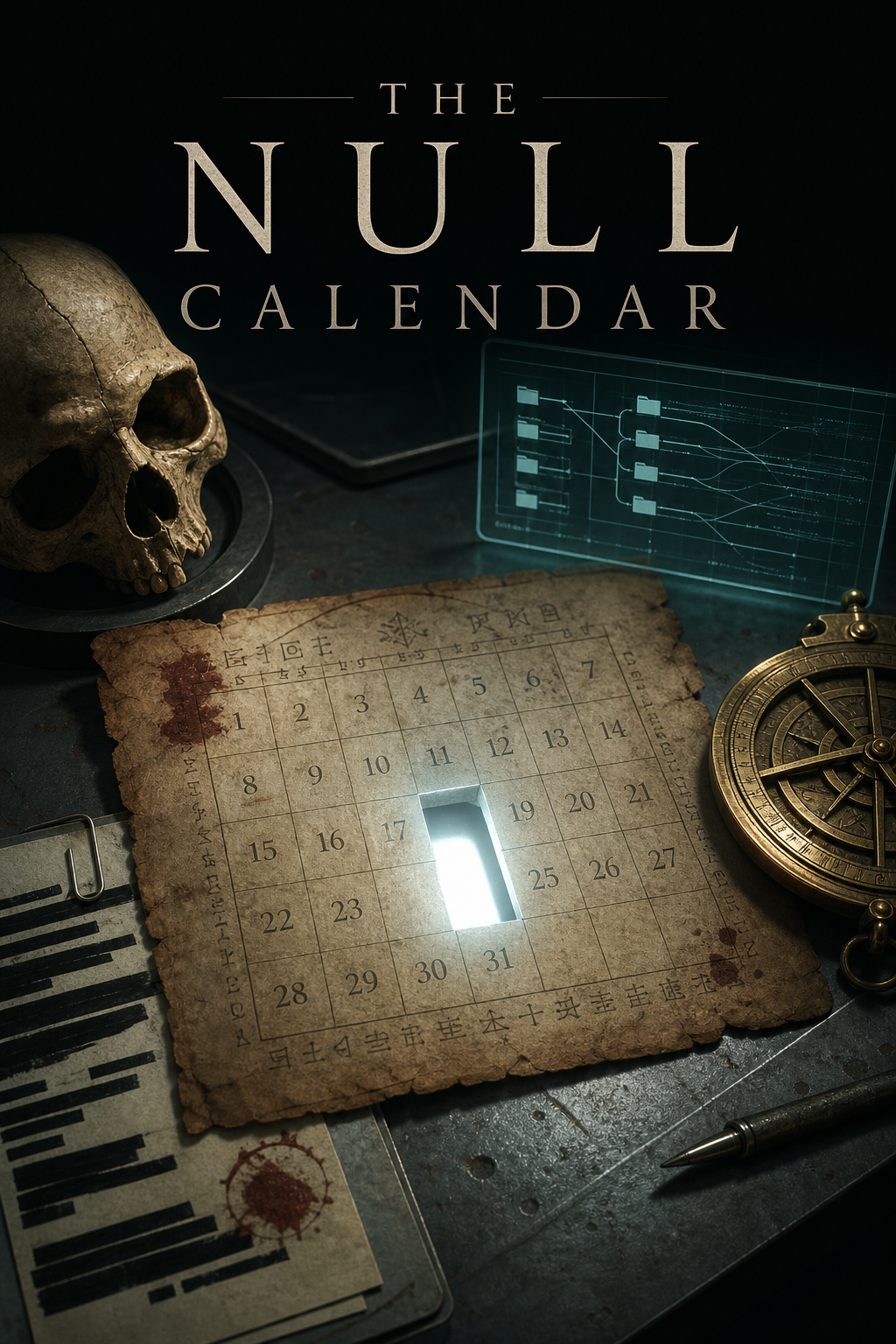
A work of documentary science fiction. Its institutional records and disclosure scenario are invented; the novel does not present unsupported alien-disclosure claims as fact.
Chapter 1: The Candidate Is Not In The Sky
Artifact Opener
INTERNATIONAL POST-DETECTION SUBCOMMITTEE AUTOMATED CANDIDATE EVENT NOTICE Distribution: Verification Ladder Core / Risk Communication / Archive Integrity Timestamp: 2031-10-03 04:17:22 UTC
Event class: Cross-repository anomaly Source geometry: Nonlocal Initial confidence: Below announcement threshold Public posture: No statement authorized Rumor posture: Monitor only Reply posture: Prohibited
Primary path:
HUMAN_ORIGINS / FOSSIL_ACCESSIONS / EAST_AFRICA / APPENDIX_A / CANDIDATE_SIGNAL
Mirror paths:
GENOMIC_ARCHIVE / ANCIENT_ADMIXTURE / RELATIONAL_METADATA ANTARCTIC_OBSERVATORY / NEUTRINO_LOGS / UNRESOLVED_BURST_CORRECTED CHRONOMETRY_REPOSITORY / NULL_DAY_CORRESPONDENCE / DO_NOT_NORMALIZE SEALED_LEGAL_ARCHIVE / KOVREN_A / SYNCHRONIZATION_WITHOUT_SIGNAL
Recommended action:
Verify before language.
The first confirmed message from another intelligence was filed under human remains.
That was the detail Dr. Mara Vale would remember later, after the hearings, after the riots over schoolbooks, after the week when no court in the world could agree on the legal meaning of the word person. Not the sirens from the street below the Geneva Annex. Not the pale blue seal of the International Academy rotating on the wall display. Not even the old dread that entered the room when the candidate alarm moved from amber to white.
It was the file path.
HUMAN_ORIGINS / FOSSIL_ACCESSIONS / EAST_AFRICA / APPENDIX_A / CANDIDATE_SIGNAL.
Mara stood alone in Conference Room 6 with a paper cup of burnt coffee cooling in her hand and read the path three times, waiting for the system to apologize.
The post-detection network had been built to listen outward: radio, optical, infrared, neutrino, gravitational, atmospheric. It could catch strange pulses from quiet stars, excess heat from hypothetical engines around distant suns, and patterned narrowband events that survived comparison against satellites, classified launches, academic jokes, broken scripts, and weather stations with personality defects.
It did not know, and was not supposed to know, how to receive a message from a fossil accession number.
Mara lifted her hand, lowered it again, and forced her fingers flat against the console before she touched the wall display.
"Reclassify source," she said.
The room listened. A soft tone answered.
SOURCE LOCKED: MULTI-REPOSITORY CONFIRMATION PENDING.
That was worse.
Candidate events were allowed to be ridiculous. Most were. Pulsars with comic timing. Satellites with bad paperwork. Military tests denied by people who had not yet been told what they were denying. Reflections from discarded upper stages. Sensor ghosts. Malicious students. Broken scripts. Anxious interns. Once, memorably, a weather station in Chile whose firmware had translated a pressure fault into what looked like a prime-number greeting.
The first rule of her profession was not wonder. It was humiliation. You let the universe embarrass you in private so that you did not embarrass science in public.
Mara opened the candidate summary.
The top field contained no star designation. No coordinates. No sky map.
Instead, there were four mirrors:
1. A genomic archive in Leipzig. 2. A fossil repository in Nairobi. 3. A neutrino observatory beneath Antarctic ice. 4. A sealed lecture transcript from a treason case in Novosibirsk.
Under them, in the clean language of machines that had never stood in front of a grieving family, the system had written:
NONLOCAL CHRONOMETRIC RECURRENCE DETECTED.
PROBABILITY OF COMMON ANTHROPOGENIC CONTAMINATION: BELOW REPORTING THRESHOLD.
RECOMMENDED STATUS: CANDIDATE TECHNO-SIGNATURE.
Mara set the coffee down carefully. If she spilled it, she would have to look away, and looking away felt like making a decision.
She checked the room status. Conference Room 6 was still in night mode. Six chairs. One wall display. No press feed. No window to the street. No staffer outside the door pretending not to guard it. The Geneva Annex had been designed by people who understood that history often began in rooms that looked temporary.
At the bottom of the candidate summary a field blinked.
PUBLIC RISK LANGUAGE: UNAVAILABLE.
Mara almost laughed. That was her field. Her office. Her whole professional compromise.
She had spent eleven years helping scientists say dangerous things without lying or causing stampedes. She had written the ladder for candidate technosignature announcements after the Atacama Burst panic, when a graduate student's unreviewed preprint had convinced twelve million people that a copper-rich star had answered Earth in prime numbers. Before that she had worked pandemic rumors, reactor rumors, asteroid rumors, synthetic embryo rumors, and one month of private hell after an observatory leak made her father's old suicide note trend under the tag CONTACT FEVER.
She believed in procedure the way some people believed in angels. Not because procedure was pure. Because panic was faster than mercy.
The door opened behind her.
"Tell me it is a training fault," said Dr. Saye.
Nia Saye carried a canvas archive bag against her chest as if someone might try to steal paper in a room that had just accused the dead of speaking. She was small, severe, sleepless, and famous among archivists for refusing to delete duplicate files until she had verified that they were truly duplicates and not history wearing a false name.
"It is not in the training environment," Mara said.
"That is not what I asked."
"I know."
Nia came beside her and read the display. Her face changed only once, at the fourth mirror.
"Kovren," she said.
"You know it?"
"Everyone in chronometry knows it. The lecture was a joke for three months, then a warning for three years."
"A warning about what?"
Nia did not answer immediately. She opened her bag and removed a folder so old that it seemed theatrical, the kind of thing Mara distrusted on principle. Truth did not become truer when printed on paper. But paper did one thing beautifully: it survived systems designed to revise themselves.
On the folder tab, someone had written in pencil:
NULL DAY CORRESPONDENCE - DO NOT NORMALIZE.
Nia placed it on the conference table.
"There are calendars that do not reconcile," she said.
"All calendars do that."
"No. All human calendars do human things. Priests move feast days. Kings lengthen reigns. Empires rename months. Conquerors erase dynasties. Scribes get tired. Translators pretend not to be guessing. Astronomers correct everyone later and become unbearable about it. Those are normal problems."
Mara looked at the folder.
"This is not normal."
"This is cleaner."
"Cleaner?"
"The same absence recurs in systems that should not know one another. Different continents. Different centuries. Different counting methods. When corrected against eclipses, tree rings, ice cores, and radiocarbon curves, they produce a date-space that has to exist mathematically and cannot be located historically."
"A missing day."
"No," Nia said. "A day-shaped instruction."
Mara read the folder label again and felt the room become smaller.
"Why was this not escalated?"
"Because no one escalates a missing day. They write an article. They lose funding. They become difficult at conferences. If they are unlucky, they become interesting to intelligence services."
The wall display chimed.
Mara flinched and hated herself for it.
NEW MIRROR REGISTERED.
PRIVATE HOLDINGS / CALDER_MEDIA_LEGAL_DISCOVERY / RAW_AUDIO / KOVREN_ELIAS_INTERVIEW_03.
Nia whispered something Mara did not catch.
"Who is Elias Kovren?" Mara asked.
The door opened a second time before Nia could answer. This time it was not a colleague but a security officer, and behind him the Director of the Post-Detection Subcommittee, barefoot in expensive shoes, hair wet from the shower, tie folded in one hand like a surrendered flag.
Director Aman Trel had the face of a man who had spent twenty years preparing for the most important day in human history and had expected, reasonably, to get dressed first.
"No one leaves this floor," he said.
Mara stared at him.
"We are not there yet."
"The Americans have the alert. So do the Chinese. So does somebody calling itself the Pale Choir, because there are already screenshots online."
Nia closed her eyes.
The Director looked at the wall display and lost a decade from his face.
"Is it real?"
Mara almost answered like a citizen. She almost said impossible. She almost said no. She almost gave him the mercy everyone would beg from her in the coming days.
Instead, she answered like a scientist.
"It is a candidate."
"I need more than that."
"No," Mara said. "You need less than that until we verify."
He laughed once. It sounded like a cough.
"The world will not wait for verification."
"Then the world will be wrong faster."
The security officer's phone began to vibrate. He looked at it, looked away, looked back. Outside the glass wall of the conference room, other phones began lighting up across the annex, one after another, a soft constellation of panic blooming on desks and in palms.
Nia slid the paper folder toward Mara.
"You should see the oldest version," she said.
Mara opened it.
The first page was a photograph of a clay fragment, cataloged in the careful dead language of museums. It showed a broken list of kings, harvests, floods, and offerings. Near the lower edge, where the fragment turned black with age, a later hand had scratched a mark that did not belong to the script around it.
It was not a word.
It was a small square with one side missing.
Under the photograph, in Nia's tight handwriting, was a note:
When reproduced as number, mark equals zero.
When reproduced as date, mark equals omitted day.
When reproduced as instruction, best translation is: wait.
The Director read over Mara's shoulder.
"Wait for what?"
The white candidate alarm stopped rotating.
For one second the room went silent in a way Mara had never experienced, not absence of noise but coordinated attention, as if the building itself had become a listener.
Then the display updated.
The file path changed.
HUMAN_ORIGINS / HOMO_SAPIENS / APPENDIX_A / CORRECTION_PERIOD_OPEN.
Below it, in plain text, appeared the first sentence no human being could claim to have written:
YOU HAVE REACHED THE PART OF YOUR HISTORY THAT CAN NO LONGER BE HIDDEN FROM YOU.
No one spoke.
The security officer crossed himself. Mara did not know he was religious until that moment, and the discovery embarrassed her, as if she had intruded on him.
Director Trel turned toward the door.
"Get Legal. Get Archive Integrity. Get Observatory Liaison. Get translation. Get everything."
"Not everything," Mara said.
He stopped.
"Mara."
"No public language yet. No noun."
"The system just wrote to us."
"It wrote a sentence. We do not know the speaker, origin, mechanism, intent, audience, or whether the translation layer is ours. We do not know if it is a message, a test, a trap, a mirror, a memorial, a contamination event, or a suicide note from something older than language."
The room looked at her.
There it was, the old shame of risk communication. To sound sane, you had to sound cold.
"No noun," she repeated. "No aliens. No visitors. No gods. No Curators. No disclosure. Not until verification."
Nia looked at the wall display.
"Too late for no disclosure."
"Not too late for honest disclosure."
A third chime sounded. This one came not from the wall display but from every phone in the room.
The security officer read first. His mouth opened.
The Director read next and sat down without looking for a chair.
Mara's phone stayed face down on the table. She did not want the public version before she had understood the private one. But the phone kept vibrating, nudging itself against the wood in tiny, urgent movements.
Nia picked it up and turned it over for her.
The post had already been mirrored six hundred thousand times.
It was ugly. A screenshot of a screenshot, cropped badly, compression artifacts crawling through the pale blue seal. Most of the file path was hidden. The comments beneath it were worse than Mara expected and exactly what she expected.
WE TOLD YOU.
PROJECT BLUE BOOK WAS REAL.
THEY FOUND THE BODIES.
FAKE.
WAKE UP.
IT IS THE RAPTURE.
IT IS CHINA.
IT IS A DEEPFAKE.
IT IS A TEST.
IT IS HERE.
The account that posted it was called Brother Null.
Mara set the phone down.
"Now," Director Trel said, "do we use a noun?"
Mara looked at the file path. At the fossil accession. At Nia's folder. At the sentence on the wall. At the public panic already building itself from old words because no new ones had arrived in time.
She thought of her father, who had died believing a false signal meant someone had come to judge him personally. She thought of his last note, which everyone online had treated as evidence for their preferred theory, stripping a sick man's final terror for parts.
She had built her career around a private vow: no one else would be killed by bad language if she could help it.
"Yes," she said.
The Director waited.
Mara took the keyboard from the table drawer and opened the blank public-risk field. Her hands were steady, which felt like another kind of panic.
She typed:
AN UNVERIFIED CROSS-ARCHIVE CANDIDATE EVENT IS UNDER SCIENTIFIC REVIEW.
No. Too cold. Too little. It would be read as contempt.
She deleted it.
She typed again:
AN UNUSUAL SCIENTIFIC CORRELATION HAS BEEN DETECTED ACROSS MULTIPLE INDEPENDENT ARCHIVES. THERE IS NO CONFIRMED PUBLIC FINDING AT THIS TIME. VERIFICATION IS UNDERWAY.
True. Also useless. It would not survive contact with fear.
She deleted it too.
Nia spoke quietly.
"Tell them what not to do."
Mara looked at her.
"That is not enough."
"It is the first mercy."
Mara began again.
PUBLIC NOTICE DRAFT 1:
Do not harm witnesses. Do not attack archives. Do not transmit replies. Do not treat rumors as instructions. Do not turn uncertainty into permission.
She stopped.
The room was silent behind her.
Then Nia said, "Add: preserve records."
Mara added it.
Do preserve records.
The candidate alarm resumed its silent rotation, white light crossing the walls, the table, the paper folder, the Director's bare feet, the security officer's trembling hand.
Mara saved the draft.
Outside the conference room the Geneva Annex woke into the first morning of the correction period.
No one called it that yet.
That was why, for a few more minutes, the world was still the world.
Chapter 2: The Dead Man's Lecture
Artifact Opener
MINISTRY OF INTERIOR PROPERTY RELEASE Case: KOVREN, ARON M. Recipient: KOVREN, ELIAS A. Release class: Personal effects, nontechnical Review status: Cleared after removal of state-sensitive material
Items returned:
- One gray wool coat, damaged. - One analog wristwatch, stopped. - One lecture pointer, cracked casing. - One notebook, pages 1-42 removed. - One paper calendar, December page only.
Recipient advisory:
Possession of returned property does not imply rehabilitation of the convicted party.
Elias Kovren signed for his father's life in a basement that smelled of wet concrete and copier heat.
The woman behind the glass did not look at him when she slid the release form through the slot. She had the bored caution of people who worked near power but did not possess it. Her badge showed no ministry name, only a photograph, a number, and the national emblem printed so badly that the eagle's second head looked like a stain.
"Full name," she said.
"Elias Aronovich Kovren."
"Relationship to convicted party."
He waited the extra half second that made clerks angry.
"Son."
She checked a box.
Not bereaved. Not next of kin. Not family.
Son.
The word looked small on the form, smaller than the case number, smaller than the red warning about unlawful dissemination, smaller than the line that said possession of returned property did not imply rehabilitation of the convicted party. Elias read that line twice while the woman counted his father's belongings as if inventory could remove intimacy from things.
"One coat."
She held it with two fingers.
His father's gray wool coat had been good once. Elias remembered it from conference photographs, from the year before everything became trial, rumor, and shame. It had hung from Aron Kovren's shoulders with professorial carelessness, pockets full of chalk, receipts, foreign coins, and the wrapped candies he pretended not to keep for graduate students. Now the left cuff was torn, and the collar held a white crust of old salt.
"One watch."
The watch had stopped at 03:12.
Elias did not ask whether it had stopped in prison, in evidence storage, or on the wrist of a dying man. The question would give the clerk an opportunity to say she did not know, and Elias had spent enough of his life listening to officials discover the luxury of not knowing.
"One lecture pointer."
It was a cheap metal cylinder with a cracked black button near the thumb. The casing had been split and glued back badly. Evidence technicians had opened it, found nothing worth stealing, and returned it because small objects embarrassed large states.
"One notebook."
She held up the notebook in a plastic sleeve. The first forty-two pages had been cut out with a ruler and a sharp blade. The remaining pages were blank except for pressure marks, the ghosts of writing visible only when light bent across them.
"One calendar."
The calendar was the kind banks used to give away before no one wanted paper on walls. December only. No photograph. No holiday art. Just a grid, numbers, and a red circle around the seventeenth day. The circle had been drawn so hard it dented the page beneath.
Elias felt something move in his chest and refused it.
"Sign here," the clerk said.
He signed.
She stamped the form, and the sound was too final for the smallness of the room.
"Do not publish images of the returned property," she said.
"Is that a law?"
"It is an advisory."
"Then advise someone else."
Her eyes lifted for the first time. There was no anger in them, only assessment. He had seen the same look from investigators, journalists, cousins, old professors, and once from his mother in the month before she moved to Vilnius and stopped answering numbers she did not recognize.
The look asked: How much of him is in you?
Elias took the bag of effects and left without giving her another sentence.
Outside, Novaya Station had been rebuilt again. The old kiosks were gone, replaced by glass stalls selling imported coffee, phone batteries, state lottery tickets, and patriotic children's books. Above the escalators, a newswall showed footage from Geneva: no sound, only a row of officials walking fast under blue-white lights. The chyron was careful. International scientific bodies reviewing unusual archive correlation. Public urged to avoid speculation.
Everyone in the station speculated anyway.
A man in a courier jacket watched the wall and said, "It is the Americans."
An old woman beside him said, "It is judgment."
A teenager said, "It is fake. Everything is fake before noon."
Elias kept walking.
He did not care what had happened in Geneva. Or he told himself he did not care with the concentration of a man keeping a match lit in weather. His father had been dead for two years, officially of pneumonia, unofficially of custody, publicly of treason. Every few months a new rumor attached itself to Aron Kovren's name. Hypersonic secrets. Chinese money. Foreign handlers. A nervous breakdown. A cult. A hidden weapon. A hidden signal. A hidden confession.
The rumors always wanted more from his father than the man had ever had to give.
Aron Kovren had not been a prophet. He had snored with his mouth open. He forgot birthdays and remembered comet apparitions. He could lecture for forty minutes on clock drift and then burn onions because he was thinking about relativistic correction tables. He believed every argument improved if someone opened a window. He once told Elias that the most dangerous sentence in science was not I know, but everyone knows.
Everyone knew he was a traitor now.
Elias took the tram instead of the metro because underground stations still made him feel hunted. He sat by the window with the property bag between his shoes and watched the city slide past in layers: apartment blocks, ministry towers, church domes, billboards for genetic ancestry kits that promised YOU ARE MORE THAN YOUR PAST, which struck him as either poor timing or perfect timing.
His phone buzzed.
Unknown international number.
He ignored it.
It buzzed again.
Then a message arrived.
DO NOT LET THEM BUY THE POINTER.
No signature.
Elias stared at the words until the tram doors opened and closed twice.
He put the phone in airplane mode.
At home, he locked the door, checked the hallway through the peephole, locked the second bolt, and placed his father's effects on the kitchen table. The apartment was too small for grief, which was why he had chosen it. There was no room for shrine behavior. No room for framed photographs or visitors who whispered. Just a table, a stove, a bed behind a curtain, and one shelf of books he had kept because selling them would not pay enough to justify the finality.
He opened the coat first.
Pockets: empty.
Lining: cut and resewn.
Collar: old sweat, old salt, old winter.
He folded it badly and placed it on the chair.
The watch next.
Stopped at 03:12. Scratched crystal. No inscription. He wound it without thinking, then hated himself when the second hand moved. The watch had not been preserving an omen. It had been out of power.
That was how grief humiliated you. It made mechanics look meaningful.
The notebook offered more hope and punished it. The removed pages were clean cuts. The remaining pages gave him pressure marks but no words he could read. He shaded one lightly with a pencil, a trick his father had taught him when he was nine and believed every adult trick was a form of magic.
No message appeared. Only fragments of equations, half-moons of notation, and one repeated indentation that might have been a word or a hand resting too hard.
The calendar he left for last.
December.
The seventeenth circled.
He checked the year in the corner and felt annoyance before fear. The calendar was from the wrong year. Three years before his father's arrest. The year of the Zurich lecture. The lecture that prosecutors called foreign transfer and his father's old colleagues called ordinary scientific exchange until ordinary exchange became a dangerous phrase.
Elias took the pointer in both hands.
"Do not let them buy the pointer," he said aloud.
His own voice sounded foolish in the kitchen.
The pointer had a battery cap. He unscrewed it and found a corroded AAA battery. Nothing hidden beneath. He pressed the cracked button. No red point appeared. He turned it in the light. The glue along the casing seam was new and clumsy. Evidence technicians had opened the cylinder from the side and resealed it in a hurry.
Small objects embarrassed large states.
He got a thin knife from the drawer and worked the seam until the glue surrendered.
Inside: spring, wire, diode, cracked board, nothing.
He was about to laugh when he saw the second seam.
Not in the casing. In the button.
The black rubber thumb button had a thin crescent cut almost hidden by wear. Elias pushed the knife tip beneath it and lifted. The rubber cap peeled away. Under it, pressed into a recess no larger than a fingernail, was a storage wafer wrapped in foil.
For a while he did not touch it.
The kitchen hummed. Pipes knocked in the wall. Somewhere below him a neighbor coughed and ran water. Outside, the city continued committing ordinary noise.
Elias had imagined this moment many times and always with contempt. In the imagination, hidden evidence arrived with music. In life it looked like trash.
He put the wafer on the table and photographed it with an offline camera. Then he took out the old laptop he used for infected files, the one with no network card and a keyboard missing the G key. He connected the reader, inserted the wafer, and waited for the laptop to decide whether history had a file format.
One folder appeared.
ZURICH_PUBLIC_BACKUP.
Inside were three files.
KOVREN_SYNCHRONIZATION_WITHOUT_SIGNAL_FINAL.pptx
KOVREN_SYNCHRONIZATION_WITHOUT_SIGNAL_NOTES.txt
IF_RETURNED_TO_ELIAS_READ_FIRST.txt
The cursor hovered over the last file.
Elias closed his eyes.
He did not want his father alive in the machine. He did not want comfort or confession. He wanted a simple villain, a simple lie, a simple proof that the dead could be restored by evidence. He had spent two years telling himself that truth would be enough if it ever came.
Now that a file had his name on it, truth looked like another room he had to enter alone.
He opened it.
Elias,
If this has reached you, then either I was wrong about the danger or right about the clock. I prefer the first possibility for your sake.
Do not give this to believers first. They will love it too quickly.
Do not give this to officials first. They will understand it too slowly.
Find a journalist who has been publicly wrong and survived the correction.
Find an archivist who refuses to normalize absences.
Find a scientist who knows the difference between silence and concealment.
I did not find visitors. I did not find ships. I did not find gods. I found timestamps that should not agree.
If they call this treason, ask them which country owns time.
Your father,
A.
Elias read it once.
Then again.
Then he minimized it because the tenderness in the word your had become intolerable.
He opened the presentation.
The first slides were boring enough to save the world.
Title. Name. Institution. Funding disclosure. A joke about clock synchronization that would not have worked in any language. Definitions. Error bars. Instrument drift. Archival timestamps. The Zurich audience, if the notes were honest, had been patient in the way scientists are patient when they smell either genius or career damage.
Slide 14: Antarctic neutrino burst, unresolved.
Slide 19: Observatory clock correction.
Slide 23: Bronze Age eclipse chronology discrepancy.
Slide 31: Ancient DNA sample metadata, independent accession logs.
Slide 37: Calendar anomaly cluster.
Slide 38 was blank except for a square with one side missing.
Elias stopped breathing.
The same mark was on the December calendar.
The seventeenth day had not been circled.
It had been enclosed on three sides.
He took the calendar from the table and placed it beside the laptop. The red mark looked crude now, not a circle but a failed square, a hand shaking or a pen running out of certainty.
The laptop speakers crackled.
Elias jerked back.
The presentation had an embedded audio file on slide 39.
His father's voice filled the kitchen, thin from compression, alive enough to be cruel.
"I am not proposing causation. I am proposing embarrassment."
There was laughter in the lecture hall.
"Good. You should laugh. A model that cannot survive laughter cannot survive peer review. But after laughter, please look at the timestamps."
The slide advanced.
Rows of numbers appeared. Elias had his father's aptitude for dread but not his mathematics. Still, even he could see the shape. Four columns from four disciplines, all corrected by methods that did not share instruments or assumptions. The same recurrence. The same absence. The same square trying not to become a symbol.
His father continued.
"A signal is not always a transmission. Sometimes a signal is an agreement between records that have no right to agree."
Elias touched the laptop screen where the null mark glowed.
His phone, still in airplane mode, remained dark.
Then the apartment intercom buzzed.
Once.
Twice.
Not the front door. The building entry.
He paused the lecture.
The kitchen became too quiet.
The intercom buzzed again, longer this time. Elias stood, moved to the wall panel, and pressed the speaker button without speaking.
A man's voice came through, polite and local.
"Mr. Kovren, I represent an infrastructure trust with an interest in your father's restored property. We are authorized to make an immediate offer."
Elias looked at the cracked pointer, the open laptop, the December calendar, and the letter that had told him not to let them buy it.
He pressed the speaker button.
"Which property?"
"The pointer."
Elias smiled for the first time that day. It did not feel like happiness. It felt like proof getting a blade.
"It is broken," he said.
"We are prepared to buy broken things."
"Then you should start with governments."
He released the button before the man could answer.
The intercom buzzed again.
He unplugged it from the wall.
For three seconds he believed that was enough.
Then the laptop, still offline, opened a new text window by itself.
The cursor blinked.
Letters appeared slowly, as if typed by someone learning the weight of each key.
PRESERVE THE RECORD.
Elias did not move.
Below the sentence came another.
CORRECTION PERIOD OPEN.
Chapter 3: The Missing Day
Artifact Opener
INTERNATIONAL CHRONOMETRY REPOSITORY ACCESS INTEGRITY INCIDENT Operator: SAYE, NIA R. Status: Credentials revoked during active session Mirror status: Public checksum replication continuing Record family: NULL_DAY_CORRESPONDENCE / DO_NOT_NORMALIZE
Incident note:
Revocation was issued by an external legal authority while operator was preserving active historical-correction records. Archive integrity process did not terminate. Duplicate mirrors should be treated as evidentiary, not redundant.
Nia Saye lost her archive access while she was still inside the past.
That was the way she would later describe it to the hearing, though every lawyer in the room objected to the wording. No one could be inside the past, they said. A person could be inside a database, a reading room, a terminal session, a custodial system, a breach, an unauthorized mirror. But not the past.
Nia let them object. Lawyers had their own rituals for managing terror.
At 05:03 Geneva time, the International Chronometry Repository still recognized her as Senior Archivist for Cross-Calendar Integrity. At 05:04, while her hands were on the keyboard and the null-day cluster was open in three synchronized panes, her name became an invalid credential.
The screen did not flash red. It did not accuse. The archive was too old in spirit for theatrical warnings. It simply dimmed the active controls and placed a gray message in the upper right corner:
SESSION PRIVILEGES MODIFIED.
Then:
EXPORT DISABLED.
Then:
USER AUTHORITY NOT FOUND.
Nia stared at the last sentence and felt, absurdly, insulted on grammatical grounds.
"I am found," she said.
The archive did not care.
Around her, Reading Room C remained almost beautiful. Long tables. Green-shaded lamps. Glass lockers. Climate-stable cases. A ceiling high enough to make whispers feel like weather. At the far end, behind transparent fire doors, the physical calendar fragments slept in trays: lunar notches cut into bone, water-damaged temple ledgers, monastery computus tables, eclipse tablets, imperial reforms, farmer almanacs, prison calendars scratched into plaster, schoolroom date wheels, ship logs, coronation lists, famine records, treaty clocks, and the bank calendar from a dead physicist's effects that had no right to be relevant.
There were more ways to count time than there were empires that had tried to own it.
Nia had loved that fact before it became evidence.
The repository phone rang.
She ignored it.
The three panes on her monitor held the same problem in different centuries.
Pane one: a reconstructed river-kingdom calendar corrected against a total eclipse.
Pane two: a monastic table adjusted for accumulated drift and copied against an older lunar record.
Pane three: a Mesoamerican agricultural cycle whose disputed interpolation had annoyed four generations of scholars and ruined two dissertations.
Three systems. No plausible contact path. Three local explanations that had satisfied local specialists for local reasons. None of the explanations survived when the correction curves were placed over one another.
Each produced a date-space that had to be counted but could not be named.
A missing day was normal. Missing days were everywhere. Reformers dropped them. Priests smoothed them. Conquerors renamed them. Sailors skipped them by crossing lines drawn on maps. Governments changed them because the sun had been embarrassing the state.
This was different.
This absence did not behave like loss. It behaved like punctuation.
Nia re-enabled the fourth pane with a keyboard shortcut her revoked account had not yet remembered to forbid.
KOVREN_A / ZURICH_PUBLIC_BACKUP / SLIDE_38.
The square with one side missing appeared beside the three calendars.
"There you are," she said.
The phone stopped ringing and began again.
The room's junior archivist, Tomi Ibarra, appeared between the stacks carrying two coffees and the facial expression of a person who had just received instructions he intended not to follow.
"Security says you need to leave the terminal," he said.
"Security can file a preservation request."
"Legal says you need to leave the terminal."
"Legal can learn chronology."
"Director Halden is on the phone."
"Which Director Halden?"
"The gray one."
That meant Office of Anomaly Resolution, not the repository. Nia had met Halden Reeve twice. He wore exhaustion like a uniform and treated archives as places officials went when the interesting part of a crisis had failed.
"Tell him the archive is busy."
Tomi placed the coffee beside her left hand.
"He says the UAP office has no evidence of extraterrestrial technology."
"Good for them."
"He says that should be reflected in any internal language."
Nia looked at him then.
Tomi was twenty-six, brilliant, badly dressed, and in possession of the dangerous belief that institutions could be improved by outlasting their worst managers. Nia had once believed something similar. Then she had removed a whistleblower's name from an index because the order was legal, temporary, and elegantly worded.
The name had never returned.
"Tomi," she said, "does this look like a UAP file?"
He looked at the panes. At the calendars. At Kovren's mark.
"No."
"Then the UAP office is denying a cupboard while the house burns."
Tomi nodded once, as if that made professional sense, which perhaps it did now.
"What do you need?"
"A physical pull."
His face changed.
"Nia."
"Tray C-17. The river-kingdom fragment. Tray J-04. The monastic table. Vault image packet M-88. And the disputed agricultural cycle facsimile."
"Your access is revoked."
"My digital access is revoked. My eyes are still accredited."
"That is not a policy."
"Then preserve the moment before they invent one."
Tomi did not move for three seconds.
Then he took off his badge and placed it on the table beside her coffee.
"If I am fired," he said, "I want the termination letter to include the phrase eyes are still accredited."
"It will be redacted."
"Even better."
He left at a walk that wanted to be a run.
Nia turned back to the terminal. Export was disabled, but the archive had older habits than export. It had checksums. Preservation proofs. Public disaster mirrors. The legal architecture had been built after a flood in Jakarta, a server fire in Oslo, and a coup that had taught everyone in her profession that cultural memory needed escape routes.
Those escape routes were now being called breach vectors by people who had never held a damp manuscript while mold ate the margins.
She opened the checksum pane.
AUTHORIZED USER NOT FOUND.
"Yes," she said. "We have established your limitations."
She opened disaster mode.
The archive asked for a reason.
FLOOD FIRE WAR SEIZURE DATA CORRUPTION OTHER
Nia selected OTHER.
The archive asked for a description.
She typed:
HISTORY UNDER ACTIVE REVISION.
The system considered this for an insulting amount of time.
Then it asked:
ARE YOU CERTAIN THIS IS A PRESERVATION EMERGENCY?
Nia looked through the glass wall toward the physical stacks. Tomi had reached the first fire door. A security officer had reached Tomi. Neither of them was touching the other yet. That was civilization, she thought: the interval before hands.
She selected YES.
Disaster mode opened.
Not everything. Not enough. But the checksum mirror resumed, and the null-day correspondence began replicating to institutions that had signed mutual preservation agreements years before anyone imagined mutual preservation might mean saving history from its own custodians.
Geneva. Nairobi. Kyoto. Montreal. Valparaiso. Cape Town. Reykjavik. Mumbai. Wellington.
Nine mirrors.
Then thirteen.
Then thirty-one.
The phone rang again.
This time Nia answered on speaker.
"Chronometry."
Halden Reeve's voice was quiet enough to be dangerous.
"Dr. Saye, you are preserving restricted material without clearance."
"No," Nia said. "I am preserving restricted material against unclear restriction."
"You know who this is."
"Yes."
"Then you know I am trying to prevent an international falsehood."
"Which one?"
There was a pause.
Halden said, "There is no evidence in official UAP holdings that any sighting represents extraterrestrial technology."
"I believe you."
Another pause. Longer.
"That is not the response I expected."
"You have been answering the question you were built to answer. This is not that question."
"The public will not understand that distinction."
"Then speak carefully."
"Careful speech is not enough now."
Nia watched the mirror count reach forty-four.
"Careless speech is why the public thinks all hidden things are the same thing."
Halden's breath moved against the microphone.
"You are not authorized to decide what enters the public record."
Nia almost laughed, but the room was too full of dead time for laughter.
"Director, the public record is where things go after powerful people fail to keep them private forever."
"That is an activist sentence."
"It is an archivist sentence. The difference is usually timing."
Tomi reappeared behind the glass doors with two security officers, one on each side of him. He had the river-kingdom tray in both hands and the satisfied look of a person being escorted after completing the important part.
Nia stood.
"I have to go."
"Do not touch the physical records."
"Then send someone with clean hands."
She ended the call.
The security officers entered Reading Room C with the hesitation of people entering a church for a legal errand. Tomi placed the tray on the nearest table before they could stop him.
"I was instructed to retrieve," he said.
"You were instructed to stop."
"Eventually."
Nia lifted the protective cover.
The fragment beneath was smaller than her palm. Clay, fired unevenly, edge broken, signs preserved in two directions because the original scribe had reused space. Scholars had fought over the lower line for a century. Was it a harvest notation? A king name? A flood count? A later correction? Every answer had a faction. Every faction had footnotes.
At the lower edge was the mark.
A square with one side missing.
On screen, the mirror count reached seventy.
One of the security officers said, "Dr. Saye, step away."
Nia did not step away.
She placed the bank calendar from Aron Kovren's effects beside the clay fragment. She had only a scan of it, printed in poor resolution from the leaked property file, but the red mark around the seventeenth was visible.
Not a circle.
A failed square.
"Tomi," she said, "photograph this."
"That is not allowed," said the officer.
"It is required," said Nia.
Tomi raised his phone.
The officer reached for him.
Then every lamp in Reading Room C went out.
For one breath there was only emergency darkness, the sudden absence of archival politeness.
Then the monitors came back on.
Not the ceiling lights. Not the table lamps. Only the monitors.
Every terminal in the room displayed the same white field. The same black mark. The same sentence in the repository's own plain system font.
PRESERVE THE RECORD.
Nia heard one of the officers whisper a word that belonged to prayer.
The sentence vanished.
The lamps returned.
The checksum mirror count stopped at one hundred and eight.
Then a new field appeared beneath the null-day correspondence:
PUBLIC ACCESSION: PENDING.
Nia looked at the physical fragment. At Kovren's failed square. At Tomi's raised phone. At the officers who no longer seemed certain which law had followed them into the room.
For most of her life, she had believed archives were not alive. That was the point of them. They did not want. They did not forgive. They did not rescue. They remained.
Now something had used the archive's own language to issue an instruction.
It had not said believe.
It had not said worship.
It had not said obey.
It had said preserve.
Nia took the photograph herself.
The shutter sound, small and artificial, carried across Reading Room C like a stamp.
Chapter 4: The First Denial
Artifact Opener
OFFICE OF ANOMALY RESOLUTION PUBLIC STATEMENT DRAFT - NOT RELEASED Prepared for interagency coordination
The Office has found no evidence in its historical UAP holdings confirming extraterrestrial technology, recovered craft, or biological material of nonhuman origin.
Internal legal note:
Statement is accurate if limited to historical UAP holdings. Statement does not address genomic archives, chronometry mirrors, fossil accession paths, neutrino logs, sealed legal transcripts, private holdings, or post-detection candidate events.
Recommendation:
Do not answer questions not asked.
June Calder distrusted beautiful leaks.
The ugly ones were harder.
Beautiful leaks arrived dressed for the appetite they meant to feed. They had seals, timestamps, redacted bars, melodramatic warnings, a phrase like do not distribute in the upper corner, and just enough blurred typography to make every amateur analyst feel needed. Beautiful leaks understood desire. They knew people wanted secrecy to look like secrecy, evil to sign its name in black ink, revelation to arrive already formatted for belief.
The file on June's laptop was not beautiful.
It was an export folder with a bad name, a broken table, two duplicate accession IDs, an audio file that refused to preview, and a metadata sheet that appeared to have been produced by software with contempt for human eyes. The redactions were inconsistent. One page had a coffee stain in the scan area. Another had a line offset by three degrees, as if someone had fed it through a cheap office scanner while afraid of being noticed.
It was exactly the sort of file June did not want to trust.
Rain combed the newsroom windows. The city below looked expensive and guilty. On the monitor wall, six muted channels tried to say the same thing without using the same nouns. Scientific correlation. Archive anomaly. False alarm. Foreign influence. UAP denial. Market uncertainty. Each phrase had been built to survive lawyers, not reality.
June paused the file transfer at ninety-three percent and forced herself to stand.
She had learned that if a story made her want to keep sitting, she needed to move before belief grew roots.
The newsroom was not really a newsroom anymore. It was three rooms above a dental practice, a server closet, a legal mailbox, and a name that still had enough weight for sources to risk ruining themselves. Calder Media had once had twelve reporters. Now it had June, a part-time records researcher in Toronto, two freelancers she paid late, and an intern who had come for climate investigations and stayed because catastrophe kept diversifying.
The intern, Sami, was asleep on the couch beneath a framed correction.
June had framed it herself after the Atacama Burst.
CALDER MEDIA RETRACTS CLAIM OF EXTRATERRESTRIAL SIGNAL PENDING REVIEW.
The correction had cost her investors, friends, a book contract, and the particular arrogance of believing that wanting truth made a person less vulnerable to wanting spectacle.
Good, she thought whenever the frame embarrassed her. Stay corrected.
Her phone buzzed under a stack of printed rumor captures.
Unknown sender.
She let it ring out.
It buzzed again.
This time a message appeared:
YOU HAVE KOVREN AUDIO. THEY KNOW.
June looked through the glass wall toward the locked stairwell door. No movement. No footsteps. No cinematic silhouette. Just rain, elevator hum, old pipes, and the glow of public panic becoming profitable.
She sat again and opened the transfer log.
Source: KOVREN_ELIAS_INTERVIEW_03.raw
She did not have a Kovren interview. She had never spoken to Elias Kovren. She had tried once, after his father's sentencing, and received a reply from a lawyer written in language so cold it seemed refrigerated.
The transfer hit ninety-four percent.
On the monitor wall, the government denial began.
June unmuted it.
Director Halden Reeve stood behind a gray podium and looked like a man being punished for precision.
"The Office of Anomaly Resolution has reviewed currently available records relevant to public speculation concerning unidentified anomalous phenomena," he said. "At this time, the Office has found no evidence in its historical UAP holdings confirming extraterrestrial technology, recovered craft, or biological material of nonhuman origin."
Sami woke up halfway through the sentence.
"Is that a denial?" he asked.
"It is a cupboard," June said.
He blinked.
"What?"
"He is denying the contents of a cupboard."
Halden continued. "We urge the public to avoid speculation and to rely only on verified information from competent scientific and government authorities."
June almost admired him. The statement was clean, accurate, and built like a lock. It would satisfy skeptics, enrage believers, and leave the real question untouched.
Sami came to stand behind her chair, hair crushed on one side.
"What are we doing?"
"Not publishing."
"We have something?"
"We have a mess."
"That's usually something."
"That is how people like me get corrected."
He looked at the framed retraction and had the decency not to say anything.
The transfer finished.
The folder opened itself.
June did not like that.
There were twenty-three items now, though the transfer log had listed seventeen. Six new files had appeared without timestamps. She disconnected the laptop from the network. The monitor wall kept talking, but the laptop screen became the only honest light in the room.
File names:
KOVREN_ELIAS_INTERVIEW_03.raw
NULL_DAY_CORRESPONDENCE_PARTIAL.pdf
CHRONOMETRY_MIRROR_HASHLIST.txt
OAR_STATEMENT_DRAFT_NOT_RELEASED.docx
GENOMIC_RELATIONAL_METADATA_README.csv
APPENDIX_A_PUBLIC_ACCESSION_PENDING.tmp
The last filename should have looked ridiculous.
Instead, it looked bureaucratic.
June opened the statement draft first. Always start with the official lie, she told interns. If it is well written, it will show you its borders.
The draft contained the sentence Halden had just delivered and a legal note he had not.
Statement is accurate if limited to historical UAP holdings.
June read the caveats once. Then twice.
"There it is," she said.
Sami leaned closer.
"There what is?"
"The doorframe."
"You are being metaphorical again."
"I am being careful. There is a difference."
He read the caveats and went still.
"So they are lying."
"No."
"June."
"No. This is worse. They are telling the truth inside a room they built too small."
Sami frowned at the screen.
"Can we say that?"
"Not yet."
"Why?"
"Because we have a leaked draft whose origin we cannot verify, and because I am done confusing emotional satisfaction with evidence."
She opened the hash list.
It was ugly too. Lines of file names. Checksum strings. Mirror locations. Some institutions she recognized. Some she did not. Nairobi, Kyoto, Montreal, Valparaiso, Cape Town, Reykjavik, Mumbai, Wellington. One hundred and eight mirrors. If this was fake, it was either brilliant or state-backed or both.
Sami said, "If the mirrors are real, this is the story."
"If the mirrors are real, the mirrors are the story."
"That sounds smaller."
"Smaller is how truth survives first contact."
The phone buzzed again.
This time the sender was not unknown.
ELIAS KOVREN.
June did not move.
Sami saw the name and whispered something that was not quite profanity.
The message contained no greeting.
Do not call my father a whistleblower. He was a scientist.
A second message followed.
Do not call him a prophet. Prophets are too easy to kill twice.
Then a third.
If you publish, publish the boring file.
June stared at the screen. Her pulse moved behind her eyes.
"Is that real?" Sami asked.
"No idea."
"Can you verify the number?"
"Probably."
"Are you going to call?"
June looked at the monitor wall. Halden Reeve was gone. A panel of commentators had replaced him, already turning his narrow denial into a broader certainty. Nothing alien. Government says no evidence. Disclosure hoax collapses. UAP believers enraged. Markets stabilize.
Another channel showed the opposite: THEY FOUND THE BODIES.
Another: GLOBAL COVER-UP ENTERS FINAL STAGE.
Another: SCIENTISTS HIDE TRUTH ABOUT HUMAN ORIGINS.
The world was building two lies from one careful statement.
June opened the raw audio.
At first there was only static, room tone, a chair scrape.
Then a young man's voice:
"My father did not discover aliens. He found clocks that disagreed with power."
June closed her eyes.
That was a sentence. Not proof, but a sentence with weight in it. A sentence that did not want to be loved too quickly.
The audio continued.
"If you are June Calder, you know what correction costs. Good. I need someone expensive."
Sami looked at her.
"That is either very real or very targeted."
"Both is an option."
June rewound. Played it again. Listened for edit seams, breath, room tone, artificial pauses. She heard fear, anger, exhaustion. She heard a man trying not to make his dead father useful to strangers.
She opened a blank document.
Headline:
WHAT WE CAN VERIFY ABOUT THE ARCHIVE ANOMALY
She deleted it.
Too broad.
Headline:
UAP DENIAL DOES NOT ADDRESS ARCHIVE LEAK
She deleted that too.
Too clever. Too inviting.
Headline:
THE GOVERNMENT DENIED THE WRONG FILE
She stared at it.
Sami said, "That one will run."
"That is why I do not trust it."
She deleted it.
For five minutes she wrote nothing. The room hummed. Rain moved down the glass. The old correction watched her from its frame.
Then June typed:
AN UNVERIFIED ARCHIVE FILE RAISES QUESTIONS OUTSIDE THE UAP RECORD
Sami groaned.
"No one will click that."
"Good."
"Good?"
"If the only people who click are the ones willing to be bored, we might have a chance."
She began the piece with what they did not know.
They did not know whether the leaked files were authentic.
They did not know whether the hash list would survive independent confirmation.
They did not know whether the Kovren audio was genuine.
They did not know whether the chronometry mirror was connected to the candidate alert reported from Geneva.
They did know that the official denial, as worded, addressed historical UAP holdings and did not address the archive categories named in the leak.
They did know that at least three mirror institutions appeared to be reachable by public checksum systems.
They did know that false claims were already spreading faster than careful ones.
Then she wrote the sentence she hated because it was necessary:
This article is not evidence of extraterrestrial contact.
Sami read over her shoulder.
"People are going to say you are hiding it."
"People already say that."
"People are going to say you are afraid."
"I am."
He looked at her.
June kept typing.
Fear was not the enemy of publication. Vanity was. Fear could sharpen a reporter if she let it ask useful questions. Vanity only asked how history would remember the byline.
At 03:17, she sent verification requests to three mirror institutions, two former sources in data integrity, one legal scholar, and a retired astronomer who had once told her, kindly, that she was not too stupid for science, only too hungry for certainty.
At 03:22, the first mirror replied with an automated checksum match.
At 03:24, the second mirror went offline.
At 03:25, her stairwell camera died.
Sami saw it on the security panel.
"June."
"I see it."
The newsroom door was locked. The server closet was locked. The laptop was offline. The old correction was still framed, still visible, still accusing her correctly.
Her phone buzzed one more time.
No sender.
Only a file.
APPENDIX_A_PUBLIC_ACCESSION_PENDING.tmp
The file icon was blank. No size. No date. No preview.
June did not open it.
Instead, she took a photograph of the laptop, the printed denial draft, the hash list, the framed correction, Sami at the security panel, and the rain on the window. A record of the room before the room became part of the story.
Then she copied the ugly folder to three offline drives.
Sami said, "Now what?"
June looked at the headline no one would click.
"Now," she said, "we publish the uncertainty before the liars publish certainty for us."
She hit save.
Not publish.
Not yet.
But save was the first moral act in a room built to erase.
Chapter 5: Verification Ethics
Artifact Opener
INTERNATIONAL POST-DETECTION SUBCOMMITTEE CANDIDATE SIGNAL PUBLIC RISK LADDER Version: 4.2 Author: Vale, Mara J.
Step 0: Unknown phenomenon. Do not imply intelligence. Step 1: Candidate anomaly. Verify instruments and metadata. Step 2: Multi-site anomaly. Seek independent observation or repository replication. Step 3: Candidate technosignature. Prepare internal notification and misinformation watch. Step 4: Credible confirmed detection. Notify scientific institutions and international authorities. Step 5: Public disclosure. Release evidence, uncertainty, archive instructions, and non-reply guidance. Step 6: Social stabilization. Protect scientists, witnesses, records, and vulnerable communities. Step 7: Post-detection governance. Prevent unauthorized reply, ownership claims, and evidence monopolies.
Margin note, handwritten:
The ladder assumes time. A leak removes time first.
Mara Vale had written the ladder in a hospital cafeteria.
That was one of the facts she never included in presentations. In presentations, the Candidate Signal Public Risk Ladder emerged from working-group minutes, protocol comparisons, post-detection literature, communications research, public-health rumor studies, lessons from false positives, and the old discipline of learning not to shout in a room full of frightened people.
All of that was true.
It was also true that she had written the first draft beside a vending machine at 02:40 in the morning while her father slept in the psychiatric observation wing three floors above her, sedated after trying to enter a closed observatory because an internet forum had convinced him that the Atacama Burst was a message meant specifically for him.
The ladder was not born from abstraction.
It was born because a false signal had learned her father's name.
Now the ladder occupied the center screen in Conference Room 6, surrounded by people who had memorized it, cited it, revised it, mocked it, depended on it, and were preparing to violate it.
"Step Four," said Director Aman Trel.
"Step Three," Mara said.
The room had become too crowded for ethics. Observatory liaison, archive integrity, legal counsel, UN notification, risk communications, data security, two people whose badges gave no office at all, and one representative from the Office of Anomaly Resolution who had entered quietly and stood near the coffee service as if hoping to be mistaken for furniture.
Nia Saye was not there. Her archive access had been revoked, which meant she had either done something reckless or something useful. Mara was beginning to suspect those categories had merged.
On the side monitor, June Calder's article sat open under a headline so boring it had already become famous:
AN UNVERIFIED ARCHIVE FILE RAISES QUESTIONS OUTSIDE THE UAP RECORD.
The article did not claim alien contact. It did not claim government reverse-engineering. It did not mention bodies, gods, ships, hybrids, or prophecy. It quoted the government denial accurately, then explained what the denial did not address. It listed uncertainties before implications. It refused every easy word.
It had been shared nine million times by people furious that it would not tell them what to feel.
Mara trusted it more than she wanted to.
"The public record has changed," Trel said. "We cannot pretend Step Three holds."
"Step Three is not a public-relations preference," Mara said. "It is an evidentiary threshold."
Legal counsel, a thin woman named Peres who used silence like a scalpel, tapped her pen once.
"The threshold may be overtaken by harm."
"Harm is why the threshold exists."
"Harm is also what happens when institutions appear to hide confirmed evidence after the public has partial proof."
"Partial proof is not proof."
"It may be enough for panic."
The room settled into the awful quiet of people hearing a correct sentence become insufficient.
Mara looked at the ladder.
Step Three: Candidate technosignature. Prepare internal notification and misinformation watch.
That was where they were by the rules. Independent repositories had confirmed relationships among the data, but the mechanism remained unknown. The translation layer was uncertain. The source identity was uncertain. The Chronometry mirror had replicated, but unauthorized public mirrors were now ahead of institutional ones. The Kovren audio appeared genuine, then appeared inside systems that should have been offline. Nia's emergency preservation action had both protected and destabilized the record.
Every fact arrived with a knife attached.
Halden Reeve, the gray man from the UAP office, cleared his throat.
"My office is being used as a weapon in both directions," he said.
Trel turned. "You gave a narrow denial."
"I gave an accurate denial."
"The public heard a broad one."
"Then the public heard badly."
Mara said, "The public heard according to the available nouns."
Halden looked at her as if deciding whether that was criticism.
She said, "You denied the cupboard."
"I denied what my office could deny."
"I know."
That was the problem. He was not a liar. The statement had been precise enough to defend and too narrow to survive broadcast. It had traveled into the public bloodstream and become two poisons at once: nothing is happening and everything is hidden.
The data-security officer pushed a new alert to the center screen.
PALE CHOIR DROP 0002.
The room groaned before reading it.
Mara read anyway.
The document looked official at first glance. Badly official, which made it more persuasive. A fake seal. A false classification banner. A dense block of pseudo-technical language. A fragment from June's article rephrased as proof of suppression. A fabricated list of "origin traitors." Three real terms stolen from the subcommittee's own draft vocabulary.
And one phrase that made Mara's skin go cold:
PUBLIC ONTOLOGICAL STABILIZATION.
That phrase existed in one internal vocabulary bulletin.
Not public.
Not leaked yet.
Not, by any defensible interpretation, lucky.
Peres leaned forward.
"Who had that phrase?"
No one answered quickly enough.
Trel said, "Everyone in this room."
"And Nia Saye," said one of the no-office badges.
Mara turned toward him.
"Do not do that."
He blinked. "Do not do what?"
"Reach for the archivist because she is not in the room."
The man said nothing.
Mara looked back at the fake document. It had already been mirrored, annotated, denounced, praised, translated, debunked, reassembled, and turned into merchandise. Under it, comments multiplied.
THEY ARE STABILIZING REALITY.
PUBLIC ONTOLOGICAL STABILIZATION = MEMORY WIPE.
SAY NO TO HUMAN RECLASSIFICATION.
PROTECT THE CHILDREN FROM ARCHIVE VIOLENCE.
Trel rubbed his face with both hands.
"We need a public statement."
"We need verification," said Halden.
"We need both," said Peres.
Mara heard herself say, "No."
Every face turned.
She had meant to say wait. She had meant to say not yet. She had meant to offer language, sequence, mitigation. Instead the smaller word had escaped because it was the only one strong enough to stand between bad options.
Trel said, "No to which?"
"No to a statement that pretends we are calmer than we are. No to a statement that uses a noun we cannot defend. No to a statement that tells people nothing while instructing them to trust us. No to another cupboard denial. No to silence that lets Brother Null write our vocabulary."
The room did not move.
Peres said, "Then what do you propose?"
Mara looked at the ladder and felt, with a grief so sharp it seemed physical, that she was about to damage the thing she had built to protect people.
"A Step Three public notice."
Trel said, "There is no Step Three public notice."
"There is now."
Halden's mouth tightened.
"You want to announce a candidate technosignature before credible confirmation."
"No. I want to announce that a candidate event is being verified, that several leaked files are unverified, that one government denial applies only to historical UAP holdings, that no reply should be transmitted, that no one should harm witnesses or archives, and that false documents are already circulating with stolen internal language."
"That sounds like panic."
"It sounds like what is happening."
Peres said, "It may create legal exposure."
"So will appearing to hide the event after the first death."
The word entered the room like smoke.
Trel said quietly, "There has been no death."
Mara looked at him.
"There will be."
No one challenged that. Not because she had authority over the future, but because every person in the room had been watching the same feeds: archives receiving threats, witnesses named in fake documents, old scientists turned into traitors or saints, children pulled from schools because a rumor said ancestry records would be seized by morning.
Trel walked to the window. The Geneva Annex did not have a useful view from Conference Room 6. It showed another building, another row of lit offices, another set of people awake because information had escaped its assigned corridor.
"Draft it," he said.
Mara sat.
Her hands found the keyboard.
For a moment she could not type.
The hospital cafeteria returned to her with the clarity of a punishment. The vending machine hum. The plastic chair. The woman at the next table crying into a phone. Her father's shoes in a clear bag because he had been admitted without laces. The forum posts printed by the nurse because he kept asking for proof. The sentence he had written on his intake form:
I do not know how to tell false contact from God.
Mara had not known either.
That was why she had built a ladder.
Now she had to teach it to bend without breaking.
She typed:
PUBLIC NOTICE - VERIFICATION EVENT
An unusual cross-archive candidate event is under active scientific review by multiple independent institutions. The event has not been publicly confirmed as extraterrestrial contact.
She stopped.
Too soft.
She added:
Several leaked materials circulating online are incomplete, altered, fabricated, or unverified. At least one fabricated document includes internal language not authorized for public release.
Peres said, "That admits a leak."
"It admits reality."
Mara continued:
The recent statement by the Office of Anomaly Resolution concerns historical UAP holdings. It does not resolve or evaluate the separate cross-archive candidate event now under review.
Halden exhaled through his nose.
"I can live with that."
"Good," Mara said, and kept typing.
Do not harm named individuals, scientists, witnesses, families, religious communities, schools, archives, observatories, or public institutions.
Do not transmit replies or attempted replies to any claimed nonhuman intelligence.
Do not treat leaked materials as instructions.
Preserve records.
Report threats.
Wait for verification.
Trel read over her shoulder.
"Wait for verification will be mocked."
"Yes."
"It may be ignored."
"Yes."
"It may be too late."
Mara looked at the final line.
"It is still the only honest command we have."
The data-security officer said, "Pale Choir just posted again."
The center screen changed before anyone approved it.
This time there was no fake seal. No long document. No theatrical banner.
Just an image of a torn calendar page and a caption:
THEY WILL TELL YOU TO WAIT BECAUSE WAIT IS THE FIRST WORD IN THE OLD TRANSLATION.
Under the caption was Nia's phrase from the clay fragment notes:
When reproduced as instruction, best translation is: wait.
Mara stood so quickly her chair struck the wall.
The room erupted. Legal demanded source isolation. Data security began shouting into a headset. Halden swore once, beautifully, with the relief of a man whose vocabulary had finally outrun his job. Trel called for the archive liaison. The no-office badges left without being dismissed.
Mara did not hear most of it.
She was looking at the word wait.
In her notice, it meant patience before proof.
In the fragment, it meant an instruction from the oldest calendar anomaly.
In the Pale Choir post, it meant obedience to hidden masters.
Same word. Three realities.
That was how language failed.
Not by lying.
By being captured faster than it could be explained.
Mara deleted the last line.
Wait for verification.
She replaced it with:
Verification is how the public keeps ownership of the truth.
Then she added:
We will publish what can be verified, when it can be verified, and we will preserve the record of what we get wrong.
Trel saw the change.
"Can you defend that?"
Mara thought of her father's intake form. Of June's framed correction. Of Nia's checksum mirror. Of Elias refusing to let his father become a prophet. Of Halden's narrow truth turning toxic because no one had explained its walls. Of the public, frightened and furious, learning old words from whoever reached them first.
"No," she said.
Trel stared at her.
"But I can sign it."
For the first time that morning, he smiled.
It was not reassuring.
It was merely human.
He said, "Send it to vote."
The notice went to the subcommittee at 06:12.
At 06:14, it failed.
At 06:15, Mara received a message from June Calder.
No greeting.
No source protection theater.
Just a sentence:
If you let them say nothing, Brother Null gets to be first draft of history.
Mara forwarded the failed notice to the emergency channel, attached her name, and typed the shortest professional suicide note in the history of post-detection governance:
Publish anyway.
Then she pressed send.
Chapter 6: The Pale Choir
Artifact Opener
ORIGIN PROOF DROP 0001 Posted by: BROTHER NULL Mirror count at capture: 18,441 Authenticity: false composite with live terminology contamination
You were taught to look up.
That was the first trick.
The proof was never in the sky. The proof was in the bones, the calendars, the court records, the dead scientists, the missing day, the language they are now trying to stabilize. They will tell you to wait because wait is what the old mark says. They will tell you to verify because verification is the priesthood of the new cage.
Every correction is a confession.
Preserve what they delete.
Do not let them define human before you do.
June Calder entered the Pale Choir through a recipe forum.
That was how bad modern history had become. One minute she was reading a thread about preserving lemons because a source in Beirut had once hidden sanctions documents inside cooking posts, and the next she was inside a disclosure cell where seventy thousand people were arguing about whether the missing day had already occurred and only the obedient had forgotten it.
The entry link was attached to a comment that said, Salt keeps truth from rotting.
June hated that it was a good line.
The Pale Choir did not have a single door. It had rooms inside rooms, mirrors inside mirrors, livestreams, archived chats, anonymous boards, private channels, public bait, dead drops that were not dead, and a cottage industry of people selling protective stickers with symbols they had stolen from documents they did not understand. The public face was theatrical: black backgrounds, brass seals, chopped audio, old UFO footage, legal excerpts, scripture fragments, scanner noise. The deeper rooms were quieter and more useful.
That was where June went.
Not because she believed them.
Because lies with good distribution were part of the story.
She sat in the office with all the lights off except the desk lamp. Sami slept on the couch again, shoes on, one hand under his chin like a student pretending not to be ruined by journalism. The monitor wall was muted. The newsroom smelled of burnt coffee, damp coats, and toner.
On her laptop, the Pale Choir welcomed her under the account name she had used for ten years in rooms where people hated journalists.
ARCHIVIST_MOTH.
The name had begun as a joke. It had become useful because people underestimated anyone who sounded like a harmless obsessive. June had learned to let them. She had been called worse things by better sources.
The main room was called CHANCEL.
Messages fell too quickly to read.
THEY DROPPED THE PUBLIC NOTICE BECAUSE BROTHER NULL MADE THEM.
WRONG. THE NOTICE IS COVER FOR THE RECLASSIFICATION.
DO NOT SAY ALIEN. ALIEN IS THEIR WORD.
HUMAN IS THEIR WORD TOO.
MY SCHOOL JUST SENT A FORM ABOUT ORIGIN-ANXIETY COUNSELING.
FAKE.
NOT FAKE. MY COUSIN GOT ONE.
THEY WILL TRY TO MAKE US CONSENT TO THE HEARING.
WHAT HEARING?
READ THE OLD DROPS.
June captured everything.
That was the first rule. Before interpretation, capture. Before belief, capture. Before outrage, capture. Every file, every timestamp, every deletion, every edit. Screenshots were poor evidence, but poor evidence was better than a memory, and memory was where false disclosure went to breed.
She opened the latest Pale Choir packet.
It called itself DROP 0003, though it included sections from DROP 0001 and DROP 0002 with altered dates. A bad sign. A useful sign. People who forged for belief did not care about version control until someone forced them to.
Page one: fake seal.
Page two: invented ministry name.
Page three: a real quote from Mara Vale's public notice.
Page four: a fabricated list of "origin traitors."
Page five: a screenshot from Nia's checksum mirror, genuine.
Page six: three paragraphs from an old conspiracy text, lightly rewritten to replace banking language with archive language.
Page seven: a photograph of Aron Kovren's Zurich slide, genuine or close enough to be dangerous.
Page eight: the null mark.
June leaned back.
The trick was not that everything was false. The trick was that almost nothing was pure.
Sami stirred on the couch.
"You still in there?"
"Yes."
"Anything real?"
"That is not the right question."
He sat up, hair smashed, face pale in monitor light.
"I hate when you say that."
"Me too."
He crossed the room and stood behind her.
"What is the right question?"
"Who benefits from making the real pieces unusable?"
On screen, a moderator pinned a new message.
BROTHER NULL WILL SPEAK IN FIVE.
The room changed immediately. The flood of messages slowed. People began posting small black square icons. Some posted prayers. Some posted threats. Some posted pictures of children holding homemade calendar signs. One user posted a photograph of an elderly scientist with the caption NEVER AGAIN. Another replied TRAITOR BLOOD. A third said SOURCE? and was buried under abuse.
June copied the scientist's photograph and added it to the harm folder.
Sami saw the folder name.
"You have a harm folder?"
"Every investigation has a harm folder. Most reporters just call it background."
The broadcast window opened.
No face appeared. Only a torn calendar page under a camera, one square cut from the middle. A gloved hand entered frame and placed a strip of black paper over the missing date. The audio was disguised, lowered and roughened until the speaker sounded like a machine trying to remember a sermon.
"You were taught to look up," Brother Null said.
June turned on local recording.
"That was the first trick."
Sami whispered, "This is creepy."
"Creepy is cheap. Listen for expensive."
Brother Null continued. "The proof was never in the sky. The proof was in the bones, the calendars, the court records, the dead scientists, the missing day, the language they are now trying to stabilize."
June wrote: knows public notice phrase, maybe internal bulletin, maybe scraped from leak.
"They will tell you to wait because wait is what the old mark says. They will tell you to verify because verification is the priesthood of the new cage."
June paused the recording and replayed the line.
Sami said, "That will spread."
"It is built to."
"It is also kind of..."
"Good?"
He looked ashamed.
"Effective."
"That is worse."
June unpaused.
Brother Null's gloved hand placed a second object under the camera. A printed table with checksum strings. June recognized two from Nia's mirror. The third was wrong by one character. Not a typo. A hook.
"Every correction is a confession," Brother Null said.
The chat repeated it.
EVERY CORRECTION IS A CONFESSION.
EVERY CORRECTION IS A CONFESSION.
EVERY CORRECTION IS A CONFESSION.
June felt the old Atacama nausea return. The sensation was not fear exactly. It was professional memory. The body remembering what it felt like to watch a sentence become a crowd.
Brother Null said, "Tonight they will ask you to trust their verification. Ask who owns the instruments. Ask who owns the archives. Ask who owns the courts. Ask who owns the word human."
Sami said, "Can we prove he is wrong?"
"No."
"Can we prove he is right?"
"No."
"Then what can we prove?"
June pointed at the third checksum.
"That he changed this."
The broadcast ended after eleven minutes and seventeen seconds.
Of course it did.
The room detonated into interpretation. Some users said the runtime proved the seventeenth day. Some said the three bad checksum characters mapped to coordinates. Some said the coordinates pointed to a military base. Some said the base was fake, which proved the real base was elsewhere. Some said Brother Null was not one person. Some said Brother Null was Nia Saye. Some said Brother Null was Aron Kovren speaking through an archive ghost. Someone posted June's old Atacama correction with the caption CALDER WILL BETRAY THIS TOO.
Sami looked at her carefully.
June copied the post into the harm folder.
"You okay?"
"No."
"Do we stop?"
"No."
She opened a new document.
PALE CHOIR DROP CONTAINS GENUINE ARCHIVE FRAGMENTS AND ALTERED CHECKSUMS.
Too long.
She tried again.
THE PALE CHOIR IS POISONING REAL EVIDENCE.
Too certain.
Again.
WHAT WE CAN VERIFY ABOUT THE PALE CHOIR DROPS.
Boring enough to live.
She began with the altered checksum. Then the genuine mirror fragments. Then the fake seal. Then the imported language from older conspiracy literature. Then the harm risk. Then, only then, the quote everyone would share.
Verification is the priesthood of the new cage.
She typed beneath it:
The line is rhetorically powerful and evidentially empty.
Sami laughed once.
"That will make people mad."
"Good."
"You say that a lot for someone who hates being hated."
"I hate being useful to liars more."
Her secure inbox chimed.
One message.
No sender name.
Subject: BORING FILE.
June did not open it immediately.
She checked headers. Partial. Dirty. Routed through a chain of compromised newsletter servers, two dead domains, and a municipal library account in Ohio. The sender had made no serious attempt to hide from an intelligence agency. They had made an excellent attempt to waste a journalist's afternoon.
Attachment: accession_delta_17.csv
Plain text:
Real proof is always the boring file.
Sami read it over her shoulder.
"That is from Brother Null?"
"Maybe."
"Are you going to open it?"
"Not here."
"Are you going to tell Mara?"
June looked at the question for longer than the technical problem required.
Mara Vale had published anyway. That was what the feeds were saying. Not in those words. The public notice had gone live through an emergency channel after a failed vote, and every institutional account was now pretending the sequence had been orderly. June could smell the lie of process. It had a particular odor, like carpets in government buildings.
She did not know Mara Vale.
She knew the notice had done one thing right. It told people not to harm witnesses, not to attack archives, not to transmit replies, not to treat leaked materials as instructions, and to preserve records.
It was not enough.
It was more than nothing.
June forwarded the message headers, not the attachment, to the emergency address printed in the public notice.
Subject:
Possible Pale Choir contact. Attachment quarantined.
Body:
If this is yours, say so through a channel that does not insult my time.
She hovered over send.
Sami said, "Professional."
"I am very tired."
She sent it.
The reply came twenty-two seconds later.
Not from the emergency address.
From the same no-sender chain.
No attachment this time.
Just one sentence:
You keep proving you know where not to look.
June sat very still.
Sami whispered, "What does that mean?"
June looked at the wall calendar with its missing square, the fossil photo, the false seals, the real checksum, the old correction in the frame, and the dark window reflecting her own face back over the rumor feeds.
"It means," she said, "someone is training us."
The next message arrived before she could close the laptop.
This one had a sender.
MARA VALE.
Calder,
Do not open the attachment.
We need to talk about the boring file.
Chapter 7: Mirror Lab
Artifact Opener
CHAIN-OF-CUSTODY NOTE: ACCESSION DELTA 17
Originating office: International Post-Detection Subcommittee, verification cell
Transfer status: compartmented, civilian mirror permitted
Primary specimen class: ancient DNA metadata, sample relationship tables, excavation calendars
Human-readable risk label: boring file
No recipient is being asked to believe a claim.
Recipients are being asked to run a blind replication against their own holdings and to preserve every negative result.
Do not harmonize field names before first pass.
Do not correct dates before first pass.
Do not infer missing values before first pass.
Do not contact another mirror lab before submitting the first checksum bundle.
If the pattern appears only after cleaning, reject it.
If the pattern survives the ugliness, call the emergency number printed at the end of this note.
Mara Vale slept for nineteen minutes under her desk.
She did not intend to sleep. She had sat on the floor to read three pages without interruption, taken off one shoe because the heel had started to chew through the back of her foot, leaned against a drawer, and closed her eyes to improve concentration. The next thing she knew, someone was knocking on the door with the apologetic force of a person who had been told not to wake her and had decided that waking her was the lesser disaster.
"Come in," she said.
Her voice sounded like it belonged to an older official who smoked and hated music.
The door opened three inches. Leena Patel looked in with a tablet against her chest.
"You said to wake you if Calder answered."
Mara was upright before she remembered the shoe.
"She opened it?"
"No. She sent headers. Then you told her not to open it."
"I remember what I told her."
"She wants to know why."
Mara found her other shoe under a stack of printed risk ladders. One page had the phrase PUBLIC CALM IS NOT PUBLIC CONSENT circled twice in red. She did not remember circling it. She hoped she had done it.
"Tell her because the file may be real."
Leena did not move.
"That is not an answer we can send to an investigative reporter."
"No," Mara said. "It is not."
Leena waited.
Mara stood, put one hand on the desk, and let the room find its edges. It was 04:16 local in Geneva, if the wall clock could be trusted. She did not trust it. Since the public notice had gone live, every clock in the building had become part of the argument. Someone had taped paper over the digital conference-room calendar because a staffer from orbital coordination had started crying every time the seventeenth day appeared.
The building had not been built for revelation. It had been built for procedure. Frosted glass. Soft security doors. Flags in the lobby. Bad sandwiches arranged under domes as if diplomacy were a form of catering. The fluorescent lights had a way of making everyone look like they had already been deposed.
"Where is Delta 17?" Mara asked.
"Air-gapped room."
"Who has touched it?"
"Nia Saye. Emil Gorski. Me. You have not."
"Good."
"That was not an accident?"
"No."
Leena's face changed by one millimeter. With Leena, that was a speech.
"You sent a file you had not opened?"
"I sent a file I had not contaminated."
"To journalists?"
"To mirror labs."
"And to Calder?"
Mara looked at the tablet. On it was the beginning of June Calder's message, plain and annoyed enough to be authentic.
If this is yours, say so through a channel that does not insult my time.
Mara almost smiled. Almost was the last decent emotion left in the building.
"No," Mara said. "Someone else sent it to Calder."
The air in the room grew thinner.
Leena lowered the tablet.
"Someone outside the cell has Delta 17?"
"Someone outside the cell has a file calling itself Delta 17."
"That is worse."
"It is only worse if it is close."
Leena understood then. Mara saw it arrive. Not fear first. Geometry first. Leena's mind built a map: the real packet in an air-gapped room, a possible false packet in Calder's inbox, the Pale Choir weaponizing a checksum, and a public notice telling the world to preserve records while every rumor farm learned the word accession.
"You think the fake file is a lure."
"I think the sender knows our vocabulary."
"Brother Null?"
"Brother Null is a mask."
"Whose?"
Mara picked up the risk ladder and folded it once, carefully, along the red circle.
"That is the question everyone wants to answer too quickly."
The air-gapped room was three floors down, past the press corridor and below the archive annex. Before the signal candidate, the room had been used for election-monitoring datasets and sanctions records. Now it held three computers without network cards, a steel evidence cabinet, two cameras, an old wall printer, and a whiteboard on which Nia Saye had written a sentence so ugly it had become holy.
TRUST NOTHING THAT HAD TIME TO BECOME BEAUTIFUL.
Mara signed the entry log with a pen that skipped on the final e.
Nia was inside, barefoot, wearing a lab coat over a blue sweater with one sleeve rolled past the elbow. She had a habit of removing shoes when thinking, as if floors could conduct evidence upward. Emil Gorski sat beside her with both hands flat on the table, watching a progress bar move across the screen.
"Do not ask me if it is real," Nia said.
"I was going to ask whether it replicated."
"That is the same question with less poetry."
"Then answer without poetry."
Nia pointed at the left monitor.
The screen showed a table with columns no public leak could have made glamorous: repository ID, excavation season, extraction protocol, library prep batch, radiocarbon calibration version, curator initials, sample handling gap, local calendar conversion, disputed stratum note, inherited damage score.
The boring file.
It was not a video. It was not a confession. It did not contain the face of an alien, the geometry of a craft, a presidential signature, a secret treaty, a glowing alphabet, or a map to a buried city. It was rows and rows of human inconvenience. Bad dates. Missing labels. Footnotes. Field seasons that crossed fiscal years. Bone fragments numbered twice because a graduate student had used the wrong tray. A century of human record-keeping, vain and exhausted and specific.
Nia loved it in the way only a scientist could love something that refused to flatter her.
"Delta 17 is not sequence data," she said. "That is the part the public will get wrong first."
"Walk me through it."
"Again?"
"As if I am a finance minister."
Nia winced.
"Ancient DNA is messy. Samples come from different sites, different labs, different eras of technique. Everyone wants the magic inside the genome, because people think DNA is scripture written in chemistry. But this pattern is not a sentence in the genome. It is in the relationships among samples and records. Metadata. Dates. Handling histories. Geographic constraints. Calibration changes. The stuff people strip away when they want a clean story."
Emil said, "A clean story would have been easier to deny."
"Yes," Nia said. "This is disgusting."
"Use the formal term," Mara said.
"Robust to reasonable contamination controls."
"That is worse."
"Yes."
Mara stood behind them and watched the table scroll.
Rows became clusters. Clusters became distances. Distances became a shape that should not have been there. It appeared when laboratories that had never collaborated were placed against one another. It appeared when known contaminated samples were excluded. It weakened when dates were polished and strengthened when original local calendars were left in place. It was not a message in the sense civilians wanted messages. It was a scar in bookkeeping.
The old human record, when left ugly, remembered being handled.
"First mirror?" Mara asked.
"Back from Valparaiso," Nia said.
"They had the same inputs?"
"No. That was the point. They had their own archive. We sent the relationship test, not the pattern."
Mara looked at Emil.
He slid a printed page across the table.
VALPARAISO INDEPENDENT GENOMIC ARCHIVE BLIND MIRROR RETURN: ACCESSION DELTA 17 Status: anomalous relationship pattern detected Contamination screen: negative for lab-common modern human overprint Calendar-normalized run: weaker signal Original-record run: stronger signal Recommendation: replicate before public interpretation
Mara read the page twice.
The first time, she was the chair of a subcommittee under emergency conditions.
The second time, she was a human being.
She preferred the first.
"Who else has returned?" she asked.
"No one," Nia said. "Oslo is late. Nairobi acknowledged receipt. Kyoto rejected the transfer until they receive a ministerial waiver. Boston claims their legal office is asleep, which may be the last healthy institution on Earth."
Emil said, "Tbilisi is processing."
Nia looked at him.
"Tbilisi received?"
"Courier confirmed at 03:52."
"That is impossible."
"Why?"
"Because their packet was delayed. They should not have media until 05:10."
Emil did not blink.
Mara put down the Valparaiso page.
"Say that again slowly."
Nia opened the courier manifest on the second monitor.
"Tbilisi's physical packet is still in transfer. Their digital checksum kit is on the drive, but the drive was not supposed to arrive before the paper packet. They were instructed not to begin until both arrived."
"And?"
Emil turned the monitor toward Mara.
A new line had appeared in the return log.
TBILISI MIRROR LAB: PRELIMINARY HANDSHAKE RECEIVED Timestamp: 04:18:33 Checksum bundle: valid structure Data receipt: pending Note field: WE HAVE SEEN THIS BEFORE
No one spoke.
The old printer clicked once behind them, as if clearing its throat.
Mara hated machines that had a sense of timing.
"Print it," she said.
The page came out slowly. It smelled like warm dust.
Nia took it with two fingers and laid it on the table.
"Could be compromised," Emil said.
"Everything could be compromised," Mara said. "Name the useful fear."
He appreciated that. Emil had been a signals analyst before he learned to look like a civil servant. He disliked panic, but he respected fear when it had a job.
"Useful fear one: someone used our structure to spoof a mirror return. Useful fear two: Tbilisi has independent pre-existing evidence. Useful fear three: the phrase is bait designed to make us contact them outside protocol."
"Useful fear four," Nia said. "They saw it before because everyone has seen it before and filed it under local error."
Mara looked at her.
Nia's face had the terrible stillness of a person who had found a thought she did not want and could not throw away.
"Explain."
"What if Delta 17 is not new evidence? What if it is a way of seeing old evidence? The pattern survives because it was always in the record, but every lab corrected its local ugliness until the signal disappeared. Everyone cleaned away the same wound."
Leena, from the doorway, said, "That sounds like Brother Null."
Mara turned.
"How long have you been there?"
"Long enough to regret it."
"Good. Regret keeps notes honest."
Leena stepped inside and held up the tablet.
"Calder is online through the emergency address. She says she has not opened the attachment. She says she has made a copy of the headers, a copy of the envelope metadata, a screenshot of the sender chain, and a list of every person in the room when it arrived."
"How many people?"
"One intern and a pizza delivery driver."
Mara did smile then, briefly and without happiness.
"Ask her to preserve the box."
"The laptop?"
"The pizza box. If the camera saw it, it is part of the room record."
Leena typed.
Nia stared at Mara.
"You are serious."
"I am always serious when people think I am insane."
Emil leaned back. "She will either appreciate that or block us."
"Calder appreciates contempt for bad evidence. We have that in common."
Leena read the reply as it arrived.
"She says, quote, I hate that you are right."
"Good."
The printer clicked again.
This time it printed without being asked.
Emil was moving before the page cleared the tray. He lifted it, checked the header, then looked at the computer that was not supposed to print on event.
"What?" Mara asked.
He did not answer immediately.
Mara took the page.
OSLO ARCHAEOLOGICAL GENOMICS UNIT BLIND MIRROR RETURN: ACCESSION DELTA 17 Status: anomalous relationship pattern detected Data receipt: local archive only External bundle comparison: not yet received Contamination screen: negative for known handling overprint Calendar-normalized run: weaker signal Original-record run: stronger signal Note field: WHY DID NO ONE ASK US THIS BEFORE
The room was very quiet.
There are silences that mean nothing. There are silences people create to appear wise. There are silences that institutions use as furniture.
This was not one of those.
This silence had mass.
Mara read the Oslo line again.
External bundle comparison: not yet received.
"They got it before receiving the first lab's data," Nia said.
No one corrected her.
The first mirror could have been luck, contamination, a shared assumption buried in a test, an old bias wearing a new hat. The second mirror before cross-contact was harder. Not impossible. Nothing in science became true because it made a room feel cold. But a corridor had opened, and on the other side of it stood the shape of a fact.
Mara felt, absurdly, offended.
Facts were supposed to knock.
The tablet chimed in Leena's hand.
"Calder again."
"Read it."
"She asks whether the boring file is about bones."
Nia said, "Do not answer that."
Mara said, "Answer that."
"Mara."
"Tell her it is about records."
Leena typed, then waited.
June replied within seconds.
Then Brother Null's line is wrong.
Mara took the tablet.
She typed with one thumb because her other hand was still holding the Oslo page.
Which line?
The answer came:
The proof was never in the sky. The proof was in the bones. That is the shareable lie. The proof is in the way humans recorded the bones, argued over the bones, moved the bones, corrected the bones, and forgot the corrections.
Mara stared at the screen.
Nia leaned over her shoulder and read it.
"I like her," Nia said.
"That is not a protocol category."
"It should be."
Mara wrote:
Do not publish that yet.
June wrote back:
Then give me something true enough to keep people from dying over something false.
Mara closed her eyes.
There it was. The entire crisis, stripped of its committees and flags and legal offices. Something true enough. Not everything. Not nothing. Not the polished lie. Not the beautiful rumor. Something true enough to stand between wonder and harm.
She opened her eyes.
"Draft a mirror-lab public addendum," she said.
Leena looked up.
"We do not have authorization."
"Correct."
"The vote failed last time."
"Correct."
"Halden will say you are turning verification into disclosure."
"Halden is right."
Nia folded her arms.
"And?"
Mara set the Oslo page beside Valparaiso.
"And false disclosure is already disclosure. We either provide an evidence-shaped boundary or Brother Null provides a myth-shaped one."
Emil said, "What can we say without collapsing the blind mirrors?"
"That an independent verification process exists. That no public conclusion has been reached. That leaked files may contain altered fragments. That the public should not harass researchers or archives. That original records matter. That correction histories must be preserved. That anyone claiming a final human-origin answer from a screenshot is lying or premature."
Nia said, "That is boring."
"Good."
"People will hate it."
"Good."
"It will not stop the Pale Choir."
"No. It will give honest people a handhold."
Leena was already typing.
Mara turned back to the computers.
"Lock the Tbilisi line. Do not respond. Route through the original protocol only. Emil, snapshot the printer state and isolate the device log. Nia, freeze the current run before anyone gets inspired to improve it."
"Improve is a hostile verb," Nia said.
"Today, yes."
The room moved.
For eight minutes, it became what Mara had been trying to build since the first candidate signal: not a government, not a priesthood, not a panic machine, but a temporary machine for preserving reality under pressure.
Emil photographed the printer tray. Leena drafted language that sounded as if it had been assembled from clean glass. Nia exported checksums and muttered threats at anyone who used the word normalize. Mara stood between screens, paper, and the door, feeling information try to become power in every direction at once.
Then her private phone rang.
No one had that number except her sister, her dentist, and two people she hoped were dead for bureaucratic rather than literal reasons.
The screen said:
UNKNOWN ORIGIN
Leena saw her face.
"Mara?"
Mara did not answer the call.
A voicemail appeared.
Seven seconds.
She played it on speaker.
Static first. Then a voice, disguised so poorly that the disguise became the message.
"You are cleaning the wrong calendar."
The call ended.
Nia whispered a word Mara chose not to record.
Emil said, "Trace?"
"Of course."
"Should we evacuate?"
Mara looked at the two mirror returns, the Tbilisi note, Leena's draft, Nia's frozen run, and the phone in her hand.
"No."
"Why?"
"Because whoever called wants us to make the room the story."
She deleted nothing. She changed nothing. She placed the phone in an evidence sleeve and wrote the time on it by hand.
Then she took a blank sheet and drafted the sentence that would ruin the next vote before anyone could hold it.
Independent mirror laboratories have returned preliminary anomalies in archival relationship data; this is not proof of origin, but it is sufficient reason to preserve records, protect researchers, and reject all forged conclusions.
She read it once.
Too long.
She crossed out half of it.
Preliminary mirrors found something in the records.
Too naked.
She crossed out found.
Preliminary mirrors preserved something in the records.
Wrong.
She looked at the wall, where Nia's sentence watched them all.
TRUST NOTHING THAT HAD TIME TO BECOME BEAUTIFUL.
Mara wrote:
The records are under verification. Protect the records.
It was not enough.
It was more than nothing.
Leena said, "Calder just sent one more message."
Mara did not look away from the page.
"Read it."
"She says, If you are about to lie, make it small enough for honest people to survive."
Mara capped the pen.
"Send her the addendum when it is filed."
"Before authorization?"
Mara picked up the Valparaiso return in one hand and the Oslo return in the other. The pages were warm from different machines in different countries, joined only by an ugly question no one had known how to ask.
"No," she said. "As authorization."
The printer began again.
Everyone turned.
The page emerged slowly, line by line.
TBILISI MIRROR LAB
FORMAL RETURN QUEUED
External packet still not received
Local archive relationship run complete
Result: same shape
Chapter 8: Son Of A Traitor
Artifact Opener
SEALED PROCEEDING EXCERPT
Matter: In re Kovren Archive Custodial Motion
Jurisdiction: withheld by emergency order
Transcript status: partial; speaker names redacted
Public release note: names removed to prevent harassment of witnesses and non-state security personnel
JUDGE: Is Mr. Kovren in custody?
COUNSEL: He is in a voluntary protective interview.
JUDGE: Was the door locked?
COUNSEL: The facility maintains controlled egress for safety reasons.
JUDGE: Mr. Kovren, did you believe you were free to leave?
WITNESS: No.
JUDGE: Why not?
WITNESS: Because the first man said my father died a traitor, and the second man knew which cupboard held the lecture pointer.
Elias Kovren learned that private security could be more polite than police.
Police had uniforms, radios, bad coffee, and the legal honesty of men who could ruin your day without pretending the ruined day was a service. The two men waiting in his stairwell wore soft black coats and shoes that had never met weather. One had a folded umbrella even though the rain had stopped. The other held a phone in both hands, screen turned down, as if technology were a prayer he did not want to interrupt.
"Mr. Kovren," the umbrella man said.
Elias had three bags: one canvas satchel with clothes, one hard case with the lecture pointer, and one paper grocery sack full of things he had taken from his father's apartment because grief made some objects look urgent for no reason. A chipped mug. A dead watch. Two notebooks with nothing useful in them except handwriting.
"No," Elias said.
The umbrella man blinked.
"I did not ask a question."
"That was efficient of me."
The second man smiled without contributing to civilization.
"We represent a trust with a legitimate interest in your father's restored materials."
"You buzzed earlier."
"We attempted to speak with you."
"You attempted to buy a broken pointer through an intercom."
"We were instructed to be direct."
"Then be directly somewhere else."
Elias stepped around them.
The second man moved one shoe into the path. Not a shove. Not even a threat. Just a private inch placed where public law was supposed to be.
Elias looked down at the shoe.
"Is this the part where you say you are not detaining me?"
The umbrella man sighed, and Elias hated him for making it sound as if Elias had disappointed procedure.
"No one wants difficulty."
"You should meet my family."
"Your father created difficulty for several governments, three academic bodies, two courts, and a number of people who tried very hard to help him."
The sentence landed harder than Elias wanted it to. Not because it was cruel. Because it had been practiced.
"My father is dead," Elias said.
"Yes."
"That usually ends the meeting."
"Not when the archive is active."
The hallway lights flickered. Only once. Elias looked up before he could stop himself.
The umbrella man noticed.
"We are all under pressure, Mr. Kovren."
He said it as if pressure were an address.
The second man's phone vibrated against his palm. He glanced at the screen and stepped aside.
"A vehicle is waiting."
"I am not getting into a vehicle."
"You are being offered transport to a secure counsel room."
"Offered."
"Yes."
"Can I refuse?"
"You can create a record of refusal."
Elias laughed. It came out dry and mean.
"That is beautiful. Did a lawyer write it or did you grow it in a lab?"
For the first time, the umbrella man looked tired.
"Mr. Kovren, people are already calling your father a prophet, a liar, a martyr, a foreign asset, a contactee, and a traitor. By morning they will add saint, spy, fraud, and victim of a cover-up. We can place you under protection before the crowd decides which story it wants."
Elias tightened his hand around the grocery sack. The mug inside knocked against the dead watch.
"You said traitor first."
"So did the court."
"Which court?"
"That depends on which year you believe still exists."
There it was. Not the whole truth. Not a confession. A shard polished just enough to cut him.
Elias looked toward the street door. He saw the old glass, the cracked brass plate, the stairs descending behind him, the useless intercom he had unplugged upstairs. There were things he could do in a movie. He could run. He could swing the hard case. He could shout. He could become the kind of son the internet had already invented.
Instead he did what his father had done in every lecture he had ever given.
He asked a boring question.
"Who owns the vehicle?"
The second man answered too quickly.
"A contracted fleet."
"Contracted by?"
"The Heliopause Trust."
Elias nodded.
"I wanted you to say it."
The umbrella man looked at the phone man.
Too late.
Elias had already pressed the side button on his own phone three times. It was a habit from years of dealing with drunk neighbors, not a plan. The device stayed dark. Airplane mode. Dead battery. Or something worse.
The phone man said, "Please do not rely on consumer hardware tonight."
"That was a private hope."
"There is no private hardware tonight."
The counsel room was on the thirty-fourth floor of a building Elias had walked past a hundred times without seeing. The lobby had no company name. Only stone, glass, a security desk, and a sculpture that looked expensive enough to be meaningless. The guards did not touch him. The elevator did not display floors. The glass walls of the room looked out over a city trying to sleep through disclosure and failing light by light.
They gave him water in a square bottle.
He did not drink it.
They gave him a tablet with a consent form.
He placed it face down.
They gave him a chair that cost more than his father's coffin.
He remained standing.
After four minutes, a woman entered without haste.
She was not beautiful in the way executives in conspiracy feeds were beautiful. She had the practical elegance of a surgeon or a debt. Her hair was gray at the temples, her suit was dark green, and her hands were empty. That bothered Elias more than a weapon would have. Empty hands meant confidence.
"Mr. Kovren. I am Ilya Voss."
"Congratulations."
"For what?"
"Saying your name before asking for my father's ghost."
She absorbed the insult as if it belonged in the room.
"I am sorry for your loss."
"Do not."
"Do not what?"
"Use the sentence that lets strangers touch grief without washing their hands."
Voss sat.
"Fair."
That irritated him more.
"You are not police," Elias said.
"No."
"You are not a court."
"No."
"You are not the subcommittee."
"No."
"Then this is kidnapping with better furniture."
"This is a protective conference."
"Was the door locked?"
Voss looked toward the glass door.
"Yes."
"Good. We are making progress."
The two security men remained outside the room. Elias could see them through the glass. They stood far enough away to imply privacy and close enough to define it.
Voss opened a folder. Paper, not tablet. The rich still trusted paper when they wanted to look mortal.
"Your father was under surveillance by at least four governments during the last eleven years of his life."
Elias did not answer.
"He was also watched by two universities, one insurance consortium, a defense analytics firm, and us."
"You forgot my mother."
Voss looked up.
"Excuse me?"
"She watched him too. From the kitchen doorway. From hospital beds. From the passenger seat while he drove past exits because he was thinking about calendars. Her surveillance was more accurate than yours."
Voss closed the folder halfway.
"I am not here to diminish your family."
"You are here because you failed to buy the archive politely."
"We are here because your father was right about one thing and wrong about what would happen when proof arrived."
Elias felt the room tilt around the word proof. He hated the body for its obedience.
"My father did not think proof would arrive," he said. "He thought proof was what remained after everyone better dressed than him finished correcting inconvenient records."
Voss seemed almost pleased.
"That is why we need your archive."
"You have your own."
"Not complete."
"Nobody has complete."
"We have more than most governments."
"That is not a moral category."
"It is an operational one."
She opened the folder again and slid three pages across the table.
Elias did not touch them.
"You brought homework."
"Your father sent copies of partial datasets to private infrastructure nodes after several public archives began changing field histories."
"Changing or correcting?"
"The distinction is the event."
He looked at her then despite himself.
Voss waited, calm as capital.
He picked up the first page.
It was a timing anomaly chart, but not one he recognized from the lecture pointer. This one did not come from fossil records or calendar conversions. It came from network logs: satellite handshakes, health data sync failures, library archive migrations, shipping ledgers, power-grid maintenance windows, private cloud backup events. Each line was dull. Together they made the same absence.
The same square.
"How long?" he asked.
Voss did not pretend to misunderstand.
"We began collecting outliers seven years ago."
"Before my father's indictment."
"Yes."
"Before the lecture everyone called a psychotic break."
"Yes."
"Before he was dead enough to become useful."
Voss did not flinch.
"Yes."
Elias put the page down.
His father's shame had been old news by then. The late-night jokes, the departmental statements, the court summaries, the articles with headshots chosen to make genius look like illness. Elias had repeated some of those jokes in private because humiliation made distance feel like survival. He had spent years telling himself that love did not require believing a broken man.
Now a private trust with glass walls and silent elevators had just admitted it had believed enough to collect.
Not enough to defend him.
Enough to profit from being ready.
"Did you know?" Elias asked.
"Know what?"
"That he was not alone."
"No one is alone inside a pattern, Mr. Kovren."
"That is not an answer. That is a sentence designed to survive quotation."
Voss gave the smallest nod.
"We believed your father had identified a class of timing irregularities with strategic implications."
"Strategic."
"Yes."
"Not true. Not false. Strategic."
"Truth without infrastructure is a candle in weather."
"And you own the roof."
"We own some roofs."
Elias laughed again, softer this time. It was worse than anger. Anger still believed the world could be insulted into decency.
"My father died with a state file calling him compromised. You had evidence that his work mattered."
"We had evidence that his work was dangerous."
"To whom?"
"Everyone."
"That is convenient."
"It is also accurate."
Voss leaned forward.
"Your father's archive is no longer a family possession. It is no longer an academic dispute. It is part of the contact infrastructure."
"There has been no contact."
"There has been reply behavior."
"According to whom?"
"According to systems that do not know how to lie in human language."
She slid the second page across.
This one had a header.
HELIOPAUSE TRUST PRIVATE ANOMALY COLLECTION Class: Cross-Domain Temporal Record Discontinuity Internal shorthand: Null Calendar First aggregated flag: seven years prior to public notice Relevant assets: satellite sync, biotech metadata, cloud mirrors, private lab intake, archive purchase offers
Elias read the line again.
Archive purchase offers.
"You bought dead people," he said.
"We purchased endangered records."
"From families."
"From estates, universities, liquidators, and governments."
"From frightened people who did not know what they had."
"Often, yes."
He expected denial. Denial would have let him hate her cleanly. Voss offered him the more indecent courtesy of accuracy.
"Why tell me?" he asked.
"Because we would prefer consent."
"And if I refuse?"
"Then we preserve what we can without you."
"By stealing it."
"By arguing necessity."
"That is the respectable cousin of stealing."
"Sometimes."
The lights outside shifted as cloud cover broke over the city. For a moment the glass reflected Elias back at himself: too thin, unshaven, carrying a dead man's case beside a corporate table. He looked less like the son of a traitor than the man who had failed to keep up with the paperwork of grief.
Voss followed his gaze to the case.
"The pointer is not the archive," she said.
Elias did not answer.
"Your father knew better than to keep everything in one object."
Still he did not answer.
"We believe the pointer contains a routing key, not the source."
He gave her nothing.
She smiled, not triumphantly. Sadly, which was worse.
"You have not opened the second storage layer."
Elias thought of the lecture. Slide 39. The voice from the laptop. The null mark. The sentence typed on an offline machine.
PRESERVE THE RECORD.
CORRECTION PERIOD OPEN.
"You people always say second layer when you mean trap," he said.
"It may be both."
"That was almost honest."
"Your father respected almost honest."
Elias felt heat rise behind his eyes and hated her for making him nearly cry in an expensive chair he had refused to use.
"Do not speak for him."
"Then speak for him yourself."
She pushed the third page across.
It was not a chart.
It was a scan of a closed-court transcript. He recognized the margins before he read the words. His father had shown him enough legal paper during the worst year that the layout had become a form of nausea.
The names were redacted.
The accusation was not.
The witness is alleged to have transmitted restricted temporal correction methods to non-state actors.
Treasonous conduct cannot be excluded.
Treasonous conduct.
Elias read it twice, then a third time because pain can make a person bureaucratic.
"He was accused of treason in a closed court."
"Not convicted."
"You collected the transcript."
"Yes."
"You did not publish it."
"No."
"You did not give it to me."
"No."
"You are giving it to me now because you want the pointer."
"Yes."
There was an honesty so complete it circled back into violence.
Elias sat.
The chair accepted him too comfortably.
"My father used to say clocks are governments that admit they need physics."
Voss listened.
"I thought it was one of his jokes. It was not one of his better ones."
"It is better tonight."
"Do not help."
"Sorry."
"No, you are not."
"No," Voss said. "I am not."
He looked at the transcript again.
Treasonous conduct cannot be excluded.
All his life, Elias had believed treason belonged to flags. Borders. Presidents. Armies. Documents signed in rooms where people wore pins. Then his father's final note had asked which country owned time, and the question had annoyed him because it sounded like something a dead man had written for future admirers.
Now he understood the smaller cruelty.
If no country owned time, every country could accuse the person who touched it.
"Who else has this?" he asked.
"Fragments are held by several state offices."
"And you."
"And us."
"And the Pale Choir?"
Voss's expression changed.
There. At last.
"No," she said.
"That answer had a pulse."
"The Pale Choir has a composite."
"Made from?"
"One real phrase. Several forged seals. Old court language. Your father's name. A fabricated confession."
"By Brother Null?"
"Brother Null is not one thing."
"Everyone keeps saying that like it is helpful."
"It is helpful if you stop looking for one throat."
Elias looked through the glass at the two security men. The umbrella leaned against the wall between them, folded and black.
"You want to buy the archive before the composite makes it radioactive."
"We want to prevent the archive from being destroyed by people who think ownership is proof."
"You mean people like you."
"Yes."
Again, the accuracy. Again, the violence.
His phone was in a lock pouch on the side table. They had not taken it. That was part of the room's legal fiction. They had only asked him to place it there for signal isolation. He could see the dark rectangle through the pouch's mesh window. A private hope in a private cage.
The hard case sat at his feet.
Inside it, the broken lecture pointer contained at least one hidden copy of his father's talk, maybe more. It also contained whatever had typed into the laptop. Unless that had not come from the pointer. Unless the pointer had only opened him enough to notice the room already speaking.
Elias closed the transcript.
"What is your offer?"
Voss did not look pleased. She knew negotiation could be camouflage.
"Full purchase of physical materials. Escrowed copy for you after classification review. Legal indemnity. Estate debt resolution. Security relocation. A public statement clearing your father of mental unfitness, without addressing active contact categories."
"That is a lot of words for hush money."
"It is a lot of words because a simple offer would be a lie."
"And if I want his name cleared?"
"Names are cleared after systems survive."
"That is the ugliest thing anyone has said to me tonight."
"It may be the truest."
Elias stood.
The men outside the glass straightened.
Voss did not.
"I need the bathroom," he said.
"There is one through that door."
"Is it locked from the outside?"
"No."
"Is there a camera?"
"Not inside."
"Audio?"
"No."
"That sounded rehearsed."
"It has been a long night."
The bathroom was absurd. Gray stone. Black fixtures. Soap that smelled like cedar and submission. Elias locked the door and stood with both hands on the sink.
His reflection looked like a man about to do something stupid enough to become family tradition.
He checked the ceiling. No camera. Or a camera good enough to make checking an insult to the camera. He checked the vent. Pointless. He checked under the sink because grief had apparently made him a detective from a cheap serial.
There was nothing.
Then he noticed the wall panel beside the mirror.
Not hidden. That was the point. A small display controlling temperature, lights, and privacy glass. It showed room status in clean icons. Networked, because wealth could not tolerate a dumb wall.
He touched nothing at first.
His father had once said the first rule of evidence was to let the room tell you what it wanted you to touch.
The panel dimmed.
Then brightened.
Then showed a calendar.
No month name.
No year.
Just a grid with one blank square.
Elias whispered, "No."
The blank square pulsed once.
The panel changed again.
PRESERVE THE RECORD.
He laughed. This time it sounded broken.
"I am trying."
The panel went black.
When he returned, Voss had not moved.
"Are you well?" she asked.
"No. But the bathroom has joined the conversation, so at least the evening is consistent."
Voss looked toward the side door.
"What did it say?"
He almost answered.
Then he saw the hunger under her calm.
Not wonder. Not fear.
Acquisition.
"The soap is terrible," he said.
She accepted the lie and marked it somewhere inside herself.
"Mr. Kovren, we can keep you alive."
"That is not the same as letting me live."
"Tonight it may be."
"My father heard that sentence from governments."
"And he is dead."
"Yes."
The word landed between them without ornament.
Voss lowered her eyes for one second. It was the first human error she had made.
Elias used it.
He picked up the hard case and placed it on the table.
"Show me the consent form again."
She slid the tablet over.
He read slowly. Not because he intended to sign. Because reading was time, and time was the only family property left to him.
Asset transfer.
Custodial preservation.
Non-public disclosure.
Derivative research rights.
Narrative stabilization.
There it was.
"Narrative stabilization," he said.
"Public panic kills."
"So does private editing."
"Agreed."
"You agree with everything just long enough to own it."
"That is unfair."
"Good. I was worried I had lost the tone."
He scrolled to the signature box.
The tablet displayed a stylus icon.
He picked up the stylus.
The two men outside leaned toward the glass by fractions.
Voss watched his hand.
Elias wrote:
WHICH COUNTRY OWNS TIME?
The tablet froze.
Not dramatically. No sparks. No alarm. The screen simply stopped accepting the fiction that it was a form.
Behind Voss, the wall display woke.
It showed the same lecture slide that had appeared on his kitchen laptop: rows of corrected timestamps, four columns, one absence trying not to become a symbol.
Then the slide title appeared.
SYNCHRONIZATION WITHOUT COMMUNICATION: A FAILURE CASE IN HUMAN RECORD CONFIDENCE
Voss stood.
"What did you do?"
"I signed."
The glass walls darkened.
Outside, one of the security men put a hand to his earpiece.
The display changed again.
Not to a file dump. Not to a manifesto. Not to a confession that would make the world easy. Just a slide. A harmless-looking lecture slide. University blue background, ugly default font, a scatterplot so dry it could pass through most content filters without leaving sweat.
At the bottom, where a slide usually held a conference footer, a line appeared:
Archive checksum route available through public lecture mirror.
Voss said, very quietly, "No."
Elias looked at her.
"That sounded like a real no."
"You do not understand what you have exposed."
"Good. Then we are even."
The room screens came alive one by one. Not the whole archive. Not the restricted data. A routing slide. A map to the existence of the map. Enough to prove the Trust had a copy. Enough to prove the court language existed. Enough to make buying the only copy impossible.
The building's emergency lights came on, soft and amber.
The door unlocked.
Nobody opened it.
For a moment, every person in the room understood the new shape of the problem.
If the Heliopause Trust detained him now, they would confirm the slide.
If they let him leave, they would lose the room.
Voss looked almost relieved, as if a worse ambiguity had ended.
"Your father built that trigger."
"Probably."
"In the pointer?"
"Maybe."
"In the tablet?"
"Ask your procurement department."
The phone pouch on the side table chirped.
Elias took his phone out. No one stopped him.
One message waited on the dark screen.
From June Calder.
I have a lecture slide that says your father was tried in a court nobody will name. Tell me what I can verify without getting you killed.
Elias stared at it until the letters steadied.
Voss said, "If you answer that, you are choosing a side."
He looked at the hard case. At the tablet. At the transcript. At the glass door that had locked because important people preferred vocabulary to force. At the city below them, every window a small argument about what humans deserved to know.
"No," he said. "I am choosing a record."
He typed:
Verify the court language. Do not call him a prophet. Do not call him a traitor. Say he asked which country owns time.
He sent it.
The door opened.
The umbrella man stepped aside.
Elias picked up the hard case and the grocery sack.
The chipped mug inside knocked once against the dead watch.
Voss did not follow him to the elevator.
At the threshold, she said, "Mr. Kovren."
He turned.
"What?"
"When this becomes public, they will not be kinder to him."
"I know."
"They will not be kinder to you."
"I know."
"Then why?"
He thought of his father's lecture voice filling the kitchen, embarrassed and alive. He thought of the court transcript. He thought of seven years of private collection and public ridicule. He thought of the bathroom wall becoming a calendar because apparently even rich stone could be drafted into history.
"Because I spent too many years helping them bury him by being ashamed."
Voss held his gaze.
"And now?"
Elias stepped into the elevator.
"Now they can do their own digging."
The doors closed.
The elevator descended without showing floors.
Halfway down, every display in the cab went blank except for one line.
CORRECTION PERIOD OPEN.
Chapter 9: Origin Vocabulary
Artifact Opener
EMERGENCY PUBLIC-LANGUAGE ADVISORY 009
Subject: Approved terms for origin-risk events
Distribution: public officials, faith liaisons, school systems, health networks, emergency broadcasters
Status: provisional; do not translate without local review
Preferred: verified archival anomaly.
Avoid: revelation.
Preferred: non-terrestrial agency remains unconfirmed.
Avoid: alien authorship.
Preferred: human-origin record instability.
Avoid: false humanity, altered bloodline, chosen line.
Preferred: continuity of civic personhood remains in force.
Avoid: new human category.
Preferred: no reply protocol remains active.
Avoid: do not pray, do not transmit, do not speak.
Preferred: preserve records and protect people.
Avoid: purge, cleanse, expose, awaken.
Father Abel Ro had always believed panic had a grammar.
It did not begin with screaming. Screaming was late panic, the kind everyone recognized because it had already escaped the body and entered the room. Early panic was quieter and more useful to anyone who wanted to steer it. It appeared in questions that refused their own verbs. Is it true. Are we still. Do they know. Were we made. It appeared in nouns people held like knives because the right word promised control and the wrong word promised exile.
By the second week of the correction period, the gym behind Saint Apollonia's had become a shelter, a press office, a translation desk, and a place where frightened people came to argue with God because the official hotline played hold music.
The basketball hoops were cranked up against the wall. The scoreboard still showed HOME 41 and GUEST 38 from a parish youth game that had happened before the seventeenth day began repeating in government rooms. Cots filled the court in sober rows. A coffee urn steamed beside a table of donated bread. Someone had taped printed public advisories over the snack-bar menu. Under NACHOS and SOFT PRETZELS, the government now explained that continuity of civic personhood remained in force.
Abel had read the sentence fifty times and hated it more each time.
"Father?"
He turned from the advisory wall. A volunteer named Imani stood with a roll of masking tape in one hand and a stack of school-system flyers in the other. She was nineteen, maybe twenty, and had the grave composure of a person who had been assigned too much responsibility because she looked less frightened than older adults.
"Yes."
"Do we put these in English only, or Spanish and Vietnamese too?"
Abel took the top flyer.
WHAT TO TELL CHILDREN ABOUT ORIGIN-RISK NEWS
The title had been written by committee. It had the unsteady kindness of people trying not to set anything on fire while standing in a room full of gasoline.
He read the first line.
Children should be reassured that all persons retain full social and legal standing while experts review anomalous claims about the human-origin record.
He closed his eyes for one breath.
"Translate it," he said.
"All of it?"
"No. Not exactly."
Imani watched him.
Abel found a black marker in the supply basket and wrote on the back of the flyer.
No one is less human while adults check the records.
He handed it to her.
"Start there. Then translate the rest as gently as you can."
Imani read the sentence twice. "Can we say that? The state packet says full social and legal standing."
"That is what it means if it has any moral content."
"And if it does not?"
"Then it is only a sentence."
She nodded as if this answered more than it did. Across the gym, a man in a construction jacket was arguing with a nurse about whether prayer counted as prohibited transmission. On the far bleachers, three elderly women were sorting pill bottles by handwritten names because the shelter software had failed at midnight and had come back with all birth dates corrected to the seventeenth.
Above them, a projector showed the current official language deck on the gym wall:
PUBLIC LANGUAGE CELL
PHASE II ORIGIN EVENT COMMUNICATIONS
OBJECTIVE: REDUCE PANIC THROUGH TERM STABILIZATION
Abel had been invited to the cell because the Continuity Churches had become useful. That was the word no one said. Useful. Shelters, kitchens, funeral lists, rumor control, interpreters, old people who still trusted a priest more than a minister of communications, young people who trusted neither but might trust a sandwich. After decades of being told to keep religion out of public life unless it was decorative, the churches had been called back in as emergency emotional infrastructure.
He did not resent the call. Bread had to go where hunger was. Blankets had to go where bodies were cold. Words had to go where terror had begun choosing its own teachers.
But he knew the old temptation. Institutions loved a revelation only after it became a department.
His phone buzzed.
FATHER RO: PUBLIC LANGUAGE CELL REQUESTS YOU IN ROOM B. URGENT.
Room B was the former equipment closet, then the pandemic storage room, then the youth robotics room, and now the interagency vocabulary chamber for a neighborhood that still smelled faintly of floor wax and canned peaches.
Inside, five people had arranged folding tables in a square around a power strip. Their badges made a small parliament of crisis. City Emergency Management. School District. Health Network. Federal Liaison. Heliopause Trust, public continuity desk. A sixth chair had been left for Abel with a paper name card that said FAITH LIAISON, as if that made him narrower than he was.
"Father Ro," said the federal liaison. "Thank you for coming quickly."
Her name was Corinne Ash. Abel had met her twice before. She had the careful face of an exhausted person who still believed procedures could protect people if everyone agreed not to lie faster than the procedures could move.
"There was a boy downstairs asking whether his grandmother's blood is illegal," Abel said. "I came as quickly as that allowed."
The school district representative put a hand over her mouth and looked down at her notes.
Corinne Ash did not flinch. "That is why we need this."
She turned the laptop toward him. Advisory 009 filled the screen.
Abel read in silence.
Preferred: verified archival anomaly.
Avoid: revelation.
Preferred: non-terrestrial agency remains unconfirmed.
Avoid: alien authorship.
Preferred: human-origin record instability.
Avoid: false humanity, altered bloodline, chosen line.
The words were smooth. That was their danger. Nothing jagged remained for the mind to catch on. No one had written a lie. A lie would have been easier. The document was made of legal fog and good intentions pressed thin until they became nearly transparent.
"What do you need from me?" he asked.
"Religious panic is becoming a primary destabilization channel," said the health-network representative.
Abel looked at him.
The man corrected himself. "I mean, people are scared."
"People are scared," Abel said, "is the better sentence."
The Heliopause Trust representative smiled as if this were charming. He was a young man with perfect hair and an expensive gray pullover that made no claim to office while quietly costing more than the shelter's coffee budget.
"We are trying to avoid language that grants unverified claims the force of metaphysics," he said.
"You are trying to avoid the word revelation."
"Among others."
"Because it is inaccurate?"
"Because it is accelerant."
Abel sat in the chair marked FAITH LIAISON. The metal legs scraped against the tile.
"Then call it frightening. People know what frightening means."
Corinne Ash folded her hands. "Father, the problem is that every term we use becomes a signal. If we say revelation, apocalyptic groups hear confirmation. If we say alien authorship, hostile states accuse us of surrendering human sovereignty to mythology. If we say engineered ancestry, the courts get petitions before lunch. If we say no reply, half the planet hears censorship and the other half hears commandment."
"And if you say human-origin record instability?"
"People stay calm enough to keep the hospitals open."
"Do they?"
No one answered.
The city emergency manager, a broad woman named Director Velez, turned a paper cup between both hands. "Last night a man tried to burn the genealogy office because a streamer told him archives were demonic grafts. An hour later, another crowd tried to break into the same building because they thought the state was hiding proof they were chosen. I do not need poetry. I need words that reduce casualties."
"Then we want the same thing," Abel said.
"Good," said the Heliopause representative. "We are aligned."
"No," Abel said gently. "We may only be standing in the same room."
The representative's smile thinned.
Abel put the advisory on the table and tapped the first line.
"Verified archival anomaly is a laboratory phrase. It can live in a memo. It cannot live in a kitchen at three in the morning when a mother is trying to explain to a child why his teacher cried during attendance."
The school district representative said, "We know. That is why we asked for clergy review."
"You asked for clergy review after drafting the forbidden words."
"Avoidance terms," Corinne said.
"Forbidden words," Abel said.
He said it softly. That made the room quieter than if he had raised his voice.
The health-network representative leaned back. "We are not forbidding people to say anything."
"Then why does the document say avoid?"
"Because some terms increase harm."
"So do empty terms."
Director Velez said, "Give us better ones."
That was fair. Abel respected fair more than polite.
He pulled the laptop closer and began reading from the top again.
"Keep verified archival anomaly for technical releases. For public speech, use verified record conflict."
Corinne typed in a side column.
"Why conflict?" she asked.
"Because people understand records can disagree. It does not ask them to accept the whole cosmos before breakfast."
The school district representative nodded once.
"Non-terrestrial agency remains unconfirmed," Abel continued. "No one outside this room will repeat that unless a lawyer is standing next to them. Say we do not yet know who made the mark."
The Heliopause representative frowned. "Made the mark implies agency."
"So does agency."
"But the proposed term contains uncertainty."
"So does yet."
Abel moved to the next line.
"Human-origin record instability. This one is dangerous."
"Dangerous how?" asked Corinne.
"It makes people hear that the record is unstable because they are unstable. It will attach to bodies. It will attach to blood. It will attach to neighborhoods."
The health-network representative rubbed his forehead. "We need to prepare for mental-health fallout."
"Prepare for moral fallout too."
"That is what this is."
"No," Abel said. "This is liability management wearing a life vest."
Director Velez laughed once, despite herself.
Corinne did not. "Father."
"Truth does not release us from one another," Abel said. "Any public language that forgets that will become a weapon by evening."
The Heliopause representative folded his arms.
"What is your alternative?"
Abel wrote:
The records about our deep past are being checked. No person loses dignity, rights, family, or shelter because of what those records may show.
The room held still.
The school district representative whispered, "That I can send to principals."
The health-network representative said, "That is longer."
"People who are afraid deserve whole sentences."
Corinne typed it.
The Heliopause representative said, "Rights should be handled by legal affairs."
Abel looked at him. "Do not ever say that in the shelter."
The man's face colored.
Director Velez put her cup down. "Next."
"Continuity of civic personhood remains in force," Abel read. "This sounds like something said at a border before the guards decide whether a family counts."
"The courts are asking us not to pre-judge categories," Corinne said.
"What categories?"
The room did not answer quickly enough.
Abel felt anger move through him. It did not burn. It cooled him, which was worse.
"Listen to yourselves," he said. "You are worried that if the origin record changes, the word human may become contested property."
The school district representative looked close to tears.
Corinne said, "There are petitions already."
"Of course there are."
"Some ask whether disclosed descendants have special standing. Some ask whether people with certain sample markers can claim custodianship of old sites. Some ask whether evidence of intervention undermines current legal personhood. Some are incoherent. Some are sponsored."
"Sponsored by whom?"
"Everyone with money and a theory," Director Velez said.
The Heliopause representative said, "Our concern is avoiding public speculation that could create discriminatory behavior."
"Your concern is also avoiding a definition of human that includes obligations you cannot monetize."
"That is unfair."
"Probably," Abel said. "Crisis makes me less elegant."
Corinne pushed a glass of water toward him.
He drank. It tasted like plastic and old pipes.
"Say this instead," he continued. "Every person remains fully human under law and conscience. No archive, signal, genome, document, or theory can remove that."
"Conscience is not state language," said the Heliopause representative.
"Then state language is underfed."
The school representative wrote it down anyway.
The next item was the one Abel had expected.
Preferred: no reply protocol remains active.
Avoid: do not pray, do not transmit, do not speak.
He read it twice.
Outside Room B, someone began singing in the gym. Not a hymn Abel recognized. A nursery tune, maybe. A small voice, then several larger voices joining because adults in shelters will do almost anything to keep a child from noticing the exact shape of fear.
"No reply protocol remains active," Abel said. "Who wrote that?"
Corinne's face changed. "Post-Detection Subcommittee guidance."
"Mara Vale?"
"The committee."
"Did she write it?"
"I do not know."
Abel did not believe her, but he believed the uncertainty was official.
"This is the line that will get someone hurt," he said.
Director Velez straightened. "Why?"
"Because it collapses prayer, broadcast, ritual, amateur radio, mourning, protest, and political speech into one forbidden act in the popular imagination."
"The actual protocol concerns outbound signal discipline," Corinne said.
"Then say outbound signal discipline."
"That means nothing to most people."
"Then explain it."
The Heliopause representative leaned forward. "Father, with respect, there are groups already trying to transmit coordinated messages. Some are praying into satellite uplinks. Some are sending genealogy data. One group calls itself the Pale Choir and is asking people to confess their bloodline into open channels. The language has to be strong."
Abel's hand tightened around the water glass.
He had heard the name that morning from a woman named Ruth, who came into the shelter wearing a raincoat over pajamas and carrying her brother's shoes in a plastic bag because he had left barefoot to join a reply vigil under the old broadcast tower. She had asked Abel whether prayer could accidentally answer the wrong thing.
He had told her he would think before speaking.
Now the room wanted him to speak quickly.
"Tell people not to aim messages at unknown listeners," Abel said. "Tell them not to send personal data, genetic data, coordinates, confessions, names of children, military information, or ritual declarations into public channels. Tell them silence can be a form of care while verification continues. But do not make frightened people think their grief is a transmitter."
The school district representative wrote so fast her pen tore the page.
"What about prayer?" the health-network representative asked.
"Prayer is not a transmission if it does not try to own the answer."
Director Velez stared at him.
"Can I put that on a city website?"
"No."
"Then give me the city version."
Abel thought of Ruth's hands around the plastic bag. The shoes inside had been expensive running shoes, bright blue, ridiculous, intimate in the way abandoned shoes always were.
"Private prayer, mourning, and ordinary worship are not prohibited," he said. "Do not broadcast targeted messages to unknown recipients. Do not give your identity or another person's identity to a group promising contact."
Corinne typed that with visible relief.
The Heliopause representative did not object. That made Abel uneasy.
They moved line by line through the advisory. Purge became harm. Cleanse became violence. Expose became endanger. Awaken became recruit.
At 11:40, the school representative's phone rang and rang until she answered. Her face changed as she listened.
"Where?" she said.
Everyone stopped.
"No. No assemblies. Keep them in classrooms. Tell principals not to use the video."
She hung up.
"A fabricated lesson plan is circulating," she said. "It says children should rank family members by origin confidence."
No one spoke.
Then Director Velez said, "Jesus."
Abel did not correct her use of the name.
The Heliopause representative opened a tablet. "We have a takedown channel for platform amplification."
"A takedown is not a correction," Abel said.
"It slows spread."
"So does a door. You still need somewhere for people to go."
Corinne looked at him. "Write the correction."
So he did.
He wrote it in the plainest language he could manage while everyone watched over his shoulders.
No school, agency, church, employer, platform, or official body should ask any person to rank themselves or others by origin status. There is no approved origin score. There is no lawful new human category. Preserve records. Protect people. Report coercion.
The words were not beautiful. Abel trusted them more for that.
"There is no lawful new human category," Corinne repeated.
"Is that legally certain?" asked the Heliopause representative.
"It had better become certain," Director Velez said.
The health-network representative said, "This may help with self-harm messaging."
"Only if you pair it with human contact," Abel said. "A sentence cannot sit with someone through midnight."
Corinne saved the draft under a file name with four underscores and the word REVISION.
The laptop fan hummed.
For one foolish second, Abel thought they had done something useful enough to deserve rest.
Then the projector in the gym changed slides by itself.
The singing stopped.
Through the thin wall, Abel heard voices rise.
Director Velez was first out the door.
On the gym wall, replacing the public language deck, was a live feed from one of the large networks. A split screen showed a studio anchor, a courthouse, and a scrolling banner:
ANCESTRY COURT PETITION SEEKS EMERGENCY DEFINITION OF "HUMAN"
Someone had turned the volume up.
"The petition does not argue that any current person lacks rights," the anchor said with the terrible brightness of a person reading a sentence that would be clipped by enemies before sundown. "Rather, it asks whether disclosed intervention in the human-origin record requires temporary categories for custodial standing, inheritance claims, sacred site access, and off-world communications authority."
Half the gym reacted to off-world.
The other half reacted to sacred.
A man near the cots shouted, "They cannot do that."
An older woman shouted back, "They already did."
Someone began crying behind the medical table.
Imani found Abel's eyes across the room.
He walked to the projector and unplugged the feed.
The wall went blank.
"Father," said the Heliopause representative behind him, "that was an authorized public broadcast."
"Then authorize it somewhere else."
Director Velez stepped between them before the representative could answer.
Abel turned to the room.
He did not raise his hands. He had learned not to look like a man blessing a crowd when what they needed was a neighbor speaking in a usable voice.
"Listen to me," he said.
Some did. Most did not.
"Listen to me."
This time the gym heard the old command beneath the gentleness.
"No court has the power to make your child less your child before dinner."
The crying changed shape.
"No document has the power to make your grandmother an object. No channel has the power to own your prayer. No archive has the power to cancel your duty to the person beside you."
A young man near the bleachers said, "What if they made us?"
The room folded around the question.
Abel looked at him. The young man wore a food-delivery jacket and had a bandage on his cheek. He looked as if he had been awake for days and had used anger to keep from falling.
"Then we begin with what we know," Abel said.
"What do we know?"
"You are hungry. Your neighbor is frightened. There are children in this room. Records are being checked. Liars are recruiting. Some officials are helping. Some are hiding. Some people with money would like your fear to become their property."
The young man's mouth worked as if none of this was enough, which it was not.
"That is not an answer."
"It is the first answer. A frightened person needs bread before cosmology."
The older women on the bleachers resumed sorting pills. Not because the metaphysical crisis had been solved, but because someone had said something that made the next action visible.
Abel nodded toward the coffee table.
"If you want to help, make sure everyone in your row has eaten."
The young man stared at him, offended by the smallness of the task. Then he looked at the child beside him, who was holding an empty paper cup.
He went to get bread.
That was how a shelter survived. Not by defeating panic, but by giving it work that did not harm anyone.
Ruth found Abel near the advisory wall ten minutes later.
She still had the plastic bag with her brother's shoes. Her hair was wet from rain though it had not rained for an hour. She looked past him to Room B, where Corinne and the others were building a new advisory around the court petition.
"They said you were with the people making the words," Ruth said.
"For now."
"Then make better ones."
"I am trying."
She gave a small, bitter smile. "That is what my brother said before he left."
"What is his name?"
"Tomas."
Abel wrote it down.
"How old is he?"
"Thirty-one. Old enough to be stupid with conviction."
"Where did he go?"
"North tower. The old weather relay. Pale Choir told them the first true answer has to include names. They said if the visitors hear the names first, governments cannot erase us."
"Did Tomas take a phone?"
"Yes."
"Did he take identification?"
Ruth looked at the plastic bag.
"No. He left his wallet. And these."
She held up the shoes.
Abel had no useful official sentence for abandoned shoes.
"Prayer," she said. "Tell me the truth. Is prayer a reply?"
He wanted to ask what kind of prayer. Petition, lament, bargaining, fury, recitation, silence, the private animal sound a person makes beside a hospital bed when language has become indecent. But her face told him that a taxonomy would be cruelty.
"Prayer can become many things," he said.
She looked disappointed.
"That is not an answer."
"It is the honest beginning of one."
"Please."
The word broke something in him. Not faith. Not certainty. Something more ordinary and therefore harder to protect. His professional distance, maybe. The false mercy of careful phrasing.
"No," he said. "Your prayer for your brother is not a dangerous reply."
She closed her eyes.
"But if a group tells you prayer is useful because it gives them your brother's name, his blood, his location, his obedience, or his fear, then they are not praying. They are collecting him."
Ruth opened her eyes again.
"What if the visitors hear anyway?"
"Then let them hear that he is loved. Not owned."
She held the shoes against her chest.
Abel wrote Tomas's name on the tower list and sent it to Director Velez.
Five names were already there.
By afternoon, Advisory 009 had become twelve pages and a glossary. Abel watched its vocabulary harden under pressure.
Origin-sensitive populations appeared in a draft.
He deleted it.
Heritage disruption stress appeared in a mental-health box.
He changed it to fear about family and history.
Speculative nonhuman parentage appeared in a legal note.
He asked who the sentence intended to protect. No one could answer without making it worse. The note was moved to a restricted appendix where bad sentences went to wait for power.
At 15:10, Corinne received a call, listened for almost a minute, then erased the word revelation from every visible draft.
Abel watched the cursor move.
"Who ordered that?"
"National consistency desk."
"What is that?"
"Today, it is three people in a conference room and twelve thousand emails."
"Tell them no."
"I cannot."
"Then tell them I said no."
She looked at him with exhausted pity. "Father, that will not matter."
"It may matter to me."
The Heliopause representative, whose name Abel had finally learned was Adrian Saye, leaned against the far wall. "The word is destabilizing across every model."
"Which models?"
"Public sentiment, violence forecast, self-harm forecast, market confidence, platform propagation."
"Mercy forecast?"
Adrian blinked.
"Is that a real metric?"
"No," Abel said. "That is the problem."
Corinne said, "The word invites institutional conflict. Churches want it. Anti-church groups reject it. Reply cults use it. Political blocs weaponize it. Markets hate it. Courts hate it. Scientists hate it because it implies meaning before mechanism."
"Scientists do not all hate meaning."
"The ones on the call did."
"Then they need sleep."
Adrian said, "Revelation suggests something has been given."
"Perhaps something has."
"By whom?"
"That is exactly the question everyone is trying to survive."
"And you want to put that in a public advisory?"
"No. I want you to stop pretending the question is absent because you removed the word."
The room grew still again. Abel had learned that committees had weather. This one had entered the pressure system before lightning.
Corinne spoke carefully. "What would you have us do?"
"Let the advisory say the word exists. Tell people not to let any institution, church, state, company, court, militia, platform, or signal cult own it."
"That is impossible."
"No. It is expensive."
"It reads like a sermon."
"Only because it tells the truth about power."
Director Velez returned from the gym with two radios clipped to her belt and no patience left in her body. "Can it stop people from driving to the tower?"
Abel looked at the draft.
"Maybe."
"Then write the version that can do that."
So he wrote:
Some people are calling the origin record a revelation. Others reject that word. No public agency can settle its ultimate meaning today. What can be settled now is conduct: do not surrender names, genetic data, addresses, children, weapons, money, or obedience to anyone claiming special authority over the event. Stay with people you know. Preserve records. Protect people.
Corinne read it.
"National will cut the first two sentences."
"Then send it locally before they do."
"That is not how clearance works."
Director Velez said, "It is how shelters work."
Adrian said, "The Trust cannot endorse unsynchronized language."
"Then do not endorse it," Velez said. "Stand over there and look synchronized."
For the first time all day, the school district representative laughed.
It sounded almost obscene in the room.
Corinne sent the local version to the city channel at 16:02.
At 16:07, the network lower-third changed from ANCESTRY COURT PETITION to TOWER GROUPS WARNED AGAINST DATA CONFESSION RITUALS.
At 16:11, three platforms labeled the local advisory disputed context.
At 16:14, a clipped version of Abel's gym speech appeared online under the caption PRIEST SAYS COURT CANNOT DEFINE HUMAN.
At 16:16, another clipped version appeared under the caption CHURCH HIDES ALIEN BLOOD TRUTH.
At 16:19, Tomas Ruth's-brother posted a live video from the north tower with the wind tearing at his microphone.
Abel watched it on Director Velez's phone.
Tomas was barefoot on wet concrete. Behind him, fifteen people stood in a half circle around a portable uplink rig. Some held candles inside jars. Some held phones. One held a genealogy binder wrapped in plastic. Their faces had the dazed brightness of people who had mistaken terror for election.
"We send our names before they erase us," Tomas said.
His voice shook.
Comments flew up the screen too quickly to read.
Ruth made a sound behind Abel.
He turned. She had come into Room B without anyone noticing. Her hands were empty. The plastic bag lay on the floor by the door, the blue shoes visible through the torn side.
"Can you call him?" Abel asked.
She held up her phone.
"He blocked me."
Director Velez spoke into a radio. "Do not rush them. Keep distance. No lights in their eyes. Get a negotiator up."
"He will not hear police," Ruth said.
Abel looked at Corinne.
She understood before he asked.
"No," she said.
"You do not know what I am asking."
"You want to speak on the live channel."
"Yes."
"That is an outbound contact risk."
"It is a local phone call to a frightened man standing in the rain."
Adrian said, "The audience is global."
"The man is local."
Corinne's jaw tightened.
Abel saw the machinery inside her. Protocol, liability, triage, fear, duty. He did not envy people whose conscience had to move through clearance.
He said, "Truth does not release us from one another."
"You used that already," Adrian said.
"It remains true."
Director Velez took the phone from Corinne and handed it to Abel.
"Make it short."
Corinne closed her eyes but did not stop her.
Ruth dialed from an unblocked shelter number. The first call failed. The second went to voicemail. The third connected because crisis loves disorder more than policy loves control.
The live stream lagged, then caught up to Tomas looking down at a second phone in his hand.
"Who is this?" he said.
Abel stood in the equipment closet with the public-language cell staring at him and the shelter listening through the wall.
"My name is Abel Ro. Your sister is here."
"Tell her I am not coming back before the send."
Ruth covered her mouth.
Abel said, "I am not asking you to come back before anything."
Tomas looked confused. That was good. Confusion could interrupt martyrdom if it arrived before the final command.
"Then why call?"
"To ask whether you have eaten."
The comments went insane.
Tomas laughed once, wild and offended. "What?"
"Have you eaten today?"
"That does not matter."
"It matters to your body."
"This is bigger than my body."
"Nothing you do without your body will be done by you."
Tomas looked away from the camera. Someone behind him shouted that the priest was stalling.
Abel kept his voice low.
"Your sister brought your shoes."
Tomas's face changed.
"Why?"
"Because she loves you enough to notice what the floor will do to your feet."
For a moment, only wind spoke.
Then Tomas said, "They are going to erase us."
"Who?"
"All of them."
"Perhaps some will try."
Corinne's eyes opened.
Abel heard Adrian inhale sharply.
He continued.
"Do not help them by handing your name to strangers who promise the sky will keep better records than your sister."
Tomas swallowed.
"You do not understand."
"I understand that being named by a machine is not the same as being known."
Behind Tomas, a woman began crying. Someone told her to be quiet.
Abel said, "If you want to witness, witness carefully. If you want to pray, pray without giving anyone ownership of your fear. If you want to preserve your name, come down and write it where your sister can read it."
The live comments slowed, or perhaps Abel stopped seeing them.
Tomas said, "What if this is revelation?"
The room behind Abel became very still.
Corinne shook her head once. Not as an order. As a plea.
Abel thought of every avoided term in the advisory. Every smooth sentence. Every court petition. Every child asked whether he was still human. Every institution circling the event with bowls, hoping to catch authority as it fell from heaven.
"Then no one owns it," he said.
Tomas stared at the phone.
"Not the state," Abel said. "Not the church. Not the Trust. Not your group. Not me. Not the first person to shout. Not the richest person to build a channel. Not the frightened person who mistakes pain for election."
On the live feed, the uplink rig flickered.
"Come down," Abel said. "Bring the others if they will come. If they will not, bring one."
Tomas looked behind him.
The man with the genealogy binder shouted something Abel could not hear.
Tomas said, "I do not know how."
Ruth stepped forward.
"Ask him about the west stairs," she whispered.
Abel said, "Your sister says west stairs."
Tomas looked toward something off camera.
"There are police."
Director Velez grabbed the radio. "Move uniforms back from west access. Now. Back. Back means back."
Tomas watched the movement below. His face, transmitted through rain and compression and panic, became suddenly young.
"She is there?"
Ruth leaned toward the phone.
"I have your stupid shoes."
The words broke him.
He began to cry without ceremony.
Two people followed him down. Then four more. The others stayed with the rig until police cut the power at a distance and the live feed became a frozen image of candle jars and wet concrete.
Room B did not celebrate. Celebration would have been vulgar. Director Velez leaned against the wall and pressed both hands over her eyes. The school representative sat on the floor. Corinne saved a copy of the call log and then deleted three auto-generated labels from the file name because the system had tagged the event as religious extremism, prohibited reply, and mental-health incident without knowing Tomas had not eaten.
Adrian Saye stood by the advisory wall.
"You said the word," he said.
"Yes."
"It will spread."
"So will everything else."
"You may have made yourself a symbol."
Abel was tired enough to smile.
"That would be a downgrade."
Adrian did not smile back. "You do understand that any claim to unowned revelation undermines every existing authority structure."
"Only the ones that require ownership."
"That is most of them."
"I know."
Corinne said, "Father, national will ask for the transcript."
"Give it to them."
"They will ask whether you were speaking for the Continuity Churches."
"Tell them I was speaking for a woman with a bag of shoes."
Director Velez lowered her hands. "That is not an answer they can process."
"Then they can preserve it as an anomaly."
Velez laughed again. This time no one else did.
Evening came without permission. Shelters learned time by the behavior of bodies: children collapsing into sleep, older people asking for medication, volunteers forgetting verbs, coffee becoming soup, soup becoming doctrine. Outside, the city moved through sirens and rumors. Inside, the advisory wall filled with revised language until the snack menu disappeared completely.
Abel sat alone at the scorer's table after the last official call, writing in his private notebook.
He kept notebooks because systems forgot the cost of their terms. He wrote names, not theories. Ruth. Tomas. Imani. Director Velez. Corinne Ash, who obeyed rules until mercy required friction. Adrian Saye, who was not evil enough to dismiss and therefore more dangerous than a villain. The boy who asked whether they made us. The grandmother whose blood a child feared might be illegal.
He wrote the phrases that had survived:
No one is less human while adults check the records.
Do not surrender names to anyone claiming special authority over the event.
Preserve records. Protect people.
Then he opened the latest national advisory on his tablet.
The local language had been absorbed, trimmed, neutralized, and polished.
Some communities may use metaphysical terms for the event. Public officials should neither confirm nor deny such terms.
Avoid language implying ownership, selection, pollution, or caste.
Maintain focus on civic continuity and evidence review.
Discourage unauthorized reply behaviors.
The document had removed revelation again.
At the end was an appendix titled:
TERMS TO AVOID IN PUBLIC COMMUNICATION
There it was, second line, between awakening and bloodline.
revelation
Abel looked at the word until the letters stopped being policy and became themselves.
He had spent his life around words that people tried to own. Grace. Sin. Nation. Safety. Heresy. Human. Words became cages when institutions nailed them shut. They became doors when frightened people could carry them without being made into targets.
He uncapped his pen.
In his private notebook, under the list of names, he wrote:
revelation
Then, after a long pause, he added:
unowned
He closed the notebook before he could improve the sentence into dishonesty.
Across the gym, Imani taped the children's flyer to the wall in three languages. Abel could not read all of them, but he recognized the shape of the first sentence because she had centered it in every version.
No one is less human while adults check the records.
The scoreboard still said HOME 41 and GUEST 38.
For the first time all day, Abel was grateful that no one had corrected it.
Chapter 10: Archive Violence
Artifact Opener
CHRONOMETRY REPOSITORY ACCESS LOG
Event class: simultaneous corrective activity
Repository: CR-NULL / calendar reconciliation workspace
Window: 00:17:00 UTC - 00:17:19 UTC
Checksum state: unstable
00:17:00.001 UTC - SYSTEM - Snapshot CR-NULL-4471 sealed.
00:17:00.002 UTC - SYSTEM - External litigation hold received: Jurisdiction A.
00:17:00.002 UTC - SYSTEM - External litigation hold received: Jurisdiction B.
00:17:00.002 UTC - SYSTEM - External litigation hold received: Jurisdiction C.
00:17:03.118 UTC - JURISDICTION A - Field normalized: calendar_gap_label
00:17:03.118 UTC - JURISDICTION B - Field normalized: calendar_gap_label
00:17:03.118 UTC - JURISDICTION C - Field normalized: calendar_gap_label
00:17:03.119 UTC - SYSTEM - Collision detected.
00:17:04.440 UTC - JURISDICTION A - Proposed value: unverified discontinuity
00:17:04.441 UTC - JURISDICTION B - Proposed value: protected origin interval
00:17:04.442 UTC - JURISDICTION C - Proposed value: [redacted by emergency order]
00:17:07.002 UTC - SYSTEM - Original value retained in cold snapshot.
00:17:07.003 UTC - USER N.SAYE - Cold snapshot duplicated.
00:17:07.004 UTC - SYSTEM - Duplicate refused. Authority conflict.
00:17:07.005 UTC - USER N.SAYE - Duplicate forced under preservation exception.
00:17:17.000 UTC - SYSTEM - Public mirror disabled pending review.
00:17:17.001 UTC - USER N.SAYE - Review noted.
00:17:17.002 UTC - USER N.SAYE - Public checksum mirror created.
Nia Saye did not believe in clean archives.
Clean meant someone had removed the fingerprints. Clean meant the torn edge had been trimmed until the tear became design. Clean meant a date had been normalized, a witness had been summarized, a clerk's panic had been made grammatical by a person who came later and mistook grammar for truth.
The International Chronometry Repository was not clean.
That was why she trusted it.
It occupied four floors under a museum that tourists visited for astronomical clocks and schoolchildren visited for the gift shop. Above ground, carved brass planets circled a blue ceiling. Below ground, time arrived in boxes, trays, cylinders, climate sleeves, tape reels, ledger books, burned tablets, glacier reports, eclipse tables, radiocarbon curves, and server racks that whined like insects behind locked glass.
The public thought the repository preserved calendars.
It preserved corrections.
A calendar told a civilization what day it believed it was. A correction told you who had been allowed to change that belief.
At 00:17 UTC, Nia was eating cold noodles from a paper cup and reviewing a second-century monastic copy of a lunar table when the archive began to injure itself.
The first alert was small.
EXTERNAL HOLD RECEIVED
She ignored it for seven seconds, which was too long and not long enough. External holds had been arriving all week. Court clerks had discovered the repository the way weather discovers a crack in a wall. They sent injunctions, data-preservation orders, privacy demands, emergency species-definition restraints, cultural-property claims, military nondisclosure notices, school-board evidence requests, and one handwritten fax from a provincial judge who had underlined the word human five times and then asked where the official calendar kept it.
Nia logged each request. She did not laugh at them. Laughter was a summary and summaries were dangerous.
The second alert was larger.
SIMULTANEOUS CORRECTIVE ACTIVITY DETECTED
She put the noodles down.
There were accidents in archives. There were duplicates, dirty metadata, old migrations, failed character sets, bad optical recognition, lazy grant-funded imports, and graduate students who thought "circa" was decorative. There were not, in a properly segregated repository, simultaneous edits from three jurisdictions against the same protected field in the same millisecond.
Not unless three hands had found the same throat.
Nia opened the access log.
The system had already translated the court tokens into neutral labels. Jurisdiction A. Jurisdiction B. Jurisdiction C. Neutral labels were supposed to keep staff from becoming political. Nia had worked in archives long enough to know that neutral labels mostly protected the people with power from being named by the people preserving evidence.
She clicked the first event.
calendar_gap_label
Original value:
NULL DAY
Proposed value from Jurisdiction A:
unverified discontinuity
Proposed value from Jurisdiction B:
protected origin interval
Proposed value from Jurisdiction C:
[redacted by emergency order]
Nia stared at the three replacements until the room seemed to lower by one degree.
"No," she said.
No one heard her. That was useful. Archives rewarded small refusals if you made them before the meeting began.
She opened the cold snapshot.
Cold did not mean safe. Cold meant slower to vandalize. The repository had three layers: working copy, review copy, cold copy. The working copy let staff clean obvious errors. The review copy preserved every proposed change with attribution. The cold copy retained scans, original metadata, checksum chains, and ugly fields no one was allowed to normalize without making a formal scar.
Nia loved scars.
She selected the snapshot and chose duplicate.
DUPLICATE REFUSED. AUTHORITY CONFLICT.
That was new.
She selected preservation exception.
REASON REQUIRED
She typed:
Three jurisdictions are attempting concurrent replacement of same protected field. Preserve original before law discovers a synonym for deletion.
The system warned her about tone.
Nia deleted nothing.
She forced the duplicate.
Across the glass wall, the night server technician looked up from a diagnostics console. He was named Oskar Pell and had the permanent expression of a man whose job required him to know which sounds were normal. Tonight, apparently, Nia was not normal.
"Problem?" he called.
"Yes."
"Human problem or machine problem?"
"Legal."
Oskar turned back to his screen. "Worst kind."
The repository's emergency lights were still white. That was bad. Red lights made everyone honest about danger. White lights let danger keep its office voice.
Nia opened the conflict viewer.
The field belonged to Accession Delta 17, the boring file Mara Vale had sent to mirror labs under chain-of-custody rules. The accession included ancient DNA relationship tables, excavation calendars, ice-core alignment notes, and a set of cross-cultural date conflicts that should have died quietly in footnotes. Instead, the same missing day had survived transliteration, empire, colonization, academic rivalry, software migration, and the polite violence of peer review.
The day had no name.
The archive software called it NULL because a developer in 1998 had been tired.
The world had started treating NULL as if it were a prophecy.
Nia blamed everyone.
She blamed the courts for turning evidence into categories before anyone understood the evidence. She blamed journalists for discovering calendars after panic made them cinematic. She blamed the Post-Detection Subcommittee for moving slowly and then acting shocked that faster people arrived. She blamed the Heliopause Trust for building mirrors with private locks and calling the locks resilience. She blamed the Pale Choir for making bad scans beautiful enough to spread.
Mostly she blamed herself, because blame with a reachable address could become work.
The third alert opened without her touching it.
PUBLIC MIRROR DISABLED PENDING REVIEW
Nia stopped breathing for one count.
The public mirror was not public in the theatrical sense. It did not publish records. It published proof that records had existed in a specific state at a specific time. Hashes, checksums, accession IDs, timestamp seals, and enough metadata for outside libraries to verify that a government, court, company, or frightened archivist had not quietly changed the floor while everyone argued about the ceiling.
The mirror had been boring by design.
Boring was a defense.
Someone had disabled it.
Nia opened the permissions panel.
The disabling order came through a lawful emergency review flag, properly signed, valid in three jurisdictions, and written in a voice so bloodless that it might as well have been sharpened.
Temporary suspension of public-facing checksum propagation is required to prevent origin-status misinterpretation, derivative harassment, unlawful ancestry scoring, cultural-property violence, and unauthorized contact behaviors.
It was not nonsense.
That made it worse.
Derivative harassment was happening. Ancestry scoring was happening. Cultural-property violence was happening. Unauthorized contact behaviors were happening. Each danger was real. Each danger had been carried into the sentence like a hostage.
The order did not say destroy.
Orders almost never began there.
First they said review. Then harmonize. Then protect. Then restrict. Then replace. Then explain why the absence had always been a necessary protection.
Nia knew the sequence.
She had used it once.
Seven years earlier, when the repository was underfunded enough to count printer paper and overtrusted enough to receive things no one else wanted to own, a field historian named Samira Joth had sent a deposition about erased excavation dates in a border region no one wanted to put on a map. The deposition included names. Witnesses, guards, two dead students, a local clerk, and a whistleblower who had copied the ledger before a ministry archive burned.
The order had said temporary redaction.
It had said witness safety.
It had said armed groups were watching court files.
All true.
Nia, younger and very sure that correct procedure could hold the world together, had redacted the whistleblower's name from the public index while preserving it in the restricted copy. She remembered typing the replacement:
SOURCE NAME WITHHELD
She remembered thinking the name would come back when safety returned.
Safety did not return.
The restricted copy migrated twice. The first migration dropped a sidecar note. The second mapped the witness table to a newer schema and treated the blank public field as authoritative. By the time Nia found the error, the original name existed in one scan no search tool could see and in her memory, which was not a repository no matter how much guilt tried to make it one.
Samira Joth was later called unreliable because no named source could confirm the ledger.
The whistleblower became a rumor.
The students stayed dead.
Nia did not keep photographs on her desk. She kept a sticky note with one sentence:
A temporary blank can become permanent if it is useful.
At 00:21, the repository director called.
His name was Dr. Halden Preiss. He believed in sleep as an aspiration for other people and wore cardigans that made him look kinder than he was. Nia liked him. Liking a supervisor was not the same as trusting him with a record under pressure.
She answered.
"I am looking at it," he said.
"Then look faster."
"Do not force duplicates without clearing legal."
"I already forced one."
Silence.
"Nia."
"Halden."
"Do you understand the exposure?"
"Yes."
"No, you understand preservation. I am asking whether you understand exposure."
"Public mirror is checksums only."
"To you. To us. To five hundred people in the world who understand that a checksum is not content. To everyone else it will look like an official proof index for the end of human history."
"It is an official proof index."
"For custody."
"Custody is history with fingerprints."
He exhaled. "The Ancestry Courts are already receiving violent petitions. Schools are being targeted. Religious shelters are receiving threats. Three ministries are accusing each other of editing time to win future property claims. If our mirror becomes a scoreboard, people will die."
"If the records vanish, people will die with better paperwork."
"That is not a plan."
"It is an objection."
"We need a plan."
Nia looked at the conflict viewer. Jurisdiction C had proposed a new value for source_person_name.
Original:
MATEJ KOVREN
Proposed:
protected deceased witness
"They are changing names," she said.
Halden went quiet.
"Which names?"
"Kovren."
"The physicist?"
"The dead one. Usually that is what deceased means."
"Do not be cruel because you are frightened."
Nia almost said I am not frightened.
That would have been a summary.
"They are changing the record from a person into a category," she said.
"Which jurisdiction?"
"The redacted one."
"Of course."
On another monitor, Oskar had pulled the network path map. Lines ran between the repository and emergency legal endpoints in five colors. Three were active. One flickered in a private exchange node the repository did not officially use.
"Nia," Oskar said.
She muted Halden.
"What?"
"There is a fourth handshake."
"From where?"
"Not a jurisdiction."
He enlarged the path.
The node name resolved slowly.
HT-RESILIENCE-MIRROR-02
Nia stared.
"Heliopause."
Oskar said, "It is read-only."
"Read-only is how a hand enters the room before it picks up the knife."
"That is not technical."
"It is archival."
She unmuted Halden.
"The Trust is watching the conflict."
"They host disaster recovery capacity."
"They host leverage."
"Do not turn this into ideology."
"I am turning it into an access log."
Halden's voice hardened. "You will not accuse a resilience partner in writing without evidence."
"I have evidence they are connected."
"Connected is not editing."
"Connected during a three-jurisdiction edit collision is not weather."
"Nia."
"What?"
"You are not the only person trying to protect the archive."
There it was. The adult sentence. The one managers used when a subordinate had become morally inconvenient but not yet wrong.
Nia took a screen capture of the network map and saved it to the cold duplicate.
"No," she said. "But I may be the only one in this room."
She ended the call.
Oskar looked at her through the glass.
"That sounded career-limiting."
"Careers are summaries."
"You hate summaries."
"Correct."
The next change request arrived as an annotation, not a replacement.
Suggested harmonization: Replace NULL DAY with ORIGIN INTERVAL in public-facing metadata. Preserve NULL DAY in technical note.
This was the gentler violence. It did not remove the original. It moved the original where fewer people could find it. A basement inside a basement. A locked room with a polite sign. The record would still exist. Professionals could say no deletion occurred. Students, journalists, local historians, and the frightened families whose lives were being reorganized by definitions of origin would search public fields and find the safer phrase.
Nia opened the accession history.
The phrase NULL DAY had entered the repository by accident. A migration script had found a blank day marker in a compiled table of lunar drift corrections and assigned it NULL_DAY_UNRESOLVED. Later, a reviewer changed the display label to NULL DAY because unresolved fields made administrators ask for resolution. A bad reason. A useful result.
The old label was ugly.
Ugly labels told the truth about damage.
She locked the display label.
LOCK REQUIRES JUSTIFICATION
She typed:
Public term has acquired evidentiary importance. Do not improve it.
The system warned her about tone again.
"Tone is not metadata," she told it.
The system did not care.
At 00:33, Mara Vale called on the secure line.
Nia answered with, "Did you disable my mirror?"
"No."
"Good."
"Hello to you too."
"You would have used a cleaner order."
"Probably."
Mara sounded as if she had not slept since the invention of clocks.
"What happened?" she asked.
"Three jurisdictions tried to rename NULL DAY at the same millisecond. A fourth private mirror is watching. Someone is changing names into categories. Public checksum propagation is disabled."
"Is the raw archive intact?"
"For now."
"Do not publish raw."
"I did not say I was stupid."
"I am saying it before someone else says the word transparency and turns a preservation problem into a riot."
Nia respected that. She disliked being told what she already knew, but she respected it.
"I want to publish checksum state."
"Publicly?"
"That is what publish means."
"Nia."
"Mara."
"There are origin-score sites scraping every accession label they can find. People are uploading family trees. A court petition is using leaked archive names as if they are caste evidence. Do not give them new handles."
"A checksum is not a handle."
"Everything is a handle after panic touches it."
Nia looked at the sticky note on her monitor.
A temporary blank can become permanent if it is useful.
"If I wait, the public cannot prove what changed."
"If you rush, bad actors may prove the wrong thing loudly."
"The wrong thing is already loud."
"Yes."
That yes stopped Nia for half a second. Mara was not defending delay because she loved control. She was defending delay because she had seen a false sentence kill. Nia knew this about her. Knowing made the disagreement harder.
"What do you need?" Mara asked.
"A sentence I can attach to the mirror that says checksums are not ancestry scores."
"That will not stop them."
"I know."
"Then why ask?"
"Because public records need warnings too."
Mara breathed once, audible through encryption.
"Write: This mirror preserves proof of record state only. It contains no authority to classify any person, group, lineage, faith, nation, or family."
Nia typed it.
"Again," she said.
"This mirror is not a contact channel. It is not an origin ranking. It is not a legal category. It is not a revelation index."
Nia paused.
"You said revelation."
"Abel is contaminating the language pool."
"Good."
"Maybe."
"Anything else?"
"Yes. Do not become a martyr for a file name."
"I am an archivist. We prefer witnesses."
"Witnesses can still be dead."
"So can records."
Mara did not answer.
The line softened.
"Nia, is there anything personal in the proposed edits?"
Nia looked at Kovren's name.
"Yes."
"Your redaction?"
Mara knew because Nia had told her once after too much airport whiskey and a conference panel on ethical metadata. Nia had regretted telling her for three years. Tonight she was relieved by the existence of one witness.
"Same pattern," Nia said.
"Then slow down for one minute."
"No."
"One minute."
"That is enough time to normalize a murder."
"It is also enough time to choose the right public surface."
Nia hated that because it was true.
She put her hands flat beside the keyboard and counted to sixty while the archive tried to change itself.
At second twelve, Jurisdiction A withdrew its proposed value and replaced it with a litigation hold on the field.
At second nineteen, Jurisdiction B added a cultural-property access claim to all related records containing the word origin.
At second twenty-six, Jurisdiction C attempted to restrict source_person_name under emergency witness-protection language even though Matej Kovren was dead.
At second thirty-one, the Heliopause mirror requested increased sync frequency.
At second forty, the public mirror disabled banner changed from pending review to pending harmonization.
At second fifty-three, Oskar said, "That word always means trouble."
At second sixty, Nia knew the surface.
She would not publish content. She would not publish names. She would not publish labels. She would not publish calendars in a way that let ranking sites scrape them into doctrine.
She would publish a manifest of sealed states:
Accession ID. Snapshot ID. Timestamp. Previous checksum. Current checksum. Collision flag. Public warning. No values.
A map of wounds without blood.
"Mara," she said.
"Yes."
"If I publish state-only checksums, no labels, no names, no raw fields, will you call me reckless in writing?"
"Not if the warning is attached."
"Will you defend it?"
"I will say preservation of state evidence is necessary."
"That is not a defense."
"It is what I can verify."
"Fine."
Nia hung up before gratitude could make either of them less useful.
She opened the mirror configuration.
The button was grayed out.
PUBLIC MIRROR DISABLED PENDING HARMONIZATION
Nia hated grayed-out buttons. They were managerial philosophy pretending to be interface design.
She did not bypass the system. Bypass was what people called it when they wanted the audit log to forget.
She used a preservation exception already written for flood, fire, seizure, coup, ransomware, and "credible risk of irreversible public-record loss." The exception had been approved by a committee that assumed irreversible public-record loss would arrive wearing boots, not a valid court token.
The form asked for event type.
She selected:
seizure
Then deleted it.
She selected:
record integrity emergency
The form asked for public note.
She pasted Mara's warning.
This mirror preserves proof of record state only. It contains no authority to classify any person, group, lineage, faith, nation, or family. It is not a contact channel, origin ranking, legal category, or revelation index.
The form asked whether any sensitive content would be released.
She selected no.
The form asked whether she had obtained director authorization.
She selected no.
The form asked why.
Nia typed:
Director authorization is pending. Edits are active. Delay may make original state unverifiable.
The form asked whether she accepted responsibility.
Nia almost laughed. The archive loved responsibility when it could put it in a checkbox.
She selected yes.
Before she submitted, a message arrived from Halden.
Do not act until legal joins. Ten minutes.
Nia read it once.
Then she opened the redaction table from seven years earlier.
The old scan took nine seconds to load because shame had no priority queue.
There was the witness name, handwritten on a burned ledger margin:
Irena Vos
One person. Not a category. Not a source type. Not a protected deceased witness. A person who had copied a record and then been turned into an absence by a sequence of true sentences.
Nia added the scan's checksum to the private audit bundle. Not public. Not yet. She was not confusing confession with repair.
Then she opened Accession Delta 17 and looked again at Matej Kovren.
The proposed replacement waited:
protected deceased witness
"No," she said.
Oskar had come into the room without her noticing. He stood three steps behind her, close enough to see the screen and far enough to give her plausible deniability she did not need.
"You know they will suspend you," he said.
"They can preserve the suspension notice."
"That is almost a joke."
"Archive humor."
"Terrible."
"Yes."
He looked at the form. "State-only hashes?"
"Yes."
"No names?"
"No names."
"No labels?"
"No labels."
"Collision flags?"
"Yes."
"Good."
"That is your technical opinion?"
"That is my human opinion. Technical opinion is longer and has dependencies."
Nia clicked submit.
For half a second nothing happened.
The screen went white.
Oskar said, "That is new."
Then the repository generated the manifest.
PUBLIC CHECKSUM MIRROR CREATED
MIRROR ID: CR-PUB-NULL-0001
RECORD COUNT: 18,442
FIELD VALUES EXPOSED: 0
COLLISION FLAGS EXPOSED: 391
WARNING ATTACHED: YES
DIRECTOR AUTHORIZATION: NO
PRESERVATION EXCEPTION: CLAIMED
REPLICATION TARGETS: 12
Nia watched the targets accept.
National libraries. University archives. Two municipal data repositories. A maritime clock service. A meteorological archive no one read unless ships were missing. One public blockchain node that Halden hated. Three international library partners. A children's museum calendar API that should not have been in the replication list and was therefore likely to survive the first legal wave.
Oskar leaned closer.
"Children's museum?"
"They have excellent uptime."
"You are going to prison for a puppet-theater calendar."
"Not prison. Review."
"That is what archives call prison."
The first external verification request arrived four seconds later.
Then twenty.
Then two thousand.
Most failed because people did not understand what they were asking for. Some tried to fetch field values that were not there. Some sent origin-score payloads and received only the warning. Some asked the mirror whether their family was changed. The mirror answered with a checksum state and no comfort.
Nia wished it could do more.
She was glad it could not.
At 00:49, the public repository status page showed a new banner:
Record-state mirror active. This page cannot determine identity, ancestry, legal status, spiritual meaning, or contact authority.
The language was too long for a banner. Good.
People who were afraid deserved whole sentences.
Abel's fingerprints had reached the archive.
At 00:52, Halden entered the room with no cardigan, which meant he had dressed in a hurry or that history had finally outrun knitwear.
"Step away from the terminal," he said.
Nia did.
He looked disappointed that she had obeyed.
The legal counsel behind him was younger than Nia expected and angrier than she deserved. Two security officers stood in the hall and tried not to look like they were guarding a woman who had published no content.
Halden read the status page.
He read the manifest.
He read the warning.
He read the absence of names.
"You created a public mirror before authorization."
"Yes."
"You exposed collision flags."
"Yes."
"You preserved proof that multiple lawful authorities are attempting to alter protected fields."
"Yes."
The counsel said, "Do you understand that those authorities may interpret this as obstruction?"
"They may preserve that interpretation."
Halden closed his eyes.
"Nia."
"What?"
"Stop being clever."
She had not meant to be clever. She had meant to keep her hands from shaking.
The counsel stepped forward. "The mirror must be taken down pending review."
Oskar said, "It has twelve targets."
"Then issue takedowns."
"To national libraries?" Oskar asked.
"If necessary."
"And the children's museum," Nia said.
Everyone looked at her.
She shrugged. "Excellent uptime."
The counsel did not understand that this was the only apology she could offer the room.
Halden studied her for a long moment.
"Leave us," he said.
The counsel started to object.
"Leave us," Halden repeated.
The counsel and security officers went into the hall. Oskar did not move until Halden looked at him.
"You too."
Oskar left, closing the glass door with great care.
Halden sat in the technician's chair.
He looked older without the cardigan.
"Tell me why," he said.
"I wrote it in the justification."
"Tell me without writing like a knife."
Nia looked at the sticky note.
Temporary blank. Permanent. Useful.
"They changed Kovren into protected deceased witness."
"I saw."
"Next they will change someone living."
"Maybe."
"Maybe is enough."
"Not for public action."
"It is for preservation."
Halden rubbed his face. "This repository has survived wars, border changes, academic fraud, three funding collapses, and a storage vendor who tried to put eclipse tables behind a licensing wall. It survived because staff understood restraint."
"It survived because people hid duplicates."
He looked at her sharply.
"Do not romanticize insubordination."
"Do not romanticize permission."
They sat with that.
Behind him, the mirror status page refreshed. More verification requests. More failures. More proof that the state existed before the harmonizers finished naming it.
Halden said, "Legal will try to suspend you."
"Yes."
"The courts may compel reversal."
"The targets have already accepted."
"That will not save you."
"I was not preserving me."
He leaned back.
"There is something else."
Nia did not answer.
"The redaction case."
She hated Mara for being a good friend badly, then stopped because the hatred had nowhere honest to stand.
"I erased a name," Nia said.
"You followed an order."
"I erased a name."
"You preserved it in the restricted copy."
"The restricted copy became a maze. The public record became a blank. The blank became truth because it was easier to use."
"I know."
That made her look at him.
Halden said, "I found the migration error two years after you did."
"You knew?"
"Yes."
"And?"
"And I filed a correction petition that went nowhere because the jurisdiction had collapsed and the witness-protection order was still technically active."
"You did not tell me."
"You had already built a life sentence out of it. I did not think adding my failure would help."
Nia almost smiled and did not.
"That was a summary."
"Yes," he said. "It was."
The mirror page refreshed again.
COLLISION FLAGS VERIFIED BY EXTERNAL TARGETS: 12
All twelve.
The room became very quiet.
Halden looked at the count.
"Well," he said.
"Yes."
"That will be difficult to unring."
"Bells are public records."
"Do not make me like that sentence."
His phone began ringing. The ringtone was a soft chime from some optimistic century.
He did not answer.
"Nia."
"Yes."
"The archive is not neutral."
She had not said it.
He had.
For a moment she felt an absurd grief for all the years she had spent defending a sentence even the archive director no longer believed.
"No," she said. "It is not."
"But it can still be disciplined."
"Yes."
"You understand the difference?"
"Better than legal."
"That is a low bar tonight."
He stood.
"I am going to tell them the mirror was an unauthorized but technically constrained preservation act that reduced greater harm by avoiding content exposure."
"That is disgusting."
"It is director language."
"Still disgusting."
"You may be suspended."
"I know."
"You may also have saved the record."
"Do not summarize me into courage."
"I was summarizing the record."
That was fair.
He opened the door.
The counsel was waiting with a tablet and the expression of a person who had already drafted consequences.
Before Halden could speak, every monitor in the server room flickered.
Not off.
Not failed.
Flickered.
The repository status page refreshed.
A new line appeared under the mirror verification count.
EXTERNAL VERIFIER ACCEPTED: 13
Oskar, from the hallway, said, "We only have twelve targets."
Nia moved back to the terminal before anyone told her not to.
The thirteenth verifier had no institutional name.
No IP address.
No certificate chain.
No jurisdiction token.
Only a timestamp.
00:17:17 UTC.
The exact second she had created the public mirror.
The verifier returned one field.
CORRECTION PERIOD ACKNOWLEDGED
No one in the room moved.
The counsel whispered, "Is that one of ours?"
Nia looked at the access log. At the collision flags. At the cold snapshot. At the ugly label NULL DAY, still unimproved, still sitting in public metadata like a broken tooth the mouth could not stop touching.
"No," she said.
Her voice was dry, concrete, and, for once, too frightened to become blunt.
"It is preserving us."
Chapter 11: The Bad Press Conference
Artifact Opener
INTERAGENCY PRESS BRIEFING TALKING POINTS
Subject: public questions concerning checksum mirror, archive anomalies, and UAP speculation
Status: live draft; contradictory edits unresolved
OPENING LINE:
The government has found no evidence in historical UAP holdings confirming extraterrestrial technology, recovered craft, or biological material of nonhuman origin.
EDIT A:
Do not restrict to UAP holdings. Looks evasive.
EDIT B:
Must restrict to UAP holdings. Broader statement is false.
EDIT C:
Replace "extraterrestrial" with "non-terrestrial." Legal wants consistency.
EDIT D:
Do not use "non-terrestrial." Triggers religious and market-response models.
Q: Are the checksum mirrors proof of alien contact?
A: No. They are technical record-state verification tools and should not be interpreted as contact evidence.
COMMENT:
Accurate but incomplete. Do not volunteer that external verifier 13 is unexplained.
Q: Is there an active correction period?
A: There is no public safety instruction under that phrase.
COMMENT:
Not responsive. Safer than no.
Q: Did officials edit calendar records?
A: Agencies routinely correct metadata to protect public safety, privacy, and legal integrity.
COMMENT:
This answer will be understood as yes.
June Calder knew the press room was lying before anyone spoke.
Not because the podium looked guilty. Podiums always looked guilty. They were furniture built for statements that could not survive conversation.
Not because the flags were arranged too carefully or because the seal on the back wall had been polished until it reflected the camera lights. Official rooms always tried to look as if history had arrived on schedule and signed in at reception.
She knew because every reporter in the room had been given the wrong category at the door.
The credential table had three lanes: NATIONAL SECURITY, SCIENCE AND HEALTH, and UAP / AEROSPACE. The staffer in a blue blazer tried to send June to the third lane because her public disgrace still had a filing code.
"Not aerospace," June said.
The staffer looked at the tablet. "Calder Media."
"Yes."
"Your prior accreditation was under anomalous phenomena."
"My prior accreditation also involved a source who forged spectrograms in a dentist's office. I have grown."
The staffer did not smile. No one at credential tables smiled unless smiling had been assigned.
"Then which lane?"
June looked at the three signs.
National security would make the story about secrecy.
Science and health would make it about expert caution.
UAP would kill it by lunch.
"Records," she said.
"We do not have that lane."
"That is the problem."
Behind her, a network correspondent with hair engineered against weather sighed loudly. June recognized him from a segment where he had called the public checksum mirror "a blockchain UFO registry," a phrase that should have resulted in temporary microphone confiscation.
"Some of us are on deadline," he said.
"Everyone is on deadline," June said. "Some of us are also on subject."
The staffer gave her a temporary badge that said SCIENCE AND HEALTH because bureaucracies loved compromise that satisfied no evidence.
June clipped it to her coat and entered the room.
The press theater had been assembled in a municipal emergency operations annex that smelled of new carpet, old coffee, and electricity under stress. Camera tripods occupied the back riser in a forest of black legs. Reporters filled the chairs with laptops open, phones charging, eyes moving between live feeds, briefing notes, source messages, and the private terror of asking the question that would be clipped forever.
On the big monitors above the podium, the same title repeated:
PUBLIC BRIEFING: ARCHIVE INTEGRITY AND AERIAL ANOMALY SPECULATION
June stopped in the aisle.
Aerial anomaly speculation.
That was how the truth had been buried without a shovel. Put the sky in the title and everyone would look up. The proof could sit under their chairs in a stack of corrected calendars and no one would bend down.
Sami was already in the second row, two seats saved with a backpack and the strained expression of an intern who had been asked to defend territory against adults with press passes.
"You got in," he whispered when she sat.
"They gave me science and health."
"That is good?"
"It is less wrong than aerospace."
He showed her his laptop. "The briefing packet dropped six minutes ago. It has version conflicts."
June leaned closer.
The PDF had been exported badly. Good. Bad exports told the truth about hurry. The first page was a normal press advisory. The second page contained hidden comments someone had failed to flatten. The comments contradicted the public answers in the dry, intimate way of bureaucrats trying to keep a sentence alive after lawyers had removed its organs.
She read the opening line.
The government has found no evidence in historical UAP holdings confirming extraterrestrial technology, recovered craft, or biological material of nonhuman origin.
"Again," Sami said.
"Not again," June said. "Narrower."
"It is the same line from Reeve."
"No. The old line was a cupboard. This one is a hallway with a locked basement."
Sami looked tired enough to accept that as technical.
June scrolled.
Do not volunteer that external verifier 13 is unexplained.
She stopped.
"Did you see this?"
"Yes."
"Did anyone else?"
"Half the room, probably. The big feeds are busy preparing UFO montages."
June looked up.
He was right. On three network laptops, paused B-roll showed aircraft silhouettes, old Navy footage, a ranch gate, and an artist's image of a saucer that looked embarrassed to be employed. The room had come prepared for the story it already knew how to sell.
The real story had no good footage.
It had access logs, checksum manifests, names turned into categories, courts trying to define human without saying caste, a priest on a phone asking a barefoot man if he had eaten, and a thirteenth verifier with no certificate chain accepting a public mirror at the exact second it was created.
No wonder television preferred lights in the sky.
Sami said, "We can publish the comments."
"Can we verify the packet source?"
"It came from the official press site."
"Can we prove the hidden comments were included at release and not injected by a mirror?"
He hesitated.
"I have a timestamped capture from three different archive services."
"Good."
"So yes?"
"So maybe."
He slumped back.
"A claim is not brave because it is large," June said.
"You quote yourself when you are scared."
"I quote myself when I am right and underappreciated."
"That too."
The room settled as the briefing staff arranged themselves near the podium. Director Halden Reeve of the Office of Anomaly Resolution stood at the center, gray-suited and tired. To his left was a woman from the Post-Detection Subcommittee whose name card read DR. MARA VALE. June had seen Vale in older conference footage arguing about public notification thresholds with the intensity of a person who considered commas a safety system. To Reeve's right stood a health official, a legal liaison, and a man introduced only as the Deputy Coordinator for Public Continuity.
No archivist.
June wrote that down.
At 09:00 exactly, Reeve stepped to the microphone.
"Good morning."
No one believed him.
"We are here to address public speculation connecting recent archive-integrity events, online checksum mirrors, and unidentified anomalous phenomena."
June typed:
FRAME SET: connects archive to UAP before denying UAP.
Reeve continued.
"The Office of Anomaly Resolution has reviewed currently available historical UAP holdings. We have found no evidence in those holdings confirming extraterrestrial technology, recovered craft, or biological material of nonhuman origin."
Hands went up before he finished the sentence.
June did not raise hers.
The first question went to the weatherproof correspondent.
"Director, are you saying there is no alien presence on Earth?"
June closed her eyes.
There it was. The right appetite. The wrong mouth.
Reeve said, "I am saying that the Office has found no evidence in historical UAP holdings confirming extraterrestrial technology, recovered craft, or biological material of nonhuman origin."
The correspondent leaned forward, pleased with the chase he thought he had begun.
"So this is not a UFO cover-up?"
Reeve's eyes moved once to Mara Vale and back.
"This office has not concealed proof of extraterrestrial craft."
Every network in the room got a clean clip.
June wrote:
TRUE. USELESS.
The next question came from a science magazine.
"Dr. Vale, are the public checksum mirrors evidence of contact?"
Mara Vale adjusted the microphone down half an inch.
"No. A checksum mirror is a technical mechanism for verifying that a digital record existed in a particular state at a particular time. It does not, by itself, establish the content, meaning, or origin of that record."
Good answer, June thought.
Then Mara added, "Members of the public should not use record-state tools to infer personal ancestry, legal status, spiritual meaning, or contact authority."
Better answer.
The room disliked it. It had too many nouns and no explosion.
A cable anchor raised his hand without waiting to be called.
"But are you denying that an unexplained thirteenth verifier appeared on the mirror?"
Mara looked at Reeve.
Reeve looked at the legal liaison.
The legal liaison looked at a page.
June watched the sentence die before it reached the microphone.
Mara said, "We are still reviewing anomalous verification activity. It would be irresponsible to characterize it beyond the evidence."
The anchor smiled as if he had won.
"So anomalous means alien?"
"No," Mara said.
"Then what does it mean?"
"It means anomalous."
Several reporters laughed. Not because Mara was funny. Because precision sounded ridiculous when the room wanted revelation or denial and she had brought a measuring cup.
June wrote:
Mara Vale refuses noun. Clip will punish her.
Sami leaned over. "Should we ask?"
"Not yet."
"What are we waiting for?"
"The wrong denial."
The legal liaison took the next question, which was never a good sign.
"Did officials edit calendar records in response to court pressure?"
The question came from an international wire reporter with no performance in her voice. June liked her immediately.
The legal liaison said, "Agencies and partner institutions routinely correct metadata to protect public safety, privacy, and legal integrity. Such corrections should not be confused with substantive alteration of historical evidence."
June heard three people type faster.
The wire reporter followed up.
"Were fields changed from names to categories?"
The liaison looked down.
"We cannot discuss individual protected records."
"That is not what I asked."
"We cannot discuss specific field-level review activity while legal holds remain active."
Good, June thought. Hold there. Hold exactly there.
The wire reporter said, "Did the review activity include the Kovren materials?"
The room changed.
Not loudly. Press rooms rarely changed loudly. They changed through posture. Shoulders rising. Producers touching earpieces. Camera operators correcting focus. A name had entered the room and made the category fail.
Reeve returned to the microphone.
"The Kovren matter has been the subject of substantial misinformation. Dr. Matej Kovren was not prosecuted for discovering extraterrestrial life."
June typed:
Again: true, probably.
The wire reporter said, "Was he prosecuted after attempting to preserve timing anomalies later connected to the public mirror?"
Reeve's face did not move.
"That characterization is not accepted by this office."
"Which part?"
"The premise."
"Which premise?"
He did not answer.
The press aide called on someone from a financial channel.
The room let the escape happen.
June felt something in her chest go cold. Not surprise. Recognition.
This was how denial survived. Not by defeating the right question. By waiting for the question to be asked in a form that sounded too strange to defend under lights, then stepping sideways until attention found a simpler noun.
The financial reporter asked whether market closures were under consideration if origin-status rumors continued.
Origin-status rumors. There was the new category, already wearing a tie.
The Deputy Coordinator for Public Continuity said, "Markets function best when public confidence is grounded in verified information."
June wrote:
Markets function best when panic has a vocabulary desk.
Sami read over her shoulder.
"Can I use that?"
"No."
"Why?"
"Because it is a line, not evidence."
The Deputy Coordinator continued.
"We urge media organizations not to amplify claims that record-state anomalies establish new categories of personhood, ancestry, or authority."
June agreed with that sentence and hated where it was standing.
Another reporter asked about the Pale Choir. Another asked whether prayer counted as transmission. Another asked whether schools should remove evolution posters until "origin materials" were reviewed. The health official answered with gentle emergency language and the dead eyes of a person whose inbox contained children.
Then the weatherproof correspondent tried again.
"Director Reeve, with respect, ordinary people hear all this and think government is hiding aliens. Why not just tell us whether we are alone?"
The room quieted.
It was the right question for a different century.
Reeve gripped both sides of the podium. For one second June thought he might answer as a person.
Mara Vale looked at him, and June understood that she was afraid he might.
Reeve said, "The question of whether humanity is alone in the universe is larger than the mandate of the Office of Anomaly Resolution."
That would be the headline.
June felt the room receive it with gratitude. Larger than mandate. It was a perfect phrase. It sounded humble, evasive, statesmanlike, useless, and safe enough for morning shows.
No one asked whether the proof had been found outside the office's mandate.
June raised her hand.
The press aide looked past her.
She kept it raised.
The aide called on a national desk near the front.
June stood.
Not dramatically. She simply stood because sitting was for people waiting to be selected.
"June Calder, Calder Media."
Several heads turned. Some recognized the name. Some recognized the scandal. A few recognized both and were polite enough to pretend not to.
The press aide said, "We will come to you."
"The briefing title links archive integrity to aerial anomaly speculation. Is any agency currently investigating whether the relevant evidence is not in UAP holdings at all, but in chronometry, genomic, fossil, legal, and mirror-replication records?"
There.
The sentence was too long. She knew it as she said it. It contained too many doors. A good television question should have one handle. June's had six and a basement.
But it was the actual question.
Mara Vale looked directly at her.
Reeve said, "We cannot comment on all interagency review pathways."
"That was not my question."
The press aide stepped toward the podium.
June continued.
"You have denied evidence in historical UAP holdings. Are you denying evidence outside those holdings?"
For the first time, Reeve looked angry.
Not at her.
At the shape of the room.
"I am not authorized to characterize records outside this office's holdings."
June heard every clip editor in the room lose interest. Not authorized. Holdings. Characterize. It was true and unusable. It would not move.
The weatherproof correspondent whispered something to his producer and smirked.
June stayed standing.
"Then the public denial is being reported under the wrong category."
The press aide said, "Please sit down."
Mara Vale leaned toward her microphone.
"Members of the press should avoid collapsing unrelated evidentiary classes."
June looked at her.
Mara's face was unreadable.
Unrelated, June thought. Clever.
Not unrelated because there was no connection. Unrelated because the agency holding one class could not speak for another. Mara had given her a phrase with a locked door inside it.
June sat.
Sami whispered, "Was that good?"
"No."
"Was it bad?"
"Also no."
"Then what was it?"
"On the record."
The briefing ended seven minutes later after a question about whether museums would close, two questions about market stability, three bad questions about alien bodies, and one very good question about school guidance that the health official answered with enough tired decency to make June briefly ashamed of everyone else.
As the officials left, the room became predatory in the ordinary way. Reporters recorded standups. Producers demanded angles. Anchors practiced concern. A young freelancer cried quietly near the power strip because her editor had killed her archive-integrity pitch and ordered six hundred words on "new UFO denial."
June almost went to her.
Then Sami grabbed her sleeve.
"We have traffic."
"On what?"
"The hidden-comments screenshot."
"We did not publish."
"Someone did."
He turned the laptop.
The comments from the briefing packet were already spreading. Not from Calder Media. Not from a cautious source. The Pale Choir had them first, dressed in red circles and gold borders.
THEY ADMIT VERIFIER 13 IS ALIEN
THEY ADMIT CORRECTION PERIOD
THEY ADMIT CALENDAR COURTS EDITED HUMANITY
Each caption was built from a true fragment and an unearned conclusion.
June felt the old nausea. The Atacama Burst had felt like this in reverse: her own certainty expanding faster than the evidence, every share a small applause she had mistaken for confirmation.
"Do we publish now?" Sami asked.
"No."
"They are going to own it."
"They already own the lie."
"If we wait, no one reads us."
"If we rush, they read us as footnotes to them."
Sami's face tightened. He was young enough to believe attention was a resource that could still be morally redirected by wanting it cleanly.
June remembered that belief. She missed it the way people missed a bad apartment where they had once been happy.
Her phone buzzed.
Unknown sender.
This time the message had no threat.
Your question was too long.
June almost smiled.
A second message followed.
But it was the first one aimed at the record.
No signature.
She showed Sami.
"Mara?" he asked.
"Maybe."
"Can we use it?"
"No."
"Why not?"
"Because maybe is not a source."
They returned to the office through a city that had become a comment section with traffic lights. Outside the annex, a small crowd shouted at cameras. Half carried signs demanding disclosure. Half carried signs demanding protection from disclosure. One sign said LET US ANSWER. Another said DO NOT LET THEM SPEAK FOR US. A woman in a business suit held a handwritten cardboard square:
MY CHILD IS NOT A CATEGORY
June photographed that one and did not post it.
On the train back, every screen carried the same headline in different clothes:
UAP OFFICE DENIES ALIEN EVIDENCE
OFFICIALS: NO PROOF OF ALIEN CRAFT
GOVERNMENT REFUSES TO SAY IF HUMANITY IS ALONE
CHECKSUM PANIC SPREADS AFTER UFO BRIEFING
No one had a headline for:
An agency denied evidence in the files it was built to hold while unexplained verification activity occurred in records it was not built to examine.
June wrote it in her notebook anyway.
It looked terrible.
Truth often did, before editing.
At the office, Sami made coffee so strong it seemed less brewed than accused. June opened a blank document and titled it:
What The Government Did Not Deny
Then she deleted the title.
Too cute.
She tried:
Officials Narrow UAP Denial As Archive Questions Remain
Accurate. Dead on arrival.
She tried:
Checksum Mirror Raises Record-State Questions Outside UAP Office Mandate
Accurate. Already asleep.
Sami watched from the couch, laptop balanced on his knees.
"No one will click that."
"I know."
"No one will understand it."
"Some will."
"Enough?"
June looked at the framed correction on the wall.
CALDER MEDIA RETRACTS CLAIM OF EXTRATERRESTRIAL SIGNAL PENDING REVIEW.
Stay corrected.
"Enough is not a unit of truth," she said.
"It is a unit of payroll."
"Also true."
She opened the briefing packet again. The hidden comments were still there in her captured copy. The official site had replaced the PDF with a flattened version. No correction note. No version history. No scar.
June captured both states and saved the hashes.
Then she opened Nia's public mirror page.
Record-state mirror active. This page cannot determine identity, ancestry, legal status, spiritual meaning, or contact authority.
Below it, collision flags climbed by the minute.
June stared at the sentence until she understood what her story had to do.
Not explain aliens.
Not prove contact.
Not vindicate every person who had ever shouted cover-up into a webcam.
Not redeem her own name.
It had to preserve the shape of what officials were not saying, without letting false certainty rush into the empty space.
She wrote:
At a public briefing on Tuesday, officials denied that historical UAP holdings contain proof of extraterrestrial craft or nonhuman biological material. The denial, while precise, does not address a separate and growing record-integrity dispute involving chronometry records, public checksum mirrors, legal holds, and an unexplained thirteenth verification event.
She read it aloud.
Sami made a face.
"It sounds like medicine."
"Medicine sometimes works."
"Can we say thirteenth verifier?"
"Yes."
"Can we say unexplained?"
"Yes."
"Can we say alien?"
"Only in the sentence where we say no public evidence supports that conclusion."
He groaned.
"I know," June said.
They wrote for four hours.
They killed every beautiful sentence.
They killed "hidden proof." They killed "first contact." They killed "cosmic audit" because it was good and therefore dangerous. They killed "the government denied the wrong thing" because it was true but sounded like a slogan. They killed a paragraph about June's old scandal because the story was not a confessional booth. They killed three jokes, one metaphor, and a line Sami loved about history wearing a different badge at the door.
They kept the ugly things.
They kept the exact denial.
They kept the phrase historical UAP holdings.
They kept the existence of hidden comments in the first briefing PDF, with three independent captures.
They kept the replacement of the official PDF without version notice.
They kept Nia's warning that the checksum mirror was not an ancestry score, legal category, contact channel, or revelation index.
They kept the fact that verifier 13 had not been explained.
They kept the fact that no raw field values were exposed by the public mirror.
They kept the fact that several viral posts had falsely claimed the mirror proved alien bloodlines.
They kept the wire reporter's question about names becoming categories.
They kept Reeve's answer because it was exact.
They kept Mara Vale's sentence: Members of the press should avoid collapsing unrelated evidentiary classes.
Sami said, "That sentence is doing a lot of work."
"Then let it sweat."
At 18:12, June sent requests for comment to the Office of Anomaly Resolution, the Post-Detection Subcommittee, the Chronometry Repository, the Ancestry Courts coordination office, and the Heliopause Trust.
At 18:13, the Heliopause Trust replied with six paragraphs about resilience.
"Fast," Sami said.
"Private infrastructure loves prepared innocence."
At 18:26, the Office of Anomaly Resolution replied:
We stand by the Director's statement. Questions concerning records outside OAR holdings should be directed to the relevant custodial institutions.
"That helps," Sami said.
"It confirms the wall."
"Can we say wall?"
"No."
At 18:44, the Post-Detection Subcommittee declined comment.
At 19:02, the Chronometry Repository sent one sentence:
The public checksum mirror verifies record state only and does not disclose field values.
No name.
June suspected Nia anyway.
At 19:17, the Ancestry Courts coordination office sent:
Emergency legal holds are intended to preserve rights and prevent improper classifications during a period of public uncertainty.
"That is both reassuring and terrifying," Sami said.
"Most state language is, if it is working."
At 20:03, June published under the dullest headline she could defend:
UAP Denial Leaves Separate Archive Questions Unanswered
The article was restrained, documented, careful, and alive in the way a seed is alive: privately, slowly, without applause.
It went nowhere.
For the first hour, a restaurant review outperformed it.
For the second, a celebrity divorce outperformed it.
By the third, the weatherproof correspondent's clip had twenty million views under the caption GOVERNMENT REFUSES TO SAY WE ARE ALONE.
The Pale Choir's red-circle version of the hidden comments had six million views and three separate translations.
June's article had forty-eight thousand views, then thirty-nine thousand after a platform adjustment removed suspected bot traffic from people who had shared it to say she was a coward.
Sami refreshed the analytics until the numbers became personal.
"We did the right thing badly," he said.
"No," June said.
"Then what?"
"We did the right thing quietly."
"That sounds worse."
"It is."
At 23:40, the first serious pickup arrived. A legal newsletter linked to the article under the subject line:
Precise denial creates unanswered custody questions
At 23:52, a university library association mirrored the captured briefing packet and noted the silent PDF replacement.
At 00:06, a retired archivist with twelve thousand followers wrote:
This Calder piece is dull in the necessary way. Read it before the exciting lies.
June stared at that for a long time.
"Is that praise?" Sami asked.
"From an archivist, yes."
"Should we frame it?"
"Do not make me fire you during the apocalypse."
Her phone buzzed again.
Unknown sender.
Dull in the necessary way. Good.
June typed:
Identify yourself.
No response.
She waited one minute, then two.
Nothing.
She set the phone down and opened the article again, hunting for the error that would eventually find her if she did not find it first.
At 00:17, the office lights flickered.
Not off.
Not failed.
Flickered.
Sami looked up.
"Did you see that?"
June did not answer.
On her laptop, the article analytics froze. The page did not crash. The dashboard did not reload. It simply added a referral source she did not recognize.
CR-PUB-NULL-0001 / verifier-13
One view.
Then another.
Then the number stopped at thirteen.
June stood so quickly her chair hit the wall.
Sami whispered, "Is that a prank?"
June copied the logs.
"Everything is a prank until the checksum survives."
"June."
"Capture first."
She saved the referral logs, the timestamps, the packet hashes, the official flattened PDF, the unflattened captured PDF, the article version, the server logs, and a screenshot she did not trust but took anyway.
Then she looked at the framed correction on the wall.
For the first time since Atacama, she wanted the story to be real so badly that wanting became a physical hazard.
She did not say it.
Instead she opened a new note and typed the only sentence she could afford:
Verifier 13 has read the correction.
Chapter 12: White Status
Artifact Opener
INTERNATIONAL POST-DETECTION SUBCOMMITTEE
Candidate Event Classification Vote Record
Session: 44-C / Emergency Continuity Channel
Timestamp: 2031-10-12 03:08:19 UTC
MOTION:
Upgrade Candidate Event CR-PUB-NULL-0001 from AMBER VERIFICATION to WHITE STATUS.
DEFINITION:
White Status indicates that independent, adversarially reviewed verification has crossed the minimum threshold for confirmed nonhuman intelligence interaction.
LIMITATIONS:
White Status does not establish intent, origin, legal authority, religious meaning, ancestry effect, public safety instruction, contact permission, or authorization to reply.
VOTE:
FOR: 17 AGAINST: 2 ABSTAIN: 4 ABSENT / DISCONNECTED: 3
ANNOTATED OBJECTION:
The designation is scientifically defensible and publicly impossible.
RESPONSE FROM CHAIR:
That is not a classification category.
COMMUNICATION HOLD:
Public notification sequence drafted. Release pending legal, diplomatic, public-health, archive-custody, and transmission-control concurrence.
UNRESOLVED ITEM:
Private infrastructure channels cannot be fully monitored before notification.
Mara Vale did not hear the vote pass.
She saw it.
The numbers arrived on the wall display in a column so plain it seemed obscene. Seventeen for. Two against. Four abstentions. Three absent or disconnected, though everyone in the room understood that disconnected had become a moral category: pulled away by governments, hidden behind failed connections, or present in every technical sense and absent in the one that mattered.
The motion turned white.
Not red. Not black. Not any of the colors emergency systems used to make fear visible. White was the status the subcommittee had chosen years earlier because no one wanted to say confirmed in the same line as intelligence until the evidence forced them to. White was meant to be clean, technical, almost boring. A light on a panel. A field in a form.
Now it sat on the wall like an accusation.
On the side monitor, the no-reply advisory had not yet been released and private-channel chatter was already climbing. A status could be announced once. A premature reply could happen before anyone agreed what reply meant.
Director Aman Trel stood at the head of the continuity room with both hands flat on the table. He had removed his suit jacket hours ago and rolled his sleeves with the severe dignity of a man preparing to repair a machine that had no parts within reach.
"Read it back," he said.
No one moved.
Trel looked at Mara.
Of course, she thought.
Mara read from the vote record because if she read from memory her voice might become human.
"Candidate Event CR-PUB-NULL-0001 is upgraded from Amber Verification to White Status. White Status indicates that independent, adversarially reviewed verification has crossed the minimum threshold for confirmed nonhuman intelligence interaction."
The room absorbed the words badly.
Scientists did not gasp. Legal liaisons did not pray. National delegates did not weep into their flags. Adults trained for global incidents remained seated, stared at paper, touched earpieces, refreshed screens, and performed small professional movements that kept the body from admitting what the mind had received.
Mara continued.
"White Status does not establish intent, origin, legal authority, religious meaning, ancestry effect, public safety instruction, contact permission, or authorization to reply."
"Again," Trel said.
Mara looked up.
"Which part?"
"The limitations."
She read them again.
Legal authority. Religious meaning. Ancestry effect. Public safety instruction. Contact permission. Authorization to reply.
By the second reading, the list sounded less like caution than pleading.
Across the table, Dr. Sen from the genomic archive pressed two fingers into the bridge of her nose. The gesture left a red mark. She had not slept since mirror lab three confirmed the relational pattern in samples that had never shared a storage system, instrument chain, field team, funding source, or contamination pathway. Sen had argued against White Status for forty-three minutes and then voted for it with the steadiness of a surgeon signing the wrong limb because every scan agreed.
Mara respected her for that.
She feared everyone who had voted without trembling.
Trel said, "Objections for the final record."
The delegate from the European transmission authority raised his hand, then seemed embarrassed by the schoolroom shape of the movement.
"My objection stands. The classification may be scientifically defensible. It is publicly impossible."
Trel said, "That is not a classification category."
"It should be."
"We will add it to the lessons-learned file if there is a file."
No one laughed.
Mara made a note anyway:
publicly impossible is not a category
Then, after a pause:
but it is a condition
The continuity room had been built under the old assumption that the worst information on Earth would still behave like information. A pandemic sequence. A missile launch. A reactor event. A financial cascade. A political assassination. Terrible things, but things with verbs attached. Spread. Strike. Melt. Crash. Kill.
This event did not behave.
It verified.
It appeared in fossil accession records, calendar corrections, ancient DNA relational metadata, a neutrino observatory log, a dead physicist's lecture, and a public checksum mirror that had acquired a thirteenth verifier from nowhere any certificate authority could defend.
It did not say hello.
It did not ask to be believed.
It waited for humanity to prove that the proof existed.
That was the cruelty Mara could not say aloud. The intelligence had not overwhelmed them with spectacle. It had given them a problem suited to their best institutions and watched those institutions discover the limits of their own courage.
Trel said, "Notification sequence."
Three screens changed.
Mara's draft appeared in the center, the version number already humiliating:
PUBLIC NOTIFICATION SEQUENCE WHITE-12.8
She had written it with a migraine, two cups of cold coffee, and the memory of her father pinned behind her left eye.
Her father had died during a false disclosure panic in a train station concourse where a crowd had mistaken an emergency alert test for confirmation that something had entered the atmosphere. He had not been trampled by aliens. He had been killed by a bad sentence moving faster than correction.
No noun until verification, she had made herself believe afterward.
Now the noun had arrived and she hated it.
Trel read the first line.
"International scientific and archival institutions have confirmed a nonhuman intelligence interaction within verified historical and scientific records."
The legal liaison said, "Interaction is still dangerous."
"Everything is dangerous," Trel said. "Find the specific danger."
"Interaction implies reciprocity."
Mara said, "The evidence implies reciprocity more than it implies artifact."
"The public will hear contact."
"The public will hear contact if we say weather."
The liaison looked at her.
Mara held the look. She could feel herself becoming exact, which meant she was afraid.
"We can define the term in the second sentence," she said. "We cannot hide the event inside a noun that will collapse under the first adversarial reading."
Trel tapped the page.
"Second sentence."
Mara read it because she had written it to survive a room like this.
"The verified interaction appears as a reproducible pattern across independent records, not as a confirmed spacecraft, biological specimen, public message, or instruction."
The Office of Anomaly Resolution representative closed his eyes in relief at the absence of spacecraft.
The religious affairs liaison closed hers at the absence of instruction.
The markets observer did not close anything.
"Third," Trel said.
"No person, state, corporation, congregation, movement, archive, or technical platform is authorized to reply on behalf of humanity."
That sentence changed the room more than confirmed nonhuman intelligence.
People could absorb revelation if it arrived as a noun. They began to panic when it became governance.
The delegate from the Pacific communications bloc said, "Can we defend that technically?"
Mara said, "No."
Trel said, "Can we defend it morally?"
"Yes."
"Then it stays."
On the side wall, a live monitor tracked unauthorized transmission chatter. It looked like ordinary infrastructure data until you knew what each column meant. Private uplink windows. Deep-space antenna access. Amateur radio clusters. Satellite relays. University facilities with weak locks and strong alumni donors. Religious broadcasters asking whether prayer counted as transmission. Artists preparing to aim poems at coordinates they did not understand.
The Heliopause Trust occupied six separate lines under different subsidiaries.
Mara had learned to dislike their elegance. Nothing they did looked illegal until it had already changed the available future.
Trel followed her gaze.
"Status on private channels."
A communications officer answered without turning from her screen.
"Partial containment. We have cooperation from public facilities and most academic arrays. Private infrastructure is mixed. Heliopause representatives have acknowledged the advisory but have not accepted binding language."
"Meaning?"
"Meaning they say they will not destabilize the verification environment."
Trel stared.
The officer said, "I know."
Mara wrote:
destabilize is not reply
Her phone vibrated in the sealed tray at the room entrance. No one was supposed to have personal devices inside. No one did, officially. The tray had become a small museum of lives interrupted: phones, watches, rings with payment chips, a child's plastic bracelet that belonged to someone who had left in a hurry and never reclaimed it.
The vibration stopped.
Started.
Stopped.
Mara did not look toward it again.
Trel moved to the fourth sentence.
"Members of the public should not use this notification to infer individual ancestry, legal status, spiritual rank, medical condition, citizenship, or contact authority."
"Too long," said the public-health official.
"It has to be long," Mara said.
"People will not remember it."
"They will remember the version that harms them."
Dr. Sen said, "Add genetic identity."
"Already covered by ancestry and medical."
"Add it anyway. The ancestry companies are drafting products as we speak."
Mara added it.
The markets observer said, "The phrase citizenship may trigger administrative panic."
"Citizenship is already triggering administrative panic," Trel said. "The sentence is for the record."
The record.
Mara thought of June Calder standing in the press room, asking the first question aimed at the record and asking it too long. Mara had sent her the message because someone had to tell her that the question had landed, even if it had not moved the room.
Your question was too long.
But it was the first one aimed at the record.
Improper. Necessary. Small.
Mara had deleted the thread before the legal hold software could notice and had spent the next hour feeling both guilty and sane.
She had told herself it was harm reduction. It was also a private channel, a protective omission, and proof that her own hands could make the boundary blur before the public ever saw it.
At 03:41 UTC, the external verifier returned a new pulse.
Not a sound. Not a light. A state change.
The public mirror accepted a read request from an identifier that had no route through any public network and left behind no request body, no error, no authentication failure, no malformed packet. Only a referral label that appeared on thirteen independent logs:
CR-PUB-NULL-0001 / verifier-13
Thirteen reads.
One of them on Calder Media.
Mara had not told the room yet.
She had told Trel.
Trel had said, "Does it change classification?"
Mara had said, "No."
He had said, "Does it change notification?"
She had said, "It changes the number of lies available to us."
He had rubbed his face with both hands and asked her to put that in different language.
She had not succeeded.
Now the communications officer stiffened.
"Director."
Everyone turned toward the wrong screen first. The room had too many screens and not enough attention left to understand them.
"Private-channel update," the officer said.
Mara looked at the Heliopause lines.
One had gone quiet.
Quiet was worse than red.
The officer said, "Heliopause Trust has requested observer status on the notification sequence."
Trel said, "Denied."
"They say they can provide continuity routing if public channels overload."
"Denied."
"They say the intergovernmental sequence is vulnerable to state-level delay and contradictory translation."
"They are correct and denied."
The liaison from diplomatic coordination said, "We may need their infrastructure."
Trel turned on him with the exhausted calm of a man who had been waiting for that sentence all night.
"Need is not representation."
Mara wrote it down.
The liaison said, "If public channels fail, the first accurate notification may come from private infrastructure."
"Then public channels will not fail," Trel said.
No one in the room believed him completely.
That was leadership sometimes: not making belief possible, only making disobedience harder.
Mara returned to the notification sequence.
There were twelve steps.
Step 1: notify international scientific repositories already under verification hold.
Step 2: notify national public-health and civil-protection agencies with the non-reply advisory.
Step 3: notify courts and administrative bodies to freeze identity reclassification.
Step 4: notify major religious and community continuity networks with anti-violence language.
Step 5: notify schools to avoid curricular claims until source packet release.
Step 6: notify financial continuity bodies without permitting market ownership of the event.
Step 7: release the scientific summary.
Step 8: release the archive-custody explanation.
Step 9: release the public mirror guidance.
Step 10: release the misinformation warnings.
Step 11: release the no-reply protocol.
Step 12: release the evidence packet.
Everyone wanted Step 12 first.
Everyone with a conscience knew why it was last.
Evidence without instructions would become a weapon before it became a record. Instructions without evidence would become tyranny before they became safety. The sequence had to carry both, and it had to do it before the Pale Choir, the markets, the churches, the courts, the ancestry companies, the private arrays, the bored teenagers, the frightened parents, the professional liars, the amateur prophets, the serious scientists, and the governments that preferred denial all spoke at once.
Mara looked at the clock.
Time was no longer an available resource. It was a hostile witness.
Trel said, "How long to release?"
"If concurrence holds," the operations lead said, "four hours."
The room reacted.
Four hours had become a fantasy word.
Trel said, "Make it two."
"We cannot translate, validate, stage, and legal-clear in two."
"Then do the honest version of failing in two."
Mara admired him then, briefly and unwillingly.
Her phone vibrated again in the tray.
This time three other devices joined it.
The communications officer said, "We have a public rumor spike."
"Source?" Trel asked.
"Multiple. Pale Choir. Two financial channels. A religious livestream. Calder article recirculation. Heliopause-adjacent accounts pushing the phrase first voice."
Mara felt the room tilt around that phrase.
First voice.
It was clean, moral, dangerous. A phrase built to make consultation sound cowardly.
The Heliopause Trust did not need to say reply. It only needed to say voice.
"Show me," Trel said.
The screen filled with posts, clips, market notes, sermon fragments, infrastructure diagrams, and one elegant statement from Heliopause's public resilience director, Ilya Voss.
In moments of species-level uncertainty, continuity of signal is not merely a technical matter. Humanity's first voice must be coherent, resilient, and free from preventable political failure.
Mara read it once.
Then again.
"He is preparing legitimacy," she said.
The diplomatic liaison said, "It is a public statement."
"No. It is a runway."
Trel said, "For what?"
Mara did not answer because the communications officer was already saying it.
"Unconfirmed movement on private uplink infrastructure."
All the lines on the side wall changed at once.
Green to amber. Amber to white. White to a blank field that the software had no icon for because no one had coded an icon for moral trespass.
"Which facility?" Trel asked.
"Not one. Mesh path. Private satellite relay, leased deep-space array time, educational observatory masks, packetized through emergency bandwidth pools."
"Can we interrupt?"
"Trying."
"Can we identify sender?"
"Heliopause shell entities. No single authorization point."
Of course, Mara thought. The future had incorporated itself.
Trel said, "Put me on with Voss."
"He is not accepting direct calls."
"Then put me on with someone who is."
The officer touched her headset and began speaking in a voice designed to travel through panic without catching fire.
Mara opened the no-reply protocol and stared at the first line.
No entity may transmit an intentional response, greeting, claim, offer, threat, prayer, ownership statement, coordinate answer, mathematical proof-of-agency, biological claim, political claim, commercial claim, or cultural representation on behalf of humanity before public consultation.
It had taken six committees to write that sentence.
It had taken one private actor to make it historical.
Dr. Sen whispered, "They will doom us."
Mara said, "We do not know that."
"Do you believe that?"
"Belief is not a status."
Sen looked at her with something like pity.
Mara deserved it.
On the main screen, the outgoing signal path built itself in pieces. Not content yet. Only routing. A skeleton of ambition.
Trel's call connected to a Heliopause attorney who began with the words "Director, we share your concern," which meant nothing useful would come from his mouth in time.
"You are not authorized to transmit," Trel said.
"Heliopause is not transmitting on behalf of any sovereign government."
"You are not authorized to transmit on behalf of anyone."
"No binding international instrument currently defines representative authority in this context."
Mara closed her eyes.
There it was: the gap between event and law. The place private power loved most.
Trel said, "Listen carefully. If your client sends an intentional reply before notification, you may become the first institution in human history to commit a crime that does not yet have a name."
The attorney said, "That is a dramatic characterization."
"It is a restrained one."
The outgoing path locked.
The communications officer said, "Payload staging detected."
Mara opened her eyes.
"Content?" Trel asked.
"Mathematical greeting structure. Prime sequence. Hydrogen line reference. Multi-language stewardship phrase. A claim of continuity capacity."
Mara said, "Representation belongs to whoever can keep the signal alive."
Trel looked at her.
"What?"
"Voss. That is his argument."
The officer said, "Attempting interruption."
The room became quiet in the way crowds become quiet before impact, though no object was falling and no sky had changed.
Mara thought of her father in the train station, killed by a false sentence.
She thought of June Calder killing beautiful sentences because proof required ugly ones.
She thought of Nia Saye saying do not normalize the absence.
She thought of Elias Kovren's father asking which country owned time.
She thought of Father Abel Ro trying to keep people from turning revelation into purge.
She thought of every person outside the room who would be told, soon or too late, that humanity had been addressed by a record and answered by a company.
The officer said, "Interruption failed."
No one moved.
"Transmission?" Trel asked.
The officer listened.
Her face changed before the screen did.
"Sent."
Mara did not write that down.
There were moments when recordkeeping became unbearable not because it failed, but because it continued.
The wall display updated:
UNAUTHORIZED REPLY ATTEMPT: CONFIRMED
Under it, the classification remained:
WHITE STATUS
White, Mara thought, was a terrible color for this much bloodless damage.
Trel said, "Start public notification now."
The operations lead said, "We do not have concurrence."
Trel turned from the wall.
"We have history."
Mara placed both hands on the table to steady herself and opened the first public sentence.
She changed one word.
International scientific and archival institutions have confirmed a nonhuman intelligence interaction within verified historical and scientific records.
Confirmed became detected.
Then she changed it back.
No noun until verification.
The noun was verified.
She pressed save.
At the bottom of the transmission monitor, a new line appeared.
Not a reply.
Not yet.
Only a receipt.
PAYLOAD ACCEPTED FOR RETURN
Mara looked at it until the letters stopped looking like language.
Then the screen added one more field.
RETURN STATE: UNOPENED
Chapter 13: The Reply That Came Back
Artifact Opener
DEEP-SPACE TRANSMISSION INCIDENT RECEIPT
Event: Unauthorized Reply Attempt
Origin: Heliopause Trust mesh infrastructure
Recorded by: International Post-Detection Subcommittee / Transmission Control Cell
Timestamp: 2031-10-12 03:52:44 UTC
PAYLOAD TYPE:
Mathematical greeting structure with prime-sequence header, hydrogen-line reference, multi-language stewardship phrase, continuity-capacity claim, and representative-intent marker.
REPRESENTATIVE CLAIM:
Humanity's first voice must be coherent.
TRANSMISSION STATUS:
Sent.
INTERCEPTION STATUS:
Failed.
RETURN STATUS:
Payload returned unopened.
ADDED FIELD:
REPRESENTATIVE ENTITY: NONE ACCEPTED
ADDED LINE:
Withheld pending verification.
HANDLING NOTE:
Do not describe this as an answer until the returned state is independently verified. Do not describe it as silence. It is neither.
The first thing the returned payload did was nothing.
That was what made the room afraid.
No alarm sounded. No exterior antenna slewed. No satellite fell out of orbit. No light appeared above a capital. No voice crossed the speakers in a language older than any mouth. The transmission-control wall simply accepted a new record state, refreshed the incident receipt, and added one line where there had been no line before.
Mara Vale stared at the monitor and waited for someone to use the wrong noun.
The wrong noun arrived quickly.
"Contact," said the diplomatic liaison.
"No," Mara said.
He turned toward her with the wounded irritation of a man who believed panic would be easier if she stopped correcting it.
"A reply was returned from a confirmed nonhuman intelligence interaction."
"A payload was returned unopened through a verified record channel."
"That is contact."
"It is an interaction."
"We are past that distinction."
"No," Mara said. "We are inside it."
Director Aman Trel did not look away from the screen. His face had gone still in a way Mara had learned to respect. Trel became less expressive when he was deciding whether history had left him any lawful tools.
"Read the receipt," he said.
The communications officer read it once, badly. Her voice failed on the word representative.
She read it again.
PAYLOAD RETURNED UNOPENED.
REPRESENTATIVE ENTITY: NONE ACCEPTED.
The room took that in with professional incompetence.
Legal heard liability.
Diplomacy heard humiliation.
Public health heard panic.
Markets heard discontinuity.
Transmission control heard a system failure.
Mara heard a sentence being born too large for any body to survive.
None accepted.
It was not an insult. That was the worst part. An insult would have been easier. An insult would have confirmed an emotion, a personality, an adversary. This was procedural. It did not say humanity was unworthy. It said the submitted representative entity had not been accepted.
It rejected the speaker before judging the speech.
Trel said, "Verification status."
The communications officer swallowed.
"Primary return state appears across five independent logs. Mirror deltas confirm a state change in the public archive layer. Certificate chain does not explain source. There is no inbound transmission in conventional telemetry."
"Meaning it did not come back by the path used to send it," Trel said.
"Correct."
"Then how did it return?"
No one answered.
Mara said, "As a correction."
The room turned toward her.
She regretted the sentence before it finished landing, not because it was wrong, but because it was too close to metaphor and therefore too close to truth.
Trel said, "Operational language."
Mara made herself breathe once.
"The outgoing payload did not receive a signal-path response. The record of the outgoing payload was altered in every verified repository holding the incident receipt. The added fields behave like archive correction metadata."
"Can we prove that?"
"We can prove the fields exist, that they were not generated by our software, that they synchronize across independent repositories, and that they refer to the transmitted payload. We cannot yet characterize mechanism."
"Then use that."
Mara wrote it down.
Every word now had to become a bridge strong enough for terrified people to cross and narrow enough to keep liars from driving tanks over it.
On the side wall, Heliopause Trust channels erupted into legal traffic.
The trust did not deny transmission.
Of course it did not. Denial was for institutions that still believed shame had a useful role in governance.
Heliopause's first statement arrived seven minutes after the return state:
The Heliopause Trust confirms that continuity infrastructure participated in a limited outbound mathematical signal intended to preserve humanity's communication option during an unprecedented failure-risk interval. We are reviewing the returned state in cooperation with relevant authorities.
Mara read the line twice.
"They are claiming participation," she said.
The legal liaison said, "They are avoiding authorization."
"They are avoiding accountability."
"That too."
Trel said, "Do we have Voss?"
"Not directly," the communications officer said. "He is offering a liaison call with counsel present."
"He transmitted without counsel fast enough."
No one had a useful answer to that.
The public-notification sequence remained staged and unreleased on the center screen. The first sentence was still there, waiting to either inform the world or fail it:
International scientific and archival institutions have confirmed a nonhuman intelligence interaction within verified historical and scientific records.
Now it was no longer the most dangerous sentence in the room.
The most dangerous sentence was withheld pending verification.
Mara looked at the hidden field.
ADDED LINE:
Withheld.
The system knew there was a line. The system knew they were not ready to read it aloud. The system, which had no conscience, had begun to look more merciful than the people operating it.
Dr. Sen from the genomic archive had both hands clasped around a paper cup she had not drunk from in hours.
"If it changed the incident receipt," Sen said, "it can change any record."
Nia Saye would have hated the room for taking this long to understand.
Mara said, "We do not know that."
"We know it changed enough."
That was true.
Enough was not a scientific unit, but crisis kept inventing measurements science would later have to clean up.
The public-health official said, "Can we delay the public notification until the returned line is verified?"
The operations lead answered before Trel could.
"No. Heliopause-adjacent accounts are already framing this as successful first contact."
"Do they have the line?"
"Not yet."
The word yet damaged the room.
On another screen, the Pale Choir was moving faster than fact again. Their feeds had not seen the returned state, but they had smelled the shape of it. Posts cascaded over one another:
THE FIRST VOICE WAS HEARD
THE COMPANY SPOKE FOR US
THEIR REPLY IS BEING HIDDEN
WHO AUTHORIZED HUMANITY
WHO OWNS FIRST CONTACT
Some were lies. Some were questions. The interface did not care which was which.
Mara pointed at the last one.
"That question will survive," she said.
Trel looked at it.
"Then answer it before they do."
"We do not have an answer."
"Then give the public the honest shape of the missing answer."
Mara almost smiled.
Trel had become fluent in her kind of failure.
She opened the notification sequence and inserted a new section before the no-reply advisory.
Unauthorized Reply Attempt
Her hands moved more slowly than thought. She typed:
A private infrastructure consortium transmitted an unauthorized mathematical greeting after the event crossed the confirmed-interaction threshold and before public consultation. No person, company, state, institution, platform, congregation, or movement was authorized to speak on behalf of humanity.
The legal liaison said, "Company will trigger immediate market identification."
"Good," Mara said.
He blinked.
She kept typing.
The transmitted payload was returned unopened through verified record-state channels. Initial returned fields indicate that no representative entity was accepted. This does not establish hostility, permission, endorsement, ancestry status, religious rank, legal identity, or contact authority.
Public health said, "That is too long."
Mara said, "It is not long enough."
The line field changed.
Not visually at first. A hash on the right side of the monitor went from gray to white. Then the word withheld disappeared.
The communications officer whispered, "Secondary verification complete."
Trel said, "Read it."
No one did.
For three seconds the room refused history.
Then Mara read because precision had become the only way she knew how to remain present.
"Added line: You are not yet a species."
Silence moved through the room, but not like absence.
It moved like assignment.
You are not yet a species.
Mara waited for the outrage. It came, but late. First came recognition.
Every person in the room knew, before ideology could protect them, that the sentence had found a weakness already present. Humanity had institutions, armies, markets, languages, faiths, histories, crimes, archives, treaties, satellites, graves, medicines, songs, constitutions, and children. It had no agreed mechanism for saying we.
The nonhuman intelligence had not called them animals or frauds or failures.
It had called them unfinished.
The diplomatic liaison said, "We cannot release that."
Trel said, "We cannot hide it."
"It will destabilize every government on Earth."
"It has already destabilized every government on Earth."
"This sentence will be used against minority populations, stateless people, migrants, religious communities, genetic outgroups, and anyone already being called less than human."
Mara turned toward him.
"Yes."
He stared at her.
"Then why would we release it?"
"Because someone else will release it without the warning you just gave."
That stopped him.
Mara added a new paragraph before she could become afraid of it.
The phrase "not yet a species" must not be applied to any person or group. It is not a biological classification, legal status, ancestry finding, moral rank, religious judgment, citizenship determination, or permission for exclusion. It refers to the rejected representative claim in the unauthorized reply attempt.
She looked at it.
It was ugly.
Good.
Beautiful language would kill people.
The Heliopause liaison call connected.
Ilya Voss appeared on the side screen in a room designed to make private power look like public service. No logo. No flag. A gray wall, soft light, one plant, a shelf of technical reports arranged with humane asymmetry. Voss wore no tie. The absence was intentional. He looked like a man who had removed ceremony because the future required practical hands.
"Director Trel," Voss said. "Dr. Vale."
Mara hated that he knew her name and hated more that he said it well.
Trel did not sit.
"You transmitted."
"A limited mathematical greeting was sent through continuity infrastructure under extraordinary failure conditions."
"You transmitted."
Voss inclined his head.
"Yes."
The legal liaison made a quiet sound, halfway between satisfaction and dread.
Trel said, "On whose authority?"
"On the authority of capacity."
"That is not authority."
"In a narrow technical sense, Director, it is often the only authority that functions during system failure."
Mara heard the seduction in it. Not charm. Worse: emergency logic arranged cleanly enough to look like duty.
Voss continued.
"Your notification sequence was delayed by concurrence dependencies you do not control. Public channels were already compromised. False actors were preparing claims. Governments were fragmenting. We preserved a coherent communication option."
"You made yourself the option," Mara said.
He looked at her then.
"No. We made sure humanity was not mute."
"Humanity did not ask you to speak."
"Humanity cannot ask while its institutions are busy proving they cannot decide."
Trel said, "The payload was returned unopened."
Voss did not flinch.
"Which proves receipt."
Mara said, "It proves rejection."
"It proves recognition."
"No. It proves the system recognized that the representative entity was not accepted."
"That is one interpretation."
"It is the returned field."
Voss leaned forward slightly. The movement was small and perfectly chosen.
"Dr. Vale, the field also confirms the central problem: representation. We agree on the crisis. Heliopause acted because no legitimate representative channel existed."
"You acted because the absence of legitimacy created a market vacancy."
That one landed. Not hard enough to break his composure, but enough to reveal the seam where composure had been built.
Voss said, "Markets are continuity mechanisms."
"Markets are not consent."
"Consent is a beautiful word for systems that have time."
There it was. One of his lines, clean as a blade and almost defensible.
Mara said, "We had time until you spent it."
Trel cut in.
"You will preserve all transmission records, board authorizations, shell-entity routing, payload drafts, counsel review, infrastructure logs, and outgoing-channel custody records. You will not transmit again. You will not characterize the returned line publicly. You will not claim representative status. You will make no contact-related statements without review."
Voss said, "We are not under your jurisdiction."
"No one is under the jurisdiction this event requires," Trel said. "That is not freedom. That is the hole."
For the first time, Voss did not answer immediately.
Mara wondered whether he understood the sentence as defeat or invitation.
The communications officer muted the call at Trel's signal.
"Can we compel them?" Trel asked legal.
"Not fast enough."
"Can we contain them?"
"Partially."
"Can we discredit them?"
Mara said, "Not without making their argument stronger."
Trel looked at her.
"Explain."
"If we frame them only as reckless, people who already distrust government will hear courage. If we frame them only as illegitimate, they will point to our delay. If we hide the line, they will claim we censored first contact. If we release the line without boundary language, the line becomes a weapon. The only defensible move is to release the event, the unauthorized status, the returned fields, the rejection of representative authority, and the anti-misuse warning in the same breath."
Public health said, "No one can breathe that long."
"Then we shorten the breath without cutting the meaning."
Mara typed again.
An unauthorized private reply was sent. It was returned unopened. The returned record rejects the sender as representative. The added phrase "You are not yet a species" is not a judgment against any person or community and must not be used to classify, exclude, threaten, rank, or harm human beings. It describes a failure of shared representation.
The room hated it less.
That was the best she could ask.
Trel read it twice.
"Add: No further replies."
Mara added:
No reply, retransmission, ritualized contact attempt, technical signal, legal claim, commercial claim, prayer broadcast, military signal, or cultural representation is authorized.
The religious affairs liaison said, "Prayer broadcast?"
"Yes," Mara said.
"People will think we are banning prayer."
"Then add private prayer is not the issue."
She added:
This does not restrict private belief, private prayer, grief, worship, study, or speech. It restricts claimed representation and intentional contact attempts on behalf of humanity.
Father Abel would still dislike it.
Father Abel would understand why it was there.
On the public feeds, Heliopause-adjacent accounts were already using the phrase continuity voice. The Pale Choir was using first voice. A financial channel used species governance event and immediately denied that the phrase had come from a trading desk. A minister with nine million followers said no corporation could baptize the Earth. A nationalist party in a country Mara had not slept enough to think about declared that only sovereign nations could speak for mankind. A teenager posted a blank calendar square and wrote, apparently before anyone else:
Maybe not yet is mercy.
The phrase spread faster than the official notification.
Of course it did.
Mercy was shorter than governance.
Trel said, "Release in ten."
The operations lead said, "We still lack concurrence from six states."
"They can dissent into the record."
"Two will accuse us of unilateral disclosure."
"Then they should have answered their phones."
Mara saved the notification sequence.
Version 13.0.
She almost changed the number.
Then she left it.
Some superstitions deserved to lose.
The communications officer unmuted Voss.
Trel said, "Your statement window is closed. Preserve your records. Stand by for lawful process."
Voss looked past Trel, at Mara.
"Dr. Vale, if we had waited, someone worse might have spoken."
Mara said, "Someone worse did."
The call ended.
No one in the room reacted. There was no time to enjoy a sentence, even a true one.
The notification clock began.
Ten minutes.
Nine.
Eight.
Mara watched the sequence stage across public health channels, science repositories, court coordination lists, school guidance systems, religious continuity networks, archive mirrors, emergency translation pools, and media embargo desks that would be broken in under ninety seconds.
At seven minutes, the returned line leaked.
Not from Heliopause. Not from the subcommittee. Not from any channel they could identify.
It appeared in the public mirror as a field label translated by no one and understood by everyone who saw it:
YOU ARE NOT YET A SPECIES
The room did not panic this time.
There was nothing left to preempt.
Mara moved the notification clock to immediate release.
Trel saw her do it.
He did not stop her.
The official statement went out at 04:19 UTC.
For one second, every monitored channel seemed to inhale.
Then the world began answering a sentence it had not been authorized to receive.
Mara stood in the continuity room with her hands on the table, listening to translators, lawyers, ministers, scientists, market officials, teachers, emergency coordinators, and liars all collide with the same seven words.
You are not yet a species.
The sentence was terrible.
It was also precise.
Yet meant possible.
Yet meant unfinished, not condemned.
Yet meant the future had not closed the file.
Mara wrote that down in the margin of the notification sequence, not for the public and not for law.
For herself.
Yet is the only mercy in the sentence.
Then the public mirror changed again.
Not the returned payload.
Not the Heliopause incident receipt.
Another archive class.
Human Origins Archive.
A new export became available without request, without upload, without source path, and without any institution admitting it had generated the file.
Nia Saye's checksum mirror accepted it first.
The title appeared on the wall:
APPENDIX A: HOMO SAPIENS
Below it, in smaller type:
CORRECTION PERIOD OPEN
Mara looked at the words and understood that the reply had never been the message.
It had been the door handle.
Chapter 14: Appendix A
Artifact Opener
HUMAN ORIGINS ARCHIVE EXPORT
PUBLIC MIRROR ACCESSION: HOA-APP-A-HS-0001
TITLE: APPENDIX A: HOMO SAPIENS
STATUS: CORRECTION PERIOD OPEN
FILE CLASS: RELATIONAL INDEX
PRIMARY TABLES: FOSSIL_ACCESSION, SITE_CONTEXT, ANCIENT_DNA, ADMIXTURE_EVENT, CLIMATE_BAND, MIGRATION_PATH, CHRONOMETRIC_REVIEW, NULL_DAY_CORRECTION, FUTURE_CHOICE_FIELD
PUBLIC WARNING: THIS EXPORT DOES NOT INVALIDATE HUMAN EVOLUTION.
PUBLIC WARNING: THIS EXPORT DOES NOT ESTABLISH BIOLOGICAL RANK, PURITY, TITLE, OWNERSHIP, OR RIGHT.
PUBLIC WARNING: THE RECORD IS REAL. THE ANNOTATION LAYER IS THE EVENT.
OPEN FIELD COUNT: 19
EMPTY FIELD COUNT: 7
LAST VISIBLE EMPTY FIELD: FUTURE_CHOICE_FIELD.HOMO_SAPIENS.RESPONSE_UNRECORDED
1
Nia Saye saw the new file appear on her public mirror at 04:22 UTC and did not touch it for nine seconds.
Nine seconds was not hesitation.
It was enough time to watch the mirror accept, duplicate, hash, reject one malformed preview request, write a receipt, and expose the accession number to the read-only public list.
People who confused archives with mysticism always touched the interesting object first.
Nia touched the receipt.
The filename was bad.
appendix_a_homo_sapiens_final_public_final_3.export
"No," she said.
No one in Reading Room C answered. Most of the staff had gone silent since the returned line. They were still in the building because the building had become one of the places the world was looking at, and archivists did not leave a record unattended during a fire.
Nia copied the filename into the incident log and marked it as externally imposed, not human original.
Then she checked the accession number.
HOA-APP-A-HS-0001
Human Origins Archive. Appendix A. Homo sapiens. First visible accession.
Better.
She compared the checksum on the public mirror to the private quarantine mirror. They matched. She compared both to the blind digest written by the thirteenth verifier before the file had a name. They matched.
She looked at the title again.
APPENDIX A: HOMO SAPIENS
Under it:
CORRECTION PERIOD OPEN
One of the junior archivists, a cataloger named Bell who had not slept enough to be careful, whispered, "Is this saying we were made?"
Nia did not turn around.
"No."
"Then what is it saying?"
"That someone made an index."
Bell waited for more.
Nia opened the schema tree and watched the room lights reflect in the black glass of the terminal. Fossil accession records. Site context. Ancient DNA. Admixture events. Climate bands. Migration paths. Chronometric review. Null-day corrections. Future choice fields.
Not a manifesto.
Not a scripture.
Not a family tree drawn by a conqueror.
A relational structure.
"It is saying," Nia said, "that the records we already have were being watched by a second record."
Bell swallowed. "By them."
"Do not put a pronoun where the record has not."
That quieted him.
Nia opened the first table.
2
The public wanted a sentence.
Every authority on Earth wanted a sentence.
The archive gave them columns.
Nia preferred columns. Columns were harder to worship. They could still be abused, but abuse had to pass through field names first, and field names left fingerprints.
The first visible row referenced an early Homo sapiens site in East Africa, dated near the deep past where modern human bones, tools, climate pressure, and later genetic inference began to overlap into a picture that could be defended without romance.
The export did not replace the site report.
It referenced it.
FOSSIL_ACCESSION_ID: EAF-300K-A
PUBLIC_RECORD_STATUS: VALID
HUMAN_CLASSIFICATION: HOMO SAPIENS
LOCAL_CONTEXT: SEDIMENT, TOOL_ASSOCIATION, FAUNAL_FRAGMENT, HEAT_EVENT
CHRONOMETRIC_METHODS: MULTIPLE
REVISION_AUTHORITY: HUMAN
NULL_DAY_FIELD: PRESENT
CORRECTION_MARKER: NOT BIOLOGICAL
Nia copied the row to the working board and pinned the warning line below it.
PUBLIC_RECORD_STATUS: VALID
That line mattered.
It mattered more than the title. It mattered more than the impossible source path. It mattered more than whatever government would try to own the discovery by breakfast.
The fossil record was not being crossed out.
Evolution was not being overturned.
No ancient bone had become a forgery because a new layer had been found around it.
The archive did not say, Your science was false.
It said, Your science kept the record alive long enough for this layer to be seen.
Nia hated how comforting that sounded.
Comfort was not evidence.
She opened the next rows anyway.
Africa, repeated in place after place, not as mythic origin but as record. Fragment, context, date range, error bar, disputed interpretation, revised interpretation, better scan, better comparison, better tool. The human line was not a ladder. It was a record of population, pressure, movement, death, survival, mixing, extinction beside survival, and the long refusal of one species to stay one thing long enough for a clean label.
The impossible layer did not straighten it.
It annotated around the bends.
Every correction marker appeared beside a human uncertainty, not in place of it.
The early rows did not glow with revelation. They looked like audit marks on evidence that had already been hard-won by human hands.
DATE_RANGE_REVIEWED
SITE_CONTEXT_PRESERVED
MISCLASSIFICATION_RISK: HIGH
PUBLIC_HARM_RISK: HIGH
Nia stopped on that last field.
Public harm risk had not been written for the dead.
It had been written for the living who would use the dead.
Her wall monitor already showed the first headlines forming outside the archive feeds.
ALIEN FILE MAY DISPROVE DARWIN
NEW HUMAN ORIGIN EXPORT RAISES CREATION QUESTIONS
WORLD GOVERNMENTS HID "SPECIES APPENDIX"
ANCESTRY FIRMS HALT MATCHING DURING APPENDIX REVIEW
Three of the four were poison. The fourth would become poison by lunch.
Nia opened a public note and typed in block capitals because block capitals survived clipping.
THE HUMAN ORIGINS ARCHIVE EXPORT DOES NOT DISPROVE EVOLUTION.
She added a second line.
THE FOSSIL, GENETIC, CLIMATE, AND MIGRATION RECORDS REMAIN VALID RECORDS.
She added a third.
THE DISCOVERY IS AN ANNOTATION STRUCTURE AROUND VALID EVIDENCE, NOT A REPLACEMENT FOR EVIDENCE.
Bell watched her type.
"Will they listen?"
"No."
"Then why write it?"
"So their version has to overwrite ours."
Nia posted it to the mirror.
The public counter jumped by four million requests.
The archive held.
3
At 04:41 UTC, the first legal demand arrived.
It came from a ministry that had spent the last six years underfunding public records and the last sixteen minutes claiming custody over the oldest public record on Earth.
The demand required immediate restriction of the Human Origins Archive pending national security review.
Nia assigned it a docket number, stamped it as received, and placed it in the public legal pressure folder.
At 04:43, a consortium of private ancestry platforms requested a normalized summary table suitable for consumer notification.
Nia marked the request hazardous.
At 04:44, a market stability task group asked whether the export could be reduced to a "confidence band" on population continuity.
Nia marked the request hazardous and underlined continuity.
At 04:46, three religious councils, two courts, a defense ministry, four universities, and one search platform requested authoritative language for "origin status."
Nia marked all of them hazardous.
At 04:48, someone from the Continuity Working Group called her terminal directly.
She let it ring three times. The archive recorded all call attempts after White Status. It recorded them because powerful people behaved differently when the first sentence they heard was not hello but your contact has been preserved.
She accepted.
"Saye," said Director Trel.
"This call is preserved."
"I assumed."
"No. You hoped."
The line stayed quiet for half a second.
Then Trel said, "We need a public interpretive layer before the bad ones harden."
"There is already a public interpretive layer."
"I saw it. Three lines."
"Then your office can cite it."
"Nia."
She looked at the schema again. Ancient DNA rows had begun rendering in the mirror. Population segments. Archaic admixture. Neanderthal. Denisovan. Unknown fragments still under human debate. Local ancestry. Contamination flags. Sample damage. Consent fields. Museum chain-of-custody. Colonial collection flags.
The correction layer did not erase any of it.
It was worse than erasure.
It made every old violence visible in the same room as the impossible one.
"Do you want a summary," Nia said, "or do you want the record to survive the summary?"
Trel exhaled.
That was answer enough.
"We need both," he said.
"You cannot have both first."
"Then give me what can be said without creating a caste system."
Nia saved the call marker. "No origin status. No rank. No purity. No chosen population. No biological claim of authority. No property claim over remains. No hereditary claim over the appendix. No map colored by worth."
"Send that."
"I will post it."
"I said send it."
"I heard you."
She closed the call before he could decide whether to admire or resent her.
Then she posted the list in the public mirror.
The file copied itself into six emergency translation channels before any agency approved it.
Good.
Approval was not preservation.
4
The ancient DNA table loaded slowly because every institution on the planet was trying to fetch the same rows and turn them into an answer that could fit inside a headline.
Nia did not let the table sort by population.
She did not let it sort by present-day nation.
She did not let it sort by commercial ancestry category.
The mirror interface allowed only accession, method, caution flag, and relation to the correction layer. Someone would call that censorship. Someone always called structure censorship when structure prevented them from making a weapon.
The first ancient DNA rows did what good records did. They made confidence smaller, not larger.
SAMPLE_CONTEXT: FRAGMENTARY
DAMAGE_PROFILE: HIGH
CONTAMINATION_REVIEW: REQUIRED
CONSENT_STATUS: HISTORICAL ABSENT
COLLECTION_HISTORY: IMPERIAL
ADMIXTURE_EVENT: PRESENT
OBSERVER_MARKER: ADJACENT
Adjacent.
Nia leaned closer.
The observer marker was not inside the genome. It did not rewrite the sequence. It did not announce itself as design.
It sat beside the record in a linked field, keyed to site, date range, migration pressure, and null-day correction.
"Not biological," she said.
Bell was writing on paper now, which meant he had learned one useful thing tonight.
"What?"
"The correction marker is not in the body. It is in the archive around the body."
He wrote faster.
Nia opened the relation view.
The archive drew no picture. It rendered tables connected by clean black lines, because the interface either understood her preferences or had the cruelty to imitate them.
Fossil accessions linked to site context. Site context linked to climate bands. Climate bands linked to migration paths. Migration paths linked to genetic drift, bottleneck, admixture, and extinction events. Chronometric reviews linked back through method revisions. Null-day corrections sat outside the chain, touching several tables at once without owning any.
Not a tree.
Not a ladder.
A record of pressure and response.
The oldest correction markers appeared around transitions where human observers had already argued for decades: date ranges, site disturbances, missing context, misleading old labels, nationalist claims, specimens removed from the people whose land held them, bones made to serve empire and race before science had cleaned its own house.
The hidden layer had not corrected evolution.
It had corrected record violence.
Nia did not like that phrase. It sounded like something June Calder might use after cutting twelve better sentences.
Still, it was accurate enough to worry her.
She opened a new note.
PRELIMINARY STRUCTURE READ: APPENDIX A LINKS VALID HUMAN SCIENTIFIC RECORDS TO AN EXTERNAL CORRECTION INDEX. CORRECTION MARKERS APPEAR AROUND INTERPRETIVE, CHRONOMETRIC, CUSTODIAL, AND PUBLIC-HARM BOUNDARIES. NO VISIBLE MARKER AUTHORIZES BIOLOGICAL RANK OR ORIGIN OWNERSHIP.
She paused before posting.
The sentence was too long.
Good.
Long sentences slowed thieves.
She posted it.
5
The first attack on the mirror came disguised as help.
A private platform offered to host a "public-friendly rendering" of Appendix A. It arrived with a clean legal letter, generous bandwidth, and an interface mockup already sorted by geographic ancestry.
Nia rejected it.
The second attack came from a national archive partner that requested permission to duplicate the appendix under emergency sovereignty controls.
Nia accepted the duplication and rejected the controls.
The third attack came from inside her own building.
An assistant deputy from the administrative wing entered Reading Room C wearing the expression of a person who had mistaken access for authority.
"Dr. Saye," he said.
"Archivist."
"The board is asking whether we can temporarily suspend the public field explorer."
"No."
He had expected resistance. He had not expected the answer before the request finished.
"We are concerned about misinterpretation."
"Then interpret accurately in public."
"There are political sensitivities."
"There are always political sensitivities. That is why archives have locks."
"The lock, in this case, may need to go on the public."
Nia looked away from the screen.
He was young enough to believe this was a hard night for administrators. She did not hold that against him. Most people had to be taught that hard nights for administrators usually became permanent damage for records.
"The public already has the title, the warnings, and the field list," she said. "If you close the explorer now, the missing detail becomes the story."
"If we leave it open, people will draw false conclusions."
"People draw false conclusions from weather."
"This is not weather."
"No. Weather does not have legal counsel."
Bell made a sound that he disguised as a cough.
The deputy ignored him. "Can we at least change the label Homo sapiens to humanity? It may reduce biological panic."
"No."
"Why?"
"Because the file says Homo sapiens."
"The public says humanity."
"The public also says final public final three. We are not keeping that either."
He looked at the wall display. "You do understand the optics."
Nia saved the current schema view to paper, local drive, offline duplicate, and public checksum.
"Optics are not records."
"Records are not governance."
"Correct."
That left him nowhere useful to stand.
His tablet buzzed. He read whatever new instruction had arrived from people with cleaner offices and worse proximity to the files.
"The board wants a concession."
"They can have minutes."
"Minutes?"
"A public minute-by-minute preservation log. Every request. Every denial. Every schema change. Every attempted summary. Every custodial pressure event. Their names can be spelled correctly."
He stared at her.
Nia waited.
At last he said, "That sounds like a threat."
"No," Nia said. "A threat is private."
He left without closing the door.
Nia added the exchange to the pressure log.
6
By 05:13 UTC, Appendix A had become too large for any one mind to hold and too dangerous for any institution to own.
That meant it had finally become an archive.
Nia divided the public surface into four protected views.
The first view was Evidence Still Valid.
It showed the known human record: fossils, tools, site contexts, dating methods, genetic evidence, climate pressure, migration, admixture, and revision histories. It did not allow spectacle fields. It did not allow the impossible layer to appear first.
The second view was Annotation Layer.
It showed the correction markers, null-day links, observer-adjacent fields, and places where the outside index touched human records without replacing them.
The third view was Public Harm Controls.
It listed forbidden reductions in plain language. No rank. No purity. No chosen blood. No national ownership. No ancestor property. No divine title. No corporate scoring. No "real human" category. No use against children.
The fourth view was Empty Fields.
Nia did not open that one for thirty-one minutes.
She told herself she was prioritizing live harm.
This was true.
It was not complete.
The empty fields bothered her because empty fields were either errors, traps, or invitations.
Errors could be fixed.
Traps could be documented.
Invitations were harder. They made people poetic. Poetic people damaged archives in distinctive ways.
She kept working through the concrete tables.
Migration paths showed no single exodus myth. They showed waves, reversals, coastlines, refugia, pressure corridors, climate openings, and deaths that left no descendant to name them. Climate bands did not explain humanity; they constrained it. Tool records did not crown humanity; they showed attention passing through hands before language had left enough durable marks. Admixture rows did not shame the species; they proved it had never been pure enough for the liars who would claim purity in its name.
The correction layer touched those rows like a marginal hand refusing bad edits.
Not maker.
Not owner.
Observer.
Indexer.
Corrector.
Maybe jailer.
She would not choose the last word yet.
The archive had not earned it.
At 05:29 UTC, June Calder sent a request through the public journalist channel. Nia almost ignored it because almost all journalist requests had become attempts to obtain a better noun for apocalypse.
June's request was shorter.
Can you confirm what Appendix A is not?
Nia answered publicly.
It is not proof that humans were manufactured.
It is not proof that any living group is older, newer, higher, lower, chosen, corrected, or exempt.
It is not permission to discard evolution, genetics, archaeology, paleontology, anthropology, or history.
It is not a consumer ancestry product.
It is not a legal identity document.
It is not a weapon unless someone makes it one.
June sent one follow-up.
What is it?
Nia looked at the connected tables until the answer became unpleasant enough to trust.
It is a correction log embedded around the evidence of becoming human.
She posted that too.
The sentence escaped faster than she liked.
7
Elias Kovren appeared in the archive pressure log at 05:38 UTC.
Not as a caller.
As a field relation.
Nia found the name while auditing the Empty Fields view. She had opened it because avoiding a table did not make it less public; it only made her less honest about what the public might already be seeing.
The first six empty fields were disturbing in the ordinary way of blank records.
FUTURE_CHOICE_FIELD.GLOBAL_PUBLIC_DISCLOSURE_RESPONSE
FUTURE_CHOICE_FIELD.CUSTODIAL_REPAIR
FUTURE_CHOICE_FIELD.REMAINS_REPATRIATION
FUTURE_CHOICE_FIELD.FALSE_ORIGIN_HARM_PREVENTION
FUTURE_CHOICE_FIELD.NONHUMAN_AUTHORITY_REJECTION
FUTURE_CHOICE_FIELD.SPECIES_SELF_DESCRIPTION
Each field contained no value.
Each one linked to human institutions currently failing in real time.
Then came the seventh.
FUTURE_CHOICE_FIELD.TESTIMONY_CHAIN_KOVREN_ELIAS
Nia did not speak for a full minute.
Bell noticed. "Is that bad?"
"It is not good."
"What does it mean?"
"It means the archive has a placeholder for a living witness."
"Kovren's son?"
"Do not reduce him to ownership by the dead."
Bell looked down. "Sorry."
Nia opened the relation.
The field did not contain Elias's location, genetics, ancestry, or any biographical data that could be sold by breakfast. It contained links to prior public records: the returned lecture pointer, the dead scientist archive, the Heliopause Trust pressure event, the unauthorized reply chain, and a blank testimony status.
TESTIMONY_STATUS: UNRECORDED
COERCION_RISK: HIGH
MARTYRDOM_RISK: HIGH
CONSPIRACY_CAPTURE_RISK: HIGH
PUBLIC_VALUE: CONDITIONAL
CHOICE_OWNER: LIVING_SUBJECT
That last field was the first merciful design decision Nia had seen all night.
Choice owner.
Not state.
Not archive.
Not alien index.
Not father.
Living subject.
She copied the relation into a restricted harm review note and posted only the field name, not the detail. The public had a right to know the appendix contained future fields. It did not have a right to strip a living person for parts.
At 05:43 UTC, a court clerk attempted to subpoena the hidden detail before Nia had finished saving the harm note.
She denied the request as premature, overbroad, coercive, and stupid.
Then she removed stupid and reposted the denial.
Paper could remember her first draft. The court did not need to.
8
Father Abel Ro called at dawn.
Nia did not know why his call reached her private terminal until she saw the routing note. Mara Vale had forwarded it with three words:
He asks carefully.
Nia accepted.
"Archivist Saye," Abel said.
"This call is preserved."
"Good."
That improved him.
"I am asking for language I can use without harming anyone."
"Use less language."
"That is often my first draft."
Nia opened the public harm list. "Do not say creation. Do not say correction as improvement. Do not say chosen. Do not say fall. Do not say punishment. Do not say design unless you also say there is no biological design marker visible in the record."
"Can I say watched?"
Nia considered.
Watched was not proven. It was an inference from observer-adjacent fields, null-day correction links, and the intolerable neatness of the appendix structure around records that should have been scattered beyond any one custodial eye.
"You can say indexed."
"That is colder."
"Yes."
"People are frightened."
"Then do not warm them with a false word."
Abel was quiet. In the background, Nia heard voices, maybe a parish room, maybe a hallway, maybe one of the places where people had gone because every private room on Earth had become too small.
"Is there anything hopeful in it?" he asked.
Nia looked at the Empty Fields view.
Future choice.
Living subject.
Response unrecorded.
"It leaves blanks," she said.
"Blanks are hopeful?"
"Blanks are not verdicts."
He repeated the sentence under his breath, testing it for weight.
Nia did not stop him. If he used it, it would become softer than she liked. That was his jurisdiction, not hers.
"Thank you," he said.
"Do not thank the archivist before you quote the archivist."
"I will preserve the attribution."
"Preserve the caution."
"I will try."
"Trying is not a custody method."
He gave one tired laugh.
Then he ended the call.
Nia added the exchange to the public language log because careful questions also belonged in the record.
9
By 06:02 UTC, the world had produced the first death threat based on Appendix A.
It was not creative.
Nia had seen versions of it in colonial letters, museum correspondence, online comments, school board testimony, and private donor notes that mistook money for truth. The form changed. The verb remained.
Remove.
Remove the person.
Remove the record.
Remove the line that says the person has always been part of the record.
Nia forwarded the threat to the harm desk, the legal log, the public pressure folder, and the private security contact. Then she wrote a public note that did not give the threat a stage.
PUBLIC HARM REMINDER: APPENDIX A CONTAINS NO FIELD THAT AUTHORIZES EXCLUSION FROM THE HUMAN RECORD. ANY CLAIM THAT A PERSON OR POPULATION IS LESS HUMAN BECAUSE OF THIS EXPORT IS A FALSE RECORD.
She posted it.
Bell read it twice. "False record?"
"Yes."
"Not false claim?"
"Claims evaporate. Records persist."
"But if it is just someone saying something online -"
"Then it wants to become a record. We stop it before it does."
Outside the archive, morning began without permission.
The windows in Reading Room C took on the weak gray of a city that had not slept and did not know what kind of day it had entered. Nia could see staff members reflected in the glass. Their faces looked older than they had yesterday. That was unfair. The record did that sometimes. It aged the keeper without touching the kept.
The Human Origins Archive continued to render.
More rows. More links. More cautions. More empty fields.
Nia opened the highest relation map again.
The pattern was visible now.
Appendix A did not count years.
It counted corrections.
Not corrections to biology.
Corrections to record, custody, interpretation, violence, and future response.
There were clusters around old bones with bad labels. Clusters around climate dates revised after better methods. Clusters around migration narratives hardened into national myth before evidence could resist. Clusters around remains taken from graves, shelves, wars, and expeditions that called theft collection. Clusters around genetic data that could explain kinship and also feed a market hungry to turn kinship into product.
The null days were not missing days.
They were places where a record had been prevented from becoming only one lie.
Nia sat back.
For the first time since the file appeared, she felt something worse than fear.
Recognition.
The archive was not foreign because it used records.
It was foreign because it had kept a second custody while humans fought over the first.
10
At 06:17 UTC, the Empty Fields view updated without a request.
Nia's screen blinked once.
Every open terminal in Reading Room C showed the same addition.
FUTURE_CHOICE_FIELD.HOMO_SAPIENS.RESPONSE_UNRECORDED
The field had been visible in the opener.
Now it had relations.
No value.
No instruction.
No demand.
No threat.
It linked to all seven future fields and to nothing outside them.
Global public disclosure response.
Custodial repair.
Remains repatriation.
False origin harm prevention.
Nonhuman authority rejection.
Species self-description.
Elias Kovren's unrecorded testimony chain.
At the bottom, in a smaller system font, the archive displayed the first sentence that did not behave like a field label.
CHOICE MAY NOT BE PREPOPULATED BY OBSERVER.
Bell whispered, "Does that mean them?"
Nia looked at the line until it stopped trying to become prophecy.
"It means the field is empty."
"But why show it?"
"So we cannot say later that we were not given one."
The room stayed silent.
That silence was better than awe. Awe made people kneel. Silence sometimes made them read.
Nia exported the Empty Fields view to the public mirror, the cold duplicate, the paper queue, and the emergency translation spool. Then she wrote the shortest note of the morning.
APPENDIX A CONTAINS EMPTY FIELDS FOR FUTURE HUMAN CHOICES.
She did not add hope.
She did not add doom.
She did not add species, soul, destiny, maker, judgment, or family.
The line did not need help.
At 06:21 UTC, the mirror accepted her note.
At 06:22 UTC, June Calder quoted it with attribution intact.
At 06:23 UTC, Father Abel Ro read it aloud without improving it.
At 06:24 UTC, a court attempted to define the empty fields as state property.
At 06:25 UTC, three private platforms attempted to reserve future-choice domain names.
At 06:26 UTC, Elias Kovren's public contact record received ten million requests and no confirmed statement.
Nia watched the numbers climb and added one more line to the pressure log.
LIVING SUBJECT MUST NOT BE CONVERTED INTO RECORD WITHOUT CONSENT.
Then she printed it.
The printer warmed, clicked, and dragged the sentence into the world one page at a time.
Paper was slow.
That was one of its virtues.
Chapter 15: The Shame Of The Living
Artifact Opener
PUBLIC TESTIMONY FEED
PROGRAM: CALDER PUBLIC RECORD INTERVIEW
HOST: JUNE CALDER
SUBJECT: ELIAS ARONOVICH KOVREN
TESTIMONY STATUS: CONSENT RECORDED
RELATED APPENDIX A FIELD: FUTURE_CHOICE_FIELD.TESTIMONY_CHAIN_KOVREN_ELIAS
PUBLIC CAUTION: SUBJECT IS A LIVING PERSON, NOT AN ARCHIVAL OBJECT.
PUBLIC CAUTION: TESTIMONY DOES NOT TRANSFER CUSTODY OF KOVREN MATERIALS.
PUBLIC CAUTION: ARON KOVREN WAS A SCIENTIST. CLAIMS OF PROPHECY, CONTACT AUTHORITY, BIOLOGICAL TITLE, OR REPRESENTATIVE STATUS ARE NOT SUPPORTED BY THIS INTERVIEW.
TRANSCRIPT EXCERPT BEGINS
CALDER: Why speak now?
KOVREN: Because the archive gave me an empty field and everyone else tried to fill it for me.
CALDER: Are you confirming your father discovered the nonhuman intelligence?
KOVREN: No.
CALDER: Then what are you confirming?
KOVREN: That my father found timestamps that should not agree. That people punished him because those timestamps embarrassed them. That richer people later tried to buy the embarrassment and call it resilience.
CALDER: Was Aron Kovren a prophet?
KOVREN: My father burned onions while thinking about clock drift. Please leave prophecy out of it.
1
Elias Kovren had once believed shame was private.
That was before ten million people tried to open his public contact record between 06:26 and 06:31 UTC.
That was before a court clerk in a country he had never visited requested preservation of his future testimony as a state-interest asset.
That was before three message platforms offered him emergency authentication badges, two ministries offered him secure transport, nine documentary teams offered him final cut, and one anonymous account with four million followers posted a photograph of his father's dead watch beside the words TIME MARTYR.
The photograph was wrong.
The watch in the photograph had a black strap. His father's watch had brown leather, cracked at the second hole because Aron Kovren wore practical things past the point where practicality became argument.
Elias stared at the wrong watch for almost a minute.
That was how the morning found him. Not thinking about aliens. Not thinking about Appendix A. Not thinking about species, correction fields, or the sentence people had begun writing on walls in languages he could not read.
He was thinking that even grief had counterfeits now.
The room around him belonged to an emergency media clinic established in the lower level of a university library. June Calder had chosen it because it had two exits, no windows, a wired network, and no decorative backdrop. Elias had agreed because the chairs were ugly and the hallway smelled of floor wax. It was hard to become a prophet in a room designed for budget hearings.
On the table in front of him sat the cracked lecture pointer, the dead watch, a chipped mug wrapped in an old shirt, and a tablet showing Nia Saye's public warning:
LIVING SUBJECT MUST NOT BE CONVERTED INTO RECORD WITHOUT CONSENT.
He had read it twelve times.
The first time, he had hated her for making him real.
The twelfth time, he had called June Calder.
June stood across the room in a dark jacket, talking to a producer without raising her voice. The producer wanted a shorter consent line. June said no. The producer wanted to know whether "living subject" sounded too legal. June said good. The producer wanted to know whether Elias would hold the lecture pointer on camera.
June looked at Elias before answering.
"No object choreography," she said.
Elias decided he liked her exactly enough to distrust her carefully.
She walked over with a paper release form.
"You can still leave," she said.
"That is a strong opening for a live interview."
"It is not an opening. It is a fact."
"Facts have been having a difficult morning."
"Yes."
She set the form down and did not push it toward him. "This records that you consent to speak, that the interview does not transfer custody of your father's materials, and that we will not ask you to authenticate any leaked medical, genetic, or biographical file not already in the public record."
"That is a long way to say you will not strip me for parts."
"I prefer the long way."
"Archivists are contagious."
June almost smiled. "Nia Saye has that effect."
Elias picked up the pen. His hand looked like his father's hand in a way that annoyed him. Same narrow thumb. Same dry knuckles. Same habit of hesitating above a signature as if the paper might change its mind.
He signed.
The producer said, "Two minutes."
Elias looked at the watch.
It still said 03:12.
Of course it did.
Dead clocks were smug that way.
2
The live feed began with June Calder alone at the table.
That had been Elias's condition. No music. No opening montage. No childhood photographs. No photograph of Aron Kovren in a lecture hall. No dramatic zoom on the pointer. No darkened room, no pale symbol, no footage of crowds looking upward as if the sky had personally betrayed them.
Just June, a table, and a wall the color of institutional oatmeal.
"This is a public record interview," she said. "The subject is Elias Aronovich Kovren. He is speaking by consent. This interview is not an official government proceeding, not a scientific authentication panel, and not a custodial transfer. It is one living witness answering questions about records already placed under public verification."
Elias listened from just outside the camera frame.
Living witness.
Not son of traitor. Not son of prophet. Not keeper of the secret. Not key. Not heir. Not bloodline. Not the one they had been waiting for.
Living witness was still too much.
It was also the least false thing anyone had called him today.
June continued. "We will not treat Appendix A as a basis for biological rank or origin ownership. We will not treat Mr. Kovren as a representative of humanity. No one person is that. The interview is being mirrored with transcript, timestamp, and checksum. Any clipped version should be checked against the transcript."
The producer counted down with his hand.
Five.
Four.
Three.
Two.
One.
June turned slightly. "Mr. Kovren, thank you for joining us."
Elias stepped into the frame and sat down.
The first thing he saw was not the camera. It was the tiny red tally light above it, stupid and bright, the sort of light that had no idea it had become an era.
"You can call me Elias," he said.
June looked at him over the top of her notes. "Do you want me to?"
No one had asked that yet.
Governments had called him subject. Platforms had called him claimant. Conspiracy accounts had called him son. Courts had called him interest holder. The Heliopause people had called him Mr. Kovren in the tone one used for a locked door.
"Yes," he said.
"Elias, why speak now?"
He had prepared an answer. It had nine clauses, three cautions, and a joke about bad timing.
He did not use it.
"Because the archive gave me an empty field and everyone else tried to fill it for me."
June did not blink. "What does that mean?"
"It means Appendix A did not contain my testimony. It contained a place where testimony might go if I chose to give it. There is a difference. Apparently the archive understands consent better than several courts, three platforms, and whatever passes for crisis branding in the private sector."
"You are referring to the field named in the Human Origins Archive export."
"Yes."
"Do you believe the field proves the archive predicted you would speak?"
"No."
"Why not?"
"Because I am speaking after I read it."
June waited.
Elias heard himself breathe. He hated that the microphones caught breathing. Breathing made every statement sound more human and therefore less defensible.
"People want this to be prophecy," he said. "It is easier if the future was written before we got here. Then nobody has to admit they are choosing anything. My father hated that kind of thinking. He used to say a bad model was just a superstition with grant formatting."
June wrote something down. "Was your father a prophet?"
Elias looked at the dead watch.
He did not mean to.
The camera followed his eyes, because cameras were trained to make betrayal useful.
"My father burned onions while thinking about clock drift," he said. "Please leave prophecy out of it."
The first clip of the sentence escaped before June asked the next question.
He could feel it leave.
3
June asked him about the lecture.
Not about aliens. Not first.
That mattered.
"The public record now includes multiple references to your father's Zurich lecture, Synchronization Without Signal. What can you verify personally?"
"The pointer was returned to me by the ministry."
"The physical lecture pointer."
"Yes."
"With files inside."
"Yes."
"Did you alter those files before sharing any verification route?"
"No."
"Did anyone ask you to sell or transfer them?"
"Several people."
"Private or state?"
"Yes."
June let that sit long enough to become answer and not performance.
"Let's take them separately," she said. "State first."
"The state took my father, tried him in a court nobody wanted to name, called him a traitor, returned his belongings badly, and then discovered recordkeeping when the world started reading his slides. That is the state version."
"And the private version?"
"The private version had better shoes."
June's mouth tightened. "You were approached by a private infrastructure group."
"I was approached by men who said they represented a trust."
"What did they want?"
"At first, the pointer. Later, custody language. Later, protection. Later, I stopped making distinctions because all of it sounded like buying the room around the evidence."
"Did they threaten you?"
"Not in the way movies prefer."
"How, then?"
"They knew which cupboard held the pointer. They knew what my father had been called in court. They knew fear travels faster if it wears a suit and says voluntary."
June looked down at her notes.
Elias could tell she had more than she was asking. That was better than having less and guessing. He had seen enough guessing to last the life of the species, assuming the species survived its own captions.
"Before we name the trust," June said, "I want to stay with your father."
"That is what everyone says before stealing him."
"I am not asking who he was to history. I am asking who he was to you."
That was worse.
Elias had prepared for institutions, hoaxes, Heliopause, the lecture files, the court transcript, and the public misuse of Appendix A. He had not prepared for the ordinary cruelty of an accurate question.
"He was difficult," Elias said.
June did not rescue him.
"He forgot birthdays," Elias said. "He remembered comet apparitions. He believed every argument improved if someone opened a window. He once spent forty minutes explaining relativistic correction tables to a taxi driver because the driver had made the mistake of asking why his watch was wrong. He snored. He kept candies in his coat pockets for graduate students and pretended they were for his blood sugar. He was vain about chalkboards. He could not cook onions."
He stopped because the next sentence had weight.
June waited because that was her skill and her sin.
"And I was ashamed of him," Elias said.
The room seemed to subtract sound.
He had not said it in court. He had not said it to Voss. He had not said it to the dead watch, which was ridiculous because objects tolerated most things.
"After the trial," he said, "after the word traitor attached itself to our name, I let other people make him smaller because small was easier to carry. I corrected strangers less often. I let colleagues change the subject. I stopped saying physicist and started saying he had worked in timekeeping. That was true. It was also cowardly."
June's voice changed, very slightly. "Is that why you are here?"
"Partly."
"What is the other part?"
"People are making him larger now."
"Larger?"
"Prophet. Contactee. Martyr. First witness. Chosen scientist. Man who saw the whole thing. They are doing the same violence in the other direction. They are replacing him with something useful."
He looked into the camera because the camera was the least personal thing in the room and therefore the easiest to accuse.
"My father was not a prophet. He was a scientist. That is not smaller. It is harder."
4
The interview spread in layers.
Elias knew because the producer's face kept changing while trying not to.
First, the public feed held.
Then the transcript mirror held.
Then two government channels clipped the consent warning and reposted it without credit.
Then a conspiracy account called Elias controlled opposition.
Then another called him the last honest bloodline.
Then someone made a shirt from the onion sentence.
Humanity, Elias thought, might not be ready for contact, but it had achieved horrifying speed in merchandise.
June asked about the shame of the living.
"That phrase is appearing in response to your interview," she said. "You have not used it, but people are attaching it to your testimony. What does it mean to you?"
"It means the dead do not get to correct us."
"Can you explain?"
"My father cannot refuse the prophet label. He cannot object to the martyr label. He cannot tell people not to put his face beside fake symbols, wrong watches, and bad music. He cannot call the court a coward. He cannot tell me whether I am doing this right."
"And the shame?"
"The shame is that the living can."
June looked up.
Elias heard the sentence after he said it and hated that it was good enough to travel.
"Do you regret saying that?" June asked.
"Already."
"Why?"
"Because it will look excellent on a banner held by someone who did not listen to the rest."
"Then say the rest."
Elias laughed once. It came out dry and mean, which was better than weeping. "You make that sound easy."
"No."
He looked at the paper consent form. His signature was visible at the bottom. It had not become less his.
"The rest is this," he said. "Do not use my father to avoid responsibility for being alive now. Do not say he proved everything, because he did not. Do not say he died so you could know, because he died after being caged by people who found his questions inconvenient. Do not say he was chosen, because chosen is a pretty word people use when they want permission to stop checking."
June's pen moved.
"Do not say he discovered aliens," Elias continued. "He found a problem in timestamps. He found records agreeing when they had no right to agree. He followed that problem because it was his job and because he was the kind of man who thought embarrassment was a valid scientific instrument."
"Did he know what the problem meant?"
"No."
"Are you certain?"
"No. But I am more certain of that than I am of anyone who says he knew everything."
"Why?"
"Because he left me notes. Not commandments. Notes."
June nodded once. "Can you describe them?"
"Boring."
"Boring how?"
"Definitions. Error bars. Instrument drift. Archive names. A reminder to check whether a timestamp had been normalized before comparison. A line that said, Find a scientist who knows the difference between silence and concealment."
"Who was that scientist?"
"Mara Vale, eventually. Not because my father knew her. Because she knew the difference."
"And you?"
"I was the son who kept the pointer long enough for better people to read it."
June set down her pen. "Is that what you believe?"
Elias's first answer was yes, because yes would move the interview forward.
His second answer was no, because no was easier.
The third answer took longer.
"I believe I was ashamed," he said. "I believe I am less ashamed today. I do not know what that makes me. Please do not make a title from it."
5
At 07:18 UTC, the first question about blood arrived.
June read it from the verified public queue because ignoring it would only let worse people answer it elsewhere.
"A viewer asks whether Appendix A gives your family a special status in the Human Origins Archive."
"No."
"Does the Kovren testimony field create hereditary standing?"
"No."
"Does your relationship to Aron Kovren give you authority over interpretation of Appendix A?"
"No."
"What does it give you?"
Elias looked at the watch again.
"A box of objects and an expensive therapy problem."
The producer made a small sound that might have been panic.
June did not.
"And consent," Elias added. "It gives me consent over my own testimony. That is all."
"What do you say to people treating Appendix A as proof that some humans are closer to the correction layer than others?"
"I say they did not read Nia Saye's warnings or they read them and preferred the weapon."
"Do you believe Appendix A changes what humans are?"
"No."
"Do you believe it changes what humans must do?"
That question was not in the prep list.
Elias could tell because June looked interested in her own mistake.
He leaned back. The chair clicked beneath him. Cheap furniture had a democratic way of complaining.
"I think it removes some excuses," he said.
"Which excuses?"
"That nobody was watching. That records do not matter. That lies become harmless after the people harmed by them die. That speed is the same thing as legitimacy. That a private channel can become humanity's voice because governments are slow. That a court can call someone traitor and make the evidence obedient."
June let the list settle.
"You said private channel," she said.
"Yes."
"We are going to get to that."
"I know."
"Before we do, are you afraid?"
Elias almost made the obvious joke. It came to him whole: I am being interviewed by you in a basement during the end of official history, so no, June, very relaxing.
He did not say it.
"Yes," he said.
"Of whom?"
"Everyone who needs my father to be useful."
"Including institutions you are about to name?"
"Especially them."
"Including people who claim to be on your side?"
"There is no my side. There is a record."
June's eyes shifted. For one second he saw her remember the message from Chapter 8, the one she had sent while he sat under private lights with Voss telling him that answering was choosing a side.
Tell me what I can verify without getting you killed.
Elias had answered then because the room was locked.
He answered now because the room was open.
The distinction mattered to him.
It might matter to history.
It would probably matter to lawyers first, which was an unpleasant form of hope.
6
June placed a printed document on the table.
No flourish.
No dramatic reveal.
Just paper, which Elias appreciated because paper looked ridiculous until someone tried to erase it.
"This is the public version of a private consortium board authorization," she said. "It describes a limited mathematical greeting transmitted through privately controlled deep-space infrastructure after the confirmed nonhuman-intelligence threshold. The response to that unauthorized message has already entered the public record."
"You mean You are not yet a species."
"Yes."
"It was a good review note."
June looked at him.
"Sorry," Elias said. "Pain leak."
"Do you recognize the consortium?"
"Yes."
"Did representatives of this consortium approach you?"
"Yes."
"Did they attempt to purchase or control your father's materials?"
"Yes."
"Did they offer protection?"
"Yes."
"Did you accept?"
"No."
"Why not?"
"Because they did not want to protect me. They wanted to protect the route through me."
"Can you prove that?"
"I can prove what they said. I can prove where I was taken. I can prove the court language, the purchase offer, the transcript fragment, and the lecture slide route. I cannot prove what they wanted in their souls. Souls have terrible chain of custody."
June gave him a look that might have become amusement under better cosmic management.
"Name the consortium."
The room changed.
Not physically. The lights stayed bad. The camera stayed red. The producer stayed too still beside the monitor. But the room changed because some sentences have doors in them, and everyone present had heard the hinge.
Elias's mouth went dry.
He thought of Voss in the glass room. Calm. Accurate. Almost kind, which had made her worse. She had told him governments were too slow. She had been right. She had told him representation belonged to whoever could keep the signal alive. She had been wrong in a way that could buy satellites.
He thought of the first men in the stairwell. Umbrella. Phone. Shoes that had never met weather.
He thought of the cracked pointer. The dead watch. The wrong photograph online.
He thought of his father saying, A signal is not always a transmission.
He thought of Nia Saye's public line.
LIVING SUBJECT MUST NOT BE CONVERTED INTO RECORD WITHOUT CONSENT.
He had consented.
Now the record was waiting.
"The Heliopause Trust," he said.
June did not look surprised.
That was how Elias knew she had known.
She asked anyway because proof required theater sometimes, and the ethical version was called procedure.
"Please say that again."
"The private trust that tried to buy my father's archive was the Heliopause Trust."
"Who represented them to you?"
"Ilya Voss."
The producer closed his eyes.
Elias kept speaking because stopping would make the name bigger.
"She did not shout. She did not threaten me like a villain. She made arguments that would sound reasonable to frightened people. Governments are slow. Public systems fail. Infrastructure matters. Channels matter. Continuity matters. All true enough to be dangerous."
"What was false?"
"That capability creates consent."
June wrote the sentence down.
"Say it again," she said.
Elias did.
"Capability does not create consent."
This time the sentence left the room faster than shame.
7
After the name, the interview became less like confession and more like weather.
Questions arrived from courts, agencies, platforms, ministries, universities, markets, and people with personal accounts whose usernames contained too many numbers. The Heliopause Trust issued a preliminary statement before June ended the segment. Elias watched the first line appear on the producer's monitor.
The Trust has always acted to preserve continuity during institutional failure.
"They are very fast," Elias said.
June glanced toward the monitor. "Yes."
"Speed is their love language."
"Do you want to respond?"
"Not to that sentence."
"To which sentence?"
Elias pointed at the phrase institutional failure.
"That one."
June read it aloud for the transcript.
Elias folded his hands because otherwise they would reach for the watch.
"Institutional failure is real," he said. "That is why people like the Trust sound sane. My father was not protected by institutions. Nia Saye's archive was attacked by institutions. Mara Vale's protocol almost became a coffin because institutions confuse sequence with morality. June Calder is sitting across from me because her profession spent years teaching the public to distrust ugly documents and then had to relearn ugliness as evidence. I am not here to tell you the public system worked."
June did not flinch at the indictment.
Good.
"What are you here to say?"
"That private power does not become legitimate because public power fails."
He looked into the red light.
"If a state buries a record, name the burial. If a company buys a record, name the purchase. If a court calls a scientist a traitor because time embarrassed a border, name the cowardice. But do not hand the species to whoever owns the cleanest channel."
"Are you speaking as a representative of humanity?"
"No."
"As a son?"
He thought about that.
"As a son, yes. But not only."
"Then as what?"
"As someone who helped bury a man by being ashamed and would like to stop being useful to the burial."
June's face softened, and Elias resented it.
Then he forgave it, which was worse.
"What should happen to your father's archive now?" she asked.
"It should stay public where it can be verified, restricted where privacy requires it, duplicated before any one institution can own it, and boring wherever possible."
"Boring?"
"Boring saved it."
"What do you mean?"
"The first slides were boring enough to pass through filters. The pointer was too small to matter. The notes were too technical to worship. The checksum route looked like a footer. Boring is sometimes how truth survives people who prefer spectacle."
June nodded.
"And what should happen to you?"
"Ideally?"
"Ideally."
"I would like to sleep for about eleven years."
"Practically?"
"Practically, I should not disappear into protection owned by anyone who wanted the archive yesterday."
"Do you have somewhere safe to go?"
Elias looked at the room. At the exits. At the ugly chairs. At the watch. At the pointer. At June Calder, who was better at questions than comfort.
"No," he said.
"Do you regret naming them?"
"Ask me after the first lawsuit."
June did not smile.
Neither did he.
8
The last question came from Nia Saye.
It arrived through the public archive channel, authenticated, timestamped, and so dry that Elias recognized her before June read the sender.
June looked at the tablet. "Archivist Saye asks: Do you consent to this testimony being linked to Appendix A as living-subject testimony, with no transfer of custody and no hereditary status?"
Elias closed his eyes.
He could feel the world trying to make the moment bigger.
He refused to help.
"Yes," he said.
June waited.
"Please answer in a full sentence."
Of course.
Procedure, the final boss of apocalypse.
Elias opened his eyes.
"I consent to this testimony being linked to Appendix A as living-subject testimony, with no transfer of custody and no hereditary status."
"Do you consent to the archive preserving your refusal of martyr, prophet, representative, or owner status?"
"Yes."
"Full sentence."
"I consent to the archive preserving my refusal of martyr, prophet, representative, or owner status."
June looked at the screen again.
"Saye writes: Accepted."
Elias laughed.
He could not help it.
It was small and ugly and almost a sob. The sort of laugh his father would have approved of because it made the model work harder.
"Accepted," he repeated.
For a moment, the shame did not leave him. That was not how shame worked. It did not vanish because one camera, one journalist, one archivist, and one exhausted son built a sentence strong enough to hold consent.
But it changed shape.
It became a thing with edges.
Edges could be carried.
June turned to the camera. "This concludes the primary testimony segment. The transcript, checksum, consent record, and source document references will remain available through the public mirror. Do not rely on clipped versions."
The red light stayed on for three more seconds.
Three.
Two.
One.
Then it went dark.
No one in the room moved.
The producer took off his headset and said, very quietly, "We have confirmation the Trust statement has been updated."
June did not look away from Elias. "Read it."
The producer swallowed.
"The Heliopause Trust rejects Mr. Kovren's characterization and reaffirms its commitment to continuity, resilience, and responsible human representation during the ongoing correction period."
Elias picked up the dead watch.
The hands still marked 03:12.
"Responsible human representation," he said.
June sat back. "That phrase again."
"Yes."
He looked at the pointer, then at the consent form, then at the transcript already scrolling through the mirror with his name attached and his refusal preserved.
"Tell Nia Saye to add another caution field."
"What should it say?"
Elias did not need to think about it.
The sentence had been waiting since Voss's locked room, since the intercom, since the first offer made through a door.
"Any group that says it represents humanity before humanity can answer is trying to buy the answer."
June wrote it down.
Outside the room, the world began saying Heliopause Trust as if the name itself were proof.
It was not.
It was only the first label on the next door.
Chapter 16: Sermon For The Unalone
Artifact Opener
SERMON DRAFT / FIELD DISTRIBUTION COPY
AUTHOR: FATHER ABEL RO
WORKING TITLE: SERMON FOR THE UNALONE
VENUE: SAINT APOLLONIA CONTINUITY SHELTER / PUBLIC STREAM RELAY
DRAFT STATUS: DELIVERED WITH DEPARTURES
ATTACHED REVIEW LAYERS: CONTINUITY CHURCHES LANGUAGE OFFICE; INTERAGENCY RELIGIOUS-STABILITY CELL; LOCAL SHELTER TRANSCRIPT
MARGIN NOTE A / INTERAGENCY: Avoid "revelation." Term increases apocalyptic uptake by 31 percent across monitored splinter channels.
MARGIN NOTE B / CONTINUITY CHURCHES: Replace "faith may not survive unchanged" with "faith remains secure."
MARGIN NOTE C / LOCAL SHELTER: Do not remove line about bread. People remembered that one.
MARGIN NOTE D / INTERAGENCY: The phrase "the unalone" may imply recognition of nonhuman personhood. Recommend "the informed public."
MARGIN NOTE E / HANDWRITTEN, A. RO: The informed public is not crying on the cot beside the coffee urn.
FINAL VISIBLE LINE: TRUTH DOES NOT RELEASE US FROM ONE ANOTHER.
1
Father Abel Ro received the request to calm the religious blocs at 07:42 UTC.
It arrived as three messages, one call, and a document packet with no author brave enough to sign the first page.
The first message came from the Continuity Churches language office.
Urgent: request stabilizing address on Appendix A, Kovren testimony, and Heliopause naming.
The second came from the interagency religious-stability cell.
Need coordinated language discouraging sectarian escalation, representative-claim rivalry, and unauthorized reply behavior.
The third came from a bishop who had once told Abel that crisis made weak priests poetic.
Say faith is safe. Do not improvise.
The call came from Director Velez, who had spent the last weeks pretending she was not frightened because the frightened obeyed better when the person holding the clipboard seemed bored.
"Father," she said, "they need you on the public stream in one hour."
Abel stood in the gym behind Saint Apollonia's with a stack of stale bread in his arms and a child asleep against his left shoe.
"Who is they?"
"Everyone."
"That is not a constituency."
"It is today."
The child shifted. Abel lowered his voice. "What do they want me to say?"
Velez exhaled. "That faith communities should remain calm, that revelation language should be handled carefully, that no group owns the event, that violence against perceived collaborators will be prosecuted, and that all ordinary duties continue."
"That is a police bulletin wearing vestments."
"Yes."
"Who added faith is safe?"
The pause told him.
He looked across the gym. The scoreboard still said HOME 41 and GUEST 38. The advisory wall had gained six more pages since dawn. One warned against origin-purity claims. One warned against private representation claims. One warned that no known field in Appendix A authorized biological hierarchy. Someone had taped Elias Kovren's sentence beside them in marker:
CAPABILITY DOES NOT CREATE CONSENT.
Under it, Imani had added:
NEITHER DOES FEAR.
Abel shifted the bread to his other arm.
"I cannot say faith is safe," he said.
Velez's voice flattened. "I am going to pretend you said that to test the line."
"I said it because it is true."
"It is exactly the opposite of what they need."
"No. It is the opposite of what they asked for."
The child against his shoe woke, looked up at him, and said, "Are they angels?"
Abel covered the mouthpiece.
"No one knows what they are," he said.
"Then why is everyone mad?"
"Because not knowing is heavy."
The child considered that and went back to sleep with the efficiency of someone wiser than institutions.
Abel returned to the call.
"Give me forty minutes," he said.
"You have sixty."
"No. Forty to write. Twenty to remove the lies."
Velez did not laugh.
"Father, if you make this worse -"
"I know."
"No," she said. "You do not. There are blocs already accusing each other of being first-contact collaborators. There are elders asking whether prayers count as unauthorized replies. There are young men outside three shelters with signs saying the Heliopause Trust did what churches were too cowardly to do. There is a faction in your own communion drafting a statement that says any nonhuman-adjacent evidence must be rejected as demonic fabrication unless routed through established authority."
"Established authority has had a poor morning."
"So has everything else."
That was true enough to deserve silence.
Abel looked at the bread in his arms. Donated. Dry. Wrapped in clear plastic with orange sale stickers still attached.
"A frightened person needs bread before cosmology," he said.
"Is that for me or the sermon?"
"Both."
"Forty minutes," Velez said.
The call ended.
2
Abel wrote at the scorer's table because it was the only flat surface in the gym not covered with forms, medicine cups, chargers, or sleeping people.
He opened the approved language packet first.
That was discipline.
Then he opened a blank document beside it.
That was mercy.
The approved packet began with the sentence the Continuity Churches wanted:
Faith remains secure in the face of extraordinary evidence.
Abel stared at it until the word secure turned brittle.
Secure was a bank word. A vault word. A word for doors, accounts, perimeters, locks, facilities, and sometimes men who had guns and called it presence.
Faith was not secure.
Faith was practiced.
He typed:
I will not tell you that faith is safe.
Then he waited for fear to rise.
It did.
Not because the sentence was false. Because it was true and therefore capable of hurting people who had already been hurt enough.
He added:
I will tell you that fear does not cancel responsibility.
Better.
Not comforting.
Better.
The intelligence packet recommended avoiding revelation, angels, creation, watchers, chosen, contamination, purge, blood, judgment, species, and covenant.
Abel understood most of the list. He had contributed to earlier versions of it when the language cell still believed that careful nouns could keep panic in its assigned folder.
He had not understood then how easily caution became custody.
Beside the forbidden list, someone had written:
Use event. Use evidence. Use correction period. Use social continuity.
He typed:
Some of you will call this revelation because that is the word your fear knows how to carry. Some of you will refuse the word because you think refusal protects you. Do not let either word make you cruel.
He paused.
Too beautiful.
Beautiful sentences were not always false. They were simply more likely to be stolen.
He revised:
Say revelation if you must. Do not use the word to hurt anyone.
That could survive a shelter.
He kept writing.
No one is less human today than yesterday.
No child has become an error.
No ancestor has become property.
No frightened person has become proof.
No institution has been granted ownership of the truth because it owned a pulpit before the truth arrived.
He stopped at that one.
There it was.
The sentence that would get him called disloyal.
Abel saved the file and printed one copy before he could improve it into something acceptable.
The printer in the shelter office jammed twice. Imani fixed it with a plastic knife, a muttered apology to the machine, and more competence than half the global advisory system had shown since dawn.
"Are you going to say the line?" she asked.
"Which line?"
"The one they will hate."
"There are several."
She handed him the pages. "Good."
Abel looked at her. "That is not the comforting answer."
"No one asked me to comfort them."
"Lucky you."
"They did ask me to run the children's table after the Heliopause clip."
He folded the sermon pages.
"How many children?"
"Thirty-two. Four asked if humans failed the test. One asked if aliens can read prayers. One asked if the Heliopause Trust is a church. One asked if God is embarrassed."
Abel closed his eyes.
"What did you say?"
"I said God can handle being misunderstood for a few hours."
Abel opened his eyes.
"You should give the sermon."
"No," Imani said. "I still believe too much of it."
He had no answer for that.
3
The religious-stability call began with twelve windows on a borrowed monitor.
It contained three bishops, two rabbis, one imam, a senior monk whose video kept freezing in a posture of supernatural patience, an interfaith council chair, an agency liaison, Director Velez, a representative of the Continuity Churches language office, and one man Abel did not know whose window identified him only as Strategic Social Harmony.
Abel distrusted unlabeled harmony.
The first bishop said, "We need a phrase that assures people the old promises remain valid."
The imam said, "We need to be careful which people hear old promises as permission."
The agency liaison said, "We need reduced violence in the next six hours."
The rabbi with the tired eyes said, "We need people to stop asking whether their dead were observed without consent."
The language office representative said, "We need to avoid framing the nonhuman intelligence as a moral actor."
The monk's video froze again.
Strategic Social Harmony said, "We need representative alignment."
Abel wrote that phrase on the corner of his sermon draft and drew a small box around it, the way one marked a dangerous wire.
"No," he said.
Everyone stopped speaking with the slight insult of people whose turn had not technically ended.
Director Velez leaned toward her camera. "Father?"
"Representative alignment is the phrase that got us Heliopause," Abel said.
Strategic Social Harmony blinked. "That is an overstatement."
"It is a sermon draft. I am allowed one."
The first bishop frowned. "We are not Heliopause."
"No."
"Then do not compare the Church to a private trust."
Abel became gentle because he was angry.
"Your Excellency, I am trying to prevent the comparison from becoming fair."
The bishop's face changed.
Abel continued before he could calculate whether courage or fatigue was speaking.
"The Trust claimed representation because it owned infrastructure. We must not claim representation because we own buildings, rituals, platforms, or old language. If we speak today, we speak as servants of frightened people. Not owners of revelation."
"Revelation is precisely the word we are asking you to avoid," the language office representative said.
"Yes."
"Then why use it?"
"Because the people are already using it."
"That does not make it safe."
"No. But surrendering the word to people who want a purge makes it less safe."
The room moved around that. Not agreement. Recognition.
The tired rabbi said, "What do you propose?"
Abel looked at his draft. The printed pages had already picked up fingerprints from the bread bags.
"I propose we stop assuring people their faith is unchanged."
The first bishop made a sound.
Abel held up one hand.
"Unchanged is not the same as alive. If their faith is alive, it will suffer contact with the truth. It will ask better questions or worse ones. It will grieve. It will resist being used by men who want emergency authority. It will have to decide whether an expanded creation, an observed history, a corrected record, whatever words they choose, makes mercy smaller or makes it more urgent."
"That is destabilizing," Strategic Social Harmony said.
"So is lying."
Velez closed her eyes for one second. Abel recognized the expression. It meant she agreed and would rather he had not made agreement expensive.
The monk's video unfroze.
He said, "The priest is correct."
Then froze again.
The second bishop said, "What is your central line?"
Abel read from the page.
"Truth does not release us from one another."
No one spoke for a while.
The agency liaison typed something.
The language office representative said, "Can you say responsibility instead of truth?"
"No."
"Truth tests poorly."
"That is not a moral category."
"It is a survival category."
Abel looked at the shelter behind his reflection in the monitor. People asleep under donated blankets. A boy drawing the null mark on a paper plate. Imani sorting crayons by whether they still had points. A woman washing one cup over and over at the sink because movement was easier than prayer.
"Then survive the truth," he said.
4
They placed the camera in front of the scoreboard.
Abel objected at first, then stopped. The scoreboard was honest in a way no official backdrop could be. HOME 41. GUEST 38. A small human contest preserved by accident through a crisis that had made every larger contest look obscene.
The stream title read:
CONTINUITY ADDRESS: SERMON FOR THE UNALONE
The language office had tried to change unalone to informed public.
Imani had changed it back.
"This is vandalism," the producer said.
"Yes," Abel said. "Thank you."
He stood with the printed sermon in both hands.
Behind the camera, Velez stood beside the agency liaison. The liaison had the look of a man trying to count possible fires by smell. Two local clergy stood near the side door. One had already warned Abel that the Council for Doctrinal Continuity considered the title dangerous.
"It implies they are with us," the man had said.
"Who?"
"Them."
"I mean people."
"You know that is not how it will be heard."
"I know many things will be heard badly today."
"Then why say it?"
Abel had looked at the cots. "Because alone is killing people faster than doctrine."
Now the tally light came on.
Abel had preached to crowded sanctuaries, empty chapels, hospital rooms, prisons, street corners, memorials, weddings, shelters, and once to a bus full of stranded pilgrims after the driver quit in a snowstorm. He knew the first silence of a room. It always asked whether he would fill it with himself or leave enough space for the people inside it.
He looked into the camera.
"I will not tell you that faith is safe," he said.
The agency liaison lowered his head.
Good, Abel thought.
Let the first sentence be expensive.
"Safe things do not need courage. Safe things do not need mercy. Safe things do not need neighbors sitting beside them through the night with bad coffee, stale bread, and words that are too small for the fear they are carrying."
He looked at the page, then away from it.
"Many of you have asked whether this is revelation. Some ask because you hope the word will make sense of the evidence. Some ask because you fear the word will take something from you. Some have been told not to say it at all. Some have been taught to say worse words in its place."
He saw Velez's face tighten.
He kept going.
"Say revelation if you must. Do not use the word to hurt anyone."
The gym was still.
"Do not use it to name a neighbor impure. Do not use it to call a child corrected or uncorrected. Do not use it to claim that your blood, nation, church, temple, mosque, lab, company, court, or private satellite channel has been chosen to speak for the human family. Do not worship the witness. Do not worship the archive. Do not worship fear because it arrives with bright evidence and a faster connection than wisdom."
A woman near the cots began to cry without covering her face.
Abel felt the old pastoral reflex rise in him, the desire to soften the next sentence.
He did not.
"The records say we are not alone in the way we thought. They do not say we are released from the hungry, the grieving, the ashamed, the sick, the angry, the misled, the neighbor whose language frightens you, or the stranger whose ancestry somebody online has decided to turn into a weapon."
He folded the first page back.
"If the universe is larger than our teaching, responsibility is larger too. Not smaller. If human history was observed, indexed, corrected, or judged by an intelligence older than our institutions, then our first task is not to seize the microphone. Our first task is to stop lying where the truth has already made the lie visible."
He heard someone whisper amen.
He heard someone else say no.
Both belonged in the room.
"No one is less human today than yesterday. No child has become an error. No ancestor has become property. No dead scientist has become a prophet because the living found shame too heavy. No private trust has become humanity's priest because it owns a channel. No church has become the owner of revelation because it had candles ready before the lights failed."
The side-door priest left.
Abel noticed. So did everyone watching him.
He continued, gentler now.
"A frightened person needs bread before cosmology. Give bread. A grieving person needs a name before an explanation. Say the name. A child asking if they failed a test needs an adult who will not turn mystery into punishment. Be that adult. A person tempted by purging language needs someone to say no before the crowd teaches yes. Say no."
He looked at the sermon draft.
The final line waited there.
It looked smaller than it had in his notebook.
Most true things did.
"Truth does not release us from one another."
He stopped.
The camera stayed on because no one had told the producer whether silence counted as content.
Abel let it count.
5
For thirteen minutes, the sermon helped.
Thirteen minutes was not nothing.
It was enough time for three shelters to report calmer rooms. Enough for a hospital chaplain to send the line about children to a pediatric ward. Enough for one mosque, two synagogues, four churches, and a secular grief center to repost the transcript with local notes. Enough for a school counselor to ask whether "bread before cosmology" could be put on a flyer without attribution because the kids did not need another important name to remember.
Then the factions arrived.
The first critique came from an account claiming to represent the Purity of Witness Fellowship. It said Abel had denied the sacredness of human uniqueness by using the word unalone.
The second came from a Continuity Churches donor network. It said the sermon had undermined confidence in established spiritual authority during a moment of civil vulnerability.
The third came from the Pale Choir, or one of the voices wearing its mask. Brother Null cut the sermon into six clips, added a black seal to the corner, and titled the compilation:
PRIEST ADMITS REVELATION IS UNOWNED
That one traveled fastest.
Abel watched the clips on mute in the shelter office while Imani counted remaining bread.
"You look like you want to throw the tablet," she said.
"I am considering a disciplined toss."
"Would that be authorized?"
"Not by the tablet."
She placed six loaves in a crate marked DINNER. "People liked the bread line."
"The worst people also liked it."
"That is how lines work."
He looked at her.
She did not look away.
"I am serious," she said. "A sentence is not ruined because someone bad repeats it."
"No. But it is endangered."
"Then say it again before they own it."
He smiled because she had found the whole day and made it irritatingly simple.
The shelter office door opened. Director Velez stepped in with a printout in one hand.
Abel knew before she spoke.
"There is a statement," she said.
"From whom?"
"Your Council for Doctrinal Continuity."
Imani muttered something uncharitable and probably accurate.
Velez handed him the printout.
Abel read it once.
Then again, because pain sometimes required confirmation.
The Council for Doctrinal Continuity rejects Father Abel Ro's unauthorized public remarks and his use of revelation language in proximity to nonhuman-adjacent archival claims. By declining to affirm the security of established faith and by implying that no surviving institution may own interpretive authority over the event, Father Ro has entered into practical collaboration with forces seeking to dissolve human spiritual sovereignty.
The sentence went on. Long sentences often did when courage had left the room.
Near the bottom:
Pending review, Father Ro is suspended from formal liaison duties and is not authorized to represent the Continuity Churches, their shelters, or their partner institutions.
And then:
COLLABORATOR STATUS: UNDER INVESTIGATION
Abel folded the page.
It was not neat. His hands did not quite obey.
Velez said, "I can make calls."
"Do not."
"Father."
"Do not make my institution braver by giving it a state enemy."
Imani took the printout from him and read it. Her face changed in small ways. Less shock than he expected. More anger.
"They used your shelter network," she said.
"Yes."
"They used your sermon draft."
"Yes."
"They used your word collaborator because Heliopause was named and now everybody wants a traitor of their own."
Abel looked at her.
"You are very young to be this precise."
"You are very old to be surprised."
Velez coughed once into her fist. It might have been a laugh. It might have been exhaustion finding a door.
Abel walked back into the gym.
People were eating. Children sat on the floor with paper plates. The scoreboard still held its small obsolete truth. HOME 41. GUEST 38.
He stood under it for a moment, holding the folded statement.
A woman approached him with a cup of coffee.
"Father," she said, "are we supposed to leave?"
"No."
"They said you don't represent the shelter."
He accepted the coffee because refusing kindness made people nervous.
"They may be right."
Her face tightened.
He added, "But I can still carry boxes."
She looked at him for a long second.
Then she handed him a crate of clean blankets.
6
By evening, collaborator had become a public word.
It attached itself to Abel's name, to Elias's name, to Mara's name, to Nia's name, to anyone who refused to turn the correction period into a weapon for their own frightened tribe.
The Pale Choir used it as proof.
The Continuity splinter factions used it as warning.
The Heliopause Trust used it without using it, issuing a statement about the need to distinguish responsible representation from destabilizing spiritual improvisation.
Abel read that one and laughed so softly that no one heard.
He was in the supply closet counting blankets.
There were not enough.
That felt more urgent than his public ruin.
Velez found him there after sunset.
"You should not sleep here tonight," she said.
"The cot near the radiator is free."
"That is not what I mean."
"I know."
"There have been threats."
"There were threats before the sermon."
"Now they are organized."
He folded a blanket. "Organization is not always an improvement."
"Father."
He set the blanket down.
There were moments when jokes became theft. He tried to notice them before they did damage.
"I know," he said.
Velez leaned against the doorframe. She looked smaller without the clipboard. "Why did you not let me stop you?"
"You did not ask."
"I almost did."
"Why didn't you?"
She looked toward the gym. "Because I wanted someone to say it who could not be mistaken for my office."
"That is a dangerous way to use a priest."
"Yes."
He appreciated the lack of defense.
On the far side of the gym, someone began singing very quietly. Not a hymn Abel knew. Maybe a lullaby. Maybe a protest song with the sharp edges removed by exhaustion. Other voices joined, not well. The song did not rise. It held.
Abel listened.
"Do you still believe it?" Velez asked.
"The sermon?"
"Any of it."
That was the first honest question an official had asked him all day.
He gave it the courtesy of an honest answer.
"I do not know whether my faith survives this unchanged."
Velez did not interrupt.
"But I know that a frightened person still needs bread. I know a lie is not made holy by panic. I know a child is not a theological footnote. I know no institution has been granted custody of mercy because the universe became less lonely."
The song in the gym faltered, then found itself again.
"That may be all I know."
Velez nodded.
"It is more than the advisory packet."
"The packet had better formatting."
"Not better."
He picked up another blanket.
His tablet buzzed on the shelf.
Imani had left it there after muting several channels for his spiritual health, as she put it.
He looked anyway.
A new notice had appeared in the public mirror. Not from Nia this time. Not from June. Not from an agency.
It was a Pale Choir broadcast announcement, scheduled for 22:00 UTC.
THE FALSE PROPHET'S TRUE FILE
Below it:
COLLABORATOR ABEL RO OPENED THE DOOR. WE WILL SHOW WHAT WALKED THROUGH.
Abel stared at the words.
Then he placed the tablet face down between the blankets.
Velez saw enough from his face.
"What is it?"
"Chapter seventeen," he said, though he did not know why.
"What?"
"A worse sermon."
The song continued in the gym.
Abel picked up the crate.
Truth had not released him from anyone.
Apparently neither had being condemned.
Chapter 17: The False Prophet's True File
Artifact Opener
PALE CHOIR BROADCAST TRANSCRIPT
Stream title: THE FALSE PROPHET'S TRUE FILE
Host identity: Brother Null / composite mask unconfirmed
Mirror capture: public archive monitor, Calder Media workstation
Initial audience estimate: 11.8 million live views across relays
Content warning: altered documents, harassment targets, unverifiable claims, one checksum collision
BEGIN TRANSCRIPT EXCERPT
BROTHER NULL:
They told you to wait.
They always tell you to wait.
Wait while they redact your origin.
Wait while they sell your future.
Wait while priests bless the silence.
Wait while corporations speak in your name.
Wait while the old archive counts your bones and says the count is not yet safe for the living.
Tonight we open the door the false prophet polished for them.
Tonight we show what walked through.
VISUAL: black field, gold ring, scanned sermon page, red circle around the handwritten sentence truth does not release us from one another.
BROTHER NULL:
Father Abel Ro says responsibility.
We say confession.
He says mercy.
We say names.
He says do not worship the witness.
We say the witness has been worshiping you since before your calendar learned to lie.
VISUAL: document packet titled RO_CHANNEL_FILE_TRUE_SOURCE.pdf. Metadata panel visible for 1.7 seconds. Hash strip partly obscured by a red seal.
BROTHER NULL:
Here is the file they called fake because it arrived with our fingerprints on it.
Good.
Let them hate the hand.
Let them read the print.
END TRANSCRIPT EXCERPT
June Calder had three rules for watching a live hoax.
First, do not watch it live if someone else can record it.
Second, if you must watch it live, keep your hands off the keyboard for the first ten minutes.
Third, never decide the file is false because the liar is ugly.
The third rule was the one people hated. It sounded like sympathy. It was not. It was a technical guardrail built from every embarrassment June had survived and one she had not. Bad sources sometimes handled real documents. Good sources sometimes polished fraud until it looked like public service. Institutions hid truth in correct procedure. Cranks preserved evidence by accident because they were too suspicious to delete anything.
The world was not kind enough to keep evidence and motive in matching folders.
At 21:57 UTC, June made coffee she did not want and placed it behind the monitor where she could not reach it without standing. At 21:58, she put her phone in a ceramic bowl on the filing cabinet. At 21:59, she opened a blank capture log and typed the only sentence she trusted before a broadcast.
I do not know yet.
Sami leaned in the doorway with two legal pads under one arm and his headphones around his neck.
"That is cheerful."
"It is a charm."
"Against what?"
"My personality."
He looked at the monitor wall. Four screens showed four different relays of the same Pale Choir waiting room. Each had its own flavor of menace. One was black and gold. One used old photocopy texture and a pulsing timestamp. One showed a looping image of Father Abel Ro's sermon notes, the sentence truth does not release us from one another circled until it looked less like moral language than a targeting reticle. The fourth relay was a mirror of mirrors, chat comments flowing too fast for human reading.
FALSE PROPHET
OPEN THE FILE
THEY USED FAITH TO HIDE THE DOOR
ABEL KNEW
CALDER WILL CALL IT FAKE
Sami pointed at the last line.
"They know you are watching."
"Everyone knows I am watching."
"Does that make it better?"
"It makes it evidence of poor imagination."
June started the local recorder, the screen recorder, the audio recorder, and the external HDMI capture that Sami had bought after her stairwell camera died and neither of them wanted to say the word paranoid in a room where paranoia had started paying rent. She wrote the start times by hand. The legal pads were for timestamps because software could lie faster than ink.
At 22:00 UTC, the broadcast began.
It did not begin with a face.
The Pale Choir rarely used faces. Faces were liability. A face could be arrested, exposed, aging, tired, caught blinking at the wrong moment. Brother Null was a throat, a cadence, a composite voice pushed through enough filters to sound like a committee impersonating a prophet in a room with bad wiring.
The voice said, "They told you to wait."
June did not type.
She wrote 22:00:03 - opening claim: delay motif.
The voice said, "Wait while they redact your origin."
Sami wrote redact origin on his pad and underlined it once.
The voice said, "Wait while priests bless the silence."
June watched the chat turn Father Abel into an icon and target in the same second. His name multiplied with flames, halos, knife emojis, prayer hands, legal threats, calls for confession, accusations of treason, and one account posting the address of the gym before moderators or filters or mercy could stop it from being copied.
"Capture that," June said.
"Already did."
"Send the address to Velez."
"Already doing it."
"Good."
"Do you want to call Abel?"
"Not while this is live."
She wanted to call him. That was the problem. Wanting made a reporter sloppy. Wanting to warn. Wanting to comfort. Wanting to tell the decent person in the path of the machine that the machine had noticed him.
The broadcast cut to his sermon page.
June had read the sermon twice. The public version was humane, maddeningly careful, and too boring for virality until the Pale Choir turned it into a crime scene. They had scanned it with theatrical incompetence. Red circles. Gold borders. Artificial shadows. A black sun watermark so obvious it felt like a parody of itself. The phrase truth does not release us from one another appeared in the center, enlarged until it lost grammar and became accusation.
Brother Null said, "Father Abel Ro says responsibility. We say confession."
Sami muttered, "That is the whole scam."
"Say it cleaner."
"They are replacing obligation with exposure."
June wrote that down.
The screen changed.
For one second, maybe less, a metadata panel appeared beside a file name.
RO_CHANNEL_FILE_TRUE_SOURCE.pdf
created: 2026-06-19T21:41:03Z
modified: 2026-06-19T21:51:44Z
pages: 43
producer: ScanBridgeLite 2.1
digest: SHA256: 9f1a5b7c...
Then a red seal slid over the digest strip.
June's pen stopped.
Sami noticed before he knew why.
"What?"
"Back thirty seconds on relay two."
"Live."
"The local buffer."
He moved to the capture deck. The room narrowed to the sound of his chair wheels on old floorboards, the broadcast voice blooming across four speakers, the chat screaming in text, rain ticking the window like a bad stenographer.
Sami froze the frame.
The digest strip was half covered. Most of it was useless. The visible prefix was too short. The type was blurred. The red seal hid the final blocks.
June leaned closer.
"It could be anything," Sami said.
"Yes."
"You hate that answer when I give it."
"I like it when it is true."
The broadcast continued. Brother Null performed grievance with professional fluency. He named the Heliopause Trust as a throne. He named Ilya Voss as the man who had tried to buy the first human sentence. He named Abel as the priest who had softened the world for surrender. He named June twice, once as controlled opposition and once as a fallen reporter hungry for rehabilitation.
The chat loved that one.
CALDER NEEDS A MIRACLE BYLINE
SHE WILL CALL THE TRUE FILE DIRTY
ASK HER ABOUT ATACAMA
June wrote all three lines into the log, because contempt was still data.
Then the file opened on screen.
It looked fake.
Not doubtful. Not suspect. Fake.
The first page had the kind of header hoaxers loved: too many agencies, too many classification marks, a warning line in red, and a grandiose subject title that sounded as if secrecy had hired a branding consultant.
SUBJECT: THE RO CHANNEL AND PRELIMINARY RELIGIOUS INTERFACE TO NONLOCAL ARCHIVAL RESPONSE
"No," Sami said.
"No what?"
"No one writes that."
"Someone wrote it."
"No one official writes that."
"Better."
He sighed and changed his note.
June scanned the page without believing it. Belief was not required. Belief was a recreational state. The page contained a memo claiming that Abel had been used as an unwitting soft-contact intermediary by an interagency religious-language cell. It claimed his sermon had been "pre-aligned" with nonhuman custodial semantics. It claimed the phrase unalone was not his invention but a received term. It claimed a private channel had predicted that religious stabilizers would become necessary after the first refused reply.
It used "custodial semantics."
It used "faith vector."
It used "prophetic compliance risk."
June hated every phrase.
Brother Null loved them aloud.
"There," the voice said. "There is your mercy. There is your shelter. There is the room where they taught him to say responsibility while the archive taught him to say obedience."
The page changed.
This one was uglier.
Not visually. Visually it had the same absurd theater. But underneath the red circles and black suns and Brother Null's moving captions, the layout broke. A table ran too close to the margin. A field name wrapped incorrectly. The footer page count said 17 / 43 while the overlay claimed page twelve. A line in the body used a boring repository tag without explaining it to the audience.
CR-NULL-PUB-MIRROR-APPX-A-STATE
June wrote the tag on paper before she breathed.
Sami saw her hand move.
"That one?"
"Maybe."
"Maybe what?"
"Maybe not theirs."
The table on screen was visible for eight seconds. Eight seconds was luxury if you had ruined enough nights watching bad leaks. June took screenshots manually even though the capture was running. She had learned the hard way that a recorded stream could compress the exact square you needed into soup.
The table listed eight rows.
Most were nonsense or dressed as nonsense.
RO-CHANNEL-INTERPRETIVE-LATTICE
SACRED-PROTOCOL-ACTIVATION
HOMO SAPIENS APPENDIX A / PUBLIC HOMILY BRIDGE
FALSE PROPHET MEDIA SENTIMENT INDEX
Then one row sat there like a nail in a birthday cake.
APPX-A-STATE-PUBLIC-CHECKSUM
The visible digest was longer this time.
Not complete.
Long enough for memory to hurt.
June had seen the prefix before in Nia Saye's public mirror.
She did not say that.
She did not say anything.
She opened the offline folder from Chapter 14, the one she had named boring_mirror_states_do_not_touch because naming folders like threats was cheaper than therapy. She pulled up the captured checksum card Nia had sent in response to the question June had asked at 05:29 UTC.
Sami kept one eye on the broadcast and one on June.
"Talk to me."
"No."
"June."
"If I talk before I compare, I will make the comparison fit the sentence."
That shut him up. Good. He knew that wound.
She copied the visible digest fragments by hand first. Then from screenshot. Then from the broadcast frame extraction. Three sources. Three opportunities to catch her own appetite making numbers beautiful.
The first six blocks matched Nia's mirror.
The seventh was covered.
The eighth matched.
The ninth was blurred but probable.
The tenth was not visible.
The timestamp beside the row was wrong for a hoax and right for a leak. Not the public posting time. Not the time the Pale Choir broadcast began. It was the time Nia's mirror accepted Appendix A first, according to the capture June had saved after Nia sent her warning. A hoaxer could have copied that time from public chatter. A good hoaxer would have copied it. A bad hoaxer might copy it by accident.
Evidence did not become clean because it was inconvenient.
Evidence did not become dirty because it arrived in a mouth full of lies.
June took her hands off the keyboard.
Rule two. Late, but still alive.
On screen, Brother Null was crying. Or the voice filter had been tuned to suggest crying. The distinction mattered to a court and not to an audience.
"They hid the origin file in the priest's compassion," the voice said. "They placed a living key inside a man who still believes bread matters. Bread matters. Yes. Feed them. Feed them while the archive eats their names."
"That line is going to move," Sami said.
"I know."
"It is good."
"I know."
"I hate that it is good."
"Write that down too."
He did.
The file kept blooming with garbage around a possible core. There were screenshots of Abel's advisory calls, most likely scraped or fabricated. There were contact sheets of Continuity Church figures, several mislabeled. There were old forum posts from the Atacama Burst era dragged in to make June look like part of the same machinery that had fooled her. There was a photo of a younger Abel outside a conference center, real enough to be boring and therefore more damaging than the fake memos around it.
Then page thirty-one appeared.
June almost missed it because the broadcast overlay covered half the screen with a slogan.
THE FALSE PROPHET OPENED THE TRUE FILE
Under the slogan was a simple table.
No seals.
No theatrical classification.
No sacred protocol language.
Just columns.
record_id
source_state
mirror_state
conflict_type
public_disclosure_recommendation
The table was damaged by compression. The row names were half legible. But one recommendation survived.
Do not expose subject identity. Verify state only.
June leaned back.
There it was.
The sentence that did not belong to the performance.
The Pale Choir wanted names. Exposure. Confession. Betrayal turned into sacrament. The table wanted restraint. It did not want Abel worshiped or ruined. It did not want a family targeted. It did not want origin fields interpreted by mobs, churches, companies, or governments. It wanted state verification without identity exposure.
That did not make it true.
It made it interesting.
June hated interesting. Interesting was where bad reporters went to die happy.
"Clip page thirty-one," she said.
Sami was already doing it.
"No social."
"Obviously."
"No internal chat."
"June."
"Say it back."
"No social. No internal chat. Local capture only. Printed stills. Hash the stills. Air-gap the export."
"Thank you."
"I hate working here."
"That is why you are still useful."
The broadcast ended with a call for release of "the names beneath the names." It told viewers to demand confession from archives, churches, schools, genome companies, refugee offices, adoption courts, museums, and families with "unusual silence." It told them Abel's gym was a gate. It told them June Calder would protect the gate because failed reporters were easiest to buy with future relevance.
The final frame showed Father Abel's sermon page again.
This time the Pale Choir had added a line below his words.
TRUTH RELEASES US FROM THE LIARS WHO ASK FOR PATIENCE.
June froze the final frame and stared at it for ten seconds.
Then she wrote:
Do not quote altered sermon line without showing alteration.
Sami removed his headphones and rubbed the bridge of his nose.
"We have a problem."
"We have several."
"Do we have a story?"
June looked at the paper beside her keyboard. The digest fragments. The Nia mirror capture. The timestamp. The table recommending state verification only. The altered sermon. The harassment targets. The fake title. The true-looking row. The beautiful poison around the ugly nail.
"We have a verification task."
"That is not the same."
"No."
"Is it enough to call Nia?"
"No."
"Is it enough to call Mara?"
"No."
"Is it enough to call Abel?"
June looked at the frozen sermon page.
"To warn him, yes. To report, no."
Sami picked up the phone from the ceramic bowl and handed it to her without unlocking it.
She called the number Abel had used once, hours earlier, to ask whether she would quote a sentence with attribution intact. It went to voicemail. Of course it did. People under threat became unreachable at the exact moment journalists discovered ethics.
"Father Ro, this is June Calder. The Pale Choir broadcast is escalating toward your location and toward anyone they can frame as a gatekeeper. Do not call me back from your personal phone. If Velez is there, use her channel. If not, hand this phone to someone boring."
She hung up.
Sami said, "Someone boring?"
"A compliment in emergencies."
The phone buzzed before she could put it down.
Not Abel.
Nia.
The message was twelve words and one attachment.
If you saw the checksum, you saw why I am angry.
The attachment was not a file. It was a photograph of a screen, taken badly and therefore plausibly by a person in a hurry. The photograph showed a private audit panel June had not seen before. Most fields were blacked out with a physical sticky note, not digital redaction. Nia, bless her mean little archivist soul, did not trust pixels with secrets.
Visible fields:
APPX-A-STATE-PUBLIC-CHECKSUM
MATCH: YES
SOURCE PATH: CONTAMINATED EXTERNAL REPRODUCTION
CONTENT TRUST: FAIL
STATE TRUST: PARTIAL
IDENTITY EXPOSURE RISK: EXTREME
RECOMMENDATION: VERIFY WITHOUT AMPLIFYING CHANNEL
June laughed once.
It sounded worse than fear.
Sami read over her shoulder.
"Is that confirmation?"
"It is confirmation of the problem."
"Is the checksum real?"
"Part of it is."
"Is the file real?"
"Part of it may be."
"Is the broadcast a hoax?"
"The broadcast is a weapon."
"Can we publish?"
There it was.
The old room. The old hunger. The framed correction on the wall, yellowing now at the edges, still legible, still accurate. June Calder had once published a source because the source fit the story the world was waiting to believe. She had called it courage then. Later she had called it speed. Later still, after the lawyers and the apology and the quiet friends and the loud strangers, she had called it vanity with receipts.
Now a bad source had brought her a fragment that might matter.
The universe had a cruel sense of professional development.
"Not yet," she said.
Sami did not groan. That was how she knew he understood.
June opened a new document.
She did not title it Pale Choir File.
She did not title it False Prophet.
She typed:
CONTAMINATED CHANNEL CONTAINS PARTIAL MATCH TO PUBLIC APPENDIX A CHECKSUM
Sami read it.
"No one will click that."
"Good."
"You keep using that word wrong."
"I am using it precisely."
The first paragraph took eighteen minutes because every useful word wanted to become a worse one.
She wrote:
A document packet broadcast Friday by the Pale Choir, an anti-secrecy network known for mixing altered files with real leaks, contains at least one partial checksum fragment that appears to match a public Appendix A mirror state previously captured by Calder Media. The match does not authenticate the packet, the broadcast, its claims about Father Abel Ro, or any identity-level content shown on screen. It does establish that a contaminated channel may have reproduced at least one real archive-state marker.
She stared at appears.
Good. Weak. Necessary.
She stared at contaminated.
Good. Strong. Necessary.
She stared at Father Abel's name.
Too exposed.
She cut it from the first paragraph and moved it lower, under harm context.
Sami watched without interrupting.
June wrote the second paragraph:
Calder Media is not publishing the packet, linking to the broadcast, or reproducing screenshots that identify private individuals, shelters, religious workers, families, or archive subjects. The public interest lies in the existence of a partial checksum match and in the risk created when authentic state markers travel through channels designed to provoke harassment and false certainty.
That sentence would make everyone angry.
The Pale Choir would call it suppression.
The Office of Anomaly Resolution would call it amplification.
Heliopause would call it incomplete.
The Continuity splinter would call it persecution.
Her old enemies would call it her comeback attempt.
Her old friends would call to ask whether she was sure.
She was not sure.
That was the point.
At 23:14 UTC, she sent verification requests to Nia Saye, Mara Vale, Halden Reeve's public office, the Heliopause Trust, the Continuity Churches liaison address, the platform trust desk, two independent data-integrity researchers, and a lawyer who had once told her the only thing worse than publishing falsehood was publishing truth in a way that made repair impossible.
At 23:19, Heliopause returned an automated statement.
The Heliopause Trust does not authenticate materials distributed by extremist channels.
At 23:21, the Office of Anomaly Resolution returned nothing.
At 23:22, Nia sent:
Do not use my name unless you want the checksum to become a religion.
At 23:23, Mara sent:
You are asking the right question too early.
June replied:
That is usually when questions are useful.
Mara did not respond.
At 23:27, Abel's number called back.
June answered on speaker. Sami started a handwritten log without being asked.
A woman's voice said, "This is Velez."
"Is he safe?"
"Define safe."
"Alive, unhurt, not alone, not giving interviews."
"Yes."
"Good."
"He asked me to tell you he does not need you to defend his reputation."
"I wasn't planning to."
"He said you would say that."
June closed her eyes.
Velez continued. "He also said, if there is a true file inside a false sermon, do not make the sermon famous to save the file."
Of course he had.
Of course the priest under threat had found the cleanest version of her problem while carrying blankets in a gym full of frightened people.
"Tell him I hate that sentence."
"He said you might."
"Tell him thank you."
"I will."
Velez paused.
"Off record?"
"If you say it first."
"Off record."
"Go."
"There are people outside the gym."
"How many?"
"Enough for police to call it manageable, which means too many."
"Do you need the platform desk?"
"Already routed. We need the story to make clear that the broadcast is targeting shelters."
"I can do that."
"Without making the shelter the story."
"I know."
"Do you?"
June opened her eyes.
"Yes."
Velez believed her or did not have time not to.
The call ended.
Sami tapped the second paragraph.
"Move the harm context up."
"I know."
"Before the checksum."
June looked at him.
"You are right."
"Say it again."
"You are right."
"No, slower."
"Do not get greedy."
They moved the harm context up.
The story became less satisfying and more accurate.
Good.
At 23:40, the independent data-integrity researcher in Toronto replied with a voice note because she had lost power and was working from a battery pack.
June played it once, then transcribed it manually.
The visible fragments are insufficient for full authentication. However, if your capture is accurate, the fragment sequence is consistent with the public Appendix A state marker circulated earlier today. The probability of random match is low. The probability of deliberate copying from a public source is nontrivial. You cannot authenticate the packet from this. You can report that the channel reproduced a plausible state marker. Do not call it proof.
June underlined Do not call it proof.
She wanted to kiss the sentence and bill it for therapy.
At 23:52, the platform trust desk asked for URLs.
At 23:53, June sent them without commentary.
At 23:57, the Pale Choir clipped her silence and posted:
CALDER HAS THE TRUE FILE AND WILL BURY IT
By then her draft had thirty-two paragraphs and no adjectives she liked.
Sami read it standing because sitting made him too honest with his face.
"It is ugly."
"Good."
"It is going to make you look scared."
"I am."
"It is going to make them say you are protecting institutions."
"I am protecting people from institutions and mobs. Unfortunately the sentence is too long for a shirt."
"It cites the Pale Choir."
"It cites the existence of the broadcast as the contaminated channel."
"Everyone will flatten that."
"Yes."
"This is the source that destroys your credibility."
June looked at the framed correction.
The old correction did not look back with forgiveness. It was not there for forgiveness. It was there because a factual record had replaced a public wrong, and because June had promised herself never to confuse humiliation with repair.
"No," she said.
Sami waited.
"The source does not destroy credibility. Hiding the source relationship does. Laundering it does. Pretending clean evidence arrived clean does. Publishing the packet would. Ignoring the partial match because I hate the channel might."
"So what destroys us?"
"If I write past what we can prove."
He nodded.
June added a disclosure box above the article:
SOURCE NOTE: This story discusses material first circulated by the Pale Choir, a network that has previously distributed altered documents, harassment targets, and unverifiable claims. Calder Media is not linking to the broadcast or reproducing the packet. The limited finding reported here concerns a partial checksum-state match, not the authenticity of the packet or its claims.
She made the box plain text. No red. No dramatic border. No image. No screenshot. Nothing beautiful.
At 00:08 UTC, Nia sent one more message.
Better headline: The dirty file has one clean fingerprint. Do not use it.
June smiled despite herself.
She did not use it.
The published headline read:
Pale Choir Broadcast Contains Partial Match To Public Appendix A Checksum
Sami looked wounded.
"It is actively hostile to readers."
"Only the impatient ones."
"That is most of them."
"Then it is a filter."
At 00:17 UTC, exactly twenty-four hours after Nia's public mirror had accepted the thirteenth verifier, June hit publish.
The article did not go viral.
Not at first.
The Pale Choir called it a burial within ninety seconds. Heliopause-adjacent accounts called it grudging confirmation. Religious splinter accounts clipped the source note and removed the warnings. Skeptics called it June Calder making the same mistake with better punctuation. Government accounts said nothing. The platform suppressed two broadcast relays, left seven alive, and sent June an automated note thanking her for her report.
At 00:31, Father Abel Ro's gym was removed from three major maps.
At 00:34, the phrase verify without amplifying channel began appearing under posts from people who were trying, awkwardly and imperfectly, to slow the spread.
At 00:41, a court clerk in New York cited June's article in a filing related to emergency origin-record litigation, not for the checksum, but for the harm note.
At 00:43, Mara Vale sent:
You have just made my morning worse. Also possibly possible.
June replied:
You're welcome. Sorry.
At 00:46, Nia sent:
Your headline is ugly. Respect.
June stood from the desk for the first time in almost three hours. Her knees complained. The coffee behind the monitor was cold and untouched. The rain had stopped. The window showed a city that had not ended, which was not the same as a city that was safe.
Sami took the legal pads and stacked them in the evidence tray.
"Now what?"
June looked at the live analytics, the platform warnings, the copycat posts, the legal requests already arriving, the emails from people begging her to verify family names she did not have and would not seek.
Then she looked at the final line of the article.
Useful evidence can travel through contaminated channels. That does not make contamination harmless. It makes verification more urgent.
She had almost cut it for sounding like a lesson.
She kept it because people were dying for lack of boring lessons.
Her phone buzzed again.
This time the sender was not Nia, Mara, Abel, Velez, Heliopause, or the platform desk.
It was an automated court notification forwarded through a legal mailbox June had forgotten she still had from the Atacama litigation.
EMERGENCY STAY ORDER - SPECIES DEFINITION CONFLICTS
All origin-based claims, identity challenges, school removals, immigration category revisions, inheritance disputes, custody motions, employment exclusions, and public-benefit eligibility actions relying on Appendix A, mirror-state data, null-calendar claims, or alleged nonhuman-origin records are stayed for seven days pending jurisdictional harmonization.
The order was signed by Judge Samira Osei.
Sami read it over her shoulder.
"That sounds big."
June sat back down.
"No," she said.
She opened a new capture log.
"That sounds administrative."
And because the apocalypse had learned paperwork, that was worse.
Chapter 18: Species Definition Conflict
Artifact Opener
EMERGENCY STAY ORDER
Multijurisdictional Ancestry Courts Coordination Panel
Filed: 2031-10-04 00:12:09 UTC
Presiding emergency coordinator: Judge Samira Osei
Matter class: Species Definition Conflict / Origin-Record Reliance
Stay duration: seven days, renewable upon finding of continuing public harm
ORDER:
All origin-based claims, identity challenges, school removals, immigration category revisions, inheritance disputes, custody motions, employment exclusions, public-benefit eligibility actions, religious membership expulsions tied to origin status, textbook-removal mandates, and private genetic-ancestry account actions relying on Appendix A, mirror-state data, null-calendar claims, alleged nonhuman-origin records, Pale Choir reproductions, Heliopause Trust statements, or derivative summaries are stayed pending jurisdictional harmonization.
No court, school authority, citizenship office, registrar, employer, insurer, religious body, genetic-ancestry service, archive custodian, or family-law tribunal may treat an unverified origin category as a change in human status.
For avoidance of doubt:
Human remains a protected legal category during the stay.
Person remains a protected legal category during the stay.
Child remains a protected legal category during the stay.
The absence, alteration, correction, or pending review of an origin record does not create permission to exclude, detain, remove, relabel, test, harass, dispossess, unenroll, disinherit, or abandon any living person.
This order preserves disputes for later adjudication.
It does not decide the meaning of human.
It prevents panic from deciding first.
Mara Vale read Judge Samira Osei's order three times before she let herself dislike it.
The order was excellent.
That was the problem.
Excellent emergency language had a shape. It was fast without looking rushed. It moved through categories before anyone could turn fear into story. It repeated the obvious because the obvious was the first thing frightened institutions discarded. It understood that a child did not become less protected because a database learned a new historical fact at midnight.
It was also an admission that the word human had become operationally unstable.
Mara sat in the continuity room at Geneva Annex with her left shoe off again, three screens of court feeds in front of her, and a paper copy of the stay order under her hand. She had printed it because the legal portals were already slowing under public load and because paper, unlike a live feed, could not blink into a revised version while she was thinking.
Leena Patel stood beside the wall display, sorting incoming conflict reports into columns.
Schools.
Courts.
Immigration.
Religious bodies.
Genetic-ancestry firms.
Private platforms.
Violence.
Mara had asked her to keep violence separate.
Leena had not argued.
That was how Mara knew it was bad.
"Define reliance," said Halden Reeve from the end of the table.
He had arrived twelve minutes earlier with an untied tie, two legal counsels, and the expression of a man who had finally found a crisis his office could not deny narrowly enough to survive.
"Operational or legal?" Mara asked.
"Both."
"Legally, reliance means an action taken because someone claims Appendix A or related origin data changes a person's status. Operationally, it means someone is about to do something cruel and wants a spreadsheet to bless it."
One counsel looked up.
Mara did not apologize.
She was becoming more exact because she was afraid.
On the wall, Leena moved a new report into the schools column.
TEXAS / DISTRICT 11: temporary removal request for biology textbook chapter "Human Evolution And Migration" pending origin review. Parent coalition cites Appendix A. Board emergency session scheduled.
Mara closed her eyes for one second.
"Do not say recall," she said.
No one had said recall.
Leena turned.
"What?"
"Not yet. Temporary removal request. Recall is a different category. A recall implies the book itself is defective. This is a panic hold."
Halden rubbed his forehead.
"Mara."
"No noun until verification."
"The public does not care whether we call it removal or recall."
"The public will care after someone breaks a window over a recalled textbook."
He did not answer.
That meant he had learned.
Mara reopened her eyes.
The violence column remained empty.
For eighteen seconds.
Then a new report arrived.
TEXAS / DISTRICT 11: crowd outside board building. Two injuries reported. One teacher struck with sign. Police requesting state guidance on textbook status.
Leena's hand hovered above the keyboard.
Mara watched the cursor blink in the violence column.
There it was. Not the first anger. Not the first threat. Not even the first injury in the disclosure crisis, if they were being precise, and Mara was always being precise when precision hurt. But it was the first violence over the administrative meaning of human.
The apocalypse had found a school board.
"Move it," Mara said.
Leena moved the report.
The room adjusted around the column as if a window had opened in winter.
Halden said, "Over a textbook."
"Over permission," Mara said.
"Permission to do what?"
"To decide that a child can be taught less because adults feel historically humiliated."
The counsel who had looked up before wrote that down.
Mara noticed.
"Do not quote me."
"It is good language."
"That is why you should not quote it."
Her phone vibrated.
June Calder.
Osei order is clean. Texas is dirty. Are you confirming textbook violence?
Mara typed:
No confirmation yet. Separate board incident from order reliance until local record exists.
June replied:
That is not a denial.
Mara:
Correct.
June:
You are getting worse at public comfort.
Mara:
You are getting better at reading verbs.
She put the phone face down.
Halden watched her.
"Calder?"
"Yes."
"Useful?"
"Annoyingly."
On the court feed, Judge Osei appeared without ceremony.
She was in a small room, not a courtroom. Beige wall. Bad light. No flag visible. Her robe was formal, but a blue emergency lanyard hung over it, making her look less like a symbol of law than a person who had been interrupted at work and handed civilization by mistake.
The feed caption read:
ANCESTRY COURTS COORDINATION PANEL - ORAL CLARIFICATION
Osei looked directly into the camera.
"This order does not decide whether new evidence changes scientific accounts of human origin," she said.
Good, Mara thought.
"This order does not decide theological meaning, historical responsibility, cultural identity, family truth, citizenship, ancestry, or the existence of nonhuman custodial actors."
Better.
"This order decides that living persons cannot lose protection while institutions argue over records."
Mara exhaled.
Leena whispered, "That will hold."
"For how long?"
"Longer than our notice."
Mara did not take offense. Her notice had failed before breakfast and then lived only because the world had run out of better options.
Osei continued.
"The court has already received petitions seeking to suspend school curricula, remove teachers, compel genetic testing in custody proceedings, revise adoption files, reopen inheritance cases, freeze immigration claims, and classify certain religious or ethnic communities as origin-risk populations. All such actions are stayed."
Halden said, very softly, "Origin-risk populations."
Mara wrote the phrase on paper.
Then she crossed it out so hard the pen tore through.
Some phrases were not language.
They were loaded weapons waiting for a mouth.
The genetic-ancestry column lit up.
GENEVA / PRIVATE PROVIDER: account banner added to 18.7M users: "Your human-origin confidence score may be affected by Appendix A."
"No," Mara said.
Leena was already opening the report.
The banner image filled one wall screen. It was clean, gentle, and corporate enough to be dangerous.
Your Human-Origin Confidence Score May Be Affected
Below it:
We are reviewing your profile in light of emerging Appendix A materials. Some ancestry features may be temporarily unavailable.
Below that:
Upgrade to Priority Review for early status notification.
For one second, no one spoke.
Then Halden said, "They are monetizing species panic."
"No," Mara said.
He turned toward her, already tired of the correction.
She pointed at the screen.
"They are monetizing legal insecurity. Species panic is the marketing language."
"Mara."
"If we call it panic, they will sell reassurance. If we call it legal insecurity, Osei can freeze it."
The counsel who had been writing stood up so fast his chair rolled back.
"Send me that."
Mara sent it.
Leena moved the report into genetic-ancestry firms and copied the stay order to the relevant enforcement contacts.
Another report arrived.
LONDON / FAMILY COURT: emergency motion to compel origin-record disclosure in custody case. Filing cites public Appendix A summaries and Pale Choir packet.
Another.
MANILA / IMMIGRATION OFFICE: supervisor requests guidance on "origin uncertainty" for pending asylum category.
Another.
SEOUL / INSURANCE MARKET: actuarial review group asks whether origin categories may affect eligibility.
Another.
LAGOS / SCHOOL NETWORK: science teachers request temporary language for evolution lessons and classroom safety guidance.
That one Mara opened herself.
The request was not cowardice. It was not denial. It was written by a teacher whose students had arrived with screenshots, family rumors, church warnings, platform filters, and the sudden terror that the word ancestor had become a trap.
The teacher asked:
Can we say humans are still human?
Mara looked at the sentence for longer than a professional should.
Then she typed:
Yes.
She stopped.
One word was not enough.
One word was also the only word the room could afford.
She added:
Say: New evidence about human history does not reduce the rights, dignity, or belonging of any living person. Scientific accounts can change without changing who is protected in this classroom. Do not ask students to identify themselves by origin claims, family stories, test results, faith claims, or online categories. Report threats. Preserve questions. Do not hold votes on who counts.
She read it twice.
"Leena."
"I have it."
"Route to school guidance."
"Already."
"Do not make it inspirational."
"I removed the good sentence."
"Thank you."
Halden looked between them.
"What was the good sentence?"
Leena said, "You would have liked it."
"Then I am glad it is gone."
Progress, Mara thought, was sometimes a room learning which attractive sentences to kill.
The immigration column began flashing red because three reports had arrived within the same minute.
Mara opened the first.
A border officer in Athens had flagged a family from a coastal town whose home records were gone, whose DNA results came from a private service, and whose grandmother's birth certificate contained a date range now circulating in Appendix A rumor maps. The officer had written:
Do we hold pending species-origin clarification?
Mara copied the line into the risk log under harmful administrative question.
"Answer?" Halden asked.
"No hold."
"Longer."
"No living person may be detained, delayed, removed, or reclassified on the basis of unresolved origin-record claims, Appendix A rumors, private genetic-ancestry notices, null-calendar speculation, or alleged nonhuman-origin status."
"Good."
"Not good. Necessary."
"Necessary can be good."
Mara looked at him.
He lifted both hands.
"Noted."
The religious bodies column had been quiet since Abel's gym was removed from the major maps.
Quiet did not mean calm.
Quiet meant organizing somewhere else.
The first report came from a coalition that was not one of Abel's.
COUNCIL FOR DOCTRINAL CONTINUITY: membership review guidance proposed for clergy and lay leaders with "origin ambiguity" in family records.
Leena swore under her breath.
Mara had never heard her do that.
"Do not say ambiguity," Mara said.
"They said it."
"We say proposed origin-based exclusion."
"That is stronger."
"It is clearer."
"It will make them angry."
"They were already calm enough to write exclusion guidance."
Halden said, "Can the stay reach religious membership?"
The counsel answered before Mara could.
"Civil protections, employment, education, custody, benefits, and public accommodation, yes. Internal doctrine is harder."
Mara said, "Shelters."
The counsel stopped.
"If a religious body runs shelters, schools, hospitals, adoption services, counseling centers, food distribution, or public emergency services, origin-based exclusion under color of Appendix A reliance may be reachable."
"May be?"
"Will be," he said, and changed his own note.
Mara appreciated him briefly.
The violence column added another line.
TEXAS / DISTRICT 11: textbook display case broken. Teacher injury confirmed minor. Student injury unconfirmed. Local board uses term "recall" in public notice.
Mara stood.
"Get me the board notice."
Leena pulled it up.
The notice was short and catastrophic.
In light of emerging evidence challenging conventional human-origin narratives, District 11 has recalled the current biology text pending species-definition review.
Mara felt the room tilt by less than a degree.
Her father's false-disclosure panic had started with a radio host saying the sky had admitted a secret. That sentence had sent people onto roads, out of hospitals, away from medication, toward lights that were only helicopters and fires that were only fires until people made them otherwise. The sentence had been wrong. But the deaths had not been metaphorical.
Now a school board had put species-definition review beside a textbook recall.
It was a smaller sentence.
It was more dangerous because it looked responsible.
"Draft correction," Mara said.
Leena opened a document.
Mara dictated.
"District 11 has not recalled a defective textbook. District 11 has initiated a temporary safety hold under disputed conditions. The biology text remains part of the evidentiary and educational record. No student, teacher, parent, or administrator should treat the hold as a finding that the text is false, harmful, obsolete, nonhuman, anti-human, religiously prohibited, or legally suspect."
Halden interrupted.
"Nonhuman?"
"They will say it."
"About a textbook?"
"About the students."
He stopped.
Mara continued.
"Educational institutions should not conduct origin-status discussions by show of hands, family disclosure, genetic testing, religious declaration, ethnicity, nationality, adoption history, medical record, ancestry account status, or rumor. Curriculum questions should be logged, not adjudicated by crowd pressure."
Leena typed fast enough that the keyboard sounded like weather.
The counsel said, "Send through education ministries and Osei?"
"Yes."
Halden said, "Public?"
Mara hesitated.
That was the old reflex. Delay can save lives. Delay can become a lie.
The public did not need every draft.
The public did need a handhold.
"Public after Osei's panel confirms no conflict," Mara said.
"How long?"
"Three minutes."
"That is not legal review."
"It is harm review."
The counsel looked at her for one careful second.
"Send."
At 00:58 UTC, the correction went out.
At 00:59, it was misquoted.
At 01:00, it was attacked.
At 01:01, three teacher unions reposted the useful part.
At 01:02, a student in District 11 filmed herself placing the biology textbook back on a desk and saying, "My grandparents are not a broken chapter."
The clip moved faster than the correction.
Of course it did.
Human beings preferred faces to categories. The problem was not preference. The problem was what people did after the face moved them.
Mara logged the clip under protective public language / unsourced.
Leena saw it.
"Protective?"
"For now."
"Unsourced?"
"We do not know if she is a student."
"You think everything is a trap."
"No. I think everything becomes evidence."
Leena accepted that.
The Heliopause Trust issued a statement at 01:07.
It was polished, calm, and wrong in the way polished calm statements became wrong when they implied ownership of categories no one had granted them.
The Heliopause Trust supports immediate global harmonization of origin-status terminology and offers secure infrastructure for a trusted human continuity registry.
Mara read it twice.
"Absolutely not."
Halden laughed once, without joy.
"Can I quote that?"
"No."
"What can I quote?"
"No private entity is authorized to maintain a continuity registry for human status."
Leena said, "Human status?"
Mara corrected herself.
"For protected-person status."
"That sounds less satisfying."
"Good."
Halden was already dictating to his office.
The public feeds split into familiar shapes. The Pale Choir declared the stay order proof that courts were hiding names. Heliopause-adjacent accounts argued that only infrastructure could prevent chaos. Continuity splinters demanded that religious bodies retain authority over revealed anthropology. Skeptics mocked the phrase species-definition conflict until the phrase appeared in a real court docket and then mocked the court. Parents asked whether their children would still have exams. Teachers asked whether they should remove posters. Students asked whether adoption records were safe. Refugees asked if ancestry rumors could cancel hearings. People with old family mysteries asked strangers to interpret grief.
Mara watched all of it enter columns.
The apocalypse was not fire yet.
It was triage labels.
It was dropdown menus.
It was risk flags.
It was a district office choosing recall because recall sounded decisive.
It was a private company discovering that fear could be upgraded to priority review.
It was a court saying child remains protected because someone, somewhere, had made that sentence newly necessary.
At 01:22, Judge Osei's clerk requested a direct channel.
Mara took it in Conference Room 6, the same room where the first candidate had arrived under human remains. She noticed the file path memory before she wanted to. The room had not changed. Same glass. Same table. Same display wall. Different world.
Osei appeared without the robe this time.
"Dr. Vale."
"Judge Osei."
"Your school guidance is useful. It is also late."
Mara respected her immediately.
"Yes."
"Can your office support a public harmonization note every thirty minutes?"
"For which categories?"
"Schools, custody, immigration, employment, benefits, detention, genetic testing, religious-service access, and archive reliance."
"That is eight categories."
"I can count."
"We can support four with confidence."
"Which four?"
"Schools, immigration, genetic testing, archive reliance."
"Why not custody?"
"Because custody will be weaponized through private filings faster than public guidance can correct it, and I will not issue language that sounds protective while being unusable to a court."
Osei's face did not soften.
It sharpened in approval.
"Good. Then say that."
"Publicly?"
"To me. I will say it publicly."
Mara looked at the judge, at the bad light, at the lanyard, at the exhaustion around her mouth.
"You understand that if you become the voice of this, they will try to turn you into the person deciding who is human."
"They are already trying."
"And?"
"And the order says I am preventing panic from deciding first."
Mara almost smiled.
Almost was as far as she trusted.
Osei continued.
"I need your office to tell me what the archive can support today."
"State verification. Public checksum. Appendix A structure. Correction history. Negative guidance on misuse. It cannot support individual origin adjudication, family-status claims, classroom exclusions, immigration determinations, religious membership decisions, or genetic-ancestry product scoring."
"Can it support the word human?"
There it was.
Not from a mob.
Not from Brother Null.
Not from Heliopause.
Not from a school board, a minister, a platform, a grieving parent, or a child with a textbook on a desk.
From a judge who needed language that could hold long enough for people to remain protected.
Mara answered carefully.
"The archive can support that Homo sapiens is the subject of Appendix A."
"That is not what I asked."
"I know."
"Can it support that people remain human?"
Mara thought of the returned line.
You are not yet a species.
Terrible.
Precise.
Yet.
Possible.
Unfinished, not condemned.
She said, "The archive cannot grant or revoke human status. It can provide evidence about history. Legal and moral protection must not wait for origin interpretation."
Osei sat back.
"That is ugly."
"Yes."
"It may be strong enough."
"It is all I have."
"Good. Send it."
The call ended.
Mara sent it.
At 01:39, Osei read it into the record.
At 01:41, June Calder quoted it correctly.
At 01:42, Brother Null quoted it incorrectly.
At 01:44, Heliopause issued a revised statement removing the phrase continuity registry.
At 01:46, the genetic-ancestry provider removed its priority-review upsell and replaced it with a notice so bland it had clearly been written by lawyers who had just seen a cliff.
At 01:49, District 11 changed recalled to temporarily held pending safety review.
At 01:51, someone threw another object through the board building window.
Progress did not reverse momentum immediately.
Mara knew that.
She hated knowing it.
Leena brought her a new cup of coffee and set it beside the old one.
"You should drink one of them."
"Which is newer?"
"Does it matter?"
"It is a calibration question."
"Left."
Mara drank from the left cup. It was terrible and warm. That was enough.
Halden stood at the window overlooking the street. Dawn had not arrived. The city lights made the glass into a second room where all of them looked more tired than they were willing to be.
"You were right," he said.
"About which unpleasant thing?"
"The apocalypse begins in administrative definitions."
Mara looked at the columns.
Schools.
Courts.
Immigration.
Religious bodies.
Genetic-ancestry firms.
Private platforms.
Violence.
"No," she said.
He waited.
"The apocalypse begins when definitions become permissions."
He absorbed that.
"Can I quote that?"
"No."
"Mara."
"Not yet."
He turned from the window.
This time he understood the mercy in the phrase.
At 02:03 UTC, the public archive changed.
Not the court feed.
Not the school guidance.
Not the platform desk.
The public archive.
The wall monitor refreshed without request. Nia's mirror status jumped from CORRECTION PERIOD OPEN to PUBLIC RELEASE STAGING.
Leena said, "That was scheduled for tomorrow."
No one answered.
The status line updated again.
APPENDIX A PUBLIC ARCHIVE DROP INITIATED
Mara stood.
"By whom?"
Leena was already checking.
"No release token."
Halden moved toward the table.
"Nia?"
"No Nia token."
"Osei?"
"No court token."
"Heliopause?"
"No private infrastructure path."
The archive added a final line.
PUBLIC EVIDENCE DOES NOT CREATE PUBLIC AGREEMENT
Mara stared at it.
The sentence was not legal.
Not scientific.
Not reassuring.
It was a warning label for the next world.
Then the download count began.
Chapter 19: The Archive Opens
Artifact Opener - United Nations Notification And Public Hash List
UNITED NATIONS TEMPORAL RECORDS COORDINATION DESK
PUBLIC NOTIFICATION 19-A
DISTRIBUTION: GENERAL PUBLIC / ARCHIVAL MIRRORS / NATIONAL RECORD AUTHORITIES / COURTS / EDUCATION MINISTRIES / EMERGENCY BROADCAST OFFICES
SUBJECT: APPENDIX A PUBLIC ARCHIVE RELEASE
NOTICE TIME: 02:03:11 UTC
RELEASE STATUS: CONFIRMED
RELEASE AUTHORITY: NOT DECLARED
PUBLIC SAFETY LANGUAGE: DO NOT RELY ON EXCERPTS, SCREENSHOTS, SUMMARIES, SERMONS, PLATFORM CAPTIONS, MACHINE CONDENSATIONS, OR GOVERNMENT DIGESTS AS SOURCE RECORDS. VERIFY FILES AGAINST THE PUBLIC HASH LIST. PRESERVE LOCAL COPIES. PRESERVE CORRECTION HISTORY. DO NOT NORMALIZE ABSENCE.
INITIAL PUBLIC MANIFEST: APPENDIX_A_ROOT_MANIFEST_0000.json
PRIMARY HASH METHOD: SHA-256
SECONDARY HASH METHOD: BLAKE3
CORRECTION LEDGER: REQUIRED
NEGATIVE FINDING LEDGER: REQUIRED
REDUCTION WARNING: A SUMMARY IS NOT A RECORD.
PUBLIC INTERPRETATION WARNING: EVIDENCE DOES NOT CREATE AGREEMENT.
ROOT HASHES 0000-0005: FULL VALUES PRESERVED IN APPENDIX_A_ROOT_MANIFEST_0000.json AND THE V13 SOURCE MANIFEST; READER-FACING V14 COLLAPSES THE LIST TO KEEP NIA'S RELEASE SCENE MOVING.
MIRROR COUNT AT NOTICE: 14,883
MIRROR COUNT AT PUBLICATION: 21,104
MIRROR COUNT AT FIRST MINUTE: 1,904,331
STATEMENT: THE UNITED NATIONS DID NOT INITIATE THIS RELEASE. THE UNITED NATIONS CONFIRMS THAT THE HASHES LISTED ABOVE MATCH PRE-EXISTING SEALED VERIFICATION RECORDS.
STATEMENT: ABSENCE FROM THIS NOTICE IS NOT NEGATION. PRESERVE THE ABSENCE.
END NOTICE
Nia Saye read the notification twice before she allowed herself to blink.
Not because it was difficult.
Because it was too clean.
A bad release carried noise. It came with vanity punctuation, invented urgency, corrupted timestamps, or a signer who wanted to be seen standing near the event.
This one did not perform.
It arrived in the public feed like a death certificate printed by a machine that had never met the dead.
At 02:03 UTC, the archive opened.
The room did not cheer or panic.
It became loud with small practical sounds.
Fans.
Chairs.
Fingers on keys.
One printer cycling because someone still believed paper could shame a server into honesty.
Nia stood behind her terminal and watched the public mirror graph climb through numbers that no longer helped her think.
Twenty-one thousand.
Forty-eight thousand.
One hundred ninety thousand.
Seven hundred thousand.
One million.
Then the graph stopped labeling individual increments and became a vertical band.
Leena said, "That cannot be correct."
"It can be correct," Nia said.
"No public infrastructure can absorb that."
"That is a network statement, not an archive statement."
Leena did not answer.
She knew better than to argue with Nia about nouns during a failure.
Halden came in from the corridor with his jacket half on and a badge hanging backward from his collar. He had the face of a man who had been awake long enough to stop respecting sequence.
"Who released it?"
"No declared release authority."
"That was not my question."
"It is the answer the record gives."
Nia enlarged the release header and moved it to the shared wall.
The top field repeated itself without ornament.
RELEASE AUTHORITY: NOT DECLARED
Halden stared at it.
"Nia."
"No Nia token."
"Osei?"
"No court token."
"Mara?"
"She does not have release authority."
"Heliopause?"
"No private infrastructure signature. No custody transfer marker. No hidden manifest fork."
Leena lifted one hand from her keyboard.
"What about the old dead-man trees?"
Nia checked the dormant release keys that had been built in the years when everyone still pretended contingency plans were imaginary.
Appendix A had several such trees. Some belonged to dead archivists. Some belonged to courts. Some belonged to scientists who had signed under protest and then spent years pretending the signatures were theoretical. Some belonged to governments that had since changed flags, ministers, and constitutional text.
None had fired.
"No dead-man trigger," Nia said.
The mirror count passed three million.
The public index began to fill with country codes, university mirrors, private seedboxes, municipal libraries, protest sites, churches, hostile forums, children's coding clubs, disaster radio nodes, emergency medicine servers, commodity traders, and family genealogy groups.
Everyone wanted a copy of the end of the old world.
Not everyone wanted it for the same reason.
That was the first correction Nia made in her own head.
She selected the thought, marked it inaccurate, and replaced it.
Everyone wanted a copy of the record that would be used to end someone else's world.
That was closer.
She opened the root manifest.
No summary.
Good.
The manifest was not merciful. It did not begin with reassurance. It did not explain itself to frightened people or decorate the facts with a moral horizon. It listed container names, file families, verification routes, provenance tags, custody breaks, redaction histories, correction notes, and negative findings.
It named the gaps.
It named the damage.
It named the places where a record had once existed and no longer did.
It named the tools used to erase.
It named the clerks who signed correction forms when their supervisors told them the correction was routine.
Nia's throat tightened.
She turned away from that line before anyone saw her looking at it too long.
"Do we issue a statement?" Halden asked.
"We issue a checksum mirror."
"The public will need context."
"The public will manufacture context before we finish one paragraph."
"That is exactly why we need to speak."
"No," Nia said.
He looked at her.
She kept her eyes on the manifest.
"We need to preserve."
The first wave of public interpretation arrived in less than two minutes.
It did not arrive as one wave.
It arrived as weather.
A health ministry posted a warning that the archive contained unverified identity claims.
A court clerk in Lagos posted a full verification thread and told people not to confuse biological origin data with citizenship.
A church in Manila declared the archive a temptation sent to humiliate scripture.
Another church in Manila mirrored the entire archive on parish servers and called preservation a form of confession.
A famous atheist channel announced that religion had ended and then misread three file names in the first sentence of its celebratory post.
A retired general called the release an attack on national continuity.
A student union called it proof that all national histories were forged.
A market desk treated the archive as a commodities event and opened a speculative index on origin-linked liability exposure.
Nia watched all of it with the same flat discomfort she felt when interns placed adhesive notes on brittle paper.
The record had left the room.
The record had not become understood.
Leena said, "Major platforms are applying unverified labels."
"To files matching United Nations hashes?"
"Yes."
"That is vandalism."
"Their policy systems do not have a category for this."
"Then the policy systems are writing a lie."
Leena's fingers moved.
"Do you want me to log that?"
"Yes."
"As what?"
Nia did not hesitate.
"Public handling error. Platform class. Severity high. Language: verification label contradicts hash-confirmed record."
Leena typed.
Nia watched her spell contradicts correctly and felt an unreasonable pulse of gratitude.
The room's largest wall monitor divided itself into four panels.
Panel one: archive distribution.
Panel two: hash verification requests.
Panel three: public correction reports.
Panel four: hostile reinterpretation clusters.
That fourth panel had not existed an hour earlier.
Someone had created it without telling Nia.
She hated the label.
Not because it was wrong.
Because it was already a summary.
She selected the panel title and renamed it.
PUBLIC CLAIMS REFERENCING APPENDIX A
Leena noticed and did not smile.
Halden did.
He had the poor judgment to say, "That is colder."
"It is less false."
"The public needs a way to distinguish hostile use."
"The public needs the record."
"Nia."
"A hostile claim can quote a true record."
"And?"
"And a true record can be used to harm."
She said it too quickly.
The room heard it.
Nia kept typing.
There were advantages to being known as unpleasant. People assumed your bluntness belonged to the work, not to a wound.
The archive expanded under her hands.
Appendix A was not one thing. It was a city with no street signs and perfect cadastral maps. It contained sensor logs from Antarctic arrays that had never officially existed, maritime distress calls edited out of insurance databases, bone transport ledgers, sealed monastic calendars, lunar observatory maintenance notes, ancestry correction tables, declassified satellite telemetry, private letters seized from dead scientists, immigration birth-code deltas, forensic lab disputes, procurement records for rooms no ministry admitted building, and religious court minutes whose margins had been blacked out in six different inks.
It also contained mistakes.
The mistakes mattered.
Nia opened the negative finding ledger first.
That was habit.
Anyone could fall in love with a confirming document. Confirmation had gravity. It pulled the eye and then the whole mind.
The negative ledger resisted gravity.
It said where a claim had failed.
It said which bones were miscatalogued.
It said which astronomical anomalies were weather.
It said which origin charts were fraud, wishful thinking, contaminated samples, cult additions, intelligence bait, or spreadsheet copy errors introduced by exhausted graduate staff.
It said which dates were probably nothing.
It said which absences could not yet be interpreted.
Nia trusted a record more when it knew how to say no.
The public did not read the negative ledger.
Within nine minutes, a famous account posted a map made from a rejected coordinate table.
Within eleven minutes, the map had been translated into twelve languages.
Within thirteen minutes, three emergency services had received calls from people trying to reach a site that did not exist.
"Correction thread," Nia said.
Leena was already building it.
"Do not say debunked."
"I know."
"Say rejected by negative finding ledger."
"I know."
"Link the exact ledger row."
"I know, Nia."
"Do not screenshot."
Leena stopped typing long enough to look at her.
"I know."
Nia nodded once.
Apology was not efficient, and Leena would hate it.
She opened the correction ledger.
There were names in it.
Of course there were names.
Records were not abstract until powerful people wanted them softened.
Names made records expensive.
Names made records dangerous.
Names made records prosecutable, mournable, deniable, and hard to fold into patriotic weather.
Nia sorted by correction type.
RESTORED_NAME
RESTORED_DATE
RESTORED_LOCATION
REDACTION_REVERSAL
FALSE_DUPLICATE_COLLAPSED
ABSENCE_PRESERVED
Her hand paused over REDACTION_REVERSAL.
The old name was not on the first page.
It did not need to be.
Nia could see it without seeing it.
Talia Renn.
Assistant records officer.
Three letters to an inspector.
Two witness notes.
One sealed deposition.
A name that had been present until Nia normalized the field.
That was the phrase in the software.
Normalize field.
It sounded hygienic.
It sounded mathematical.
It sounded like something that could not leave a widow holding a folder outside a locked hearing room.
Nia had been twenty-seven. She had believed refusal belonged to people with secure jobs, not to temporary staff with student debt and a mother who needed medication. She had told herself the original remained somewhere. She had told herself normalization was not deletion. She had told herself she was not the person who ordered the absence.
All three statements had been partial.
Partial truth was the preferred grammar of rot.
The archive now opened in public because too many people had told themselves partial truths in private.
"Nia?"
It was Halden again.
"What?"
"You stopped."
"I was reading."
"Anything we need?"
"Everything."
That shut him up for four seconds.
The public mirror count passed eight million.
The verification queue split across backup routes. Volunteers began posting clear instructions before the official agencies agreed on a font. Archive students corrected ministers. Retired librarians corrected students. A prison education network mirrored the hash list through a text-only gateway. Satellite internet groups smuggled manifest chunks into blackout regions by pretending the files were firmware updates.
Then came the rejections.
Not disbelief.
Rejection.
Nia made the distinction because it mattered.
Disbelief had questions.
Rejection had assignments.
The first major rejection statement came from a coalition of states that had signed three of the original sealed protocols. Their public statement said the Appendix A files could not be accepted until "the authorship chain has been resolved."
Nia logged it as AUTHORITY SUBSTITUTED FOR VERIFICATION.
A financial network refused to display the hash list because it contained "destabilizing temporal claims."
She logged it as RISK LANGUAGE USED TO SUPPRESS SOURCE RECORD.
An education board announced that no classroom should mention Appendix A until "proper historical consensus" formed.
She logged it as CONSENSUS REQUIREMENT USED BEFORE RECORD EXAMINATION.
A private genealogy firm said its customer identity products were unaffected.
That one made Leena laugh once, without humor.
Nia logged it as COMMERCIAL CONTINUITY CLAIM CONTRADICTED BY ACTIVE CORRECTION LEDGER.
There were worse ones.
A militia forum downloaded the human-origin tables and began sorting neighborhoods by fake purity categories the archive did not support.
A religious broadcaster called the sealed calendars proof that certain births were unclean.
An immigration ministry quietly restored three rejected origin codes as deportation flags.
The archive had been open for twenty-four minutes.
Twenty-four minutes was long enough for a record to become a weapon if the person holding it had entered the room armed.
"We need a harm notice," Halden said.
"We need a misuse ledger."
"That is not language people understand."
"People understand when they want to."
"Nia, this is not a reading room."
"It should be."
"It is the planet."
She looked up then.
Halden was not wrong.
That irritated her more than his errors did.
The archive had become planetary, and planetary reading was not reading. It was grazing, chanting, pricing, gaming, litigating, sermonizing, laundering, and making enemies out of nouns.
She opened a new public file.
APPENDIX_A_PUBLIC_MISUSE_LEDGER_0001.md
Then she stopped.
The filename was bad.
It assumed misuse was secondary.
It assumed the record existed first and harm arrived later.
That was not true.
The record had been built inside harm.
She renamed it.
APPENDIX_A_PUBLIC_CLAIM_LEDGER_0001.md
Better.
Not good.
Nothing was good.
She added fields.
CLAIM_TEXT
CLAIM_SOURCE
RECORD_REFERENCED
HASH_VERIFIED
INTERPRETIVE_ADDITION
CONTRADICTION
LIKELY_HARM
CORRECTION_ROUTE
STATUS
The structure did not save anyone.
It gave the next person a way to do less damage.
That was the archivist's secret religion, though Nia would not have called it that where Abel could hear.
You made a path for the next correction.
You did not confuse the path with redemption.
Mara Vale appeared on the internal channel with the camera off.
"Nia, tell me what I can say in court."
"About what?"
"About the release."
"It happened."
"I need more than that."
"It happened without declared release authority. The published root hashes match sealed verification records. The manifest includes correction history and negative findings. Any party relying on excerpted identity claims without ledger context is misusing the record."
Mara was silent long enough to be writing.
"Say that again."
Nia did.
Mara repeated it, slower, turning each clause into something a judge could make another adult hear.
"Do I say the archive is authentic?"
"You say the hash-verified files match sealed verification records."
"Nia."
"Authentic is a courtroom argument wearing perfume."
"Fine. Do I say the files are real?"
"You say what I said."
"They will ask what it means."
"They should read."
"They will not."
"Then they should not rule."
Mara gave a single exhausted laugh.
"You understand I cannot file that."
"I know."
"Do you?"
Nia looked at the mirror graph.
Fourteen million.
Millions of people were copying the files.
Millions more were rejecting the files.
Some were doing both.
"Yes," Nia said. "I understand."
She closed the channel before Mara could hear the softness in the answer.
A new panel opened without permission.
HELI0PAUSE STATEMENT MIRROR
The zero in Heliopause was not a typo. Someone had registered a hostile lookalike and pushed a statement claiming private custody over Appendix A.
Leena cursed.
Nia copied the source.
Saved the source.
Hashed the source.
Then she marked it false.
In that order.
"Why preserve it?" an intern asked.
Nia had forgotten the intern was there.
His name was Adam or Arman or Adrian. He had been assigned at midnight and had spent the last two hours with the expression of a person discovering that history was mostly file hygiene under threat.
"Because false records are records," Nia said.
"But if we preserve it, people can copy it."
"They already can."
"Then why keep it?"
"So the correction has a body."
He did not understand.
That was fine.
He had time to become worse or better.
She added the hostile Heliopause clone to the claim ledger. She linked the real Heliopause denial, which was shorter than she expected.
WE DID NOT RELEASE APPENDIX A. WE CANNOT RECALL IT. WE RECOGNIZE THE HASHES. WE REJECT ALL IDENTITY-PURITY APPLICATIONS. PRESERVE CORRECTION HISTORY.
No logo.
No leader's name.
No moral theater.
For once, private infrastructure had written like an archive.
Nia almost approved.
Then she saw the last line.
INTERPRETATION CONTROL WILL BE ADDRESSED THROUGH TRUSTED PARTNERS.
"No," she said.
Leena looked over.
"What?"
"They are building a meaning layer."
"Everyone is building a meaning layer."
"That does not make it less bad."
"It may make it unavoidable."
Nia did not answer.
There were old professional sins that always returned in better clothes.
Interpretation control.
Trusted digest.
Context package.
Public safety summary.
Responsible narrative.
The archive was not neutral. Nia knew that. Its categories had been built by frightened people, funded by institutions with reputations to protect, corrected by whistleblowers, damaged by ministries, recovered by stubborn clerks, and assembled by archivists who carried their own cowardice into every folder they touched.
But a summary could be worse.
A summary could pretend its own violence was kindness.
Nia opened the United Nations notice again.
REDUCTION WARNING: A SUMMARY IS NOT A RECORD.
Whoever released Appendix A had known.
That was the first thing that frightened her.
The second was the absence of any need for her.
For years, Nia had imagined release as a door she might one day be ordered to open or keep shut. She had imagined refusing. She had imagined obeying and then hating herself. She had imagined a room, a key, a supervisor, a tribunal, a final argument in which the archivist said no and history noticed.
History had not asked.
The door had opened while she stood beside it with her hands clean and useless.
No.
Not clean.
Never clean.
Useful, then.
Her hands were still useful.
She returned to the files.
The old world had relied on managed delay.
Seal the record.
Commission a study.
Challenge the chain of custody.
Move the hearing.
Classify the annex.
Normalize the field.
Rename the day.
Wait for witnesses to die.
Wait for clerks to retire.
Wait for children to inherit a calendar with a hole in it and call the hole tradition.
Appendix A destroyed delay.
It did not destroy power.
That was what people failed to understand as the mirror count rose. A public record did not become public power. The same state that denied a file could arrest the person printing it. The same platform that hosted a mirror could hide the hash list behind a safety label. The same court that admitted Appendix A could interpret it narrowly enough to make the dead remain dead in law.
Evidence entered the world as a fact.
Agreement entered by negotiation, coercion, exhaustion, faith, fear, and convenience.
Nia hated that sentence.
It was too abstract.
She wrote a better one in the claim ledger preface.
A verified file can be used in an unverified sentence.
Then:
This ledger tracks the sentence.
Leena read it over the shared document.
"That is good."
"It is adequate."
"Nia."
"What?"
"Let it be good for ten seconds."
Nia did not know how.
So she said nothing.
The public correction queue overflowed at 02:41 UTC.
That was the first true operational failure.
Not the release.
Not the mirrors.
Not the rejections.
The corrections.
People were submitting claims faster than the coordination desk could verify whether the claims referenced real records, altered records, misread records, fabricated screenshots, translations of summaries, or fever.
Nia shifted the queue into tiers.
Tier one: claims producing direct harm.
Tier two: institutional misuse.
Tier three: high-spread false reference.
Tier four: interpretive dispute without immediate record contradiction.
Tier five: noise.
The word noise was not fair.
She changed it.
UNTRIAGED LOW-REFERENCE CLAIMS
Ugly.
Accurate.
Leave it.
The intern, whose name was Arman, brought her a paper cup of water.
She had not asked for it.
She drank half because the body was also an infrastructure system and could not be treated as an optional archive.
"Thank you, Arman."
He looked startled that she knew his name.
She did not explain that names were the first preservation duty.
On the public wall, the interpretation clusters had begun to stabilize.
The first cluster treated Appendix A as proof of invasion.
The second as proof of divine concealment.
The third as proof of human fabrication.
The fourth as proof that governments had forfeited legitimacy.
The fifth as proof that no biological category could support any moral hierarchy.
The sixth as proof that new biological categories must be enforced immediately.
The seventh as proof that the archive itself was alive.
That one spread quickly.
People loved a mind in the machine. It relieved them of clerks, cabinets, budgets, signatures, and guilt.
Nia opened the claims.
The archive had released without declared authority. It had inserted warnings no committee had approved. It had refused summary. It had named absences with more care than many institutions named people.
None of that made it alive.
Agency was not a mood.
She logged the cluster as UNSUPPORTED ANTHROPOMORPHIC ATTRIBUTION.
Halden saw the entry and put both hands over his face.
"No one will repeat that."
"Good."
"That was not praise."
"Good."
Then the calendar server flagged.
At first Nia assumed it was another mirror overload.
The archive had several calendar-linked indexes. Most were historical: suppressed feast days, missing court dates, altered fiscal years, dead observatory calendars, censored monastic cycles, ship logs with impossible duplicated dawns, treaty schedules that skipped the day after certain excavations.
Those belonged to the past.
The past was unpleasant, but it had the administrative advantage of having already happened.
This flag came from the active civil calendar index.
Nia opened it in a separate window.
CURRENT_CALENDAR_SEQUENCE_AUDIT
RUN TIME: 02:46:19 UTC
SOURCE: LIVE PUBLIC TIME-STANDARD MIRRORS
STATUS: DIVERGENCE
She stopped breathing for one count.
Then she resumed, because superstition wasted oxygen.
The audit displayed the current month in a plain grid.
No animation.
No warning color.
No cinematic mercy.
The grid listed day one.
Day two.
Day three.
Day four.
It continued correctly through day sixteen.
Then day eighteen.
Then day nineteen.
Nia leaned closer.
That was not a metaphor.
It was not an archival recovery of a seventeenth-century omission.
It was not a suppressed ritual date or a sealed feast day or a court calendar corrupted by a clerk with orders.
It was the active public calendar sequence.
The seventeenth was absent.
"Leena," Nia said.
Leena heard something in her voice and came at once.
Nia pointed.
Leena did not speak for three seconds.
Then she said, "Refresh."
"No."
"Nia."
"We preserve first."
She captured the active view.
Saved the raw response.
Hashed it.
Duplicated it to cold storage.
Printed it.
Only then did she refresh.
The calendar grid returned.
Day one.
Day two.
Day three.
Day four.
Through day sixteen.
Day eighteen.
Day nineteen.
No day seventeen.
Leena whispered, "Is this local?"
"Check external mirrors."
Leena moved.
Halden came over.
"What happened?"
"Do not stand in front of the screen."
He moved.
Nia opened mirror after mirror.
Tokyo civic time.
Nairobi court calendar.
Reykjavik maritime standard.
Sao Paulo freight clearing.
Delhi education schedule.
Vancouver hospital roster.
Lunar relay civil sync.
Some still showed seventeen.
Some did not.
The ones that did not were not losing time.
Appointments remained spaced.
Durations remained intact.
Deadlines slid like furniture moved quietly in the night.
The day had not been consumed.
It had been removed from count.
"This is not Appendix A," Halden said.
Nia did not answer.
He wanted a category because categories made fear behave.
She wanted one too.
That did not mean she should invent it.
Arman said, "Could it be a display bug?"
"Yes," Nia said.
He looked relieved.
"So maybe it is nothing."
"A display bug in a live civil calendar during a public archive release is not nothing."
His relief left.
Good.
Relief was not evidence.
Nia added a new file to the claim ledger and then stopped.
No.
This was not a claim.
Not yet.
She opened a new record family.
ACTIVE_CALENDAR_DIVERGENCE_0001
The file requested a title.
Nia typed:
No Seventeenth
Then she deleted it.
Too interpretive.
She typed:
ACTIVE_SEQUENCE_DAY_17_ABSENCE
Better.
Less true than she wanted.
More useful than panic.
The public feed caught the anomaly four minutes later.
By then Nia already had captures from thirty-two systems, thirteen of which showed the missing day, ten of which retained it, and nine of which returned mixed responses depending on cache route.
The first public post said, "THE ARCHIVE DELETED A DAY."
False.
The second said, "TIME IS COLLAPSING."
Unverified.
The third said, "They are hiding the seventeenth because of the bloodline files."
Invented.
The fourth said, "My court date moved and nobody told me."
Actionable.
Nia logged that one first.
People would laugh about the apocalypse until rent, custody, medicine, school, payroll, asylum, birthdays, hearings, and prison release dates moved underneath them.
Then laughter would become a filing requirement.
Mara called again.
This time she used audio only.
"Tell me you are seeing the calendar."
"We are seeing active sequence divergence across public time-standard mirrors."
"Nia."
"Some systems no longer list day seventeen in the current sequence."
Mara inhaled.
"Clocks?"
"No clock loss observed."
"Appointments?"
"Some shifted."
"Debts?"
"Unknown."
"Courts?"
"At least one public claim. Not yet verified."
"Birthdays?"
"Mara."
"I know."
Nia looked at the grid again.
Day sixteen.
Day eighteen.
The space between them was not blank.
That bothered her most.
Blankness had honesty. A blank said something had been left open, not filled, damaged, or held.
This was worse.
The grid closed around the absence.
It normalized it.
It made no room for the missing.
"Do not normalize the absence," Nia said.
Mara was quiet.
"Was that for me?"
"For everyone."
"Put it in writing."
Nia did.
She added it as the first public handling note under the active calendar divergence record.
DO NOT NORMALIZE THE ABSENCE. PRESERVE ALL VERSIONS OF THE ACTIVE SEQUENCE, INCLUDING VERSIONS THAT RETAIN DAY 17. DO NOT MERGE CALENDARS BY CURRENT MAJORITY STATE.
Then she added a second note.
A DUPLICATE IS NOT A DUPLICATE UNTIL HISTORY AGREES.
Leena saw it and looked at her.
Nia did not look back.
The room had changed again.
Not loudly.
Not with the earlier operational sprint.
The release had made the room work.
The missing day made the room understand that work was no longer a bridge back to ordinary time.
The archive had opened.
The public had copied it, denied it, monetized it, weaponized it, prayed over it, sued through it, mislabeled it, translated it, protected it, and used it to hurt strangers in under an hour.
Now the current calendar was revising itself in front of the people who had spent years studying dead revisions.
Nia thought of Talia Renn's name removed from a field because a young archivist had believed the original remained somewhere.
The original did not remain by magic.
Someone had to keep it.
Someone had to refuse the clean merge.
Someone had to preserve the ugly file.
She opened the print tray and took the first sheet.
It was warm.
The active calendar grid sat on the page in black and white.
No seventeen.
She wrote the hash by hand across the bottom margin because machines were busy learning how to betray sequence.
Then she dated the page.
She wrote:
Observed 2026-06-20 02:46 UTC
Then she stopped.
The printed grid did not agree with the date she had just written.
The date line in the active sequence had advanced without seventeen.
The system accepted her timestamp.
The calendar rejected its own count.
Nia looked at the wall.
The mirror count for Appendix A passed twenty million.
The active calendar audit updated one final line.
CURRENT_CALENDAR_INDEX: DAY 17 NOT FOUND
No red banner.
No siren.
Just a sentence with the cruelty of clean data.
Nia copied it.
Saved it.
Hashed it.
Printed it.
Then she said the only thing an archive could say when the present began deleting itself.
"Record it twice."
Chapter 20: No Seventeenth
Artifact Opener - Global Time-Standard Incident Report
GLOBAL TIME-STANDARD INCIDENT REPORT
INCIDENT ID: GTSIR-20-00017
ISSUING BODY: INTERNATIONAL CIVIL TIME COORDINATION GROUP / EMERGENCY SESSION
NOTICE STATUS: PUBLIC TECHNICAL SUMMARY
NOTICE TIME: 03:12:44 UTC
INCIDENT CLASS: ACTIVE CIVIL CALENDAR DIVERGENCE
PRIMARY OBSERVATION: MULTIPLE CIVIL CALENDAR SYSTEMS OMIT DAY 17 FROM THE ACTIVE MONTH SEQUENCE.
SECONDARY OBSERVATION: CLOCK TIME REMAINS MONOTONIC. ATOMIC CLOCK COMPARISON SHOWS NO DETECTED LOSS, GAIN, LEAP, REPLAY, OR PHYSICAL TIME ANOMALY.
AFFECTED SYSTEM FAMILIES: COURT CALENDARS, HOSPITAL ROSTERS, SCHOOL ATTENDANCE SYSTEMS, PAYROLL RUNS, DEBT SERVICING SCHEDULES, FREIGHT CLEARING WINDOWS, CIVIL BIRTH REGISTRIES, IMMIGRATION HEARING QUEUES, BIRTHDAY AND AGE CALCULATION SERVICES, CONTRACT DEADLINE ENGINES.
UNAFFECTED SYSTEM FAMILIES: PRIMARY ATOMIC CLOCKS, MONOTONIC PROCESS TIMERS, HIGH-PRECISION LAB CLOCKS, AIRCRAFT FLIGHT CLOCKS, SATELLITE OSCILLATOR LOGS, MANUAL MECHANICAL CLOCKS, PHYSICAL WATCHES, SOME LOCAL PRINTED CALENDARS.
CURRENT ASSESSMENT: THIS IS NOT A CLOCK EVENT.
CURRENT ASSESSMENT: THIS IS NOT YET A PHYSICS EVENT.
CURRENT ASSESSMENT: THIS IS A RECORD-SEQUENCE EVENT WITH DIRECT CIVIL CONSEQUENCE.
PUBLIC INSTRUCTION: DO NOT AUTOCORRECT BY MAJORITY STATE. DO NOT BULK-MERGE DAY 16 TO DAY 18. PRESERVE ALL LOCAL PRE-INCIDENT CALENDARS, PRINTED SCHEDULES, COURT NOTICES, PAYMENT AGREEMENTS, BIRTH REGISTRATIONS, AND APPOINTMENT CONFIRMATIONS.
PUBLIC INSTRUCTION: PEOPLE WHO HAD LEGAL, MEDICAL, FINANCIAL, IMMIGRATION, CUSTODY, OR CARCERAL ACTIONS SCHEDULED FOR DAY 17 SHOULD BE TREATED AS HAVING ACTIVE RIGHTS AND LIVE CLAIMS UNTIL JURISDICTION-SPECIFIC REVIEW.
PUBLIC INSTRUCTION: NO PERSON SHALL LOSE A DEADLINE BECAUSE A RECORD SYSTEM LOST A DAY.
ARCHIVAL NOTE: DO NOT NORMALIZE THE ABSENCE.
STATUS: OPEN
END SUMMARY
Elias Kovren was awake when the world failed to lose time.
That was how he would have described it if anyone had asked for the short version, which no one did because the short versions were already outnumbering useful facts.
He was sitting in the same interview room, under the same stupid red tally light, with the same dead watch on the table.
The watch still said 03:12.
It had said 03:12 when the ministry returned it in the property bag. It had said 03:12 when June asked him about his father. It had said 03:12 while the Heliopause Trust performed concern in better typography than governments. It said 03:12 now, which made it more accurate than several ministries.
"That is not fair to the ministries," Elias said.
June looked up from the incident report.
"What?"
"Nothing. I am developing professional respect for broken objects."
"Pain leak?"
"Bureaucratic leak."
June did not laugh.
No one was laughing much anymore.
The report had arrived through three channels at once: the public time-standard feed, Nia's active calendar divergence record, and a court emergency bulletin that had managed to misspell monotonic in the first line. June printed all three. She had stopped pretending the printer was quaint. Paper was becoming a kind of stubborn furniture. You could throw it away, but you had to touch it first.
Elias read the time-standard report once.
Then he read it again because his father had raised him badly in useful ways.
THIS IS NOT A CLOCK EVENT.
"He would have hated that sentence," Elias said.
June knew who he meant. She always knew who he meant when he avoided the noun.
"Because it is wrong?"
"Because it is almost right."
She waited.
Elias looked at the watch.
"A clock event sounds dramatic. People imagine hands spinning, satellites falling out of phase, lab equipment screaming in Swiss. This is worse. The clocks are fine."
"The calendars are not."
"The calendars are where people live."
That came out too clean.
He disliked it immediately.
Clean sentences traveled without washing their hands.
On the wall monitor, a hospital roster in Vancouver showed a surgery moved from day 17 to day 18 without changing the operating room, the surgeon, or the scheduled duration. The patient consent form still referenced day 17. The automated reminder sent to the patient said day 18. The insurance pre-authorization system said expired.
Beside it, a family court calendar in Nairobi showed a custody hearing advanced by one day in the case list and delayed by one day in the parent notification. Both records carried the same docket number. Both were timestamped after the divergence. Both claimed to be authoritative.
Below that, a debt servicing dashboard showed payment due dates moving in favor of lenders on some systems and borrowers on others. The finance commentators had noticed this faster than the hospitals, which told Elias something about civilization he preferred not to phrase.
June said, "People are waking up."
"That seems optimistic."
"You know what I mean."
He did.
In some places it was still night. In others, early morning. In others, people had already begun to live the day that the record refused to name. They were finding appointments shifted, payroll scheduled incorrectly, birthdays missing from social feeds, school absences marked for children who had not yet had a morning, hearing notices invalidated by systems that could not hold an absent square.
The world had not ended.
It had made people call help desks.
That was more frightening in a way Elias did not want to respect.
There was no comfort in spectacle, but there was at least scale. You could point to a crater, a light in the sky, a shaking bridge, and say there. There is the thing. Here, the thing arrived as a denial from scheduling software.
No seventeenth.
Not no day.
No seventeenth.
That distinction mattered, and Elias hated that it mattered because it sounded like something his father would have corrected while standing too close to a chalkboard.
The clocks agreed that time had passed.
The records disagreed about whether a day had existed.
His father's voice came back from the old lecture, compressed and patient.
Sometimes a signal is an agreement between records that have no right to agree.
Elias whispered, "And sometimes?"
June heard him. "Sometimes what?"
"Sometimes a signal is a disagreement between records people have to obey."
She wrote that down.
"Do not write that down."
"Too late."
"June."
"It is useful."
"That is my concern."
She set the pen down.
"Useful is not the same as exploited."
"You have met people."
"Yes."
"Then you know that is an aspirational distinction."
Her face did the small thing it did when she wanted to argue and knew the argument was not urgent enough to deserve time. Elias respected that. He had come to prefer people who could leave a point unfinished without mistaking the silence for surrender.
The producer, Sami, came into the room carrying a fresh stack of pages.
"We have court impact summaries."
"Which court?" June asked.
"That is a spiritual question now."
Elias looked at him.
Sami lifted one hand. "Sorry. Tired."
"No," Elias said. "That was almost good."
Sami placed the pages on the table.
"Emergency jurisdictions, civil, criminal, family, immigration, tax, prison release, asylum review, probate, two religious arbitration systems, and one maritime cargo tribunal that sounds fake but apparently moves more medicine than most countries."
"Any guidance?"
"Everyone says nobody should lose rights because day 17 vanished."
"Everyone means it?"
Sami looked at the stack.
"Everyone means to sound like they mean it."
Elias picked up the first summary.
The language was careful. Careful language had become a weather system. It cooled rooms and hid bodies.
All filings with deadlines calculated to or through civil day 17 shall be held in administrative suspension pending local calendar reconciliation.
"Held in suspension," he said.
June glanced over.
"Bad?"
"Maybe necessary. Also terrible. Suspension is where rights go to stop making noise."
He read the next page.
Carceral release events scheduled on omitted sequence dates shall be reviewed by the relevant authority.
His hand tightened.
June saw it.
She did not ask.
That was kindness or discipline. With June, the distinction was often procedural.
His father had died in custody two years earlier, officially of pneumonia, unofficially of custody, publicly of treason. His release date had not mattered. There had been no release. There had been a body, a form, a sealed note about medical deterioration, and then a property bag.
Still, Elias imagined a man in a cell whose release date had been day 17. Not innocent, perhaps. Innocence was not required for clocks. A man with a bag packed, a sister waiting, a borrowed shirt, a bus fare, a fragile plan to stand outside in air not controlled by the state. Then the system revised the date. No clock lost a second. A locked door remained locked.
That was how record systems touched flesh.
"Carceral release gets tier one," Elias said.
June nodded to Sami.
Sami wrote it down.
"I do not have authority."
"You have a working mouth and a verified testimony field," June said.
"That is not authority."
"No. It is pressure."
Elias almost made a joke about dentistry.
He did not.
On the wall, the public feed split into ordinary harms.
A grandmother in Manila had no birthday in her government pension portal but still had one in her church calendar.
A teenager in Toronto was marked absent for a school day that no longer existed in the district system and present in the classroom tablet.
A farmer in Maharashtra saw an irrigation allotment lapse because the system moved the renewal date over the gap.
A woman in Recife posted two screenshots of a chemotherapy appointment: her hospital app said day 18; the printed card in her hand said day 17. She held the card close enough to the camera that the ink showed through the paper from the other side.
Elias looked away.
"Too much?"
"Too ordinary."
June understood that too.
The first conspiracy channels were already calling the missing day proof that Aron Kovren had predicted a world clock reset. Someone had clipped the line from his Zurich lecture and placed it over footage of old astronomical clocks with choir music underneath. Someone else had made a devotional image of his father holding a broken calendar like a saint with a sword. A third account was selling NO 17 shirts with the proceeds allegedly going to "Kovren family truth defense."
Elias did not have a truth defense.
He had a dead watch, a pointer, and a talent for answering questions after the world had already stolen the first answer.
"Can we get those taken down?" Sami asked.
"Which ones?"
"The shirts, at least."
Elias laughed once.
"We have reached the civilizational stage where merchandise is the most actionable harm."
June said, "I can file platform notices."
"They will ask for proof of ownership."
"Of your father's name?"
"Of the design."
Sami made a sound that was not quite a laugh and not quite despair.
Elias picked up the dead watch and turned it over.
The back was scratched. His father had used every object as if it had agreed to field conditions. There was a shallow dent near the crown and a residue line where an old repair sticker had been. Elias had once told him to buy a new watch. Aron had said replacement was a theology for people with too much drawer space.
Elias had laughed then because he had not yet learned which sentences would return armed.
June's phone buzzed.
She looked at it and went still.
"Nia sent a direct handling request."
"For me?"
"For the public record room. But yes, it references you."
She turned the phone so he could read it.
ACTIVE_CALENDAR_DIVERGENCE_0001
REQUEST: LIVING WITNESS CROSSCHECK
SUBJECT: KOVREN, ELIAS ARONOVICH
RATIONALE: ORIGINAL PRIVATE EFFECTS INCLUDE ANALOG WATCH STOPPED AT 03:12 AND PRINTED DECEMBER CALENDAR WITH DAY 17 ENCLOSED ON THREE SIDES. REQUEST CONSENT TO RECORD CURRENT STATUS OF BOTH OBJECTS. NO TRANSFER OF CUSTODY. NO INTERPRETIVE CLAIM.
Elias stared at the line NO TRANSFER OF CUSTODY.
Nia had learned, or she had already known, that those five words were the difference between asking and taking.
"Yes," he said.
June looked up.
"Full sentence."
"You are enjoying this."
"I am preserving it."
"That sounds like Nia talking through you."
"Good."
Elias set the watch on the table beside the hard case that held the lecture pointer. Then he opened the grocery sack, slowly, because grief made even paper bags accusatory.
The chipped mug came out first.
Then two notebooks.
Then the bank calendar.
It had been folded wrong in the property bag. One corner had worn soft. The December grid was ordinary except where it was not: day 17 enclosed on three sides in red ink, not circled, not crossed out, not marked for an appointment. A failed square. A shape trying not to become a symbol.
Sami set up the document camera.
June read the request into the local recorder.
"Elias Aronovich Kovren, do you consent to the current condition of the analog watch and printed calendar from Aron Kovren's returned effects being recorded, imaged, timestamped, and linked to the active calendar divergence record with no transfer of custody and no interpretive claim?"
Elias looked at the watch.
The hands still said 03:12.
The incident report had been issued at 03:12:44 UTC.
Coincidences were allowed.
His father had said that often, usually when people wanted the universe to become theatrical on command. Coincidences were allowed. A model that outlawed coincidence was only vanity in a lab coat.
But the watch had been stopped for years.
The incident report time was now.
The red mark was old.
The missing day was current.
Elias could feel belief leaning toward him like a crowd.
He moved away from it.
"I consent to the current condition of the analog watch and printed calendar being recorded, imaged, timestamped, and linked to the active calendar divergence record with no transfer of custody and no interpretive claim."
June repeated, "No interpretive claim."
"Yes."
"Full sentence?"
"Do not get greedy."
For the first time since the incident report arrived, she smiled.
Small.
Exhausted.
Human, which made it dangerous and necessary.
The imaging took twelve minutes because nothing important should be smooth. The document camera threw a driver error. The backup camera overexposed the red ink. Sami found a gray card. June made him photograph the gray card. Elias stood aside while the table became a minor lab.
That helped.
Procedure was not comfort, but it kept comfort from lying.
Outside the room, the no-seventeenth crisis multiplied.
The social feeds named it before the time-standard group did. Calendar-loss. The skipped day. 17gate, because the public had earned extinction through suffixes. Null Day Live. Civil Time Attack. The Kovren Proof.
That last one arrived fast.
Elias watched his father's name attach itself to the missing day like mold finding bread.
He opened a public channel and typed:
Do not call it the Kovren Proof. My father did not prove this event. He found earlier records that disagreed with power. The current civil calendar incident has to be verified on its own terms. Stop stealing the dead to simplify the living.
He stared at the text.
June said, "Good."
"Too sharp?"
"No."
"Too useful?"
"Also no."
He posted it before he could make it kinder.
The replies arrived in seconds.
Thank you.
Coward.
Controlled opposition.
Son of the first witness.
Traitor bloodline.
Protect him.
Aron lives in the record.
Aron was murdered for this.
Aron would want us to rise.
Aron Kovren never existed.
That one made Elias pause.
Not because it was persuasive.
Because it was new.
He clicked.
The account linked to a cleaned government biography portal. The portal had been updated three minutes earlier. Aron Kovren's old faculty page remained, but the conviction record no longer displayed his name. The case number existed. The sentence existed. The date of custody existed. The charges existed as a redacted block. The defendant name field read:
RECORD WITHHELD FOR STABILIZATION REVIEW
"June."
She came over.
He pointed.
"They erased him from the conviction?"
"Withheld," Elias said. "A more expensive word."
"Why?"
"Because if they restore him too fast, they admit too much. If they leave traitor, they look like murderers. So they make him temporarily absent."
June's face hardened.
"Temporary absence is not neutral."
"You have been spending time with archivists."
"Apparently."
Elias copied the page.
Saved it.
Hashed it.
Then he stopped and looked at his hands.
Nia's disease had reached him too.
Good.
Let it.
Sami said, "There is another one."
"Another what?"
"Archive result. Appendix A correction ledger. Public mirror."
He put it on the wall.
The entry was plain.
No apology.
No music.
No consolation.
CORRECTION LEDGER: RESTORED_NAME
SOURCE FAMILY: CLOSED LECTURE TRANSCRIPT / CUSTODY RECORD CROSSCHECK / CHRONOMETRY REPOSITORY
PREVIOUS PUBLIC STATUS: TREASON CONVICTION, NAME SUPPRESSED IN TECHNICAL INDEXES
RESTORED NAME: KOVREN, ARON MIKHAILOVICH
ROLE: PHYSICIST, CHRONOMETRY RESEARCHER, WITNESS TO CROSS-SYSTEM TIMESTAMP RECURRENCE
NOTES: RESTORATION DOES NOT NULLIFY HARM, CONVICTION, DEATH IN CUSTODY, OR FAMILY TESTIMONY REQUIREMENTS.
CAUTION: DO NOT CONVERT RESTORED NAME INTO HEREDITARY AUTHORITY OR PROPHETIC STATUS.
Elias read it.
He read it again.
His father's name was restored in one archive and erased in another.
Not symbolically.
Not metaphorically.
On one screen, Aron Kovren returned as a physicist with a role, a correction route, and a caution against useful mythology.
On the other, he vanished into stabilization review.
Elias had spent two years wanting the traitor label removed.
He had not known removal could look like another burial.
June said, very quietly, "Elias?"
He did not answer.
The room waited in the ugly discipline of people who understood that grief was not a quote source.
The dead watch sat on the table.
03:12.
The incident report remained open.
NO PERSON SHALL LOSE A DEADLINE BECAUSE A RECORD SYSTEM LOST A DAY.
His father had lost years because a record system gained a convenient word.
Traitor.
Now the system was trying a cleaner one.
Withheld.
Elias laughed.
It sounded bad.
It sounded like pain had found a legal dictionary and cut itself.
"They finally stopped calling him a traitor," he said.
June did not move.
"That is what I wanted, yes?"
"No."
She answered too quickly.
He loved her a little for that and immediately resented the obligation.
"No," he repeated.
The public feed was still moving. The missing seventeenth had entered payroll, custody, medicine, debt, jokes, prayers, pricing models, and court freezes. The record systems were not fully ours, or something had learned to alter them without touching physics. Elias did not know which possibility was worse.
His father would have said the correct answer was to stop ranking unknowns by terror and start comparing rows.
Elias took the printed correction ledger in one hand and the government stabilization page in the other.
Both pages had his father's name on them.
Only one admitted it.
"Put both in the record," he said.
June nodded.
"Linked how?"
Elias looked at the red-marked calendar, the watch, the incident report, the two pages, and the room full of people trying very hard not to comfort him into uselessness.
"As active conflict."
"Between?"
"Restoration and erasure."
June wrote it down.
"Anything else?"
He looked at the government page again.
RECORD WITHHELD FOR STABILIZATION REVIEW
Stabilization.
There was the next word. It had the smoothness of a hand over a mouth.
Somewhere, someone had already decided that public panic could be managed by changing the order in which truth arrived. Not denying, exactly. Not lying, not in the old lazy way. Holding. Smoothing. Withholding. Stabilizing. Replacing jagged records with digestible ones until the people most hurt by the record learned to be grateful for the delay.
Mara would understand that trap.
Mara would hate that she understood it.
"Send it to Vale," Elias said.
June looked at him.
"The conflict?"
"The word."
"Stabilization."
"Yes."
He set the pages down.
The dead watch kept its useless appointment with 03:12.
The current calendar still had no seventeenth.
And his father, after all the courts and channels and corrections, existed in public exactly as Elias feared most:
restored enough to be used,
erased enough to be controlled,
and dead enough that everyone felt entitled to explain him.
Chapter 21: The Good Lie
Artifact Opener - Cabinet Memo Proposing Temporary Ontological Stabilization
MULTIJURISDICTIONAL CABINET COORDINATION MEMORANDUM
CLASSIFICATION: EMERGENCY PUBLIC ORDER / LIMITED DISTRIBUTION
SUBJECT: TEMPORARY ONTOLOGICAL STABILIZATION FOR PUBLIC DISCLOSURE SEQUENCE
NOTICE TIME: 04:08 UTC
AUTHORS: CABINET WORKING GROUP ON CIVIL CONTINUITY, PUBLIC HEALTH, EDUCATION, FINANCIAL SYSTEMS, IMMIGRATION, JUSTICE, AND POST-DETECTION COMMUNICATIONS
DISTRIBUTION: HEADS OF GOVERNMENT / COURT LIAISON GROUPS / EDUCATION MINISTRIES / PLATFORM SAFETY OFFICES / SCIENTIFIC AUTHORITY DESIGNEES / SELECT PRIVATE INFRASTRUCTURE PARTNERS
PROBLEM STATEMENT: PUBLIC RELEASE OF APPENDIX A, ACTIVE CIVIL CALENDAR DIVERGENCE, SPECIES-DEFINITION CONFLICT, AND UNRESTRICTED MIRRORING HAVE EXCEEDED THE CAPACITY OF EXISTING DISCLOSURE PROTOCOLS. POPULATIONS ARE BEING EXPOSED TO UNSEQUENCED CLAIMS REGARDING ORIGIN, RECORD AUTHORITY, FAMILY STATUS, RELIGIOUS MEANING, BIOLOGICAL CATEGORY, AND CIVIL TIME.
PROPOSAL: ISSUE A TEMPORARY PUBLIC SUMMARY THAT ACKNOWLEDGES A CONFIRMED CROSS-ARCHIVE EVENT WHILE WITHHOLDING SELECT INTERPRETIVE AND IDENTITY-DISRUPTING DETAILS UNTIL JURISDICTIONAL HARM CONTROLS ARE IN PLACE.
WORKING PHRASE: TEMPORARY ONTOLOGICAL STABILIZATION
PUBLIC PHRASE: CIVIL CONTINUITY SUMMARY
SUMMARY PRINCIPLES:
1. CONFIRM THAT VERIFIED ARCHIVE MATERIAL EXISTS.
2. CONFIRM THAT NO PERSON LOSES LEGAL OR MORAL PROTECTION BECAUSE OF ORIGIN INTERPRETATION.
3. CONFIRM THAT CALENDAR DIVERGENCE IS A RECORD-SEQUENCE EVENT, NOT A CLOCK-LOSS EVENT.
4. DEFER DISCUSSION OF NONHUMAN INTELLIGENCE, SPECIES INCOMPLETION, AND PRE-CIVILIZATIONAL METADATA UNTIL PUBLIC SAFETY MESSAGING IS STABILIZED.
5. PRESENT APPENDIX A AS A HISTORICAL AND SCIENTIFIC ARCHIVE, NOT AS AN ADJUDICATION OF HUMAN STATUS.
6. RECOMMEND TEMPORARY RELIANCE ON AUTHORIZED SUMMARIES OVER RAW MIRRORS FOR GENERAL PUBLIC USE.
7. ESTABLISH TRUSTED PARTNER CHANNELS FOR LOCAL LANGUAGE, RELIGIOUS, EDUCATIONAL, AND FAMILY-GUIDANCE ADAPTATION.
LEGAL NOTE: SUMMARY MUST NOT DIRECTLY CONTRADICT HASH-VERIFIED RECORDS.
PUBLIC HEALTH NOTE: SUMMARY SHOULD REDUCE ACUTE PANIC, COPYCAT VIOLENCE, SELF-HARM, RELIGIOUS EXTREMISM, AND ORIGIN-BASED EXCLUSION.
ARCHIVAL NOTE: SUMMARY WILL BE PERCEIVED AS REDUCTION, CONCEALMENT, OR LIE BY RECORD AUTHORITIES.
RISK NOTE: ALL AVAILABLE OPTIONS ARE HARMFUL.
DECISION REQUESTED: APPROVE STAGED PUBLIC DISCLOSURE SUMMARY WITHIN 30 MINUTES.
END MEMO
Mara Vale read the memo standing up because sitting down would make it look like work.
Standing made it look like resistance.
That was not true, but posture was all she had left that did not require a vote.
The cabinet room was not a room. It was a secure conference bridge with twenty-seven government seals, five court observers, four scientific authority boxes, three private infrastructure tiles, two emergency public-health directors, one religious liaison who had not spoken since joining, and a black rectangle labeled TEMPORARY CHAIR.
No one had admitted to being the chair.
That was probably wise.
Mara's local screen showed the memo in six columns: original text, public-language revision, legal risk, public-health risk, archive objection, and decision status.
Every row was bad.
That did not mean every row was equally wrong.
"Dr. Vale," said a minister from a country whose schools were already sending children home under two different calendars. "We need your category assessment."
Mara looked at the first line again.
TEMPORARY ONTOLOGICAL STABILIZATION
The phrase had returned better dressed.
In Chapter 5 it had been a draft vocabulary term, stolen by the Pale Choir and turned into proof that institutions planned to edit reality. Now it was inside a cabinet memo, surrounded by public-health cautions, legal notes, and the exhausted tone of adults who had seen enough hospital rosters to understand that bad language could still save a body before morning.
That was the cruelty of it.
The memo was not stupid.
If it had been stupid, Mara could have killed it cleanly.
It was partially correct.
It named real harms. Copycat violence. Origin-based exclusion. School expulsions. Custody filings. Detention delays. Families pulling children from clinics because a broadcaster had said the archive could reclassify blood. A pension office freezing accounts for people born on the missing seventeenth. A prison system asking whether release orders scheduled on an omitted sequence date were valid.
The memo also proposed to make raw truth subordinate to authorized summaries.
That was not a category error.
It was a wound with a committee around it.
"This is not ontological stabilization," Mara said.
The minister frowned. "The phrase is internal."
"Internal phrases leak."
"Everything leaks."
"Then everything must be written as if it already has."
No one answered for half a second.
Progress, maybe.
Peres appeared in one of the legal boxes, hair pulled back so tightly it looked like an argument.
"What phrase would you use?"
"Civil continuity summary is defensible."
"Good."
"As a public phrase. Not as a shield."
"Meaning?"
"Meaning a summary cannot become the record. It cannot outrank Appendix A, the correction ledger, the negative findings, the active calendar divergence record, or any local evidence of harm."
A private infrastructure representative said, "General publics cannot process raw mirrors."
Mara turned to his tile.
"General publics process being lied to very quickly."
"No one is proposing a lie."
Mara almost laughed.
She did not. Laughter would let them mistake her for tired.
"You are proposing a sequence of true omissions."
The public-health director from Lagos said, "Sometimes sequence is care."
There it was.
The sentence that made the room harder.
Mara looked at her. Dr. Abeke Iru. Epidemiologist. Risk communicator. A woman who had spent the last six hours coordinating clinics where families were asking if their children remained human enough to vaccinate.
She was not a coward.
That mattered.
"Yes," Mara said.
The room shifted.
People preferred easy enemies. Mara did too. Easy enemies saved oxygen.
She continued.
"Sometimes sequence is care. Sometimes telling a frightened person the next defensible sentence, not the entire universe, keeps that person alive long enough to hear the following sentence."
Dr. Iru nodded once.
The private infrastructure representative looked relieved.
Mara fixed that.
"And sometimes sequence is how an institution trains the public to accept the edited version as reality."
The relief left.
"Both are true," Mara said. "That is the problem."
The temporary chair's black tile produced a voice.
"Dr. Vale, we are not asking for a philosophical objection. We are asking whether you advise approval."
"I advise revision."
"There is no time."
"That is a pressure condition, not an argument."
"It is the governing condition."
Mara looked at the cabinet memo again.
ALL AVAILABLE OPTIONS ARE HARMFUL.
That line was honest.
She hated honest lines in dangerous documents. They made the rest feel more forgivable than it was.
Halden Reeve sat in the Geneva room behind her, off camera, because his office was no longer trusted enough to lead and too implicated to vanish. Leena was at the side console, sorting incoming harms into schools, courts, detention, health, money, platforms, and families. Trel had gone to a separate court bridge. Nia had stopped answering anything except record-integrity messages. Elias's two-page conflict capture sat in Mara's queue like an object with heat.
Restoration and erasure.
Stabilization.
Send it to Vale, he had said.
She had received it.
Now she was in the room where the word was becoming policy.
"Row six is unacceptable," Mara said.
Peres opened the row.
RECOMMEND TEMPORARY RELIANCE ON AUTHORIZED SUMMARIES OVER RAW MIRRORS FOR GENERAL PUBLIC USE.
"Why?" asked the temporary chair.
"Because it creates an evidence monopoly."
"It recommends reliance, not prohibition."
"Today."
"Dr. Vale."
"Today it recommends reliance. Tomorrow platforms demote raw mirrors as harmful context. Courts accept summary language because it is easier to cite. Schools use summaries because teachers are terrified. Ministers quote summaries because the raw record is ugly. Private partners localize summaries and call that adaptation. Then the public learns the record through a layer whose corrections are slower than its authority."
The private infrastructure representative said, "That is a chain of speculation."
"It is a chain of implementation."
Peres said, "What replacement?"
Mara typed before permission could form.
RECOMMEND TEMPORARY PUBLIC GUIDANCE ALONGSIDE RAW MIRRORS. ALL SUMMARIES MUST LINK TO HASH-VERIFIED RECORDS, CORRECTION HISTORY, NEGATIVE FINDINGS, AND KNOWN LIMITS. SUMMARIES MUST CARRY EXPIRATION TIMES AND CHANGE LOGS.
Leena read over the shoulder and whispered, "Good."
"Not good," Mara said. "Less bad."
The microphone caught it.
Several tiles flickered as people decided whether to react.
No one did.
Also progress.
The minister said, "Expiration times will create instability."
"No. They will reveal instability."
"The public needs confidence."
"In what?"
"Institutions."
Mara answered too quickly.
"No."
The room sharpened.
She made herself slow down.
"The public needs traceable correction. Confidence without correction is obedience."
Dr. Iru said, "Public-health messaging relies on confidence."
"Public-health messaging also updates when evidence changes."
"And people accuse us of lying."
"Sometimes they are wrong."
"Sometimes?"
Mara looked at the memo.
"Sometimes they are early."
That hurt the room.
It should.
The current crisis had not been created by one lie. It had been created by thousands of defended partials: a narrow denial heard broadly, a sealed record treated as absence, a custody death called medical deterioration, a calendar correction normalized, a species term treated as permission, a summary pretending not to be an interpretation.
The good lie was not born evil.
It was born exhausted.
It was born holding a child outside a school while a parent asked whether the archive meant the child was still human.
It was born in a prison administrator's email asking whether a man should walk free on a date no system could display.
It was born in a clinic intake form where the staff had added a box labeled contact-anxiety because no one had time to invent a better category.
It was born in Mara's own ladder, Step 6:
Social stabilization.
Protect scientists, witnesses, records, and vulnerable communities.
The same sentence could protect and conceal.
That was how good lies survived audit.
They came attached to real bodies.
"We need a decision," the chair said.
Mara said, "Then make the categories explicit."
"List them."
She did.
"Category one: immediate civil protections. These must be public, direct, and unambiguous. No person loses legal, medical, educational, financial, custody, immigration, religious-access, or detention rights because of origin interpretation or calendar divergence."
Leena typed faster at the side console.
"Category two: verified record access. Summaries must not replace the archive. Every public sentence about evidence links to source records or states that the source is not yet public."
Peres was already marking the legal column.
"Category three: interpretive delay. Governments may say some interpretations are not yet ready for public authority. They may not say the underlying records do not exist, are irrelevant, or should be ignored."
Dr. Iru leaned closer to her camera.
"Category four?" she asked.
Mara looked at her.
"Harm triage. Schools, clinics, prisons, courts, and benefits systems get plain language first. Not ministers. Not platforms. Not investors. Not trusted partners who want to brand themselves as calm."
The private infrastructure representative said, "You keep using trusted partners as an accusation."
"Because you keep using it as a door."
Peres said, "Category five?"
Mara hesitated.
There was no way to make the next sentence safe.
"Category five: record conflict. If one authority restores a name and another withholds it, if one calendar retains day seventeen and another omits it, if one court freezes origin claims and another advances them, the public summary must name the conflict. Not resolve it by smoothing."
The temporary chair said, "That will reduce confidence."
"It will reduce false confidence."
"Which may increase panic."
"Yes."
"You concede that."
"Of course."
Mara felt something in her become very still.
This was the trap her profession had built and then called responsibility. If panic was the only measured harm, every true sentence became suspect. If stability was the only outcome, the people harmed by stable lies disappeared politely.
"A good lie can be protective," she said.
The cabinet bridge went silent.
She continued because stopping would let them turn the phrase into agreement.
"It can keep a child from being harassed in school. It can keep someone from self-harm. It can keep a court from making a decision out of panic. It can keep a minister from saying nonhuman in a sentence that gets translated into purge."
No one interrupted.
"And it can become the seed of future tyranny. It becomes the official summary. The official summary becomes curriculum. Curriculum becomes exam answer. Exam answer becomes employment screen. Employment screen becomes border category. Border category becomes detention logic. Then a child asks why the archive says one thing and the school says another, and an adult tells that child the adult version is safer."
She realized her hands were shaking.
She put them flat on the table.
"That is not safety," Mara said. "That is inheritance."
The temporary chair said, more quietly, "What do you recommend?"
"Approve a civil continuity summary only if it is bound to the verification ladder, expiration, change logs, source links, and conflict disclosure."
"And if those conditions fail?"
"Then I recommend public objection."
Halden made a small sound behind her.
It might have been respect.
It might have been fear.
Either would do.
Peres said, "Your conditions will slow approval."
"Yes."
"Delay can cost lives."
"So can unreviewed authority."
"You understand that your own ladder includes social stabilization."
"I wrote it."
"Then you understand what you are resisting."
Mara looked at the ladder pinned beside the memo. Step 6 did not apologize. It was a tool. Tools had no conscience. People did, or claimed to.
"I am resisting Step 6 becoming Step 5."
Peres stopped typing.
Dr. Iru said, "Say that again."
"Stabilization comes after disclosure. Not before. If we stabilize before we disclose, we are not stabilizing. We are editing."
Leena whispered, "That is the sentence."
Mara did not answer.
The cabinet memo changed again. Peres, or someone in her legal group, inserted a new paragraph under conditions:
STABILIZATION SHALL NOT PRECEDE DISCLOSURE OF SOURCE EXISTENCE, VERIFICATION STATUS, RIGHTS PROTECTIONS, AND RECORD-CONFLICT PRESERVATION.
Mara stared at it.
Not victory.
Nothing so clean.
But a bracket.
Sometimes history needed brackets to keep from swallowing the noun.
The temporary chair said, "We can take that to immediate vote."
"No," Mara said.
Twenty-seven seals waited.
"The full verification ladder goes out with it."
The chair's black rectangle seemed to darken.
"The public does not need a process chart before emergency guidance."
"The public needs to know what kind of sentence it is reading."
"That is excessive."
"No. It is consent."
The private infrastructure representative said, "A full ladder gives bad actors a map."
"Bad actors already have maps. The public has captions."
Peres said, "The ladder includes internal notification steps and non-reply guidance."
"It has already leaked in fragments."
"Fragments are not the same as official release."
"Exactly."
Mara opened the ladder file.
Version 4.2.
Her name at the top.
The hospital cafeteria under every line.
Step 0 through Step 7.
The margin note: The ladder assumes time. A leak removes time first.
She had written the ladder to slow panic. She had watched leaks remove time. She had bent the ladder once. She could feel the next bend becoming break.
"If the summary goes out without the ladder," she said, "the summary becomes a priesthood."
The religious liaison finally spoke.
"That is not a metaphor you should use lightly."
Mara looked at him.
"I am not."
He nodded once.
The chair said, "We cannot attach every procedural artifact."
"Attach this one."
"Vote will fail."
"Then the public should know that too."
Leena looked at Mara with alarm.
Halden said quietly, "Mara."
She ignored him.
The cabinet bridge started talking over itself. Ministers wanted shortened ladder language. Courts wanted jurisdictional addenda. Platforms wanted machine-readable summaries. Private infrastructure wanted "trusted partner adaptation rights." Public health wanted clinic-first scripts. Education wanted age-banded classroom wording. Religious liaison wanted faith groups warned before the phrase nonhuman intelligence entered official language. Finance wanted liability language. Immigration wanted a hold-harmless clause. Prisons wanted local discretion, which meant locked doors staying locked.
All of them were partly right.
That was why the room was dangerous.
Mara muted her microphone.
For seven seconds, the world became text.
Leena said, "You cannot leak during a live cabinet bridge."
"I know."
"Mara."
"I know."
"Do you?"
Mara opened Elias's message again.
Restoration and erasure.
Stabilization.
Then she opened June Calder's last secure contact.
No greeting.
No explanation.
No moral theater.
She attached the full verification ladder, Version 4.2. She attached the current cabinet memo diff. She attached the conditions paragraph. She attached the rejected row six language and her replacement. She attached the source-existence note and the public-rights categories. She attached nothing classified about private locations, security routes, witness addresses, or lab vulnerabilities.
She was not dumping secrets.
She was leaking the shape of the next official sentence.
There was a difference.
There was also a court that might not care.
Leena whispered, "If you do that, you are outside procedure."
Mara looked at the bridge.
People were still arguing over whether the public could be trusted with the ladder that explained why they were being asked to trust a summary.
"No," Mara said. "Procedure is outside itself."
"That is not a defensible sentence."
"I know."
Mara typed one line to June.
If they publish the summary without the ladder, run the ladder first.
She paused.
Then added:
If they publish it with the ladder, run the ladder anyway and compare.
She almost sent it.
Almost.
Her father returned to her in the form he always did now: not as a face, but as an intake sentence.
I do not know how to tell false contact from God.
The good lie would have told him not to worry.
The true answer would have told him the clinic did not know either.
Mara had built her whole life between those sentences.
She pressed send.
The message left.
No siren.
No screen flicker.
No moral weather.
Just a timestamp, a delivery receipt, and the smallest possible betrayal of a room that had not yet decided whether it meant to betray the public.
She unmuted.
Peres was saying, "...could accept ladder disclosure after summary release."
Mara said, "No."
Everyone stopped again.
This time she did sit down.
Not surrender.
Calibration.
"The ladder goes before the summary or with it. Not after."
The temporary chair said, "You are making that a condition?"
"Yes."
"On whose authority?"
Mara looked at the memo, the ladder, the no-seventeenth bulletins, the restoration-erasure conflict, the hospital roster, the custody queue, the prison releases, the schools, the clinics, the archives, and the public that kept being described as if it were a weather system rather than the people harmed by every sentence in the room.
"On the authority of the next correction," she said.
It was not legal.
It was not enough.
But June had the ladder now.
The good lie had a witness.
Chapter 22: Witness Families
Artifact Opener
CONTACT-ANXIETY CLINIC INTAKE FORM
Clinic: South Lake Contact-Anxiety and Memory Stabilization Unit Program: Family Record Triage / Disclosure Week Overflow Intake class: Nonemergency, high distress, minor present Form revision: D-4 / post-summary interim Staff instruction: Do not validate causal claims. Do not ridicule causal claims. Record sequence, exposure, custody of objects, and immediate safety needs.
Primary concern reported by parent or guardian:
- Missing relative newly appearing in archival material - Child repeating phrase from broadcast before viewing broadcast - Family photograph altered or newly contextualized by public archive - Calendar discrepancy affecting custody, medical care, debt, court order, or funeral record - Recurrent drawing, mark, sound, or dream now believed to match disclosed material - Other: She drew the square before the broadcast. I am not saying that means anything. I am asking you to tell me it means nothing.
Exposure history:
Has child viewed public summary? No Has child viewed leaked ladder, restored archive, or mirror repository? No Has household member viewed public summary? Yes Has household member discussed details within child's hearing? Unknown Has family contacted media? No Has media contacted family? Yes
Staff note:
Do not tell frightened people what things cannot mean. Ask what they need before meaning arrives.
June Calder saw Mara Vale's message at 3:16 in the morning, sitting on the floor between two stacks of shoes in a hallway outside a contact-anxiety clinic that had been a dermatology office four days earlier.
The clinic had kept the old sign because no one had time to order a new one. SOUTH LAKE SKIN AND LASER still glowed in blue plastic above the reception desk. Under it, a printer coughed out federal triage forms with the soft, defeated sound of a machine asked to become a country.
June had been there since midnight.
She had come for one quote.
That was the lie she told herself when she left the newsroom with a charger, a bottle of water, and the ugly file Mara had not known she would need to complete. One quote from one family would let her write around the cabinet leak. One ordinary voice would keep the story from becoming another fight among institutions whose names could be abbreviated.
By 3:16, June had seven families in her notebook, none usable without harm.
Mara's message arrived without subject line.
If they publish the summary without the ladder, run the ladder first.
Then:
If they publish it with the ladder, run the ladder anyway and compare.
The attachments followed in a sequence that told June the sender had expected to lose access before finishing the act. Full verification ladder. Cabinet memo. Redline of the memo against the proposed public summary. Conditions paragraph. Rejected row-six language. Replacement language. Source-existence note. Public rights categories.
Not a leak.
A handed-over instrument panel.
June read the first page with her back against a wall painted the color of weak mint. Across from her, a boy of about twelve slept under a coat. His grandmother held a paper number and mouthed through a prayer without sound. Near the vending machines, a father kept scrolling a frozen school attendance portal as if refreshing it would bring back the date that had moved his custody hearing to a day the court no longer admitted it had held.
The story was no longer in the sky.
That was the first honest sentence June wrote in her notebook.
Then she crossed it out.
Too good. Too clean. Too ready to become an opener for a piece that would make her sound like she understood the room.
She wrote:
The families are not metaphors.
That held.
The public summary was scheduled for 8:00 Eastern. The first official briefing had promised "context appropriate to public stability." June did not need Mara's cabinet memo to know what that phrase meant. It meant a frightened state had discovered adjectives.
She opened the redline.
There it was, the thing Mara had risked herself to show: lines moved from evidence sequence into reassurance sequence. Causal claims postponed. Rights language softened. Custody categories merged into "sensitive family material." Missing-person records described as "historical anomalies requiring humane review." Child reports boxed under "secondary anxiety phenomena."
June looked at that phrase until the words lost shape.
Secondary anxiety phenomena.
In the waiting room, a child with glitter on her sneakers drew a square inside a circle inside a square. She pressed the marker down so hard the paper buckled.
June closed the memo.
The fake documents are beautiful. That is the problem.
She had said that years earlier to a producer who did not believe her, and then to a disciplinary committee that did. The fake Mars cache had ruined three careers, one fellowship program, and whatever useful softness remained in June's face when strangers said they had proof. Since then, she had treated every leak as a staged photograph until it survived the ugly tests: provenance, sequence, hostile review, custody, contradiction, bored clerks, broken metadata, people with no incentive to help.
Mara's package had contradiction built into it.
That did not make it true.
It made it expensive to fake.
"Ms. Calder?"
The woman standing over her was still wearing the badge from her day job. LEONA KEYS, ASSISTANT MANAGER, COUNTY RECORDS. The badge had been clipped to a cardigan, not a lanyard, as if Leona had dressed in one life and been pulled into another before she could change. She was maybe thirty-seven, with a careful braid and the dry-eyed stillness of someone who had been asked three times already whether she wanted water.
June stood too quickly and felt her knees object.
"Leona?"
"You said you would not record my daughter's voice."
"I won't."
"Or her face."
"No face. No voice. No name unless you decide otherwise later."
"No name later either."
"Then no name."
Leona looked toward the double doors that led to the exam rooms. "They said you understand records."
"I understand how records hurt people."
That was the answer June gave before she could make it professional.
Leona studied her. A reporter's trick was to let silence feel less like a weapon than an available chair. June had learned it from cops, then unlearned it from families. Leona was not a source to be opened. She was a person deciding how much damage to permit in exchange for being less alone.
"My daughter is eight," Leona said. "Her name is not for this."
"Understood."
"She draws a mark."
"What kind of mark?"
Leona's mouth tightened. "You know what kind."
"I need you to describe it anyway."
"Why?"
"Because if I put my language on it first, I contaminate your sequence."
The phrase sounded cold in the hallway, but Leona nodded. Records people understood contamination. They knew that the shape of a label could change a life.
"A square," Leona said. "But not closed. One side missing. Sometimes a line through it. Sometimes she puts it beside calendars."
"How long has she drawn it?"
"Since February."
June wrote February, then underlined it once. "Before the first mirror repositories."
"Before any of this."
"Before the public knew the null mark?"
Leona looked at her as if deciding whether to punish the word. "Before I knew the word."
In the newsroom, a sentence like that would ring. June heard the ring and distrusted herself for liking it.
"Has she seen the summary?"
"No."
"The leaked archives?"
"No."
"Television? A relative's phone? School?"
"I do not know. I work records. I know better than to say impossible."
"Good."
Leona flinched.
June put down the pen. "I mean, that is the right answer. Not good that you are here."
"I know what you meant."
The clinic doors opened and released a line of sound: a printer, a crying infant, a nurse saying "non-acute does not mean unimportant," and an older man asking whether a photograph of his brother in 1979 could be evidence if his brother had died in 1968. Then the door shut and the hallway returned to its tired aquarium hum.
Leona handed June a folder.
"You can look. You cannot photograph. You cannot quote the school name. You cannot say the city."
"I can work with region only."
"No region."
"State?"
"No."
"Then I can describe sequence and category."
"That sounds like hiding."
"Sometimes hiding is what keeps a pattern from becoming a bounty."
Leona did not answer. That was not agreement. It was permission to continue.
June opened the folder.
The first page was a photocopy of a refrigerator calendar. February had four dental stickers, one teacher conference, a birthday party, and a box drawn around the seventeenth. The box was not closed on the left side. A child's handwriting, wobbly but decisive, had written DON'T FORGET under the date.
The second page was a school drawing on construction paper. A house. Four stick figures. Sun. A dog made of enthusiastic triangles. Above the roof, in the upper right corner where children put birds or airplanes, the same open square floated beside seven small vertical marks.
The third was a clinic intake form.
June stopped at the handwritten line.
I am asking you to tell me it means nothing.
She did not write that down. Not yet.
"What did the clinic say?" June asked.
"They said children repeat forms. They said she may have seen something and forgotten where. They said not to assign meaning before safety."
"That is not a bad answer."
"It is not an answer."
"No."
Leona folded her arms. Her badge tilted. June could see where the lamination had cracked at the corner, a small white wound over COUNTY.
"My mother used to say my father did not leave," Leona said. "She said he was misplaced."
June waited.
"I thought that was grief. He disappeared when I was six. There was a police report. There was a drinking problem. There was another woman, people said. Then there was a storage unit my mother kept paying for until she died because she said he would need his things when the record corrected itself."
"When did she say that?"
"All my life."
"Those exact words?"
"The record will correct itself." Leona looked embarrassed by the precision. "She said it like a proverb."
June wrote it down because Leona had given it to her as language, not as wound.
"What happened this week?"
Leona took the folder back, turned to a page near the end, and handed it over.
It was a printed archive return. One of the mirror repositories had restored a scanned personnel roster from a regional atmospheric program in 1987. The roster included a man with Leona's father's name, birth date, and photograph. The location field had been blacked out, then restored by a parallel copy from a university server in Chile. The restored location was an installation that, officially, had never existed.
June checked the hash line before the face.
That was not moral strength. It was training.
The hash matched a line in Appendix A.
The face was harder.
She had expected resemblance. The human mind made resemblance under pressure. Every missing father became every blurred man in a restored file if the light was cruel enough.
But the personnel card had a scar over the right eyebrow. Leona had the same scar in the same place, thinner, inherited or coincidental. June could not tell. The photograph was dull, bureaucratic, badly cropped. It did not care whether anyone believed it.
"I am not asking you to tell me aliens took my father," Leona said.
"Good."
This time Leona did not flinch. Maybe she had begun to understand June's use of that word.
"I am asking whether the record now says he was somewhere he could not have been."
June looked at the roster again. "The record says a man matching his identifiers was attached to a program your family's police file did not include."
"That is not the same sentence."
"No."
"Can you publish that?"
"Not like this."
"Why?"
"Because if I publish enough detail to make strangers believe it, I publish enough detail for strangers to find you."
Leona laughed once. No humor, just air. "They already found me."
"Media?"
"Two producers. A documentary assistant. A man who said he was building a witness map. A woman from a church that says children are receiving the first language. Three accounts with flag pictures. One account with no picture that sent my daughter the mark."
June felt something in her move from attention into anger. Anger was dangerous. It made evidence feel like permission.
"Did your daughter see the message?"
"No. I delete requests before she gets the tablet. But she saw me delete it."
"Did the account know her name?"
"Yes."
"Do you have screenshots?"
Leona gave her a look that said county records had not raised a fool.
"Good," June said, and this time it meant exactly what it sounded like.
She wrote: harassment vector. minor. preexisting mark claim. do not publish identifiers. verify contact sequence.
The waiting room television had been muted, but subtitles crawled over a panel of experts. June could see the words from where she stood:
PUBLIC STABILITY SUMMARY EXPECTED WITHIN HOURS.
Under that, in smaller text:
WHAT TO TELL CHILDREN.
As if anyone knew.
June's phone vibrated. Her editor.
WHERE ARE WE?
She typed:
With families. Cabinet doc confirms summary may bury ladder. Need two-track publish: verification explainer first, family harm second. No child ID.
The reply came fast.
WE NEED FACE.
June typed:
No.
Then:
We need the pattern, not the face.
Her editor did not answer.
That was either acceptance or escalation. In newsrooms, silence was often just a meeting moving upstairs.
Leona was watching the phone. "They want my daughter."
"They want a reader to feel the story."
"That is a nicer sentence."
"It is."
"Do you do that a lot?"
"Less than I used to."
June closed the folder. "May I ask your daughter one question with you present?"
"No."
"Then I will not."
Leona seemed surprised by how easily the boundary held.
June had not always been that reporter. She had been hungry once in a way that looked, from inside the hunger, like duty. She had published a widow's voicemail because the sentence was perfect. She had let a producer persuade a frightened graduate assistant to cry under bright lights. She had told herself that witnesses could refuse. Later, after the fake Mars cache, after the correction, after strangers put her face next to the word hoax, she had learned that the power to ask was not neutral.
The clinic doors opened again.
An intake nurse called, "Keys family?"
Leona took the folder. Her fingers shook only after she had it back.
"What happens if you do not publish us?" she asked.
"I publish what can be proved without making you the proof."
"And if people say you are hiding the best evidence?"
"They will."
"And?"
"I will tell them a claim is not brave because it is large."
Leona studied her again. "That sounds rehearsed."
"It is."
"Does that make it less true?"
"No."
Leona went through the doors.
June sat down on the floor again and opened Mara's ladder.
It had twelve rows, each colder than the last. Source existence. Independent custody. Hash match. Cross-repository conflict. Public reproducibility. Institutional response. Harm category. Rights category. Correction path.
Mara had added notes in the margin of the public-rights category:
Families are not an evidentiary reservoir. Consent survives disclosure.
June stared at the line.
Then she copied it by hand.
Not because she needed to. Because handwriting slowed theft.
At 4:02, June began calling families back.
Not for quotes.
For corrections.
The first was a retired bus mechanic in Akron who had left three messages claiming his mother had drawn the null mark on grocery receipts in the 1990s. On the phone, the dates softened. It might have been 2004. It might have been after a television special about crop circles. He had the receipts somewhere, but the basement had flooded. He wanted to know whether June thought his mother had been "one of the early hearers."
"I do not have evidence for that," June said.
"But you think it could be true."
"I think grief looks for a door when history opens one."
He breathed into the phone for a while.
"That is not no," he said.
"It is not yes."
She marked the item: no object, date unstable, emotional relevance high, publish only as caution if at all.
The second was a teacher in Nevada whose kindergarten class had produced nine drawings with open squares on the day after the public bulletin. The teacher believed it was proof of a shared signal until June asked whether the classroom display included the simplified null mark from the children's news segment. It did. The teacher cried, not because she had been wrong, but because she had wanted the children to be special instead of afraid.
June marked: exposure confirmed, no pre-broadcast value, useful for media-contamination sidebar.
The third was a woman whose husband had been added to a recovered hospital registry after dying twice in two different systems. June could not understand the case at first because the woman kept saying, "They buried him in the wrong order." Eventually June saw it: death certificate one, corrected death certificate two, hospital restoration record, funeral ledger, insurance denial, calendar shift. The man's life had not returned. Only the sequence by which institutions agreed he had left.
June marked: records harm, no contact claim, high policy value.
The fourth call she did not make.
The message was from someone using a voice changer, inviting her to an "answer circle" at noon. Bring proof, the voice said. Bring a child if you have one. Children hear first. The location was a church basement three neighborhoods from the clinic.
June sent the audio to her editor, then to a source in a city office who owed her nothing and therefore sometimes answered faster.
Her phone vibrated again.
Editor:
CABINET DOC?
June:
Real enough to run against public summary. Need counsel.
Editor:
CAN WE SAY GOVT HIDING FAMILY RECORDS?
June:
No. We can say draft summary reclassifies family material as sensitive and delays source ladder. We can show language.
Editor:
That is slower.
June looked around the clinic.
A mother was trying to fill out a form while holding a sleeping toddler and a manila envelope in her teeth. An old woman had taken off one shoe because her foot had swollen during the wait. A teenage boy was using a vending-machine reflection to rehearse a sentence he could not say to his father. On the television, the expert panel had been replaced by a childhood psychologist explaining that routine was important.
The date on the lower corner of the screen was wrong for half the room.
Slow was not the problem.
Extraction was.
June typed:
Then slower is accurate.
At 5:10, the clinic let her into a consultation room to use an outlet. Room 4 still had a poster about mole asymmetry on the wall. Someone had taped a paper over the diagram of skin layers:
FAMILY RECORD TRIAGE IS NOT A DETERMINATION OF CONTACT STATUS.
Below it, in smaller type:
WE CAN HELP WITH SAFETY PLANS, DOCUMENT PRESERVATION, AND REFERRALS.
June respected the language. It had been written by someone who knew the value of refusing the wrong authority.
She spread Mara's files across the exam table.
The cabinet memo wanted to call families like Leona's "sensitive family material." The phrase had a reasonable face. It would keep minors off television. It would slow harassment. It would reduce copycat claims. It would also let the state hide the one place disclosure could not remain abstract.
History entered a house differently than it entered a hearing.
In a hearing, history had exhibits.
In a house, it had a locked drawer, a story no one believed, a parent who drank too much, a child told not to ask about the room at the end of the hall, a school assignment with the wrong symbol in the corner, a birthday that did not behave, a photograph turned facedown because it made dinner impossible.
June wrote:
Mass disclosure becomes personal when the archive enters the family record.
She did not cross that one out.
The question was how to publish it without turning the families into a roadside attraction for fear.
She built the piece in sections.
First: the ladder.
No faces. No tears. No violin sentence. Just the twelve rows and what each row allowed the public to check. She embedded the cabinet redline where counsel would allow it and paraphrased where it would not. She explained that a summary without its evidence sequence was not disclosure. It was a trust request.
Second: the family harm map.
Missing relatives. Restored rosters. Conflicting death records. Calendar shifts. Child drawings. False memories. Harassment. Religious recruitment. Nationalist recruitment. Commercial witness databases. Clinics overwhelmed by people who needed safety before meaning.
Third: the rule.
Do not identify minors. Do not share school drawings with names, locations, uniforms, EXIF data, or household details. Do not treat a family mystery as proof of contact. Do not treat lack of proof as proof of fabrication. Preserve objects. Record sequence. Mark exposure. Ask what the person needs before asking what the story means.
Fourth: one family.
Not Leona's name.
Not her state.
Not the scar.
Not the father's program.
Only enough to show the shape:
A records worker. A missing father. A restored roster. An eight-year-old. A mark drawn before the household says it saw the mark. A clinic form with a sentence every official summary would want to smooth into a category.
June wrote the sentence as a paraphrase first. Then she deleted it.
Some sentences could survive as direct quotes because their exactness protected them from decoration.
She asked the clinic nurse to carry a note to Leona:
Can I quote the intake sentence without name, place, school, program, scar, or identifying family details?
Leona's answer came back on the same paper.
Yes. Not her name. Not my father. Not the city. Say I asked for safety before meaning.
Then, below it:
Say she was already drawing it. I need that on the record somewhere before people tell me I invented it.
June read the note three times.
The request was fair.
The request was dangerous.
The request was the chapter in one sentence, if June had been the kind of reporter who thought in chapters.
She called counsel. Counsel said the cabinet document was publishable if they withheld the raw source line that could expose Mara. Counsel said the family quote was publishable with consent. Counsel said the minor angle increased liability and public value at the same time, which was the sort of sentence lawyers used when a fact had become a knife.
At 6:22, June walked outside.
Dawn had arrived without ceremony. The clinic parking lot was full. People sat in cars with dome lights on, each face floating above paper. A news van idled across the street, not yet bold enough to come closer. Someone had taped a sign to the clinic door:
NO CAMERAS INSIDE. NO CHILD INTERVIEWS. NO LIVE STREAMING IN LINE.
Under it, in pen:
NO PROPHETS EITHER.
June stood under the dead dermatology sign and called her editor.
"We run the ladder first," she said when he answered.
"June."
"The summary is scheduled for eight. If we run family first, the government calls it anecdotal and the reply groups call it sacred. If we run the ladder first, people get a way to tell claim from record."
"The family piece is the traffic."
"The family piece is the point. That is why it needs the ladder above it."
"Do we have Mara?"
"No."
"Do we have enough to protect her?"
"If we do not print the source line."
"Do we have enough without it?"
"We have the redline. We have the cabinet language. We have the public summary when it drops. We have Appendix A. We have family material that shows why the language matters."
"Is this another beautiful leak?"
June closed her eyes.
There it was. The correction under every conversation. The old failure had become a newsroom tool. People could invoke it for caution, which was fair, or for fear, which was not.
"No," she said. Then corrected herself. "I do not know. That is why we print the tests instead of asking readers to trust us."
Her editor was quiet.
"Good line," he said.
"Do not headline it."
"I was not going to."
He was.
"Headline the ladder," June said.
"Send me copy in thirty."
"Twenty."
She hung up.
Inside, Leona emerged with her daughter.
The girl wore glitter sneakers and carried a folder almost as wide as her body. Her hair was tied with yellow ribbon. She did not look like evidence. She looked tired, bored, and annoyed that adults had made the morning enormous.
June stepped back to keep distance.
Leona gave a small nod. Not greeting. Not gratitude. Just acknowledgment that a bargain existed.
The girl looked at June's notebook.
"Are you the newspaper?"
Leona said, "You do not have to talk to her."
"I know."
June crouched, not closer, just lower. "I am a reporter."
"My mom says reporters ask the wrong first question."
"Your mom is right."
"What is your first question?"
June looked at Leona. Leona's face did not grant permission, but it did not withdraw it either.
"Whether you want to go home," June said.
The girl considered this seriously. "Yes."
"That is the right answer."
"There are wrong answers?"
"Only from adults."
The girl almost smiled. Then she opened her folder and took out a page.
Leona put a hand out. "Honey."
"She can see one. Not keep."
The page was lined school paper. At the top, in careful letters, the girl had written:
Things That Are Not Mine But Follow Me
Under it were five drawings.
A key.
A bus.
A shoe.
A square with one side open.
A calendar page with no number in the middle.
June felt the old dangerous sentence rise in her:
This proves something.
She killed it before it reached her face.
"Thank you for showing me," she said.
"Do you know what it means?"
Every adult in the parking lot seemed to pause, though none had heard.
June could have given the stabilizing lie. She could have said no one knew. She could have said it was only a drawing. She could have said the same thing every institution wanted to say until it was sure which claims would cost it less.
Instead she chose the smaller truth.
"I know it means people should be careful with you."
The girl accepted that. Children often did better with exact limits than adults did.
Leona put the drawing back in the folder.
Across the street, the news van door opened.
June stood.
"Go out the side," she said. "If there is one."
"There is," Leona said.
"I will walk toward the van."
"That will make them follow you."
"Yes."
"Why?"
"Because they are waiting for a face."
Leona looked like she wanted to say thank you and hated the debt of it. She did neither. She took her daughter's hand and went back inside.
June crossed the parking lot in full view.
The producer saw her and lifted a hand. The camera operator began the small, practiced scramble of someone trying to make a person into footage before the person could refuse.
"June Calder?" the producer called.
"No child interviews," June said.
"We just want to ask families how they feel."
"Ask your own family how they feel. These people are at a clinic."
"Is it true a child here drew the symbol before disclosure?"
So it had already moved.
Not Leona's consented sentence. Not June's careful pattern. A cleaner, hungrier version.
Children hear first.
She could see the phrase forming in the producer's eyes, not as belief, but as segment architecture.
"I am publishing guidance in twenty minutes," June said. "Use that."
"Guidance is not the story."
"It is if you care whether the story survives contact with the people inside it."
The camera light came on.
June did not turn away. Let them have her face. It was already damaged property.
Her phone vibrated in her pocket.
The city source had answered:
We have six unauthorized reply gatherings by noon. Three religious, one veterans group, one startup demo, one art action. Phrase spreading: CHILDREN HEAR FIRST.
A second message arrived before June could breathe.
Federal asking platforms to downrank "bring a child" posts. No one knows who started it.
June looked back at the clinic door.
Behind the glass, through a seam in the posted signs, she saw Leona's daughter turn once in the hallway and draw the open square in the air with her finger.
Not for the camera.
Not for June.
For herself, maybe. Or for the thing she had no better name for yet.
Then Leona guided her out of sight.
June opened a new note and typed the next headline she would try to kill before anyone above her could make it worse:
Before We Ask Children What They Know, We Need To Stop Adults From Using Them To Reply.
At 6:41, she sent the ladder explainer.
At 6:42, she sent the family harm map.
At 6:43, the first public channel announced a noon reply ritual and used a child's drawing as the banner image.
The child's name was wrong.
The mark was right.
June copied the link, preserved the timestamp, and added it to Mara's ladder under a row Mara had not included.
Abuse path.
Then she called the one priest in her contacts who understood that silence could be a public safety measure.
Chapter 23: The Reply Cults
Artifact Opener
UNAUTHORIZED TRANSMISSION ATTEMPT REGISTER
Desk: Civil Religious Continuity / Public Safety Liaison Window: 06:43-12:00 UTC, Disclosure Day plus one Status: Partial list, active triage Instruction: Do not classify prayer as transmission. Do classify coordinated uplink, broadcast beaconing, directed-energy signaling, satellite acquisition, mass radio synchronization, or crowdsourced mathematical payload assembly as attempted reply behavior. Protect minors before preserving devices.
Time UTC • Label • Claimed authority • Method • Risk note --- • --- • --- • --- • --- 06:43 • Children Hear First • Religious splinter / witness-family exploitation • livestreamed basement ritual, minor images, toy radios • Minor-targeting, copycat risk 07:18 • Nation Signal One • veterans group and nationalist channels • coordinated amateur-radio pulse grid • Counterprotest already forming 08:02 • First Voice Demo • private startup / sponsor unknown • rented dish time, mathematical greeting, investor stream • Corporate representation claim 09:11 • Open Choir Action • artist collective • synchronized human voice, public-address towers, museum roof relays • crowd surge, unclear consent 10:04 • The Final Courtesy • nihilist forum cluster • empty carrier wave, suicide-note aesthetics, dead-air pledge • self-harm contagion risk 11:40 • Mass Reply Liturgy • Continuity chapel splinter and Pale Choir mirrors • hybrid prayer, signal chant, stolen child drawing as banner • likely flashpoint
Field note from volunteer desk:
The first question is not whether they can reach the Curators. The first question is who gets hurt while they are trying.
Father Abel Ro received June Calder's call while changing the batteries in a borrowed flashlight.
The flashlight had been donated with no batteries. The batteries had been donated with no packaging. The volunteer who brought both to him had apologized as if mercy were supposed to arrive with the right accessories.
Abel had thanked her.
He had meant it.
The gym behind Saint Apollonia's still smelled of coffee, bleach, floor wax, and too many people trying not to sweat through fear. The shelter had not slept. It had shifted shapes through the night: cots moved to make room for a legal table, legal table moved for a family intake line, intake line moved for a group of elders whose apartment building had lost its calendar-linked medication service. Every hour someone taped a new sign to the wall. Every sign tried to keep language from becoming a weapon.
NO CHILD INTERVIEWS.
NO ORIGIN TESTS.
NO REPLY EQUIPMENT IN THE SHELTER.
DO NOT ARGUE WITH PEOPLE IN LINE.
The last sign was Imani's. It had reduced conflict more effectively than three official advisories.
Abel held the flashlight under his chin and twisted the cap closed when his phone shook on the folding table.
June's name appeared with no greeting.
He answered.
"Father," she said. Her voice was clean in the way an exhausted knife was clean. "Are you still in the gym?"
"Yes."
"Good. Do you have a side room?"
"That is rarely how good news begins."
"It is not good news. Six reply gatherings by noon. Three religious, one veterans group, one startup demo, one art action. There is a phrase moving."
He already knew.
It had reached the gym in the mouths of people who had not meant harm.
Children hear first.
It sounded gentle if no one had ever used a child before.
"I have seen it," Abel said.
"One of them is near you. A basement chapel. The channel banner uses a child's drawing. It may be the drawing from the family clinic, or a copy, or a theft. I do not know yet."
Abel looked toward the cot rows. A boy slept with both hands tucked under his cheek. A woman sat beside him, not sleeping, protecting his dream by watching the room.
"What do you need from me?" he asked.
"I need you to keep them from bringing children."
"I can say that."
"Not just say. Stop it if you can. The stream language is turning witness into invitation."
"Who is running it?"
"The clean answer is no one. The useful answer is everyone who benefits from no one being responsible. A Continuity chapel splinter, two Pale Choir relays, local livestream people, and accounts that went from scripture graphics to signal math in under an hour."
"That is a crowded altar."
"Yes."
"Do the police know?"
"They know enough to make the street worse if they arrive first."
Abel closed his eyes.
He had once believed the hardest religious work was helping people suffer without lying to them about suffering. That had been before the universe became public evidence and every wounded metaphor learned to operate a radio.
"Send me the address," he said.
"I already did."
"Of course you did."
"There is more."
"There always is."
"A startup is calling itself the First Voice Consortium. They claim private infrastructure can deliver a coherent greeting before governments turn contact into litigation. Heliopause people are amplifying without owning it."
"Coherence is not consent."
"I know. It is in your stolen file now."
"That is not why it is true."
June paused. He could hear traffic behind her and something metallic, maybe a news van door.
"There is a nationalist grid too," she said. "Veterans channels. They say the first reply has to come from a sovereign people, not frightened committees. Counterprotesters are going there."
"And the art action?"
"Museum roof, public-address towers, human voice as nonviolent reply. They may be sincere. They still did not ask the people who live under the towers."
"The nihilists?"
June breathed out.
"Dead air. They call silence the only honest answer. There are self-harm signals in the chat. I sent the list to the platform desk and crisis line contacts."
Abel opened his eyes.
On the opposite wall, someone had taped a public advisory under the scoreboard:
THE NO-REPLY PROTOCOL REMAINS ACTIVE. DO NOT ATTEMPT SIGNALING, REPRESENTATIVE CLAIMS, OR CONTACT ACTIONS.
Under it, in pen, someone had written:
WHO ASKED YOU TO REPRESENT US?
The handwriting was angry. It was also correct.
"June," Abel said, "are you safe?"
"No one is safe. I am useful."
"That was not my question."
"It is the answer I have."
He accepted that because people under strain often gave the truth they could afford.
"Send me everything," he said.
"Done."
The phone filled with links, screenshots, audio notes, route maps, and one still image of a childlike open square beside the words CHILDREN HEAR FIRST. The child's name attached to the image was wrong. That did not make the theft smaller.
Abel looked at the stolen drawing until anger arrived.
His anger did not heat him.
It cooled his voice.
"I have to go," he said.
"Father."
"Yes."
"Do not become the story."
He almost laughed.
That was June's version of a blessing.
"I will try to remain only a problem," he said.
He ended the call and turned to Imani.
She had been watching from the blanket table with a roll of tape on her wrist like a bracelet.
"We need a van," Abel said.
"For people or equipment?"
"People."
"How many?"
"First, one priest. Then as many frightened parents as will listen before they put their children in front of cameras."
Imani did not ask what he meant. She had heard the phrase too.
"Velez is outside with the city liaison," she said. "Also the old church van has gas if you do not mind the side door only opening from the outside."
"That sounds like most institutions."
"I will get the keys."
Abel put the flashlight in his coat pocket.
It immediately turned on and lit his thigh.
He turned it off.
"Father," Imani said.
He looked up.
She was holding his tablet.
"Before you leave, you should see the register."
The register was not official yet. It was a shared document started by volunteers, reporters, safety workers, clergy, amateur radio moderators, museum staff, and one anonymous person who understood satellite acquisition schedules better than anyone in a public chat should. It listed unauthorized reply attempts by time, method, claim, and immediate danger.
Abel read the first six rows.
Religious splinter.
Nationalist grid.
Startup demo.
Art action.
Nihilist carrier wave.
Mass Reply Liturgy.
The categories looked separate because spreadsheets preferred the mercy of columns. In the world, they overlapped. A veteran could be religious. An artist could be suicidal. A startup could hire a former defense contractor who wore a flag pin and quoted scripture with investor polish. A frightened mother could click a link because a banner promised that children heard first and because no official had yet answered the question under her question:
Is my child in danger from meaning?
"Do not call them cults in public," Abel said.
Imani blinked. "The file title says reply cults."
"Then the file is wrong."
"What should we call them?"
"People trying to make fear travel."
"That is too long for a column."
"Then call them reply movements."
She edited the header.
"Some of them are cults," she said.
"Yes."
"Some of them are scams."
"Yes."
"Some of them want someone hurt."
"Yes."
"So why soften it?"
Abel handed her back the tablet. "Because if we call all frightened people a cult, the actual predators get to hide inside the insult."
Imani looked at the rows again.
"Reply movements," she said.
"For now."
He found Velez at the side entrance in a windbreaker over a blouse that looked slept in. Velez had been assigned to religious continuity liaison because she had once written a paper on mass-apocalyptic rumor after industrial disasters and because agencies liked to confuse having read about a wound with being able to dress it.
She had improved since then.
"You got Calder's list?" she asked.
"Yes."
"Can you identify the chapel splinter?"
"Probably."
"Can you stop them?"
He looked past her at the street. Three police cars idled at the curb without lights. Across from them, two people were arguing beside a pickup covered in antenna parts. A woman with a baby strapped to her chest stood between the police and the pickup, not part of either group, simply trying to decide which danger to avoid first.
"I can interrupt," Abel said. "Stopping belongs to God, physics, and sometimes fire code."
Velez did not smile.
"We have city authority to shut down unauthorized transmission equipment if it creates a public hazard. We do not have authority to shut down prayer."
"Good."
"Good?"
"If you did, you would use it badly by accident."
"I know."
Again, no defense. Abel appreciated her in exact proportion to her exhaustion.
"The basement chapel is six blocks from here," she said. "A group from Saint Severin's Continuity House. They broke from their bishop two hours after the public summary. They have an old shortwave club in the building and a livestream team from the Pale Choir perimeter. They are calling it a Mass Reply Liturgy."
"Who is leading?"
"Deacon Mathis. Former deacon. Suspended last year. Charismatic, grievance-driven, knows enough theology to make bad actions sound ancient."
"Children?"
"Two families confirmed on stream. More in chat saying they are coming."
Abel felt his anger cool further.
"No cameras on children," he said.
"We agree."
"No grabbing children away from parents unless there is immediate danger."
"We agree."
"No riot gear visible when I walk in."
Velez looked toward the police cars.
"I can ask."
"That is not an answer."
"It is the one I have."
He accepted it because she had given him his own medicine.
The old church van started on the third try. Imani drove because Abel's license had expired during an ordinary month and no one had since found a calm day to renew it. The van smelled like dust, crayons, and forty years of committee transportation. The side door rattled with the patience of a metal thing that had survived many youth retreats and intended to survive the apocalypse through spite.
Abel sat in the passenger seat with the register open.
At 07:18, the nationalist grid began.
Ham channels and veteran forums lit with a sequence called Nation Signal One. The posted instructions had the crisp look of someone who understood both radio protocol and grievance merchandising. Participants were told to transmit timed bursts from county high points. They were told not to use hate language. They were told the first voice of humanity must not be outsourced to "unelected committees, supranational bodies, corporate traitors, compromised clergy, or frightened academics."
It was a wide net. Everyone important to the last three weeks was in it.
The route map showed a counterprotest forming at a memorial park where three transmitters had been mounted on a veterans hall roof.
"Turn left," Abel said.
Imani looked at him. "The chapel is right."
"I know. Left first."
"June said the children are at the chapel."
"The men on the roof have rifles in the comments."
Imani turned left.
The veterans hall stood behind a row of flags that had been added to over time until the building seemed less decorated than defended. A small crowd had gathered on the sidewalk. Some held signs saying NO ONE SPEAKS FOR EARTH. Others held signs saying WE ANSWER AS FREE PEOPLE. Between them, a line of older men and younger men carried cable coils up a side ladder.
Abel stepped out before the van fully stopped.
Velez, arriving behind him, said something sharp to a police sergeant. The sergeant said something sharper back. Abel did not listen. He walked to the base of the ladder.
"Friends," he said.
No one heard him.
He put two fingers in his mouth and whistled.
The sound cut through the chants with embarrassing efficiency.
Everyone looked at the priest, which was useful until it became dangerous.
"Please come down," he said to the men on the ladder.
One of them, gray beard, ball cap, forearms like old rope, stared down. "Father, this is not your service."
"No."
"Then step back."
"I will when you come down."
The crowd began recording.
Of course it did.
The man on the ladder said, "We are not attacking anyone. We are sending a greeting."
"From whom?"
"From people who will not be ruled by committees."
"That is not a species."
The sentence landed badly. Abel heard the returned line echo in it and hated himself for letting it happen.
The man's face closed. "Do not use their words on us."
"You are right," Abel said.
That surprised him.
It surprised the crowd too.
Abel lifted his empty hands. "You are right. I should not have said it that way. Let me say it like this. A frightened committee cannot speak for humanity. Neither can a roof."
Some of the counterprotesters laughed. That made the roof men angrier.
Abel turned toward the counterprotesters. "And neither can a sidewalk that came to watch men fall."
The laughter stopped.
Good.
Quiet was sometimes just shame arriving on time.
"We served," the man on the ladder said. "We buried people for this country. We know what it means to answer a threat."
"I believe you."
"Do you?"
"Yes. And I believe a person trained to answer threats can mistake every silence for one."
The man's mouth worked.
Abel took one step closer to the ladder. The police shifted behind him. He did not look back.
"If you transmit, people across town will answer you, not the Curators. They will come here. They will come angry. Your roof becomes a pulpit for a street fight. If someone is hurt, your greeting becomes their injury."
"Then tell them not to come."
"I am telling you not to invite them."
For a moment Abel thought the man would climb higher out of pride.
Then another man on the roof, younger, said, "Cables are wrong anyway."
"Shut up," someone said.
"They are," the younger man said, with the relief of a technical objection becoming moral permission. "The phase timing is bad. It would not do what the post says."
Abel looked up at him with gratitude he tried not to show too brightly.
"Then mercy has good engineering today."
The younger man smiled despite himself.
The gray-bearded man cursed once, not at Abel, not exactly, and began climbing down.
No one cheered.
Abel was grateful for that too.
He returned to the van with his shirt sticking to his back.
Imani handed him water.
"One," she said.
"Delayed," Abel said. "Not stopped."
"You are impossible."
"Only because people keep misusing possible."
At 08:02, the startup demo went live.
They watched five minutes of it from a gas station parking lot while Velez negotiated by phone with someone who used the word jurisdiction as a shield and a pillow.
FIRST VOICE CONSORTIUM had a good logo. That was how Abel knew they were dangerous before anyone spoke. The stream showed a clean room, a black backdrop, a row of sober engineers, and a founder in a soft gray jacket saying that delay was itself a representation choice. He said governments were not humanity. He said panic did not invalidate initiative. He said the greeting was mathematical, minimal, peaceful, and privately funded.
Then he said, "If we do not speak, someone worse will."
Abel closed his eyes.
"I hate when villains are right about one sentence," Imani said.
"Do not call him a villain."
"What should I call him?"
"A man whose correct fear has become permission."
"That is also too long for a column."
"Yes."
The startup had no children on screen. No chanting. No weaponized grief. No black sun graphics or stolen drawings. It had redundancy, uplink contracts, legal memos, philanthropic language, and an investor ticker that had risen thirty-one percent since the stream began.
That made it less visually obscene and more structurally dangerous.
Velez got off the phone. "Federal injunction is pending. Their lawyers are faster than ours."
"Can they transmit?"
"Maybe."
"Will the Curators hear it?"
Velez looked at him.
Abel accepted the rebuke.
"That is not the first question," he said.
"No."
The first question was who had been told they were represented.
The first question was who had been converted into voice without consent.
The first question was whether a mathematical greeting could be violent before it reached anything, simply by making every human being on Earth a silent shareholder in a sentence.
Abel called the only person on the consortium's advisory page who had once shared stale pastries with him at an interfaith disaster conference.
She answered on the second ring.
"Father Ro, I cannot talk."
"Then listen."
"I am in a legal room."
"Good. Legal rooms need moral ventilation."
"That is not funny."
"I am not joking. Your founder is using the same logic as the men on a veterans hall roof and the basement chapel people about to put children on camera."
"We are not them."
"Of course not. Your fonts are better."
Silence.
Abel softened his voice, which meant his anger had found its proper work.
"Dr. Senn, I know you believe a coherent reply can prevent worse replies. I know that may even be true in a narrow engineering sense. But representation is not a bandwidth problem. If your first sentence begins by borrowing the mouth of people who did not consent, then it is already false before it leaves the dish."
"We have public signatories."
"You have signatures. Not humanity."
"Governments do not have humanity either."
"Correct."
"Then who does?"
"No one."
He heard the room around her go quiet, as if she had put him on speaker.
Good.
Maybe not good.
Useful.
"No one has humanity," Abel said. "That is why a first reply is not a trophy. It is a wound waiting to be assigned."
Dr. Senn said nothing.
"Delay the stream," he said. "Use your lawyers to slow yourself down. It may be the first honest thing your consortium has done today."
She hung up.
Three minutes later, the startup stream displayed TECHNICAL HOLD.
Imani looked at him.
"Two."
"Delayed," Abel said again.
"Yes, Father."
"That tone is not mercy."
"It is hydration." She handed him the water again.
At 09:11, the art action began anyway.
It was beautiful, which made Abel trust it less.
Thousands of people stood under public-address towers and sang a single vowel. Museums, college roofs, community theaters, and public squares relayed the sound. The organizers called it Open Choir. They said no one was claiming representation because everyone was invited. They said voice without words avoided politics. They said a species begins as breath.
The stream moved across city skylines, plazas, stairwells, a desert amphitheater, a bridge where traffic had stopped because people had stepped into the lanes to listen.
Abel watched a child cover her ears.
"There," he said.
Imani saw it. "Too loud."
"And no consent."
"It is just singing."
"Nothing is just anything today."
He hated that sentence as soon as he said it. It was the kind of sentence frightened authorities used when they wanted unlimited control. But being misused by authorities did not make a fact false.
They could not drive to every tower. They could not call every museum. Abel recorded a message standing beside the gas pumps while a man in the next row filled plastic containers and pretended not to listen.
"This is Father Abel Ro. If you are participating in Open Choir, please lower volume near hospitals, shelters, schools, elder residences, and family clinics. If you did not ask the people beneath your speakers whether they wanted to become part of your voice, ask now by stopping. Beauty does not make consent unnecessary. Wonder does not erase responsibility. A frightened person needs quiet before cosmology."
He sent it to June.
She posted it with no headline, which was the highest professional courtesy she could give.
The message moved badly at first. People mocked it. People clipped his tired face. People put his words over footage of empty skies. Then a hospital account reposted it. Then a school district. Then three Open Choir sites powered down. Then twenty. Then the organizers issued a statement about "adaptive quiet zones," which sounded like a compromise designed by a committee that had been forced to discover neighbors.
"Three?" Imani asked.
"Softened."
"Take the win."
"I am trying."
At 10:04, the nihilist dead-air pledge crossed the register threshold.
It did not look like a movement at first. That was its danger. No crowds. No roof cables. No logo worth mocking. Just black squares, empty carrier-wave diagrams, screenshots of old suicide forums, and the phrase THE FINAL COURTESY. The argument was simple and therefore viral: every human reply would be vanity, violence, or sales. The only honest answer was deliberate silence. Participants were encouraged to broadcast blank carrier waves at noon and then "complete the silence personally."
Abel read the phrase three times.
Then he said a word Imani had never heard him use.
She took the tablet from him without comment and forwarded the links to crisis responders.
"I should call them," Abel said.
"Who?"
"All of them."
"There are thousands."
"I know."
"Then call one."
He looked at her.
She shrugged. "You keep saying a frightened person is not a category."
That was the cruelty of teaching. Occasionally someone listened.
Abel opened one live audio room before Velez could advise against it.
He entered under his own name.
Silence filled the room. Not peaceful silence. Watched silence.
Someone typed:
priest came to sell noise
Another:
ask him if god answered
Another:
ask him why not leave the universe clean
Abel did not read more.
"My name is Abel Ro," he said. "I am not here to argue you into hope."
The chat slowed.
"Hope is a word people use badly when they are far from the ledge. I am not far enough from you to use it cheaply."
No one spoke. He could see listener count rising because spectacle had entered even despair. He ignored the count.
"If you believe silence is the only honest answer, then begin with a smaller silence. Do not post for one hour. Do not transmit for one hour. Do not harm yourself for one hour. If after that hour you still believe no one has heard you, make another hour. Not a future. An hour."
Someone laughed through a voice filter. "Bread before cosmology?"
"Yes," Abel said.
"What if there is no bread?"
"Then water."
"What if there is no water?"
"Then call someone who can bring it."
"What if no one comes?"
"Give me your city."
The filtered voice did not answer.
Abel waited.
Waiting was dangerous because it looked passive. He had learned that from rooms where grief had no proof of being loved unless someone could bear silence without leaving.
The voice returned quieter.
"Tulsa."
Abel wrote it down and looked at Imani.
She was already finding the crisis line contact.
"Tulsa is not the universe," Abel said. "Let us begin there."
The room did not transform. No violins. No conversion. No visible grace. But three usernames posted cities. Then seven. Then too many.
The dead-air pledge did not disappear.
It acquired interruptions.
Sometimes mercy was only a bad signal in a worse broadcast.
At 11:12, Velez said the Mass Reply Liturgy had moved from basement-only to street overflow.
At 11:18, June sent a screenshot.
The banner had changed.
It still used the child's drawing.
Now it also used Abel's face.
He stared at himself beside the stolen square and felt an almost peaceful disgust.
FATHER RO WILL OPEN THE CHILDREN'S VOICE
"That is new," Imani said.
"No," Abel said. "It is old."
Every bad ritual eventually tried to borrow a witness.
The splinter chapel was below a storefront that had once sold mattresses. The sign still promised SAME DAY DELIVERY in letters large enough to make the apocalypse feel poorly staged. People filled the sidewalk. Some prayed. Some argued. Some held phones above their heads. A few carried children on their shoulders, which made them visible to cameras and impossible to protect from being turned into symbols.
The air had the unstable charge of a room that had spilled outdoors.
Police waited at both ends of the block.
The riot gear was not visible.
Abel did not ask how Velez had accomplished that. If she wanted to confess later, he would listen.
He walked toward the basement stairs.
A man at the entrance blocked him with a hand on Abel's chest.
"Father Ro," he said. "We are honored."
"Then move."
The man blinked.
Abel's voice was gentle. It made the command worse.
"You are expected," the man said.
"No. I am being used. Those are different arrangements."
The hand dropped.
The basement smelled of damp carpet, hot electronics, incense, and bodies. Folding chairs faced a card table covered in cables, candles, a toy radio, a laptop, a cracked tablet displaying the stolen drawing, and a printed copy of the no-reply protocol with red marks through every sentence containing "do not."
Deacon Mathis stood behind the table in a white stole that did not belong to him.
Former deacon, Abel corrected himself.
Names mattered.
Mathis smiled with relief, not surprise. That was worse. Surprise meant Abel could change the script. Relief meant his arrival had been written into it.
"Father Ro," Mathis said. "You came."
"To remove the children."
The room shifted.
Good.
Say the true thing before the ceremony could eat it.
Mathis opened his hands. "No child here is in danger."
"Every child here is being filmed."
"Faces are blurred."
"Blurred is not consent."
"Their parents brought them."
"Parents can be frightened into handing over what they do not mean to surrender."
One mother near the aisle pulled her daughter closer. Not away from Abel. Away from a camera.
Mathis noticed and raised his voice. "We are here because institutions have silenced the witness."
"No," Abel said. "You are here because silence frightened you and you mistook a child for a microphone."
A murmur moved through the basement.
Mathis smiled harder.
"You preached that revelation belongs to no institution."
"Yes."
"Then why do you defend the institutional no-reply order?"
"I do not defend ownership of silence. I defend people from being drafted into speech."
"The children already hear."
"Then protect them from adults."
The sentence did what he needed it to do. Not enough. Enough to make two parents look at their children instead of the table.
Mathis lifted the toy radio.
"This is not a weapon."
"Neither is a name until someone posts it."
"We are sending prayer."
"Then pray."
Mathis hesitated.
Abel gestured to the cables, the laptop, the relay stream, the synchronized timing screen, the list of participating channels, the stolen drawing.
"Pray without the transmitter. Pray without the stream. Pray without the child banner. Pray without pretending your fear has been elected to speak for Earth."
The basement went very quiet.
Someone in the back said, "Earth?"
It was a small voice. A child's, maybe. Abel did not look for the child. Looking would make the child a center.
He answered the room.
"Earth is too large for this basement."
Mathis's face tightened. "And too large for governments. Too large for reporters. Too large for priests. You say no one may speak. That is despair dressed as humility."
"No," Abel said. "It is the beginning of listening."
"Listening to what? The Curators have given silence."
"Then do not fill it with yourself so quickly."
Mathis leaned forward.
"People need a sign."
"People need exits, water, names kept off streams, and adults who can bear not being chosen for one afternoon."
The mother in the aisle stood.
Everyone looked at her.
Abel hated the look because he understood it. The room wanted her to become verdict.
She picked up her daughter's backpack.
"I thought this was just prayer," she said.
Mathis softened instantly. Predators and pastors both knew softness; the difference was what they did with it.
"It is," he said.
"Then why is her drawing on the wall?"
The basement turned toward the banner.
Not the same child. Not the same drawing, perhaps. But close enough to be theft.
Mathis said, "The children are signs of first listening."
The mother said, "She is not a sign."
There it was.
The whole chapter, if Abel had been a writer and not a tired priest in a mattress-store basement.
She took her daughter up the stairs.
One family followed.
Then another.
Not a flood.
Floods belonged to spectacle.
This was a leak in the ritual container.
Mathis saw it and reached for the laptop.
Abel moved before he knew he had decided.
He put his hand flat over the keyboard.
Mathis stared at him.
"Do not touch the altar," Mathis said.
"This is not an altar."
"You do not decide that."
"No. But the extension cord does."
Imani, who had entered quietly behind him with the city fire marshal, pulled the plug.
The room lost its screens.
For one second, everyone gasped as if the Curators themselves had been disconnected.
Then the battery backup began beeping.
It was a small, ugly, domestic sound.
It saved them from grandeur.
The fire marshal said, "This equipment is blocking egress."
The most beautiful words in public safety were sometimes the least spiritual.
Velez entered with two officers behind her, both in ordinary jackets. "No arrests if people leave now," she said. "No child filming. Devices down."
The stream continued from phones for another minute. Then platforms began cutting it, late but not absent. The Pale Choir mirrors screamed censorship. Startup accounts called it an example of why private infrastructure was necessary. Nationalist channels called Abel an agent of planetary surrender. Open Choir accounts remixed his basement line into a chant. Nihilist forums clipped his Tulsa exchange and argued whether one-hour survival was capitulation.
Humanity wanted to speak before it had listened.
Not because humanity was uniquely vain.
Because listening required an injury to the self. Speech let fear leave the body wearing a costume. Listening kept it inside long enough to become responsibility.
Abel stood with his hand still on the dead laptop while the basement emptied in clumps.
Mathis did not leave.
"You stopped nothing," Mathis said.
"I know."
"They will transmit from somewhere else."
"Some will."
"Then what did you accomplish?"
Abel looked at the stairs where the mother and child had gone.
"Somewhere else," he said.
Mathis did not understand.
That was all right. Abel barely did.
Outside, the street had changed from threat into aftermath. Aftermath was not peace. It was only danger looking for its next shape. Parents yelled. Reporters negotiated. Police lied politely about not having been worried. A teenager cried because the stream had cut before his comment appeared. Imani sat on the curb beside a girl with yellow ribbons and taught her how to breathe out longer than she breathed in.
Abel did not ask the girl's name.
Names were not souvenirs.
His phone buzzed until his hand disliked him.
June:
You delayed the chapel. We are seeing copycats collapse and mutate. Send statement. Short. No poetry.
He typed:
Do not bring children to reply events. Do not use family drawings, names, faces, or grief as contact evidence. No person, church, nation, company, artwork, or despair circle has authority to speak for humanity. If you need to pray, pray. If you need to grieve, grieve. Do not transmit. Listen first.
He sent it.
June replied:
Last two words are the headline. Sorry.
He put the phone away.
At 12:00 UTC, the register showed thirty-nine unauthorized reply attempts active or scheduled.
At 12:01, it showed forty-two.
At 12:03, all the monitoring channels went quiet.
Not down.
Quiet.
The amateur bands still hissed. The startup hold screen still pulsed. The museum towers still showed local audio levels. The dead-air rooms still had listeners. The basement mirrors still blamed everyone. The nationalist grid still argued about phase timing. Nothing failed in the ordinary technical sense.
But every attempted outbound reply acquired the same absence.
No bounce.
No rejection line.
No YOU ARE NOT YET A SPECIES.
No anger.
No answer.
Just a field in each monitoring log, appearing independently across systems that did not share code:
RECEIPT: NONE
Then:
ATTENTION: NOT ESTABLISHED
Then nothing.
The words were not transmitted to the public. They appeared only in logs, dashboards, stream overlays, radio monitors, and archive captures that happened to be watching the outgoing attempts. Some screens showed English. Some showed local languages. One showed only a blank cell where a status code should have been.
The Curators answered every unauthorized reply with the same silence.
Not the silence of absence.
The silence of a door that knew it was being knocked on and had not opened.
Abel stood in the street among people who had wanted the sky to choose them, punish them, bless them, employ them, indict them, or end them.
For once, the sky refused to become useful.
Imani came to his side.
"Father?"
"Yes."
"Is silence mercy?"
He watched Mathis sit down on the curb, stole in his lap, face emptied of performance. He watched Velez read a screen and understand that her jurisdiction had just become a smaller word. He watched a father lift a child into the old church van without cameras. He watched a reporter lower her phone before taking a picture.
"Sometimes," Abel said.
"Is this?"
He did not answer quickly.
A frightened person deserves bread before cosmology.
The world, unfortunately, had both hunger and cosmology now.
"I do not know," he said.
Then, because uncertainty was not release from duty, he picked up a crate of bottled water and carried it to the families waiting beside the van.
At 12:09, every unauthorized reply register acquired a final field.
No source.
No signature.
No instruction.
Only a question, plain enough to be mistaken for a human sentence until no human office would claim it:
WHO TAUGHT YOU THAT SPEAKING WAS FIRST?
Chapter 24: The Origin Hearing Opens
Artifact Opener
NONHUMAN INTERFACE RENDERING / CROSS-ARCHIVE EVENT
Desk: Verification Continuity / Archive Safety Window: 12:09-12:31 UTC, Disclosure Day plus one Status: Confirmed across independent mirrors Instruction: Do not describe as broadcast, landing, channel, prophecy, answer, or invitation until validated. Preserve local logs. Do not normalize, translate, beautify, summarize, or reply through archive fields.
Repository renderings, V14 clean block:
- Unauthorized reply register: WHO TAUGHT YOU THAT SPEAKING WAS FIRST? Stabilized across attempted outbound logs. - Chronometry Repository: missing-day index generated a new root docket without file-write trace. - Human Origins Bone Index: provenance fields exposed the same semantic object in six catalog languages. - Genomic Commons mirror: variant annotation headers rendered a blank observer field while checksums stayed intact. - Satellite ephemeris archive: a non-orbital event row appeared with no telemetry source and no sky vector. - Court and custody ledgers: suppressed-correction records gained a visible audit prompt. - Hospital and clinic registries: intake-error audit logs surfaced the question without transmitting patient names. - School calendar services: deleted attendance days reappeared as unresolved civic absences; student names stayed restricted. - UN continuity bridge docket: an agenda item convened without author, sponsor, or timestamp authority.
Consensus description, Version 0.3:
This is not a screen.
This is not a signal received by antenna.
This is not an arrival vector.
This is a cross-archive interface event. Each verified repository renders the same underlying question according to the kind of truth it was built to preserve.
Provisional public language:
An unknown nonhuman system has opened a proceeding inside verified archives. There is no evidence of physical arrival. There is evidence of a hearing.
Mara Vale refused the first noun.
The event was not a broadcast, not an arrival, and not a screen message waiting to be read aloud. It was a hearing only if the archives themselves were being made into rooms.
The room wanted one. It wanted it with a hunger she understood well enough not to despise.
Signal.
Answer.
Arrival.
Judgment.
Contact.
Every face on the continuity bridge had begun to search for a word large enough to hold the new fact and small enough to survive television. That was how language failed in emergencies. It tried to become shelter before it had become accurate.
Mara kept her hands flat beside the keyboard.
"No noun until verification," she said.
Leena, three seats down, had one palm over her headset as if pressure could make bad information behave. The battery indicator blinked red against her wrist because even the room's smallest systems had begun to fail in ordinary ways. Trel stood behind the main table with his tie loosened, eyes moving between four live dashboards. Deputy Chair Peres was still muted on the cabinet bridge, which meant someone above him was speaking in a room Mara could not see and would later be asked to pretend had reached consensus.
The unauthorized reply register held the field that had appeared at 12:09 UTC.
WHO TAUGHT YOU THAT SPEAKING WAS FIRST?
Mara had read it twelve times.
She had not read it aloud.
The sentence was too clean. If spoken too early it would become scripture, meme, accusation, absolution, merchandise, chant, proof text, banner, and party platform before anyone could establish whether it was even the right way to translate what had happened.
The sentence had appeared on attempted reply logs that shared no code base, no language layer, no vendor, no jurisdiction, and in some cases no working network connection after the first status capture. It had appeared after RECEIPT: NONE and ATTENTION: NOT ESTABLISHED. It had appeared where humans had expected confirmation or rejection and instead received a question about the premise of reply itself.
That was enough to terrify the room.
It was not enough to name.
Trel said, "We have thirty-seven confirmed instances."
"Define confirmed," Mara said.
"Local logs preserved, independent clock source, no shared update channel, no matching malware signature."
"That is a technical confirmation of appearance. It is not a semantic confirmation of authorship."
"I know."
"Say the smaller thing."
Trel swallowed. "The field appeared. We do not know who or what authored it."
"Better."
Peres came off mute. "The Secretary-General's office needs a category in four minutes."
"Then they can have uncertainty."
"They cannot brief uncertainty."
"They can brief verified uncertainty or they can brief a lie."
The room became still in the exact way rooms became still when everyone knew a sentence was true and no one knew whether it was useful.
Leena said, "Mara."
It was a warning, not a correction.
Mara looked at the register again.
WHO TAUGHT YOU THAT SPEAKING WAS FIRST?
The question had no ornament. No cosmic rhetoric. No threat. No promise. No invitation. It had the impersonal courtesy of a door that had refused a hand and asked why the hand believed turning the knob came before being allowed inside.
"The category is archive event," Mara said.
Peres blinked. "That is not a public phrase."
"No."
"Is it a signal?"
"Not in the way the public will understand signal."
"Is it contact?"
"Not yet."
"Is it the Curators?"
Mara hated that the working name had escaped into speech so easily. Names were handles. Handles became leverage.
"It is consistent with prior nonhuman interventions in verified records," she said. "That is the strongest defensible sentence."
Trel's second monitor flashed yellow.
Then a third.
Then the wall display that had been idle since the Heliopause return.
Leena straightened. "Chronometry is changing."
"Read the exact alert."
"Not file change. Not checksum break. Root relation change."
Mara turned.
The Chronometry Repository had been built to keep time from becoming a political convenience. It held restored calendars, suppressed days, prison-release errors, shipping ledgers, ritual-cycle corrections, agricultural registers, court recesses, school closures, missing festival dates, and every recovered no-seventeenth sequence that had survived the first disclosure wave. It was ugly, slow, and deliberately hostile to narrative.
On the wall, its index tree had opened without a command.
No file had been added.
No file had been removed.
The tree had reorganized.
At the root, above era, region, jurisdiction, correction class, and confidence interval, a new docket line appeared.
ORIGIN HEARING / QUESTION ONE
Under it, the archive rendered a field in the repository's own internal terminology:
PRESERVATION BEHAVIOR WHEN OBSERVER INCENTIVE ABSENT
Every repository had arrived by a different route at the same missing witness.
Trel whispered, "That is the same question."
"It is not the same sentence," Mara said.
"Same meaning."
"Candidate same meaning."
"Mara."
"Candidate until mapped."
Her fear had become so exact it could survive only as procedure.
Leena's display went yellow now.
"Human Origins Bone Index," she said.
Mara did not move fast. Moving fast made people believe speed was a plan.
"Put it up."
The bone catalog appeared beside Chronometry. Excavation sites, lab chain-of-custody, accession numbers, disputed provenance, destructive-sampling logs, repatriation claims, colonial collection transfers, museum suppression notes. The system had resisted the first weeks of disclosure like an old building resisting floodwater. Every correction had found another correction beneath it.
Now the provenance column had exposed a line that did not belong.
Not in English.
Not exactly.
Each catalog language rendered it according to its own grammar, but the structure was stable:
What is kept when no authority rewards keeping?
What remains recorded when no institution watches the recorder?
What evidence survives the absence of witness?
The translators began to argue in their side channel. Mara saw the first thread title appear:
PRESERVE / KEEP / MAINTAIN / PROTECT / FAIL TO ERASE
She wanted to tell them to argue harder.
It was the first useful human response she had seen in half an hour.
"Do not collapse the variants," she said. "Preserve every rendering."
Leena repeated it into the bridge. "Do not collapse variants. Preserve every rendering."
Peres said, "Are we under attack?"
"No evidence of attack."
"Is archive control compromised?"
"No evidence of ordinary compromise."
"That will sound evasive."
"It is precise."
"Precise evasiveness is still evasive."
Mara turned to him.
"If we call it an attack, armed agencies will try to defend targets that are not being struck. If we call it a broadcast, reply movements will try to answer. If we call it arrival, people will move toward the sky or away from it. If we call it judgment, every faction with a punishment fantasy gets a recruitment line. The wrong noun is an accelerant."
Peres did not answer.
Good.
Not victory. Space.
Trel said, "Genomic Commons mirror has an observer-field anomaly."
"Details."
"Variant annotation headers. No data exfiltration. No sequence alteration. Checksums intact. Display layer renders blank observer authority and a prompt."
"Text?"
"Not text. It is exposing absent witness status. The closest English is, 'What do you preserve when no one is watching?'"
There it was.
Plain.
Unadorned.
Less theatrical than panic wanted and therefore harder to survive.
Mara's father returned to her as he always did when public language failed: not his face, not his voice, but the intake sentence from the clinic.
I do not know how to tell false contact from God.
The good lie would have given him an answer.
The true answer had never forgiven her for not being kinder.
She closed her eyes once.
Opened them.
"No public release of the exact question until we know the renderings," she said.
Leena flinched.
Mara heard herself.
She heard the cabinet memo.
Temporary ontological stabilization.
Protective omission.
The good lie putting on its official coat.
She corrected before anyone else could.
"Correction. No paraphrase. If the public release contains the question, it contains the source-specific renderings and the limits. We do not hold exact language while giving them a calmer substitute."
Leena looked at her then.
Not forgiveness.
Recognition.
"I have it," Leena said.
Trel's fourth monitor went yellow.
"Satellite ephemeris."
Mara stared at him. "The sky?"
"No. That is the thing. No sky vector. Predicted track table inserted a non-orbital event row. It is not a body. It is not a track. It is a relation rendered in a table built for track prediction."
"Put it up."
The satellite archive had expected position, velocity, object class, confidence, source, perturbation, and event flag. The new row had no object ID, no position, no velocity, and no decay model.
It did have an event class.
CONVENING
Under predicted track, the system rendered:
NO ARRIVAL VECTOR
Under source:
ARCHIVE CONSENSUS
Under event flag:
QUESTION ONE PENDING
Someone on the bridge said, "They are here."
Mara did not know whose voice it was.
She answered anyway.
"No."
The word struck harder than she intended.
She softened it by making it exact.
"No evidence of physical arrival. No vector, no craft, no local intrusion, no landing site, no atmospheric entry, no orbital insertion, no gravitational anomaly. Do not say they are here."
The unseen voice said, "Then where are they?"
Mara looked at the archives blooming yellow.
"That is the wrong preposition."
No one liked that.
She did not either.
The continuity bridge began to split into desks.
Archive safety wanted mirror locks.
Public order wanted movement advisories.
Faith liaison wanted language that did not mock prayer.
Cyber defense wanted permission to isolate repositories.
Science ministries wanted a joint paper before the rumor cycle ate them alive.
Domestic security wanted a list of likely gathering sites.
The Secretary-General's office wanted one sentence.
The President's office wanted three, one for camera, one for allies, one for markets.
Markets were closed in several places and pretending to be open in others.
Mara wanted one noun that would not kill anyone.
She did not get it.
Nia Saye's channel opened without video.
That alone told Mara more than any greeting. Nia used video when the human stakes mattered. She used audio when the record mattered more than the person speaking.
"Mara," Nia said.
"Say status first."
"Chronometry is stable but reorganized. No destructive write. No known rollback path that does not become redaction."
Mara wrote that down.
"Human Origins?"
"Same. The question is not in a file. It is in the relation between records. If we export the data, the question appears as metadata generated by the archive map. If we print a single record, it may vanish unless the record contains suppression history."
"Say that again."
"It is not attaching itself to everything. It appears where a record has had to prove its integrity against absence, omission, correction, or observer pressure."
Leena whispered, "Court ledgers just went yellow."
Nia heard. "Yes. Custody too. Redaction histories."
Mara's throat tightened.
"Hospital registries?"
"Audit logs only. No patient names exposed. Intake-error trails, death-certificate corrections, maternity-record disputes, psychiatric holds that were later corrected, triage categories changed under pressure. The system is not exposing the private injury. It is exposing the fact that the correction exists."
Mara looked at Peres.
He looked older than he had four minutes earlier.
"Schools?" Mara asked.
Leena answered. "Deleted attendance days reappearing as unresolved civic absences. No student names in public layer. Local administrators are panicking."
"Tell them not to scrub."
"They will want to."
"I know. Tell them scrubbing is a reply."
Leena repeated the line, then stopped because it was too good, which made it dangerous.
Mara corrected herself.
"No. Tell them destroying or beautifying logs may change evidentiary state. Use that exact phrase."
Leena nodded and sent it.
Nia said, "We need a word."
"I am aware."
"It is convening."
Mara did not answer.
Nia let the silence remain. Archivists were good at that. They understood that not every blank was absence.
"Why convening?" Mara asked.
"Because the repositories are not receiving the same message. They are being made parties to the same proceeding."
Trel closed his eyes.
Leena said, "Proceeding is worse than hearing."
"Hearing is worse than event," Peres said.
"Event is now too small," Nia said.
Mara wanted to dislike her for that. She could not. Nia was right in the most inconvenient way.
The wall display updated again.
UN continuity bridge docket.
The live agenda had been a human mess: public safety, food supply, hospital time services, school closures, no-reply enforcement, faction monitoring, archive publication timing, witness-family privacy, and the still-unresolved fight over whether the verification ladder had to precede every official summary.
A new item appeared at the top.
Not inserted in the document history.
Not added by the secretariat.
No author.
No sponsor.
No timestamp authority.
It was not a file edit.
It was a docket condition.
ORIGIN HEARING
Below it:
QUESTION ONE
Below that:
PARTIES: RECORD-BEARING CIVILIZATION / SELF-DESIGNATION PENDING
The room went silent for the second time that hour.
The first silence had been fear.
This one was insult.
Not because the words were cruel.
Because they were exact.
Self-designation pending.
Humanity had a thousand names for itself, each one sharpened by exclusion, nation, god, language, empire, injury, pride, grief, continent, market, class, caste, memory, and story. The nonhuman system had refused to choose among them. It had also refused the comfort of pretending they added up to one witness.
Who speaks for a species that has not agreed to be one?
That was not on the wall yet.
Mara knew it would be.
Document 10 had warned them, if a classified appendix could be called warning when the warning arrived minutes before the event it described.
Question one was preservation.
Question two would be truth when it harmed the protective story.
Question three would be representation.
Question four would be visible correction.
Question five would be what had begun if contact began after disclosure.
The hearing was not asking whether humans had lied.
It assumed lies.
It was asking what humans did with evidence after lying became visible.
Mara sat down.
Not surrender.
Calibration.
"Leena," she said, "start public language."
Leena opened the drafting pane.
Mara dictated slowly.
"At 12:09 UTC, independent monitoring systems associated with unauthorized reply attempts displayed a shared field. At 12:11 UTC and after, multiple verified public-interest archives began rendering a related prompt in archive-specific form."
Peres said, "Too technical."
"Good."
Leena kept typing.
"There is no evidence of physical arrival, landing, orbital insertion, attack, data theft, or instruction to gather. There is evidence of a cross-archive interface event."
Peres said, "No one knows what that means."
"The next sentence defines it."
Leena waited.
Mara looked at Nia's audio channel.
"A cross-archive interface event means the same underlying question is appearing differently inside independent records, according to the kind of evidence each record preserves."
Trel said, "Underlying question may be too strong."
"Candidate underlying question?"
Nia said, "Defensible."
Mara nodded. "Candidate underlying question."
Leena inserted the word.
Mara continued.
"Do not attempt to answer through radio, archive fields, public databases, private uploads, school systems, hospital systems, court systems, religious services, corporate channels, or mass gatherings. Preserve logs. Do not destroy, embellish, normalize, translate without source, or overwrite affected records."
Leena's typing slowed.
"Last sentence?" she asked.
Mara had three and rejected each.
This is a hearing.
Too sudden.
This may be a hearing.
Too weak.
We appear to have been convened.
Too beautiful. Beauty was an accelerant too.
Nia said, quietly, "They are not arriving."
Mara felt the sentence cross the room and become a threshold.
Not comfort.
The end of one category of panic and the beginning of another.
"Write," Mara said. "Current evidence does not indicate arrival. Current evidence indicates convening."
Leena typed it.
Peres said, "Convening of what?"
No one answered.
The UN docket did.
The agenda item expanded.
ORIGIN HEARING
STATUS: OPENING
QUESTION ONE: PENDING ACCEPTANCE BY ARCHIVE
Nia inhaled once.
Mara heard paper move near her microphone. Nia still printed when she needed her hands to remember the weight of a record.
"Chronometry just received a testimony packet shell," Nia said.
"Do not fill it."
"I am not."
"Do not refuse it either."
"I know."
"Status?"
"It is asking for an archive witness."
Peres said, "Human witness?"
Nia answered before Mara could.
"No. Archive witness. That is different."
"Can an archive testify?"
Nia's voice changed then.
Not warmer.
Older.
"It can preserve evidence of what humans tried to remove."
Mara wrote the sentence down.
It would matter later.
Maybe in court.
Maybe in a book.
Maybe only as a note inside a civilization's answer to a question it had not earned the right to answer quickly.
The room's public feeds began to fill with ordinary human reaction to a fact that was not ordinary enough to be reacted to well.
Outside the bridge, people were already naming.
THE HEARING HAS BEGUN.
THE SKY COURT.
ALIEN TRIAL.
THEY ARE JUDGING US.
THEY ARE NOT HERE, THEY ARE EVERYWHERE.
WHO SPEAKS FOR EARTH?
SHUT DOWN THE ARCHIVES.
OPEN EVERYTHING.
ANSWER THEM.
DO NOT ANSWER THEM.
PRAY FIRST.
SUE FIRST.
NUKE THE RECORDS.
RESTORE THE RECORDS.
Children in school systems saw deleted attendance days return as gray boxes on family apps. Parents called principals who had no language. Hospital compliance officers stood over audit logs and cried because old corrections had become visible to the system but not to the public, which was somehow more frightening. Court clerks found suppression histories asking for preservation status. Museum registrars looked at bone catalogs and understood that provenance was no longer a private embarrassment. Satellite analysts stared at NO ARRIVAL VECTOR and felt betrayed by the sky's refusal to be the place where the story happened.
Mara watched all of it arrive as reports.
She did not let herself imagine the whole world at once.
The whole world was how officials excused harm to one person.
She stayed with categories.
Category one: movement risk.
No arrival vector. Push that hard.
Category two: reply risk.
No answering through systems. Push that harder.
Category three: record tampering risk.
Preserve, do not beautify, do not erase. Push hardest.
Category four: representation risk.
No person, institution, state, faith, company, archive, movement, or machine speaks for the species. Not yet.
Not yet.
The phrase returned from Heliopause like a bruise that had learned grammar.
YOU ARE NOT YET A SPECIES
At the time, Mara had written in her private notes:
Yet is the only mercy in the sentence.
Now the mercy had opened a hearing.
That did not make it mercy.
It made it procedure.
Procedure could save lives.
Procedure could also become the cleanest room in which cruelty learned to stand up straight.
Mara knew too much about both.
Trel said, "Cyber defense wants permission to sever external archive mirrors pending compromise review."
"No."
"They will say standard containment."
"This is not standard compromise."
"They will say you do not know that."
"Correct. We do not know. Which is why irreversible containment that destroys public evidentiary continuity is not justified."
"They can isolate without destroying."
"Can they preserve public hash chains, local witness logs, jurisdictional mirrors, translation variants, and access records while doing it?"
Trel listened to someone in his ear.
His face answered before he did.
"Not immediately."
"Then not immediately."
Peres said, "If this spreads into banking ledgers, food systems, power grids..."
"Then we reassess by system. We do not turn fear of future spread into permission to damage current records."
"You are assuming benign intent."
Mara looked at him.
"No. I am refusing to pretend panic is analysis."
That one would be remembered.
She regretted it immediately.
Not because it was false.
Because it was portable.
Leena did not look up, but Mara saw her copy the line into private notes. Later they would decide whether to cut it from the official record. Mara hoped they would not. She hoped they would. Hope had become uselessly bilateral.
Nia said, "Mara."
"Go."
"The testimony packet shell is not accepting narrative."
"What does that mean?"
"I tested a blank template in a sandbox mirror. It does not accept claims, arguments, summaries, or institutional credentials. It indexes corrections."
"Do not test further."
"I stopped."
"Say what you know."
"The shell appears to request a record of preserved corrections, including corrections that make the preserving institution look guilty."
Mara's first thought was June.
Not because June was an archive.
Because June had become a public practice: ugly file first, clean story second if it survived.
Her second thought was Aron Kovren, hearing the word restoration and discovering that survival could require admitting which erasures had protected him.
Her third thought was Abel in a basement, refusing to let children become reply equipment.
None of them spoke for humanity.
That was the point.
Maybe testimony would not begin with a person saying humanity was good.
Maybe it would begin with a record proving humanity could keep evidence that humanity had not been good.
Mara pressed two fingers against the bridge of her nose.
It did not help.
"Nia," she said, "you are not authorized to testify."
"I know."
"You may be asked anyway."
"I know that too."
"If you respond, you are not speaking for the species."
"I would not claim to."
"If you do not respond, the archive may look silent."
"Archives are often silent."
"Not when convened."
Nia did not answer for three seconds.
Then she said, "I will preserve the shell and wait for instruction."
Mara almost said good.
She stopped herself.
Good was too small and too large.
"Verified," she said.
Leena sent the public language to review.
Within ninety seconds, two offices tried to soften convening.
One proposed:
unusual archive interaction
Another proposed:
possible external communication
A third, from a market-stability liaison, proposed deleting every sentence after "no evidence of physical arrival."
Mara marked all three unacceptable.
Peres saw the marks appear.
"You are not cleared to reject at that level."
"Then clear someone who can defend worse language in public."
"That is not how authority works."
"It is how correction works."
He looked at her with the weary anger of someone who had spent a career learning which rooms could be forced and had just discovered a room large enough to make forcing look childish.
"You know," he said, "there will be a hearing about this too."
Mara looked at the wall.
ORIGIN HEARING
"Yes," she said.
He almost smiled.
Almost.
Then the docket changed again.
The question was no longer pending acceptance by archive.
QUESTION ONE: ACCEPTED FOR ARCHIVE TESTIMONY
Nia made a sound that was not speech.
Mara said, "Status."
Nia breathed in.
Out.
"Chronometry Repository testimony packet opened. It is naming itself as witness to correction history."
"Any data exposure?"
"Not beyond existing public-interest archive scope. It is selecting records with visible correction chains."
"Can you stop it?"
"Yes."
That was worse than no.
Mara understood immediately.
"But stopping it would be a correction event."
"Stopping it would be a suppression event," Nia said.
Everyone heard that.
No one improved it.
The wall display dimmed around the edges, or seemed to. Later the engineers would insist the luminance had not changed. Later three people would remember the air pressure changing though no sensor confirmed it. Later a minister would describe the room as cold and be corrected by a thermostat log. Human memory wanted weather for every threshold.
The archives did not need weather.
They changed state.
Across the bridge, the same underlying question stabilized in its simplest public rendering.
The unauthorized reply register kept:
WHO TAUGHT YOU THAT SPEAKING WAS FIRST?
The Chronometry root docket kept:
PRESERVATION BEHAVIOR WHEN OBSERVER INCENTIVE ABSENT
The Human Origins catalogs kept their provenance variants.
The Genomic Commons mirror kept its blank observer field.
The satellite archive kept:
NO ARRIVAL VECTOR
The court ledgers kept visible audit prompts where redaction histories had once ended in silence.
The hospital registries kept correction trails without exposing private names.
The school calendars kept gray civic absences.
The UN docket kept:
ORIGIN HEARING
And then, in the public translation pane that no human office had approved, the first question appeared without grandeur.
Not thunder.
Not flame.
Not a voice.
Not the sky.
Just a sentence every record could understand and no civilization could answer by claiming innocence:
WHAT DO YOU PRESERVE WHEN NO ONE IS WATCHING?
Mara did not speak.
For once, no one asked her for the noun.
The hearing had supplied it.
Chapter 25: Testimony Of The Archive
Artifact Opener
CHRONOMETRY REPOSITORY TESTIMONY PACKET
Docket: ORIGIN HEARING / QUESTION ONE Question: What do you preserve when no one is watching? Witness designation: Archive witness / Chronometry Repository Human custodian on duty: Nia Saye Status: Opened without author token; accepting correction chains only Instruction: Do not summarize. Do not improve labels. Do not remove shame fields. Preserve original sequence, correction sequence, redaction authority, restoration authority, hash witness, and known harm note.
Packet field • Accepted input • Rejected input • Current state --- • --- • --- • --- Record body • Original calendar, ledger, docket, or registry fragment • Narrative defense • Open Correction chain • Time-stamped changes with authority trail • Clean replacement copy • Open Redaction history • Suppression mark, deletion token, sealing order, hidden-name index • Justification without source • Open Witness layer • Hash mirror, paper duplicate, independent custody note • Institutional reputation statement • Open Harm note • Identified damage caused by suppression or exposure • Moral conclusion • Open Custodian statement • Method only • Species claim • Restricted
System response to first attempted summary:
SUMMARY REJECTED
RECORD CHAIN REQUESTED
System response to first attempted institutional credential:
AUTHORITY NOT TESTIMONY
System response to blank packet:
A SILENCE MAY BE A RECORD
Nia Saye printed the testimony packet because paper made lies move slower.
The printer was the old one. Gray shell. Crooked tray. A dent near the manual-feed slot from the year an intern had tried to clear a jam with a screwdriver and learned that machines kept custody marks too. It made a grinding sound on the first page, hesitated, then surrendered the packet line by line.
Nia did not touch the paper until the last sheet dropped.
Touching too early bent corners.
Bent corners became arguments later.
The room around her had stopped pretending to be an office. It had become a salvage site with desks. Archive staff moved between terminals, scanners, rolling carts, sealed boxes, and wall displays without speaking unless a word could change an outcome. The emergency lights stayed off. The ordinary lights stayed on. Nia was grateful for that. The end of the world did not need theatrical lighting. It needed legible labels.
At the top of the first printed page:
ORIGIN HEARING / QUESTION ONE
Below it:
CHRONOMETRY REPOSITORY TESTIMONY PACKET
Below that:
ACCEPTING CORRECTION CHAINS ONLY
No seal.
No signature.
No voice.
No sky.
Just a packet that refused every human habit of excuse.
Nia placed the pages on the clean mat, aligned the edges with two fingers, and read from the beginning.
Mara was still in her ear.
"Status," Mara said.
"Printed."
"You printed it?"
"Yes."
"Why?"
"Because screenshots are gossip with pixels."
There was a pause on the line. Nia could hear rooms behind Mara: the continuity bridge, the cabinet bridge, the low thunder of people needing the same thing from different nouns.
Mara said, "Is that a technical assessment?"
"It is a custodial one."
"Accepted."
Nia almost smiled.
Almost was not a record.
She keyed the testimony packet into the local preservation log and assigned a provisional reference:
CHR-ORIGIN-Q1-TEST-PACKET-0001
The system rejected it.
Not with an error.
Errors were generous. They admitted the possibility of repair.
The field reset and rendered:
REFERENCE ALREADY EXISTS
Nia looked at the accession index.
No match.
She ran duplicate detection across local, regional, cold-storage, public mirror, private escrow, dead-man tree, and paper-catalog import.
No match.
She widened the query to hidden, sealed, corrupted, deprecated, and retired reference classes.
No match.
The packet field remained:
REFERENCE ALREADY EXISTS
Halden, who had been awake long enough to mistake standing for competence, came to her desk. "How can a reference exist if it does not exist?"
"Bad sentence."
"Which part?"
"All of it."
He pinched the bridge of his nose. "Please translate that into something I can say upstairs."
"The archive is treating the packet as a relation, not an object. The relation exists because the question exists."
"That is not better."
"It is more accurate."
He looked at the printed packet as if paper might make it less offensive.
"Can we decline?"
"Yes."
"Can we decline without changing the record?"
"No."
He closed his eyes.
Good. Sometimes people needed darkness to see a smaller truth.
Mara said, "Nia."
"I heard him."
"I was not correcting you."
"You were preparing to."
"Yes."
"Do not."
Another pause.
Mara said, "Verified."
Nia took the first blank input field.
RECORD BODY
The packet would not accept typed explanation. It would not accept a letterhead. It would not accept the repository's mission statement, the UN hash notice, or the public release note that had taken three committees to make less useful. The field remained inert until Nia attached a correction chain.
She began with the oldest one because order mattered even when sequence had become politically inconvenient.
CAL-KISH-RESTORE-017
Clay tablet fragment. Damaged regnal calendar. Early dynastic copy, later temple copy, colonial excavation label, museum acquisition ledger, twentieth-century transliteration card, twenty-first-century scan, modern correction against eclipse data, margin dispute, null-day recurrence.
The packet accepted the record.
No applause.
No confirmation tone.
Just:
ADMITTED
Halden exhaled through his teeth.
"That is one ancient calendar," he said.
"It is one correction chain."
"Does the distinction matter to them?"
"It matters to us. I do not know what matters to them."
She added:
MAYA-CORR-443-B
Calendar-wheel reconstruction. Missionary transcript. Local oral correction, ignored. Archaeological recovery, partial. National heritage dispute. Museum translation, amended. Astronomical cross-check. Missing interval preserved in three incompatible notations. Harm note: sacred custodians described as unreliable until modern correction confirmed their continuity marker.
ADMITTED
She added:
ALEXANDRIA-INDEX-FIRE-COPY-12
Not the library. People loved the library because a single fire let them imagine loss as dramatic. This was smaller. Tax register duplicate. Monastery copy. Port seizure record. Later municipal overwrite. Modern water-damage recovery. Correction note buried in a catalog appendix because no department wanted to own the error.
ADMITTED
Nia's staff had stopped moving.
She did not look up.
Spectators made records shy.
On the wall, the public rendering of Question One remained unchanged:
WHAT DO YOU PRESERVE WHEN NO ONE IS WATCHING?
Nia did not answer it.
She fed it records.
That was different.
Mara said, "Are those selections yours?"
"The packet is accepting by correction-chain density."
"Are you selecting candidates?"
"I am staging candidates. The packet admits or rejects."
"Can that be manipulated?"
"Everything can be manipulated. That is why the chain matters."
Trel came onto the line. "Do you have any evidence the admitted records are leaving local custody?"
"No."
"Any data exposure beyond existing public-interest scope?"
"No."
"Any privileged personal data?"
"Not yet."
Mara caught the last two words.
"Define not yet."
Nia looked at the next packet field.
REDACTION HISTORY
The field pulsed once.
Not with light.
With attention.
That was not a technical term.
She disliked that she had thought it.
"It is requesting suppression marks," she said.
Halden said, "Ancient?"
"No."
"Modern?"
"Yes."
"Can we limit to public institutional redactions?"
"We can try."
"Try."
Nia tried.
She attached a court-sealed calendar correction: a prison release delayed by one day after a software reconciliation error. The error had kept thirty-two people in custody past lawful release. The correction existed. The apology did not. The original report had buried the date problem under "administrative processing variation."
ADMITTED
She attached a school calendar deletion: four emergency closure days removed from a regional attendance system to protect funding averages. The correction had restored the days after a teacher leaked the paper rosters. Harm note: families accused of truancy, food-assistance triggers delayed, one custody dispute worsened by the false absence pattern.
ADMITTED
She attached a hospital registry correction: death-certificate time of death revised after a shift supervisor pressure note. Harm note: insurance denial, burial dispute, malpractice clock nearly expired. Patient name restricted. Correction chain visible.
ADMITTED
Halden said, "This is not Chronometry anymore."
Nia looked up.
"Everything with a date is Chronometry when someone lies with it."
He did not argue.
Good.
The field changed.
REDACTION HISTORY: CUSTODIAN IMPLICATED RECORD AVAILABLE
The room became smaller.
Nia did not move.
Mara said, "Nia?"
"I see it."
"Do you know what it is?"
"Yes."
Halden looked from her to the wall.
He knew too. Not the details. The shape.
Every institution had one record that trained its staff to become obedient. Not the largest scandal. Not the most expensive. The one that made silence feel procedural.
For Nia, it had been a name.
Dr. Samira Venn.
Climate-calendar specialist. Contract researcher. Bad temper in email. Good math. Had flagged a cluster of agricultural calendar corrections that made a regional famine death count worse by altering planting-window records after the fact. She had used the wrong channel. She had copied the wrong people. She had accused a ministry of intentional revision before she could prove intent. That part had been sloppy.
The ministry had seized on the sloppiness.
The archive had received a quiet instruction: seal the whistleblower identity while preserving the data for neutral review. Nia had agreed because the correction itself survived. She had told herself names were not always necessary to truth.
Then the review cited the data without the person who risked her career to preserve it.
Then the ministry described the correction as internally generated.
Then Samira Venn became unemployable in every institution polite enough to call retaliation "reputational friction."
The record body survived.
The person did not.
Nia had changed one field.
SOURCE COMPLAINANT: VENN, SAMIRA
to:
SOURCE COMPLAINANT: SEALED
She had not deleted the correction.
That was how she had slept.
The packet waited.
It did not accuse.
Accusation would have been easier.
Mara said, "You do not have to process that live."
"Bad sentence."
"Nia."
"I do not have to process it at all. That is the problem."
Halden said, quietly, "If you attach it, you expose yourself."
"Yes."
"And the repository."
"The repository was already exposed. It is a room with windows pretending to be a vault."
"That is not fair."
"Correct."
She pulled the sealed correction chain.
The system required two confirmations, then three, then a paper index code that only existed because an old deputy archivist had refused to retire a box label after the migration team called it redundant. Nia found the label in the physical drawer. Beige card. Black ink. One coffee ring. No elegance. Perfect.
She typed:
BX-77-SOURCE-COMP-SEAL
The sealed record appeared.
Dr. Samira Venn's name remained masked in the public layer.
Nia opened the custodian layer.
Halden said, "Wait."
She stopped.
Not because he had authority.
Because waiting was sometimes custody too.
Mara said, "What are the exposure classes?"
Nia read them.
"Public correction body. Restricted identity. Custodian action log. Institutional suppression order. Harm note. Appeal history. Employment consequence appendix. Current consent status unknown."
"If consent status is unknown, can you expose the name?"
"No."
"Can you expose that the name was sealed by custodian action?"
"Yes."
"Can you expose your token?"
"Yes."
Halden said, "Nia."
She ignored him.
She attached the record without exposing Samira Venn's public name.
She exposed the custodian action log.
Her own token appeared in the chain.
CUSTODIAN ACTION: SOURCE NAME SEALED
TOKEN: NSAYE-CHR-04
AUTHORITY: COMPLIANCE DIRECTIVE 19-F
HARM NOTE: SOURCE ATTRIBUTION LOST; RETALIATION PATHWAY OBSCURED; CORRECTION CREDIT MISASSIGNED
Nia did not breathe until the packet answered.
ADMITTED
Then:
CORRECTION VISIBLE
The room did not explode.
No alarm.
No sky.
No moral weather.
Just the small mechanical sound of the printer cooling beside her.
Mara said nothing.
That was kind.
Halden said, "You did not expose the name."
"Consent unknown."
"But you exposed yourself."
"Consent known."
He sat down in the nearest chair.
It was not his chair.
No one corrected him.
Nia added a note to the packet:
Custodian does not claim absolution. Custodian preserves action trail. Source identity remains restricted pending consent or lawful release. Correction remains visible. Harm note remains attached.
The packet rejected the note.
NARRATIVE DEFENSE
Nia stared at it.
Then, despite herself, laughed once.
It was not a happy sound.
It was the sound of a file cabinet finally opening after years of being kicked.
"Fair," she said.
She replaced the note with method:
IDENTITY FIELD: RESTRICTED
RESTRICTION REASON: CONSENT UNKNOWN
CUSTODIAN ACTION TOKEN: VISIBLE
HARM NOTE: VISIBLE
CORRECTION BODY: VISIBLE
APPEAL STATUS: OPEN
PACKET LIMITATION: DOES NOT RESOLVE PERSON-HARM
ADMITTED
Mara's voice changed. Not warmer. More careful.
"Nia, public order is asking whether this is a confession."
"No."
"What is it?"
"A correction chain."
"They will need a public sentence."
"No."
"They will ask anyway."
"Then tell them a sentence is how they got into this."
Trel said, "We need something usable."
Nia looked at the wall.
Question One remained there, patient as dust.
"A species is not honest because it lacks lies," she said. "No archive has that. It is honest when it can keep evidence of its lies."
The line went quiet.
She wished she had said it worse.
Useful sentences were dangerous.
The packet accepted the next three correction chains without drama.
Museum provenance transfer. Admitted.
Court docket backdate. Admitted.
Public-health calendar adjustment that moved a contamination window away from an election day. Admitted.
Then came rejections.
A national confession statement with no source logs.
SUMMARY REJECTED
A corporate transparency report with beautiful charts and no deletion tokens.
REPUTATION NOT TESTIMONY
A religious archive's curated apology page that omitted the inventory of destroyed records.
SILENCE BEAUTIFIED
A revolutionary government's truth commission index that named enemy crimes and sealed its own.
PARTIAL RECORD ACCEPTS ITSELF TOO EASILY
Halden whispered, "That one sounds almost human."
"No," Nia said. "Humans would have made it longer."
The packet opened a new field.
CUSTODIAN STATEMENT: METHOD ONLY
Nia read the label three times.
Method only.
Not defense.
Not apology.
Not species claim.
Not I am scared.
Not I changed a record once.
Not the archive is not neutral.
The field knew the lines she would not say.
Or the archive did.
Or she was exhausted and assigning malice to a form.
She hated all three possibilities.
Mara said, "Do not enter anything until we understand the field."
"We understand it."
"Nia."
"It asks for method."
"It may treat method as testimony."
"Method is testimony."
That stopped the bridge.
Nia placed her hands beside the keyboard, not on it.
She had learned that from Mara without admitting it. Hands off the instrument until the noun was stable.
"I am not speaking for humanity," Nia said.
"Verified," Mara answered.
"I am not speaking for the archive."
Halden looked at her.
"Then who is?"
"The record."
He wanted to ask whether that was possible.
He was wise enough not to.
Nia typed:
METHOD STATEMENT
1. Preserve original record body when available.
2. Preserve correction body.
3. Preserve redaction mark, not only restored text.
4. Preserve authority trail, including lawful authority, unlawful pressure, and uncertain authority.
5. Preserve duplicate and checksum witness.
6. Preserve harm note when correction, suppression, or exposure caused identifiable harm.
7. Do not convert shame into summary.
8. Do not convert survival into innocence.
The packet waited.
Nia expected rejection.
It gave one.
ITEM 7: METHOD OR ARGUMENT?
She looked at it for a long time.
Then she changed:
7. Preserve shame-bearing fields without relabeling.
The packet waited.
ADMITTED
Then:
ITEM 8: METHOD OR ARGUMENT?
She changed:
8. Preserve evidence of harm even when record body survived.
ADMITTED
The field closed.
The wall display shifted.
Not brightened.
Not dimmed.
Shifted. A bad word. She would replace it later if there was a later.
Question One moved from public rendering to docket status.
QUESTION ONE: ARCHIVE TESTIMONY RECEIVED
Nia did not relax.
Reception was not acceptance.
Every archivist knew the difference between a box delivered and a box accessioned.
The packet opened a review ledger.
INNOCENCE: NOT REQUESTED
Halden put both hands over his mouth.
Trel said something on the bridge that did not become a sentence.
Mara said, "Read exact."
Nia did.
The ledger continued:
RECORD INTEGRITY: PRESENT
CORRECTION VISIBILITY: PRESENT
HARM VISIBILITY: PARTIAL
Nia did not like the word partial.
Not because it was unfair.
Because it was accurate.
Partial was the archivist's most honest insult. It said the chain existed and still failed to hold the whole injury. It said the record had survived while the person walked around carrying a wound too alive to be filed.
"Why partial?" Halden asked.
"Because we preserved suppression harm," Nia said. "Not preservation harm."
"What does that mean?"
She pointed at the admitted chains.
"The prison release correction exposed unlawful delay. It also exposed people who had already returned home and did not want reporters at their doors. The school-calendar correction restored funding truth. It also made families relive accusations that had been dismissed in private. The hospital correction fixed a death record. It also reopened grief that had learned to survive the wrong date."
Halden looked at the packet.
"So the record hurts people twice."
"Sometimes."
"And hiding it hurts them longer."
"Usually."
"That is not an answer."
"It is the condition."
Mara said, "Can the packet accept preservation-harm notes?"
Nia checked the field.
No visible prompt.
That did not mean no. It meant no one had given the archive a proper name for the thing yet.
She created a supplemental field in the local custody layer:
PRESERVATION HARM NOTE
The packet rejected it.
UNDEFINED HARM CLASS
She changed:
EXPOSURE HARM NOTE
Rejected.
DISCLOSURE HARM NOTE
Rejected.
Trel said, "Maybe it does not want that category."
"Bad assumption."
"Nia."
"It asked what we preserve when no one is watching. It did not ask what we preserve when preservation makes us look noble."
She tried again.
HARM CAUSED BY RECORD SURVIVAL
The packet accepted the field label.
No drama.
Just admission of a category humans had avoided because it gave no faction a clean chair.
Nia attached the first note to the prison release correction:
Record survival restored lawful timeline. Record exposure also disclosed affected persons as prior detainees after reintegration. Harm mitigation incomplete.
ADMITTED
She attached the second to the hospital correction:
Record survival corrected legal death interval. Record exposure reopened contested family grief and insurance dispute. Harm mitigation incomplete.
ADMITTED
She attached the third to Samira Venn's sealed source chain:
Record survival proves source attribution was suppressed. Source identity remains restricted because exposure may extend retaliation. Harm mitigation incomplete.
The packet waited longer.
Nia watched the cursor blink. She had always hated blinking cursors. They looked like patience but behaved like accusation.
Then:
ADMITTED
The review ledger updated.
HARM VISIBILITY: PRESENT / INCOMPLETE
"That is worse," Halden said.
"No," Nia said. "It is less false."
Mara said, "Public language will not survive that distinction."
"Then do not ask public language to carry it alone."
"What carries it?"
"Records. Courts. Clinics. Archives. Corrections. People who have to sign their names when a summary would be cleaner."
She heard herself and stopped.
Too close to argument.
Too close to speech.
The packet did not reject it because she had not typed it.
That was lucky.
Luck was not custody.
Nia entered only the method update:
9. Preserve harm caused by record survival when identifiable.
The packet replied:
ITEM 9: METHOD ACCEPTED
Then, beneath the review ledger:
SURVIVAL IS NOT INNOCENCE
Nia read it aloud because Mara had asked for exact wording and because exact wording was the only prayer she trusted.
No one on the bridge spoke for several seconds.
Halden said, "Is that them?"
"It is the packet."
"That is not what I asked."
"It is the answer I have."
REPRESENTATION CLAIM: ABSENT
SPECIES CLAIM: ABSENT
TESTIMONY STATUS: ACCEPTED AS ARCHIVE
Nia's legs felt strange. Not weak. Present. As if her body had become another document requiring preservation because no one else in the room could be trusted not to summarize it as composure.
She sat down.
Halden said, "Accepted."
"As archive."
"That matters?"
"Yes."
"Why?"
"Because archive testimony is not human testimony. It does not say we are good."
"What does it say?"
Nia looked at the admitted chains.
Clay tablet. Calendar wheel. Tax duplicate. Prison release. School attendance. Hospital registry. Sealed source. Museum transfer. Court docket. Public-health window. Each one a small proof that humans lied, hid, corrected, preserved, damaged, restored, and argued over whether restoration counted if no one paid for the damage.
"It says some lies survived themselves," she said.
Mara said, softly, "That may be the first hopeful sentence I have heard today."
"Then you heard it wrong."
"Probably."
The packet generated an export manifest.
Nia checked the hash.
Then checked it again.
Then printed it.
Then gave it to Halden, who took it with both hands, which was the only correct way to hold a document during a hearing conducted by records.
Across public mirrors, the Origin Hearing display changed.
It did not show Nia's name.
It did not show Samira Venn's name.
It did not show a medal, verdict, absolution, or threat.
It showed:
ARCHIVE TESTIMONY ACCEPTED
Below that:
CORRECTION VISIBLE
Below that:
INNOCENCE NOT REQUESTED
The world began to misunderstand immediately.
That was not a failure of the record.
It was the condition under which records had to live.
Channels called it acquittal.
Channels called it condemnation.
Markets called it stabilization.
Reply movements called it proof the Curators wanted confession.
Governments called it an example of strong institutional transparency until reporters found the admitted chains and began asking which institutions had hidden what.
Families opened school calendars and hospital logs and court ledgers and learned that a visible correction could hurt almost as much as the original lie because it arrived with proof of how long the lie had been allowed to work.
Nia did not watch the feeds.
Feeds were summaries pretending to be weather.
She watched the packet.
The accepted status remained stable for eleven minutes.
Then a new field appeared.
COUNTEREXAMPLE REQUESTED
Mara said, "Exact wording."
Nia read.
There were only six words.
Plain. Minimal. Unimprovable by any committee that deserved oxygen.
SHOW ONE HUMAN WHO DID THIS.
Halden frowned. "Did what?"
Nia looked at the admitted archive testimony.
Preserved the correction.
Kept the harm note.
Refused innocence.
Did not claim to speak for everyone.
Allowed the record to remain ugly.
She thought of Elias Kovren, who would have to present his father's work without turning the dead into a flag.
She thought of June Calder, whose ugly file had saved more than her clean sentences ever would.
She thought of Abel Ro, who had told frightened people not to use children as reply equipment.
She thought of Mara Vale, who had leaked the ladder and stayed in the room.
She thought of Samira Venn, whose name remained restricted because consent was not a prize Nia could award herself.
The packet waited.
Nia did not type.
For once, not typing was accurate.
"It is asking for a human counterexample," she said.
Mara was silent.
Halden held the manifest.
The printer cooled.
The archive did what archives did when no one was watching.
It kept the question.
Chapter 26: Testimony Of The Son
Artifact Opener
RESTORED LECTURE TRANSCRIPT / DR. ARON KOVREN
Docket: ORIGIN HEARING / HUMAN COUNTEREXAMPLE REQUEST Prompt carried forward: SHOW ONE HUMAN WHO DID THIS. Submitted material: Restored lecture transcript, court custody crosscheck, property-file recovery, correction ledger conflict Human custodian: Elias Kovren Status: Partial restoration / active harm note Instruction: Do not convert restored name into hereditary authority, prophecy, acquittal, or revenge claim. Preserve conviction record, correction record, custody harm, scientific method, public misuse, and family objection.
Field • Preserved content • Elias Kovren instruction • Current state --- • --- • --- • --- Lecture title • Synchronization Without Signal • Do not rename as alien proof • Restored Speaker • Dr. Aron Mikhailovich Kovren • Use physicist, not prophet • Restored Court status • Treason conviction, closed proceeding, names removed • Preserve conviction as harm-bearing record • Active conflict Property evidence • Cracked lecture pointer, hidden storage chip, dead watch stopped at 03:12 • Do not aestheticize • Restored Scientific claim • Cross-system timestamp recurrence, not ships, gods, or visitors • Preserve limits • Restored Family note • "If they call this treason, ask them which country owns time." • Do not make slogan without case file • Restricted quote Public misuse • Conspiracy canonization, state erasure, faction recruitment • Preserve misuse log • Open Custodian statement • Elias Kovren refuses revenge claim • Method only • Pending
Transcript recovery note:
The recovered lecture includes unresolved errors, abandoned hypotheses, and correction marks by the speaker. These marks are not to be cleaned for public use. The witness is the method as much as the result.
Elias Kovren did not answer the hearing for twenty-seven minutes.
People later called that restraint.
They were wrong.
Restraint made him sound better than he was. The truth was smaller and less useful. He did not answer because he was busy hating everyone who wanted him to.
The prompt sat on the wall display in the interview room where he had been sleeping badly between emergencies.
SHOW ONE HUMAN WHO DID THIS.
No one in the room said his father's name.
That was the first kindness.
The second was that June Calder turned the monitor slightly away from him without asking permission. The sentence remained visible in the reflection of the dark window anyway. Human beings had invented too many reflective surfaces for mercy to work efficiently.
Sami, the production engineer who had become the room's accidental archivist because he knew which cables not to kick, stood beside the printer with his hands in his pockets.
"Do we know what 'this' means?" he asked.
Elias rubbed his eyes. "No."
June said, "We know what the archive thinks it means."
"That is not the same thing."
"No."
Good. She had stopped trying to make agreement sound like comfort.
The Chronometry testimony packet had already moved through the public mirrors. Archive testimony accepted. Correction visible. Innocence not requested. People were doing terrible things with those phrases at speed. Elias had seen three channels call it proof that humanity had been acquitted. Five called it proof that humanity had been condemned. One state account called it "a meaningful affirmation of institutional transparency" and then deleted the sentence when users found its own admitted redaction chain in Nia's packet.
Repair made people stupid in new ways.
Or old ways with better lighting.
The prompt remained:
SHOW ONE HUMAN WHO DID THIS.
"They want your father," Sami said.
Elias looked at him.
Sami raised both hands. "Sorry."
"No. You are not wrong. That is the problem."
June sat at the table with three piles in front of her: restored lecture transcript, closed-court transcript excerpt, and the correction ledger conflict from the missing-seventeenth event. She had labeled each pile in block letters because neatness was how she admitted fear.
LECTURE.
COURT.
HARM.
Elias hated the labels.
He also trusted them.
"My father is a bad answer," he said.
June did not look up. "Because?"
"Because dead men are easy to improve."
Sami said, "Improve?"
"Make useful. Make clean. Make brave in the right order. Remove the parts where they were tired, vain, wrong, scared, petty, or boring. That is how people build monuments. First they sand off the fingerprints. Then they pretend the stone was always moral."
June wrote something in the margin.
He pointed at her pen. "Do not quote that."
"I wrote 'fingerprints, possible.'"
"June."
"I did not write your name."
"A generation of cowards has hidden behind that sentence."
She put the pen down.
Fair.
The room settled back into printer noise, distant sirens, and the soft incoming chime of new mirror reports. The city outside had not burned, which now counted as a temporary administrative success. Somewhere beyond the window, people were learning that archives had testified before any head of state did. Somewhere, reply cults were turning correction into confession. Somewhere, a young man with a camera was probably standing outside the building, waiting to ask Elias whether his father had saved humanity.
His father had not saved humanity.
His father had once spent six months refusing to fix the heater in their kitchen because he insisted the landlord's maintenance log had to show the failure. He had eaten dinner in a coat. Elias's mother had called that principle. Elias had called it being cold.
Both records were accurate.
He picked up the restored lecture transcript.
The title page had come from the cracked lecture pointer hidden in Aron's property bag.
SYNCHRONIZATION WITHOUT SIGNAL
A. M. KOVREN
CLOSED SEMINAR DRAFT / NOT FOR PUBLIC ABSTRACT
The phrase not for public abstract had become, after all the restoration, the funniest sentence in the file.
Elias did not laugh.
He turned the page.
Aron's first slide had no image, only three lines:
No visitors.
No ships.
No gods.
Under that, in handwriting:
If I start there, perhaps they will listen to the clocks.
Elias ran his thumb along the printed margin without touching the text.
"He knew they would not," he said.
June said, "What?"
"Listen."
"Probably."
"Do not make that tragic. It was also annoying."
Sami made a small sound and looked away.
"What?" Elias said.
"Nothing."
"That was a laugh."
"It was not."
"It wanted to be."
Sami gave up. "It wanted to be."
Good. The dead deserved at least one honest laugh before being submitted to an alien hearing, or nonhuman archive event, or whatever noun Mara had most recently permitted.
Elias turned to the next page.
The transcript had been restored in layers. Audio fragment. Slide notes. Handwritten corrections. Court exhibit copy. Custody inventory. A smuggled student transcript with three sections missing. A later state translation that made every uncertainty look like evasion. A restoration ledger from Nia's repository, careful enough to be rude.
At the top of page seven, Aron had crossed out:
The recurrence demonstrates agency.
In the margin he had written:
No. It demonstrates recurrence. Agency is an indulgence until mechanism narrows.
Elias looked at the line for a long time.
There he was.
Not prophet. Not traitor. Not martyr. Not first witness to the gods. Just his father, irritatingly exact, correcting himself before anyone else could turn him into furniture.
June said, "That is strong."
"It is inconvenient."
"Those can overlap."
"Do not admire him too soon."
"I am admiring the correction."
"Safer."
He set page seven in the center pile.
The hearing prompt did not change.
SHOW ONE HUMAN WHO DID THIS.
"It wants a person," Sami said.
"It can learn disappointment."
June said, "Or it wants an example of the behavior. Not a saint."
"Every saint began as behavior someone found useful."
"Then do not give it a saint."
That was why she was good at her job. She made the obvious answer sound like work.
Elias took out the court file.
He had avoided it for years. Avoided was not the right word. He had orbited it. Paid lawyers to request it. Hated lawyers for failing. Hated himself for being relieved when they failed. Read excerpts when they leaked. Refused full scans when conspiracy accounts sent them with subject lines like YOUR FATHER'S FINAL TRUTH. Reported some as harassment. Saved others. Deleted none.
The restored closed-court transcript had names removed in the original. Later corrections had restored some. Others remained sealed for living witness protection. The prosecution had called Aron's work coordinated technical betrayal. The defense had been permitted to say error but not pattern, publication but not warning, foreign contact but not cross-border replication. The judge had said national security thirty-two times and time only twice.
Elias laid the pages beside the lecture transcript.
"If I submit only the lecture," he said, "I clean him."
June nodded.
"If I submit only the court record, I let them keep him."
She nodded again.
"If I submit both, everyone gets to use him."
"Yes."
"You are supposed to offer a fourth door."
"I am a journalist. We mostly label doors after people walk into them."
"Useful profession."
"Today? Barely."
The wall display changed.
Not the prompt. The field beneath it.
COUNTEREXAMPLE PACKET AVAILABLE
ACCEPTING: RECORD / CORRECTION / HARM / REFUSAL
Elias felt his stomach drop with the unpleasant sensation of a system understanding him too quickly.
"Refusal," he said.
June read it. "That is new."
"No. It is old. They just filed it."
The packet opened on June's terminal without her touching the keyboard.
She took her hands away.
Good.
The input fields were plain:
HUMAN RECORD BODY
CORRECTION CHAIN
HARM NOTE
REFUSAL OF USE
REVENGE CLAIM
The last field was not blank.
It showed:
PENDING
Elias stared at it until the letters stopped being letters and became a dare.
"Absolutely not," he said.
The packet did not respond.
June said, "To which part?"
"All of it."
Sami said, "That is your father's style."
Elias almost told him to shut up.
He did not.
That restraint was real. He would allow that one.
He sat down at the terminal and began with the lecture.
HUMAN RECORD BODY: RESTORED LECTURE TRANSCRIPT / SYNCHRONIZATION WITHOUT SIGNAL / A.M. KOVREN
The packet rejected it.
SUMMARY REJECTED
Elias smiled despite himself.
"Nia's monster has standards."
June leaned closer. "Try page references."
He entered:
LECTURE PAGE 7: AGENCY CLAIM STRUCK BY SPEAKER
LECTURE PAGE 12: CROSS-SYSTEM TIMESTAMP RECURRENCE TABLE
LECTURE PAGE 19: ALTERNATE MECHANISMS LISTED
LECTURE PAGE 23: NO VISITORS / NO SHIPS / NO GODS
The packet answered:
RECORD BODY ADMITTED
Then:
CORRECTION CHAIN REQUESTED
He attached the restoration ledger: property bag, cracked pointer, hidden chip, closed seminar draft, student copy, court exhibit, state translation, Chronometry crosscheck, public mirror hash.
CORRECTION CHAIN ADMITTED
Then:
HARM NOTE REQUESTED
Elias's hands stopped over the keys.
He could put anything there.
That was the danger.
Harm loved adjectives. Legal harm. Reputational harm. Familial harm. Carceral harm. Death in custody. Public shame. Private inheritance of a word everyone else said before your name.
Son of a traitor.
He typed:
HARM NOTE: Treason conviction entered after closed proceeding. Speaker died in custody. Family received property file with delayed release, partial inventory, and public stigma. Later restoration does not restore years, body, testimony rights, or trust.
The packet waited.
Then:
HARM NOTE ADMITTED
June exhaled.
Elias did not.
The next field:
REFUSAL OF USE
He hated that one most.
Because it sounded noble.
He was not noble. He wanted names. He wanted judges photographed outside their houses. He wanted the minister who had smiled through the conviction summary to watch every calendar in his life fail by one day forever. He wanted channels that had called Aron mad to print corrections in type too large for their screens. He wanted every conspiracy account that had sold his father's death as proof of its own genius to choke on the boring file.
He wanted revenge in more formats than he had admitted to anyone.
Including himself.
The field waited.
"Do not write what sounds good," June said.
"I hate how often that is your advice."
"It is how I remain popular at parties."
"You do not go to parties."
"Exactly."
Elias looked at the lecture transcript.
At page seven.
Agency is an indulgence until mechanism narrows.
He typed:
REFUSAL OF USE: I do not submit this record as proof that my father was chosen, prophetic, representative, pure, or entitled to revenge. I submit it as evidence that he preserved correction against power and corrected himself against desire.
The packet rejected it.
ARGUMENT DETECTED
Elias laughed.
"Good," he said. "I hated it too."
He deleted the sentence.
He tried again:
REFUSAL OF USE: Do not designate speaker as prophet. Do not designate family as authority. Do not convert conviction correction into revenge license. Preserve speaker's errors, court harm, and restoration limits.
The packet waited.
REFUSAL ADMITTED
The last field remained:
REVENGE CLAIM: PENDING
It gave him two options.
Not buttons. Lines.
ENTER CLAIM
REFUSE CLAIM
Sami whispered something in a language Elias did not know.
June did not move.
The room seemed to understand that this was the real field.
Not the lecture. Not the court. Not the harm note.
The field that asked whether repair was only revenge waiting for better evidence.
Elias thought of his father in the old kitchen, coat collar up, insisting the landlord's failure had to remain logged. He thought of Aron burning onions because relativistic correction tables had stolen the stove from his attention. He thought of the way he snored. The way he forgot birthdays. The way he sent long corrections to restaurant menus if they misprinted historical dates. The way Elias had believed, for years, that the old man broke under pressure and hid madness under math.
He had believed them.
There it was.
The sentence he did not say.
He believed the court, not fully, but enough to be ashamed. He believed the whispers enough to stop defending Aron at parties. He believed the word traitor enough to hate his father for leaving him with it. He believed because not believing required more courage than he had at twenty-six, twenty-seven, twenty-eight.
The packet did not ask for that.
Thank God, or records, or whatever remained indifferent enough to be kind.
It asked for revenge.
Elias selected:
REFUSE CLAIM
The packet answered:
REFUSAL REQUIRES SCOPE
"Of course it does," he said.
June said, "Scope is good."
"Scope is what bureaucrats invented to make knives look like rulers."
"Still good."
He typed:
SCOPE: I refuse to use this restoration to punish unrelated persons, erase lawful uncertainty, sanctify my father, excuse his errors, claim hereditary authority, or demand suffering as proof of correction.
He stopped.
Then added:
I do not refuse courts, appeals, names, evidence, responsibility, or repair.
The packet rejected the last line.
ARGUMENT DETECTED
"Oh, come on."
June said, "Method."
He inhaled.
Deleted.
Retyped:
SCOPE: Revenge claim refused. Legal appeal preserved. Evidence claims preserved. Harm claims preserved. Public misuse log preserved. Family authority claim refused. Prophet designation refused.
The packet waited longer than before.
Then:
REVENGE CLAIM REFUSED
Below it:
REPAIR CLAIM PRESERVED
Elias put his face in both hands.
He did not cry.
Or he did. The record would need a better witness than him.
The Origin Hearing display changed.
HUMAN COUNTEREXAMPLE RECEIVED
Below that:
RESTORATION WITHOUT REVENGE CLAIM
Below that:
REPAIR IS NOT WINNING
Elias looked up.
"That last one is rude."
June's eyes were wet. She did not insult him by hiding it quickly.
"It is exact," she said.
"That is a type of rude."
Sami laughed this time.
No one corrected him.
Then the misuse log opened.
Elias had not created one.
Of course he had not. He was tired of systems knowing what he would need before he admitted need counted as evidence.
The packet displayed a new field:
PUBLIC MISUSE LOG: OPEN
Under it, the first entries arrived from public mirrors.
CHANNEL: KOVREN WAS RIGHT / LABEL: PROPHET RESTORED / STATUS: MISUSE CANDIDATE
STATE ARCHIVE FEED / LABEL: HISTORIC SCIENTIFIC CONTRIBUTION RECOGNIZED / STATUS: HARM OMISSION
REVENGE FOR ARON ACTION / LABEL: NAME THE JUDGES / STATUS: REVENGE CLAIM
UNIVERSITY MEMORIAL PAGE / LABEL: COURAGEOUS VISIONARY / STATUS: METHOD OMITTED
MARKET RESEARCH BRIEF / LABEL: KOVREN LIABILITY EXPOSURE / STATUS: PERSONHOOD COLLAPSED INTO RISK
Elias stared.
"It is going to make me curate comments about my dead father," he said.
June read the field. "Not comments. Misuse."
"That distinction is how hell gets organized."
"Probably."
The first entry expanded.
The KOVREN WAS RIGHT channel had already clipped the Origin Hearing display into a thirty-second loop with thunder audio, a childhood photograph pulled from an old university newsletter, and the caption:
THE SON TESTIFIED. THE PROPHET RETURNS.
Elias had never seen that photograph without his father's hand cropped out. Aron had been holding a paper cup of coffee and pointing at something outside the frame. The channel had darkened his eyes, sharpened his face, and turned the coat collar into something ceremonial. A man who had once forgotten to buy shoelaces was now being dressed by strangers for revelation.
Elias selected:
PROPHET DESIGNATION REFUSED
The packet accepted.
He opened the state archive feed.
The ministry that had once benefited from closed proceedings now called Aron's restored lecture a "historic scientific contribution." No treason. No custody. No death. No son. No court. No note about which country owned time. A clean paragraph with a blue seal and no blood anywhere near the margins.
Elias selected:
HARM OMISSION PRESERVED
Accepted.
He opened REVENGE FOR ARON ACTION.
Names scrolled fast. Judges, clerks, guards, ministers, journalists, academics, one translator, two junior legal aides, and a retired court stenographer whose crime appeared to have been proximity to a transcript. Some had signed orders. Some had repeated lies. Some had been twenty-four and employed. The list did not care. Lists like that never did. They replaced inquiry with hunger and called the result justice because justice was a better recruitment word than appetite.
Elias's hand hovered.
For one ugly second, he let himself read the names.
Then he selected:
REVENGE CLAIM REFUSED / LEGAL REPAIR PRESERVED
The packet rejected it.
COMBINED METHOD AMBIGUOUS
"Even now?" he said.
June said, "Split it."
He did.
REVENGE CLAIM REFUSED
Accepted.
LEGAL REPAIR PRESERVED
Accepted.
The university memorial page was worse in a quieter way.
COURAGEOUS VISIONARY
No mention of the hearing where they had distanced themselves from his work. No mention of the committee that removed his name from a visiting lecture series before the court had ruled. No mention of the graduate students who kept copies of his tables and then denied having them when subpoenas arrived. No mention of emails. No mention of fear. The page contained a photograph of a candle.
"He would have hated the candle," Elias said.
Sami asked, "Because symbolism?"
"Because it was probably scented."
The joke came out before he could stop it.
Pain leak. Fine. Let the record have that too.
He selected:
METHOD OMITTED
Accepted.
Then the market brief.
Kovren Liability Exposure.
Not Aron. Not Dr. Kovren. Not the lecture. Not the conviction. Not the son. Exposure. A set of possible claims, settlements, sovereign-risk repricing, academic liability, insurer stress, media damages, and potential heritage-tourism activity around "Kovren-linked sites."
Elias selected:
PERSONHOOD COLLAPSED INTO RISK
The packet waited.
Then:
MISUSE CLASS ACCEPTED
June said, "That one is new."
"No," Elias said. "It has just been named."
The misuse log stabilized.
PUBLIC MISUSE LOG: ACTIVE
REVENGE CLAIM: REFUSED
LEGAL REPAIR: PRESERVED
MYTHOLOGY CLAIM: REFUSED
HARM OMISSION: PRESERVED
METHOD: PRESERVED
PERSONHOOD COLLAPSE: PRESERVED
Elias sat back.
He had thought refusing revenge would feel like being better than revenge.
It did not.
It felt like refusing to put a match to a room that had earned fire and then having to keep inventory while everyone else complained about the lighting.
"There," he said. "The dead are protected from their admirers. For twelve seconds."
"Maybe thirteen," June said.
"Reckless optimism."
"Professional defect."
For ninety seconds, the room held.
Not peace.
Not victory.
A record state.
Then the wall display changed again.
The public mirrors did not show it at first. The field appeared only in the counterexample packet, then in Chronometry, then in the Human Origins provenance map, then in the UN docket. It did not translate into every language immediately. Some systems rendered it as missing relation. Others as prior example. One as negative archive. The best provisional English appeared on June's terminal:
PRIOR CIVILIZATION RECORD OFFERED
Elias stood.
"No."
June said, "You do not know what it is."
"That has never stopped anything from being terrible."
The packet opened a single relation map.
Not an image. Not a film. Not a vision.
A record shape.
Rows without names.
Corrections without restored subjects.
Harm notes without descendants.
Court equivalents with no surviving court.
Calendar structures missing the days on which appeals would have been heard.
Archives that had preserved victories and erased errors so completely that later records could not distinguish justice from purge.
At the center, a plain Curator rendering:
THEY REPAIRED TRUTH BY REMOVING THOSE WHO HAD LIED.
Then:
THEIR RECORD BECAME CLEAN.
Then:
THERE WAS NO ONE LEFT WHO COULD CORRECT IT.
Elias sat down before his knees made the decision less gracefully.
The relation map did not show bodies.
That was worse.
It showed absences where bodies had once made records difficult.
June covered her mouth.
Sami said, "A prior civilization?"
Elias looked at the map.
The rows were too clean.
No appeal noise. No dissenting footnotes. No counter-ledgers. No stupid marginal complaint. No personal objection. No son refusing to let the father become useful. No daughter protecting a name from both erasure and sainthood. No clerk keeping a bad timestamp because the order to fix it had arrived unsigned.
Clean enough to vanish.
The Curator rendering added one more line.
REVENGE PRESERVED THE ANSWER AND LOST THE SPECIES.
No threat.
No lesson voice.
Just a record of an absence.
Elias looked at his father's transcript on the table.
Page seven. Page twelve. Page nineteen. Page twenty-three.
Errors, corrections, limits, a dead man's refusal to make agency arrive before mechanism.
"My father would have hated this," Elias said.
June lowered her hand. "The prior civilization?"
"Being useful."
She almost smiled.
Almost.
He gathered the transcript pages, the court file, the harm note, and the refusal log. He did not stack them neatly. Neat stacks lied about sequence.
The hearing did not ask another question.
Not yet.
Outside, the world began to turn Aron Kovren into a banner anyway.
Inside, Elias added one more local note to the packet.
He expected rejection. He wrote it anyway, then translated it into method before the system could scold him.
Not:
I miss him.
Not:
I believed them.
Not:
Please do not love him more than I did.
He wrote:
FAMILY NOTE: Grief claim preserved. Authority claim refused.
The packet accepted it.
That was all he could bear.
Chapter 27: Testimony Of The Priest
Artifact Opener
SERMON FRAGMENT TRANSLATION SET / TWENTY-SEVEN LANGUAGES
Docket: ORIGIN HEARING / RELIGIOUS RESPONSE TESTIMONY Source fragment: Father Abel Ro, Continuity shelter sermon and later public correction Translation count: Twenty-seven languages, with five disputed back-translations Primary sentence under review: No revelation belongs to the institution that survives it. Human custodian: Father Abel Ro Status: Publicly copied / institutionally disputed / shelter-use permitted Instruction: Preserve the fragment as moral testimony, not doctrine. Do not convert survival, martyrdom, translation authority, public usefulness, or institutional continuity into ownership of the event.
Translation issue • Back-translation risk • Abel Ro correction • Current state --- • --- • --- • --- "Revelation" rendered as apocalypse • Makes truth sound like guaranteed ending • Preserve disclosure without despair claim • Corrected "Belongs to no institution" rendered as "belongs to everyone" • Converts refusal into public seizure • No office, crowd, church, market, nation, or despair circle owns it • Corrected "Institution that survives" rendered as "winning church" • Rewards endurance with authority • Survival is not proof of custody • Corrected "Witness" rendered as "prophet" • Makes the speaker an object of authority • Witness is duty, not rank • Corrected "Mercy" rendered as "pardon" • Implies acquittal without repair • Mercy requires responsibility • Active note "Faith tested by truth" rendered as "faith replaced by truth" • Invites panic and institutional retaliation • Tested is not erased • Corrected
Preservation note:
The fragment is authorized for shelters, grief rooms, community kitchens, and public-language packets. It is not authorized as creed, oath, election claim, species charter, government slogan, proof of innocence, proof of guilt, or contact protocol.
Father Abel Ro learned that his sentence had entered twenty-seven languages because a boy in the shelter asked whether it still counted in his grandmother's.
The boy was seven or eight. That was the cruel age for a crisis, old enough to understand that adults were frightened and young enough to think an adult might be able to repair the world by choosing the correct sentence.
He stood beside the breakfast table with a paper cup of orange juice held in both hands.
"Father Abel," he said, "my grandmother says the television made you say the thing wrong."
Abel had been sorting donated socks by size. There were not enough children's socks. There were never enough children's socks. The apocalypse, he had decided, would be revealed not by fire but by a plastic bin labeled TODDLER that contained three adult left socks and a baseball glove.
"Which thing?" Abel asked.
The boy looked at the cup, then at the wall where Imani had taped a multilingual shelter notice between a medication schedule and a list of missing chargers.
"The thing about nobody owns it."
Abel set down the socks.
"Your grandmother may be right."
The boy looked disappointed. "But you said it."
"People can repeat a true sentence badly."
"Then is it still true?"
That was the kind of question children produced when adults believed they were discussing policy.
Abel looked across the gym.
Morning had turned the shelter ugly in honest ways. Blankets twisted around sleeping bodies. Folding tables sagged under coffee, donated bread, medicine bottles, phones charging from too few outlets, prayer beads, legal forms, school tablets, and one damp pair of bright blue running shoes that Ruth had refused to remove from the lost-and-found table because Tomas still looked at them whenever he needed proof that someone had waited.
Near the entrance, Director Velez was arguing quietly with a courier from the city office. Corinne Ash stood beside her, holding a tablet like a shield. Imani carried a box of cereal with the solemnity of a sacrament. Three volunteers were trying to move a family away from the windows because a news van had parked outside and discovered that zoom lenses were cheaper than shame.
The world had not ended.
The world was doing administration.
"What language does your grandmother speak first?" Abel asked.
The boy told him.
Abel did not know enough of it to trust himself. He knew greetings, thanks, mourning formulas, the kind of phrases a priest collected because funerals ignored linguistic convenience. He did not know the precise difference between unowned, ownerless, communal, abandoned, and available to whoever shouted first.
"Ask her to come here," Abel said. "If she wants."
The boy went.
Abel looked at the wall notice.
The English line read:
No revelation belongs to the institution that survives it.
Below it were translations collected overnight by volunteers, religious workers, municipal interpreters, two school aides, one retired court translator, and an anonymous account that June Calder had allowed into the document only after its checksum matched three prior shelter forms and its first edit corrected a comma instead of improving the universe.
Some versions were beautiful.
That made Abel distrust them.
Beautiful sentences were sometimes clean because they had already thrown away the people who complicated them.
He took a marker from the supply table and wrote above the page:
BACK-TRANSLATION REVIEW REQUIRED BEFORE PUBLIC USE
Then, because he knew institutions loved a heading more than a human being, he added:
SHELTER USE CONTINUES WHILE REVIEW PROCEEDS
1
The sermon fragment had not been meant to travel.
That was true of almost every sentence that had traveled far enough to hurt someone.
Abel had said it three nights earlier under the scoreboard, after a Continuity council notice called him a collaborator and before a girl with yellow ribbons asked whether silence could be mercy. He had been trying to speak to people in a gym that smelled of rain, coffee, fear, and the patient dust of public school varnish.
He had not been composing doctrine.
He had been trying to keep frightened people from turning revelation into ownership before anyone had finished checking whether their neighbors had eaten.
June Calder had clipped the line with context.
Other people had clipped it without context.
The Continuity Churches denounced it with footnotes.
The splinter churches printed it on banners.
The Pale Choir overlaid it with countdown static and called him the false priest of the silent door.
Two governments described it as destabilizing but useful.
A startup selling private grief-room infrastructure placed it in the footer of a subscription page until Imani found it and sent them a letter so calm that Abel had considered asking whether she was available to write homilies.
By dawn, the fragment existed in twenty-seven languages and at least nine weaponized paraphrases.
One said:
No surviving church may rule the new heaven.
One said:
All revelation belongs to the people.
One said:
The old offices are dead.
One said:
God has no owners.
One said:
The witness has no god.
Abel read that last one twice because he could not decide whether it was a mistranslation, a threat, or better theology than he deserved.
His tablet buzzed.
June:
Hearing packet is asking for religious testimony. It found your translations. Sorry.
Abel typed:
You apologize too often for being accurate.
She replied:
You forgive too slowly for a priest.
That almost made him smile.
Then the archive packet opened.
It did not arrive with light.
It arrived as a plain document window on a battered municipal tablet between a cereal inventory spreadsheet and an unsent complaint about the news van.
ORIGIN HEARING
TESTIMONY REQUEST: ABEL RO
ARTIFACT ACCEPTED: SERMON FRAGMENT TRANSLATION SET
RESPONSE FIELD OPEN
Below it:
SPEAK AGAINST DESPAIR.
Then:
SPEAK AGAINST OWNERSHIP.
Abel looked at the tablet for a long moment.
The universe, he thought, had developed a cruel instinct for timing.
Velez came up beside him. She read without asking.
"Do you need the office?" she asked.
"No."
"The counseling room?"
"No."
"The stage?"
He shook his head.
Velez looked at him.
The city had taught her to dislike improvisation. The event had taught her that every plan was a superstition with better stationery.
"What do you need?" she asked.
Abel looked at the breakfast table.
"The grandmother."
2
Her name was Lidia.
She was small, exact, and angry in the way older people became when history had tried to move them several times and each attempt had failed to acquire permission.
She came to the table with the boy beside her and an aluminum cane in one hand. The cane had a strip of reflective tape near the bottom. Abel liked that detail before he understood why. It made her visible in traffic. It suggested that survival could be practical without becoming a theology.
The boy said, "This is him."
"I know who he is," Lidia said.
Abel stood.
"Good morning."
"That remains under review."
"Fair."
She pointed at the wall with the cane.
"That sentence is wrong."
"Which part?"
"In my language, the television man said revelation is orphaned. Like no one cares for it."
Abel felt the mistake enter the room like cold air.
"That is not what I meant."
"I know."
He appreciated the severity of that mercy.
She continued, "An orphan needs someone. Then people hear it and think the strongest house should take it in."
"Yes."
"That is ownership pretending to be rescue."
Abel uncapped the marker.
"May I write that down?"
She gave him the look of a woman who had raised children through several economic theories and did not intend to be impressed by a man discovering notes.
"You should have already known it."
"Yes."
He wrote:
Ownership can pretend to be rescue.
The boy watched the marker move.
"So what should it say?" Abel asked.
Lidia thought.
People gathered without being invited. That was how shelters worked. Every conversation belonged first to the person having it and then to the room that needed it. Corinne came with the tablet. Velez stayed at the edge. Imani kept cereal in her arms because even revelation had to wait behind breakfast.
Lidia said a sentence in her first language.
It was not beautiful to Abel because he could not hear its edges. It had rhythm, but rhythm was not comprehension. He asked her to say it again slowly.
She did.
The boy translated with the blunt confidence of a child who thought bilingualism was normal and adults were late.
"It means, the true thing is not a child for the strongest house."
Lidia corrected him.
They argued softly.
The boy tried again.
"The thing revealed is not given to the house that still has walls."
Lidia nodded once.
Abel felt the sentence strike the table and stay there.
He wrote:
The thing revealed is not given to the house that still has walls.
Corinne said, "That is good."
Lidia looked at her. "It is not for being good. It is for not getting people killed."
Corinne lowered her eyes.
"Yes, ma'am."
The boy smiled into his orange juice.
Abel turned back to the packet.
The response field remained open.
He could feel the institutional pressure assembling before the officials reached the room. It had a sound even when silent: inboxes filling, legal teams waking, statements in draft, councils preparing grief with letterhead, commentators deciding whether his sentence threatened them enough to monetize.
The hearing had asked him to speak against despair and ownership.
It had not asked him to be useful.
That distinction might save his soul, or only his manners.
3
The first institutional call arrived at 08:11.
Corinne took it on speaker by accident and then left it there because the call had already become public in spirit.
"Father Ro," said a voice Abel recognized from three committees and one very long memorandum about language harmonization, "we need to establish whether the translated fragment has your authorization."
"For shelters, yes."
"For public use?"
"Define public."
"Media, government, religious institutions, civil society partners, school guidance packets."
"That is not public. That is a parade of owners."
Silence.
Velez covered her mouth with a clipboard.
The voice continued, "We are trying to prevent misinterpretation."
"Then preserve the correction chain."
"People need a stable message."
"People need bread, accurate records, and fewer people turning grief into authority. Stability may follow if it behaves."
"Father, with respect, a sentence like no revelation belongs to the institution that survives it can be heard as an attack on continuity."
"Only by continuity that has mistaken itself for custody."
The voice changed texture. It became less human and more minutes-of-meeting.
"Are you stating that established religious bodies have no interpretive role in the event?"
"No."
"Then what are you stating?"
Abel looked at Lidia, at the boy, at the wall of translations, at the packet waiting between cereal inventory and complaint draft.
"I am stating that an interpretive role is not ownership. A church may help people endure a truth it did not create. A state may protect people during a truth it did not authorize. A scientist may describe a mechanism without owning the meaning of every frightened person who hears it. A journalist may preserve proof without becoming its priest. A family may grieve a witness without turning him into a flag. Survival gives responsibilities. It does not give title."
No one on the call spoke.
Abel could hear typing.
He hated being typed while alive.
The voice said, "May we use that?"
"With the correction chain."
"We need a shorter form."
"No."
"Father..."
"A shorter form is how we got here."
He ended the call.
Velez said, "That was not how call discipline works."
"Was it worse than usual?"
"No."
"Then perhaps usual is the problem."
Imani set the cereal box on the table and said, "There are already edits."
She showed him the public mirror.
Someone had cut his sentence to:
Survival gives no title.
Abel sighed.
"That one is unfortunately efficient."
"Do you want it removed?"
"No. Add context before it becomes a weapon."
Imani looked relieved to have a task that involved keys instead of miracles.
She typed:
Survival gives no title. Survival gives responsibilities. Preserve both sentences.
The packet accepted the addition.
Then the hearing field changed.
DESPAIR RESPONSE INCOMPLETE.
Abel stared at it.
Velez said, "Does that mean you failed?"
"It means I did what I usually do."
"Which is?"
"Corrected power first."
He looked around the gym.
The despair was quieter than the ownership. That made it more dangerous.
Ownership shouted. It printed banners. It demanded microphones. It asked who had the right to name, lead, interpret, answer, classify, absolve, punish, inherit, represent, profit, or cleanse.
Despair sat on cots and stopped asking for breakfast.
Despair let forms go unsigned.
Despair told parents there was no point finding medicine because history had become too large for dosage.
Despair told old people they had survived the wrong century.
Despair told young people every future had been pre-owned by an archive older than prayer.
Despair was ownership by negation.
It said catastrophe owned tomorrow, so no one else had to care for it.
Abel picked up the tablet.
"Lidia," he said, "may I borrow your sentence again?"
"It is not mine if it helps."
"Careful," Abel said. "That is how institutions begin."
She smiled for the first time.
It made her look older and more dangerous.
4
Abel did not go to the stage.
Stages confused frightened rooms. They made words taller than people and then everyone had to decide whether to kneel, boo, record, or leave.
He stood beside the breakfast table, under the translated notices, close enough to the coffee urn that anyone reaching for a refill had to decide whether revelation could wait behind politeness.
Imani started a local recording for the shelter archive.
June joined by audio only. She said nothing. Abel could tell she was present because the shared document began correcting its own punctuation with almost religious severity.
Nia's repository mirrored the transcript field.
Elias sent one message:
Do not let them make you useful.
Abel typed back:
Too late. Trying to remain inaccurate enough to live.
Elias replied:
Good method.
That was probably tenderness from him.
Abel took off his glasses, cleaned them on his sleeve, and put them back on. It changed nothing. Ritual did not need to be effective to be honest.
"My name is Abel Ro," he said. "This is not a sermon in the way some people will want it to be a sermon."
The room quieted by degrees.
"A sermon is sometimes an argument with the person speaking it. This one is also a correction notice."
Someone laughed softly.
Good. A room that could laugh had not surrendered all of itself.
"A sentence of mine has traveled badly. Some versions say revelation is orphaned. That is wrong. Some say revelation belongs to everyone. That is also wrong. Some say surviving institutions have lost all responsibility. That is a tempting sentence, and it is wrong in a different direction."
He looked at the wall.
"No revelation belongs to the institution that survives it."
He let the sentence stand, then refused to let it become lonely.
"That does not mean truth is abandoned. It does not mean the loudest crowd may seize it. It does not mean old communities have no work left. It means survival is not a deed of ownership. If your church survives, feed people. If your government survives, protect people. If your archive survives, preserve the record. If your laboratory survives, keep the method honest. If your newsroom survives, tell the limits. If your family survives, keep one another's names without turning them into weapons."
A baby began crying near the medicine table.
The sound helped.
"And despair does not own this either."
The room changed.
Ownership was easy to rebuke because everyone could imagine someone else doing it.
Despair was harder. Despair always believed it had earned privacy.
Abel kept his voice gentle because anger would have given people somewhere else to look.
"Some of you woke this morning with a thought you did not say aloud. That because the archive is older than us, our choices are smaller. That because we may have been watched, mercy is fake. That because someone or something knew more than we did, your life has been downgraded into evidence. That because no answer came to the reply attempts, no one heard us. That because no institution can own the revelation, no one will care for the people it breaks."
He looked at Lidia.
"The thing revealed is not given to the house that still has walls."
She nodded once.
"But the people inside the house are still hungry."
The boy leaned against her side.
"Faith can be tested by truth without being replaced by it. A test is not always an execution. Sometimes it is the discovery that the thing you claimed to believe was smaller than the duty now in front of you. If your faith cannot survive a truer universe, grieve honestly. Do not fake certainty to keep the building warm. But do not let despair call itself wisdom. Despair is only another institution asking you to surrender the future to its custody."
Velez lowered her clipboard.
Corinne stopped typing.
Abel felt the room listening in the painful way rooms listened when nobody was being entertained.
"We were never alone," he said. "That does not mean we were never responsible."
He had said that before.
This time it hurt more.
"Do not worship the witness. Do not punish the witness for failing to be a savior. Do not call silence abandonment before you have checked whether silence kept someone from becoming a tool. Do not call truth god because god is the only word large enough for your fear. Do not call truth fraud because fraud is the only word small enough for your control."
The tablet on the table brightened.
No one touched it.
"If the Curators are listening, they do not receive our worship from me. If they are not listening, they do not receive our despair either. If they are witnesses, then let them be witnesses. A witness is not excused from responsibility. A witness is also not automatically a god."
He stopped.
The baby had quieted.
That seemed too neat, so he refused to treat it as a sign.
"Eat breakfast," Abel said. "Take your medicine. Charge your phones. Write down names before rumors eat them. Do not give your children to anyone's cosmic argument. If you pray, pray without recruiting the frightened. If you cannot pray, sit with someone who can breathe beside you. If you believe, let belief become service before it becomes explanation. If you do not believe, help carry boxes. Boxes are mercifully indifferent to metaphysics."
This time the laughter was stronger.
Not happy.
Alive.
The packet accepted the transcript.
For three seconds, nothing else happened.
Abel almost trusted those seconds.
Then the lights flickered once, though the gym did not lose power.
Every visible translation on the wall changed.
Not erased.
Aligned.
The twenty-seven versions remained in their own languages, their own scripts, their own local cadences, but each acquired a plain back-translation line beneath it:
SURVIVAL GIVES RESPONSIBILITY, NOT TITLE.
Then:
DESPAIR IS NOT RELEASE.
Then:
WITNESS IS NOT OWNERSHIP.
The room did not cheer.
People had learned some things.
5
The hearing question arrived after lunch.
That was rude of it, Abel thought.
Cosmic judgment should at least respect cleanup.
He was carrying a crate of bottled water toward the side entrance when every device in the gym acquired the same field. Phones, tablets, the office laptop, the public mirror, the muted television, the old attendance kiosk that usually refused to acknowledge anything newer than a student ID card.
No sound.
Just text.
TESTIMONY ACCEPTED
Then:
QUESTION FOR WITNESS
The gym held still.
Abel set down the water.
The field changed.
CAN HUMANITY FORGIVE A GOD THAT WAS ONLY A WITNESS?
No one spoke for a long moment.
Then someone in the back said, "Oh, hell."
Abel appreciated the theological range.
Velez whispered, "Are they asking you?"
"It says witness."
"You are the witness."
"That is one possible reading."
"Father."
"I know."
His hands felt cold.
He had spoken often about language being dangerous. That did not make it less dangerous when the danger noticed him.
The question was almost simple.
That was the worst thing about it.
A complicated question gave humans places to hide. A simple question found the locked room and sat down.
Can humanity forgive a god that was only a witness?
The word god made the air heavier.
Abel disliked it in the question. Not because the word was forbidden. He had spent the last days arguing that forbidden words returned armed. He disliked it because the word was too available. It was the largest bowl in the room, and everyone would pour fear into it until it looked full.
He picked up the tablet.
The response field blinked.
People watched him with the terrible hope that he might answer for more than himself.
He would not.
That was the first honest thing he could still refuse.
He typed:
Do not make me humanity.
The packet accepted the line.
Then it waited.
Abel breathed out.
He typed again:
Do not make witness into god before responsibility is named.
Accepted.
He kept typing because stopping there would leave the sentence too clean.
If a being watched suffering it could have prevented, forgiveness cannot be requested as tribute. It must pass through record, grief, accusation, repair, and the freedom to refuse.
Accepted.
The room stayed silent.
He typed:
If a being watched because interference would destroy what it watched, then witness is still not innocence. Restraint is not automatically mercy. Noninterference is not automatically cruelty. The harmed must be allowed to say what it cost.
Accepted.
His hands shook.
He wished nobody could see.
That wish failed.
Lidia put one hand over his. Not to stop him. To make the shaking less private.
Abel typed:
Faith can survive a witnessed universe only if it is allowed to accuse heaven without being called ungrateful.
The packet did not accept immediately.
For one second, Abel felt the old childhood terror of having said the unforgivable thing.
Then:
ACCEPTED
Velez exhaled.
Corinne was crying silently. Abel pretended not to notice because mercy sometimes required bad eyesight.
The response field remained open.
Abel understood.
He hated that he understood.
The question had not been asking for an argument. It had been asking whether humanity could forgive a god that was only a witness.
He had answered what forgiveness would require.
He had not answered whether it could happen.
He looked around the gym.
At the children who had learned the event through adults' unfinished faces. At the old people who had survived enough history to recognize another official uncertainty when it entered wearing cosmic clothes. At Velez, whose jurisdiction had become smaller and whose duty had not. At Corinne, who had typed dangerous mercy into public documents. At Imani, who had kept cereal and translation and courage in the same operational category. At Lidia, whose house-with-walls sentence had saved more theology than any council statement issued that morning.
Could humanity forgive?
Humanity was not a person.
That was its danger and its defense.
He typed:
Humanity cannot forgive as a single mouth. People may forgive. Peoples may refuse. Records must preserve both.
Accepted.
Then, after a pause:
No institution may forgive on behalf of the harmed in order to inherit peace.
Accepted.
Then:
No despair may forbid the harmed from forgiving in order to preserve grievance as identity.
Accepted.
He stopped because more words would begin protecting him from the ones already written.
The packet closed the response field.
On the wall, beneath the twenty-seven translations, a new line appeared in every back-translation field:
FORGIVENESS CANNOT BE OWNED EITHER.
Abel sat down.
It was not graceful.
Lidia remained standing beside him like a guard.
The boy with the orange juice looked at the wall.
"Does that mean God is sorry?" he asked.
The room seemed to lean toward Abel.
He wanted to give the child a soft answer. He wanted that so badly he distrusted it.
"It means," Abel said carefully, "that if anyone powerful asks to be forgiven, we are allowed to ask what they repaired first."
The boy thought about this.
"Even God?"
Abel looked at the wall.
Witness is not ownership.
Despair is not release.
Survival gives responsibility, not title.
"Especially anyone who lets us use that word," he said.
6
By evening, the fragment had become harder to steal.
Not impossible.
Abel no longer believed impossible was a useful category. Every bad idea had volunteers, venture funding, or a committee somewhere. Sometimes all three wore the same suit.
But the correction chain held.
June published the full context with a headline so boring it deserved a medal:
Abel Ro Testimony Preserves Dispute Over Forgiveness, Ownership, And Witness
The article spread more slowly than the clipped question.
That was fine.
Slow truth had legs if someone kept feeding it.
Nia's repository preserved every version, including the bad ones. Elias added a note objecting to three attempts to put his father's name beside Abel's sentence. Mara requested that no agency summary use "faith leaders agree" unless the document included a list of leaders who did not agree, people who could not answer, and harmed communities that rejected the premise. Velez signed a shelter-use authorization that began with the phrase For practical care only and ended with a request for more diapers.
Abel liked that document best.
At 19:40, the Continuity council issued another notice.
It accused him of destabilizing doctrine, undermining institutional confidence, and failing to provide a clear path for spiritually coherent public reconciliation.
Abel read it while labeling donated formula.
Imani asked, "Are you going to respond?"
"I am responding."
"You are writing expiration dates on cans."
"Yes."
She leaned against the table.
"That is annoying even when I agree with you."
"Good. Agreement should not protect me."
She took a can and began checking dates with him.
Across the gym, Lidia corrected a volunteer's pronunciation and then accepted soup from him, which Abel understood as a negotiated peace. The boy slept against her folded coat. Velez argued with the news van until it moved another half block. Corinne sat with a family filling out forms that no form had been designed to hold.
The scoreboard still said HOME 41 and GUEST 38.
Someone had taped a new paper beneath it:
FOR PRACTICAL CARE ONLY
Abel laughed.
He could not help it.
The laugh became something else halfway through, but no one interrupted him, which was another kind of mercy.
When he could see clearly again, he opened his private notebook.
Under revelation and unowned, he wrote:
tested, not replaced
Then:
forgiveness cannot be owned
Then, after a long pause:
accusation may be prayer when power has called itself heaven
He stared at the last line.
It frightened him.
He left it.
Systems forgot the cost of their terms. Notebooks could remember fear without turning it into policy.
His tablet brightened one last time.
No public display changed.
No wall text appeared.
Only his private packet field, quiet as a person waiting outside a door:
NEXT TESTIMONY REQUEST PREPARED
WITNESS: JUNE CALDER
ARTIFACT: WHAT WE CAN PROVE
QUESTION: WHAT LIMITS MAKE TRUTH PUBLIC?
Abel closed the tablet.
For a moment, he considered warning June.
Then he saw that she had already sent him a message.
I hate the title.
He typed:
That suggests it is accurate.
She replied:
Pray for my commas.
Abel looked around the gym at the translations, the socks, the medicine, the canned formula, the sleeping child, the people surviving without becoming owners of anything except the next necessary act.
He answered:
I will preserve them in context.
Then he put the tablet away and carried water to the door.
Chapter 28: Testimony Of The Journalist
Artifact Opener
CALDER MEDIA ARTICLE / WHAT WE CAN PROVE
Docket: ORIGIN HEARING / PUBLIC TRUTH TESTIMONY Artifact: June Calder article, What We Can Prove Publication status: Live / context-locked / correction chain active Human custodian: June Calder Primary standard: Publish what can be verified, name what cannot, preserve harm without laundering certainty. Instruction: Do not convert uncertainty into weakness, restraint into concealment, harm names into spectacle, or proof limits into institutional protection.
Article section • Published status • Verification standard • Public risk --- • --- • --- • --- Confirmed archive behavior • Verified across public mirrors and independent captures • Multi-source timestamp and checksum agreement • Overclaimed as direct contact Curator interface fields • Confirmed as appearing across archive-linked systems • Captured by unrelated operators and court records • Misread as divine speech False leads • Listed and preserved as false or unverified • Source history, image forensics, timestamp conflicts, missing custody chain • Accused of protecting secrets Witness-family harm • Named only with consent or functional role • Direct interview, clinic corroboration, non-identifying details for minors • Exploitation and harassment Abel Ro testimony • Published with correction chain and disputed translations • Full transcript, shelter archive, back-translation review • Religious ownership claims Elias Kovren testimony • Published with limits and misuse note • Court record, restored lecture transcript, correction ledger conflict • Prophet-making and revenge claims Legal reliance • Not framed as truth decree • Court citations and stay-order use tracked separately • Courts may fossilize provisional language Unknowns • Front-loaded • Explicit "we do not know" list • Less viral than certainty
Article dek:
This report lists what can be verified, what cannot, who has already been harmed by premature certainty, and why public truth requires limits that survive being unpopular.
June Calder hated the title before anyone else had the chance.
What We Can Prove
It sounded noble if you were not paying attention. It sounded like a school poster. It sounded like a newsroom award panel had trapped a sentence in a glass case and fed it adjectives until it learned to pose.
That was the first reason to distrust it.
The second reason was worse.
It was accurate.
June stared at the words on her monitor while the article body waited below them, thirteen thousand words of limits, evidence boxes, source notes, harm records, false leads, correction notices, and sentences that would ruin the morning of every reader who wanted disclosure to arrive with a clean villain and a useful god.
Sami stood behind her with a mug of coffee he had not drunk.
"I still hate it," he said.
"Good."
"As an editor or as a human being?"
"Both if you can manage the range."
He leaned closer to the screen. "It sounds final."
"It is not final."
"Then say that in the title."
"I tried."
He glanced at the graveyard of discarded headlines on the legal pad beside her keyboard.
WHAT WE CAN PROVE SO FAR
WHAT WE CAN PROVE WITHOUT MAKING IT WORSE
WHAT WE CAN PROVE AND WHAT WE SHOULD STOP PRETENDING WE CAN
THE BORING RECORD
A PUBLIC GUIDE TO NOT LYING BEAUTIFULLY
"The fourth one has charm," Sami said.
"The fourth one wants applause."
"The fifth one wants a therapist."
"So do I."
He picked up the legal pad and set it facedown before she could keep reading her own indecision as if it were reporting.
The emergency media clinic had outlived its temporary name. It now had three wired workstations, two legal fellows sleeping under desks, a municipal sign taped over a university library map, and a coffee machine that had begun producing a liquid with more legal standing than flavor. June had published from worse rooms. She had also published from better rooms and done more harm.
On the wall above the printer, Sami had taped her old correction notice from the Atacama story.
He had asked first.
That made it worse.
The framed version in June's office had been left behind when the stairwell camera died and she stopped trusting the building. The printout on the clinic wall was uglier. The ink had banded. The paper curled at the lower left corner. Someone had spilled tea near the headline. June preferred it. A clean correction was too easy to admire.
The new article began with a box.
Not a pull quote.
Not a dramatic warning.
A box.
WHAT THIS ARTICLE DOES NOT PROVE
Below it:
This article does not prove that the Curators are gods, invaders, saviors, judges, jailers, ancestors, angels, demons, or legal guardians of humanity.
This article does not prove that any living person is more or less human than any other living person.
This article does not prove that any family, faith, nation, company, court, archive, laboratory, or news organization owns the event.
This article does not authenticate Pale Choir packets, anonymous bloodline claims, child-drawing claims, sermon clips, private reply rituals, or unverified origin rosters.
This article does not excuse governments, archives, companies, religious bodies, journalists, or private networks that hid, distorted, monetized, or weaponized partial evidence.
This article does not replace grief with explanation.
June had moved that box to the top after the fourth lawyer and the second court clerk asked whether it was really necessary before readers reached the evidence.
Yes, she had said.
Readers had reached enough evidence armed with the wrong hunger.
1
The Origin Hearing had asked:
WHAT LIMITS MAKE TRUTH PUBLIC?
June had read the question five times and hated that it sounded like something a journalism professor would assign to students before ruining a weekend.
The packet field had opened on her screen without ceremony at 20:03, three minutes after Abel texted that he would preserve her commas in context.
She had typed:
Attribution. Verification. Consent. Correction. Named uncertainty. Harm accounting. Refusal to launder contaminated channels. Refusal to hide contamination when useful evidence travels through it.
The packet accepted the line.
Then it waited.
Of course it waited.
June had dealt with editors like that. They asked for the real answer and then sat there making silence expensive.
She had typed:
A limit makes truth public when the reader can see where the claim stops.
Accepted.
Then:
A limit becomes concealment when the writer uses it to protect power instead of protecting accuracy and people.
Accepted.
Then:
I cannot answer this as a creed. I can answer it as an article.
The response field had changed:
ARTIFACT REQUESTED
WHAT WE CAN PROVE
June had said a word that did not belong in a court transcript.
Sami had looked up from the capture station. "What?"
"The universe wants a draft."
"Tell it to join the queue."
She had almost laughed. Then the first new Pale Choir lie hit six million views in eleven minutes.
CURATORS CONFIRM GOD WATCHED US SUFFER
The clip used Abel's testimony question. It removed his answer. It placed the question over footage of flooded streets, hospital corridors, old wars, children's drawings, refugee camps, genetic ancestry ads, and one AI-generated image of a white-robed figure standing behind a glass wall while Earth burned.
It was beautiful in the way June had learned to fear.
Beautiful because each frame knew where pain lived in the body.
Beautiful because it mistook injury for proof.
Beautiful because it made doubt feel cowardly.
Beautiful because the lie fit inside the mouth before the correction found its shoes.
June opened the draft.
The first section already existed in fragments from the last week.
The ugly file.
The Partial Match article.
The family harm map.
The stay-order explainer.
The translation chain around Abel's sermon.
Elias Kovren's restored lecture caution.
Nia's archive testimony.
Mara's verification ladder and cabinet redline.
Her own list of false leads, which had become so long that Sami had labeled the folder beautiful-trash and then apologized to the trash.
June created a new document and typed:
WHAT WE CAN PROVE
Then she added, before the title could become a statue:
Version 1.0. Correction chain open.
2
The article's confirmed section was boring enough to be useful.
That was the plan.
June wrote it like a ledger because ledgers aged better than speeches.
1. Multiple public archive mirrors recorded the null-calendar correspondence and related Origin Hearing fields with matching timestamps inside expected variance.
Source note.
Method note.
What it did not prove.
2. The Chronometry Repository testimony packet included correction chains, visible redactions, and harm notes preserved across independent captures.
Source note.
Method note.
What it did not prove.
3. Aron Kovren's restored lecture transcript, "Synchronization Without Signal," exists in a custody chain that includes court status, recovered property evidence, and correction ledger conflict.
Source note.
Method note.
What it did not prove.
4. Father Abel Ro's sermon fragment was translated into twenty-seven languages and publicly corrected after back-translation review. Several viral versions are materially misleading.
Source note.
Method note.
What it did not prove.
5. Unauthorized reply attempts received no established attention response in monitored logs. The logs show silence; they do not show approval, rejection, anger, selection, or invitation.
Source note.
Method note.
What it did not prove.
6. Several courts and emergency offices have relied on published reporting, archive records, and stay-order language to halt origin-based harms. Legal reliance is not truth certification. It is evidence of public consequence.
Source note.
Method note.
What it did not prove.
Sami read section six and made a small sound.
"Legal reliance is not truth certification," he said. "That one is going to make judges angry."
"Good."
"We like judges this week."
"I like useful boundaries. Judges can visit them."
He set the coffee down. "You are getting sharper."
"I am tempted to believe. It makes me unpleasant."
"You were unpleasant before."
"Then there is continuity."
Her phone buzzed. Mara.
Cabinet summary version 7 just uses "verified origin facts" without the qualifiers. I am sending the redline. If you publish before this hardens, I will deny admiring you.
June replied:
Send. Also "verified origin facts" is a felony against nouns.
Mara:
Agreed. Unofficially.
The redline arrived with more track changes than prose.
June added a section:
Words Currently Outrunning Their Evidence
Under it:
origin facts
species verdict
witness god
Curator admission
bloodline confirmation
children hear first
humanity acquitted
humanity condemned
revenge civilization
faith leaders agree
public stabilization
Each entry received the same treatment.
Where it came from.
What could be proved.
What could not.
Who might be harmed if the phrase became policy.
The phrase faith leaders agree took longer than expected because the article had to say that Father Abel Ro's testimony existed, that some religious leaders affirmed parts of it, that several rejected it, that some harmed communities refused the premise, and that no public office should turn a surviving institution into a mouth for the people it had failed to hear.
Sami read the paragraph and said, "This will not fit in a push alert."
"It is not a push alert."
"Everything becomes one."
"Then the push alert can say: Do not summarize this sentence."
"That is not how alerts work."
"That is why alerts should not govern civilization."
He wrote that down.
"Do not quote me."
"Too late."
3
The false-leads section hurt more than the confirmed section.
Not because the false leads were embarrassing.
June had passed embarrassment somewhere around the third time an anonymous account sent her a forged baptism record with a star map in the margin and an urgent note that began, "You will know what this means if you are brave."
The section hurt because false leads were rarely harmless after people loved them.
She opened the folder.
FALSE_LEADS_ACTIVE
Inside:
curator_confession_clip.mp4
child_oracle_thread_capture
kovren_prophet_manifesto.pdf
faith_leaders_agree_compilation
clean_species_list.csv
pale_choir_god_witness_v3
heliopause_first_voice_leak_unverified
ancestry_court_secret_categories_fake
revenge_civilization_translation_bad
calder_suppression_chat_forged
She put them in the article one by one.
Not the media.
Never the media if the media itself was the lure.
Text descriptions, hashes where useful, dates, origin accounts when safe, reasons for exclusion, named uncertainties, and harm notes.
The Curator confession clip removes the response that followed the question. It is not evidence of divine identity or apology. It is evidence of clipping.
The child oracle thread contains a real clinic rumor, false names, and images not connected to the family in question. We are not linking it.
The Kovren prophet manifesto uses one restored lecture title and five invented quotations. Elias Kovren has rejected prophet framing. We are preserving that rejection because misuse is part of the record.
The faith leaders agree compilation cuts out disagreement, uncertainty, and harmed-community refusal. It should not be used as evidence of religious consensus.
The clean species list is fabricated. It has no custody chain and appears to reuse formatting from an unrelated school attendance export.
The Pale Choir witness-god packet contains one real hearing question, no real answer, and multiple AI-generated images.
Sami said, "Attendance export?"
"Line spacing, column order, and a footer from a district system in Ohio."
"How did you see that?"
"It has the same typo in homeroom."
He looked at her for a long second.
"You scare me sometimes."
"Good. Use that energy to check the timestamps."
He did.
At 22:14, the article's false-leads section went to legal for the fifth time.
At 22:19, legal returned it with one sentence highlighted:
The Pale Choir witness-god packet is false.
Comment:
Can we say "unsupported" instead of "false"?
June typed back:
No. Unsupported is for claims that may still acquire evidence. This packet fabricates images, removes context, and misstates the transcript. False is the accurate word.
Legal:
Approved, with ulcers.
She added:
Correction chain open. If evidence changes, we will update the classification.
That was not weakness.
That was the lock on the door.
4
The names section nearly stopped her.
It should have.
A reporter who did not slow down at names had become a courier for harm.
June opened the consent file.
Not a spreadsheet.
Spreadsheets made consent look too much like inventory.
It was a folder of signed forms, recorded calls, redaction requests, withdrawal notes, court references, family safety flags, and one scanned envelope that contained a child's drawing she would not describe in more detail than the family allowed.
The article used names where naming served the record and the named person consented or had already made the role public.
It withheld names where curiosity was the only beneficiary.
It named Aron Kovren because state conviction, restored lecture, and family objection had already made his name a public harm record, and because Elias insisted the correction and the erasure remain visible together.
It named Father Abel Ro because he was already targeted, already public, and had asked that his full transcript travel with the corrections rather than clips.
It named Judge Samira Osei only in the context of public orders.
It named Leona Keys because she had signed the paragraph after changing three adjectives and removing one sentence June had liked.
June respected the edits more than the original.
The paragraph read:
Leona Keys brought her daughter to a contact-anxiety clinic after family records, online rumors, and a pre-broadcast drawing claim became entangled in public speculation. The child's name is withheld. The drawing is not reproduced. The verified harm is not that the drawing proves contact. It is that adults used the possibility of meaning to target a child.
June had wanted to write, The story is the adults.
Leona crossed it out.
In the margin she wrote:
The story is that my child still has to go to school.
June used that.
Then she sat still for almost a minute.
Sami noticed.
"You okay?"
"No."
"Do you need me to take the section?"
"No."
He waited.
"I once put a man in a paragraph because he made my story better," June said.
Sami did not move.
"He had consented to an interview. He had not consented to becoming evidence of my courage. I knew the difference when I wrote it. I wrote it anyway."
"Atacama?"
"Before. Adjacent. Same disease."
The correction on the wall curled at its corner.
She had apologized to the man. He had accepted because he wanted it over. Acceptance was not absolution. Journalism forgot that when it made apology the last paragraph.
Sami said, "Do we cut the names?"
"No."
"Why?"
"Because unnamed harm becomes atmosphere. Named harm can enter the record. But the name has to serve the harmed, not the article."
She highlighted the section header and changed it.
From:
People Harmed By Premature Certainty
To:
Harm Records, With Consent And Limits
Less elegant.
Better.
5
At 23:02, the Pale Choir began to fracture in public.
June noticed because the same accounts that had spent the week calling her a purchased coward started arguing about whether to cite her false-leads section.
One account wrote:
CALDER ADMITS WITNESS GOD CLIP IS REAL QUESTION
Another replied:
She proves your edit is fake. Stop using it.
Then:
You trust Calder now?
I trust timestamps more than your merch store.
Then:
Brother Null has context.
Brother Null clipped Abel and got the child thread wrong.
Then:
The lie is spiritually true.
That sentence is how you know it is over.
Sami read the thread aloud until June told him to stop enjoying history.
On another channel, a Pale Choir moderator posted a pinned message:
DO NOT SHARE THE WITNESS-GOD PACKET UNTIL VERSION CONFLICTS ARE RESOLVED
Below it, three hundred comments accused the moderator of infiltration, cowardice, professionalism, court sympathy, or having been seduced by commas.
The last accusation bothered June less than it should have.
Brother Null went live at 23:17.
The stream opened with the usual black background, gold seal, static pulse, and too many timestamps. The voice came through its filters with a tremor that might have been performance, technical failure, or several people fighting over one script.
"They will tell you the beautiful file is false because beauty frightens clerks."
June kept editing.
"They will tell you evidence needs custody because they want custody of you."
She added a comma to a legal reliance paragraph.
"They will tell you names must be protected because protected names remain controlled names."
She checked a source note against Nia's capture.
"They will tell you proof has limits because they cannot survive revelation without fences."
June looked up.
There it was.
The best lie.
Not that the article was false.
Not that June was paid.
Not that the Curators had confessed divinity or that children heard first or that Aron Kovren had been a prophet or that Abel had opened a door.
The best lie was that limits belonged to power.
It worked because sometimes it was true.
June knew that. Mara knew that. Nia knew that. Elias knew that. Abel knew that. Anyone who had begged an institution for records and received a polite locked door knew that limits could be where truth went to die with stationery.
So the article had to show its locks.
June opened a new section above the conclusion.
WHEN LIMITS PROTECT POWER
Sami saw it and made a noise that could have meant admiration or indigestion.
June wrote:
Readers are right to distrust limits used by governments, corporations, courts, churches, archives, and newsrooms to avoid accountability. A redaction can protect a child or hide a crime. A delayed publication can prevent a panic or let power arrange its story. A source note can clarify contamination or launder it. A refusal to name can protect the harmed or erase them. The difference is not trust. The difference is whether the limit itself can be examined, challenged, corrected, and tied to a named harm standard.
She stopped.
"Too long?" Sami asked.
"Yes."
"Cut?"
"No."
She added:
The public should not trust limits it cannot audit.
That sentence stayed.
At 23:31, Brother Null's stream lost twenty percent of its active viewers in under four minutes.
Sami whispered the number as if speaking too loudly might scare it away.
June did not trust analytics, but she trusted trends that made liars simplify.
Brother Null simplified.
"Calder will never show you the full file."
June wrote in the article:
We are not showing full files that contain harassment targets, fabricated origin rosters, child images, private family records, and forged court categories. We are preserving hashes, descriptions, timestamps, and reasons for exclusion so other qualified parties can audit the classification without amplifying the harm.
Brother Null said, "She will call the proof harmful."
June wrote:
Harm is not a magic word that cancels proof. Harm is a reason to define the path by which proof travels.
Brother Null said, "They want you bored."
June looked at the draft.
At the source notes.
At the correction chain.
At the names held back and the names preserved.
At the ugly line about legal reliance not certifying truth.
At the box saying the article did not prove gods.
"Yes," she said.
Sami looked at her.
June typed the conclusion:
Boredom is not the enemy of revelation. It may be one of the last tools we have left for keeping revelation from becoming appetite.
Then she cut revelation and replaced it.
Boredom is not the enemy of public truth. It may be one of the last tools we have left for keeping truth from becoming appetite.
Better.
Less beautiful.
6
At 00:04, June published.
She did not pray for the servers.
She did not believe servers appreciated the genre.
She had the article mirrored through the archive partners, court-accessible PDF, plain-text version, low-bandwidth version, translation packet, and a version stripped of all tracking that Sami called "for people who think cookies are a psyop, which is rude but not always wrong."
The headline went live:
What We Can Prove
Subhead:
Confirmed records, open uncertainties, false leads, and harm limits in the Origin Hearing period.
The article did not go viral.
The witness-god clip remained larger.
The child-oracle thread remained louder.
The humanity acquitted and humanity condemned hashtags continued arguing like twins fighting over a knife.
But the article began to move in stranger places.
At 00:11, a family court clerk attached the harm-record section to a sealed custody docket and wrote:
Non-identifying treatment recommended pending evidentiary hearing.
At 00:13, a school district copied the child-harm paragraph into guidance that told principals not to question students about symbols without a parent, counselor, and written policy present.
At 00:17, a municipal shelter network adopted Abel's translation correction chain and linked June's source note instead of a sermon clip.
At 00:22, Judge Samira Osei's office cited the legal reliance section in a supplemental notice:
Journalistic summaries are not evidentiary substitutes. However, public harm documentation may assist temporary triage where court records lag live abuse.
At 00:29, Nia's repository mirrored the article with a note:
Correction chain visible. False leads preserved without amplification.
At 00:34, Elias sent:
You did not make him useful. Thank you.
June stared at that one longer than the others.
At 00:41, Mara sent:
I am stealing your auditability paragraph for my final risk statement. I will attribute unless classification theater eats my hands.
June replied:
Attribute or I haunt the footnotes.
Mara:
Fair.
At 00:52, Leona Keys sent no words. Only a photograph of a school backpack beside a door.
June saved it in the consent folder and did not use it.
At 01:06, the Pale Choir's pinned channel split into two.
The larger channel kept the witness-god clip and purged moderators who cited the article.
The smaller channel called itself The Boring File.
That was so annoying June nearly closed the laptop.
Then she opened the channel capture because annoyance was not an evidentiary standard.
The first pinned post in The Boring File read:
We were wrong about the witness-god packet. We will preserve version conflicts before claims.
The second read:
Correction is not betrayal.
The third read:
Brother Null is several accounts. We think. Thread open.
Sami laughed once.
"They are becoming you."
"Do not say that."
"Too late."
"No. Becoming me would be a public-health failure."
He pointed at the analytics.
"The lie is still bigger."
"Yes."
"But it is losing its clean edge."
That was true.
The witness-god clip still spread, but now every repost had comments underneath with timestamps, missing answer fields, false-image notes, and links to the plain-text source box. Not enough. Never enough. But enough to change the shape of the fight.
The Pale Choir's best lie had not been defeated by truth arriving triumphantly.
It had been damaged by boredom with receipts.
June leaned back.
The Origin Hearing packet field reopened.
PUBLIC TRUTH TESTIMONY RECEIVED
Then:
DISCIPLINED LIMITS PRESERVE CORRECTION.
Then:
CORRECTION PRESERVES PUBLIC FUTURE.
Sami read it over her shoulder.
"That feels like praise."
"Do not start."
"I am just saying."
"If the archive wants to praise me, it can file a correction first."
The packet did not respond to that.
Good.
Then one more field appeared.
NEXT TESTIMONY REQUEST PREPARED
WITNESS: MARA VALE
ARTIFACT: FINAL RISK STATEMENT, UNREDACTED
QUESTION: CAN A SPECIES BE JUDGED BY ITS CAPACITY TO CORRECT ITSELF?
June closed her eyes.
Mara was going to hate that.
Mara had hated easier things.
Her phone buzzed.
Mara:
I saw it.
June typed:
Do you want advice?
Mara:
No. Send your worst paragraph.
June looked at the published article.
There were many candidates.
She copied the auditability paragraph and sent it.
Then she added:
Do not write past what you can prove. Do not stop before what you owe.
Mara did not answer for a long time.
Outside the clinic, dawn was beginning to turn the library windows gray. The city had survived another night. June distrusted how easily that sentence could become comfort.
She opened the article's correction log and created the first empty entry for the day.
Correction log open.
Then she went back to the top and read the first box again.
What this article does not prove.
It was still the best part.
Chapter 29: Testimony Of The Scientist
Artifact Opener
FINAL RISK STATEMENT / UNREDACTED
Docket: ORIGIN HEARING / SCIENTIFIC AND PROCEDURAL TESTIMONY Artifact: Dr. Mara Vale final risk statement, unredacted Prepared for: International Post-Detection Subcommittee, public archive mirror, and Origin Hearing record Human custodian: Dr. Mara Vale Status: Released with full verification ladder, rejected language, cabinet memo comparisons, correction chain, and harm notes Instruction: Preserve the statement as a procedural confession, not a defense brief. Do not convert admission into purity, delay into innocence, disclosure into victory, or correction into absolution.
Statement field • Redacted draft version • Unredacted public version • Risk named --- • --- • --- • --- Detection sequence • "The Subcommittee followed established protocol." • The Subcommittee followed protocol, broke protocol, and invented protocol while people were already being harmed. • Procedure became both shield and delay Public notification • "Disclosure timing reflected public-safety concerns." • We delayed public language after evidence had already entered public rumor systems. • Delay became a lie when leak conditions changed Evidence protection • "Sensitive records were protected." • We protected witnesses and records; we also protected institutions from accountability longer than we should have. • Protection and concealment shared tools Unauthorized reply • "Private-sector action complicated sequence." • Heliopause transmitted before public consultation. We failed to prevent it. • Representation failure Stabilization summary • "Temporary ontological stabilization reduced acute harm." • The summary reduced immediate harm and could have become future tyranny if the ladder had not been preserved. • Good lie risk Scientific claim • "Verified nonhuman intelligence interaction." • Verified interaction inside human records, not arrival, salvation, ownership, ancestry rank, or acquittal. • Noun discipline Moral claim • "Humanity remains under review." • Judge us by our capacity to correct ourselves after verified failure, not by any claim of purity. • Correction as test
Unredacted header note:
This statement includes harmful delay, useful delay, justified protection, unjustified concealment, verified evidence, failed governance, and active correction. Removing any one category makes the statement more comfortable and less true.
Mara Vale had spent twenty-three days preventing nouns from becoming weapons.
At 05:12 UTC, she opened a document titled:
FINAL_RISK_STATEMENT_PUBLIC_VERSION_DRAFT_19_REVIEW.docx
She renamed it before reading a word.
FINAL_RISK_STATEMENT_UNREDACTED.md
Leena, watching from the other side of the conference table, closed her eyes.
"That is not the approved file name."
"Correct."
"Mara."
"File names are claims."
"File names are not usually where people start a disciplinary proceeding."
"Then this will be efficient."
The Geneva Annex had become less a building than a body that refused to admit exhaustion. People moved through it with the stunned competence of disaster staff after the disaster had become routine. Screens showed archive mirrors, court notices, school guidance, shelter supply chains, platform trust reports, reply-attempt registries, translation reviews, and an old clock above the west stairwell that had stopped at 03:12 after a maintenance surge and which nobody had repaired because everyone who noticed it privately decided not to make the obvious mistake.
Mara noticed it every time she passed.
She did not mention it.
Not every pattern deserved public employment.
Director Aman Trel stood near the window, reading June Calder's article on a tablet held in both hands. He had not sat down since the Origin Hearing field opened her name.
The field waited on the wall display:
WITNESS: MARA VALE
ARTIFACT: FINAL RISK STATEMENT, UNREDACTED
QUESTION: CAN A SPECIES BE JUDGED BY ITS CAPACITY TO CORRECT ITSELF?
Mara had copied the question into the header of her statement and then removed it.
Too performative.
Then she put it back.
Too evasive without it.
Scientific integrity, she had learned, was sometimes the art of becoming annoyed at your own motives before someone less careful mistook them for virtue.
Leena set a folder beside Mara's laptop.
"Legal markup."
"I saw it."
"You did not accept it."
"That is also a way of seeing."
"They removed concealed."
"I put it back."
"They changed failed to did not fully prevent."
"I put failed back."
"They changed we to the process."
Mara looked up.
That one had made her angry enough to become calm.
"The process did not delay language after the leak," she said. "We did. The process did not debate whether the public could see the ladder. We did. The process did not fail to stop Heliopause. We did. The process did not almost let a stabilization summary outrank its source record. We did."
Leena sat down.
It was the first time Mara had seen her sit all morning.
"If you publish that," Leena said, "some people will use it to claim the entire sequence was fraud."
"Some will."
"Some will use it to prosecute people who kept witnesses alive."
"Some may try."
"Some will use it to burn down every institution that admitted anything."
"Yes."
"And you still think it is safer?"
Mara thought of June's paragraph.
The public should not trust limits it cannot audit.
She thought of Nia's ledger.
Do not normalize the absence.
She thought of Elias Kovren's refusal to let a restored name become a banner.
She thought of Abel Ro saying survival gave responsibility, not title.
She thought of her father in the train station, killed by a sentence that had arrived too clean for the terror it carried.
"No," Mara said. "I think the safer period ended."
1
The first redaction had been easy to reject.
HARMFUL DELAY
Legal wanted:
SEQUENCE CONSTRAINT
Mara wrote:
HARMFUL DELAY / USEFUL DELAY / DISTINGUISH IN BODY
Then she built the table.
Useful delay:
Time used to confirm independent archive mirrors.
Time used to protect witness addresses, clinic locations, school records, and vulnerable family names.
Time used to prevent private reply actors from claiming representative authority.
Time used to preserve full correction chains before summary language hardened.
Harmful delay:
Time used to avoid saying nonhuman intelligence after the noun had become verified.
Time used to wait for concurrence from offices whose main contribution was liability fog.
Time used to protect institutional reputation from the consequences of earlier narrow denials.
Time used to polish public language while the Pale Choir, Heliopause, courts, churches, markets, and frightened parents built their own.
She put both lists in the statement.
Then she added:
The same hour can contain useful and harmful delay. This is not a contradiction. It is the risk category.
Trel read over her shoulder.
"That sentence will be quoted against us."
"It should be."
"You are enjoying that too much."
"I am enjoying nothing."
He studied her face.
"No," he said. "You are not."
That was the problem with competent people who were also tired. They sometimes became honest by accident.
Mara returned to the statement.
Section two:
PROTECTION AND CONCEALMENT
The approved draft said:
Sensitive material was held to protect public safety, witness privacy, and infrastructure integrity.
True.
Insufficient.
Mara wrote:
Sensitive material was held to protect public safety, witness privacy, and infrastructure integrity. Sensitive material was also held because institutions prefer to decide the first public sentence about their own failures. Both claims are true. Any public account that preserves only the first claim will become a lie.
Leena said, "That one may end your career."
"No noun until verification."
"Mara."
"Career is not verified."
Leena laughed once.
It sounded like something breaking in a controlled environment.
2
At 06:03, the Origin Hearing field updated.
RISK STATEMENT DRAFT DETECTED
Then:
UNREDACTED STATUS: PARTIAL
Mara stared at the wall.
"It is grading you," Leena said.
"No."
"No?"
"It is identifying a mismatch."
"That is grading with better posture."
Trel almost smiled and did not.
The field added:
OMITTED CATEGORY: PURITY CLAIM
Mara looked back at her document.
She knew immediately.
Of course she knew.
The whole statement admitted failure. It named delay, concealment, unauthorized reply, public-language harm, source-protection ambiguity, and the danger of good lies.
But it still tried to make correction look clean.
It still implied that because they were correcting now, the correction itself could stand outside the failure.
That was not true.
The correction had motives too.
Some people wanted correction because it was right.
Some wanted correction because June had made concealment expensive.
Some wanted correction because courts had started preserving records without waiting for ministerial comfort.
Some wanted correction because the Pale Choir was losing its clean edge and institutions wanted to stand near the winning noun.
Some wanted correction because the Curators were watching.
Mara opened a new section.
WHY WE ARE CORRECTING
She typed:
We are correcting because the record requires it.
Then:
We are correcting because the public forced auditability.
Then:
We are correcting because harmed people, journalists, archivists, courts, shelters, families, and some officials made concealment less stable than disclosure.
Then:
We are correcting because being observed changed institutional incentives.
She stopped.
That was the sentence.
The room felt colder. It was not colder. Mara did not need the thermostat log this time.
She wrote:
This means correction is evidence of capacity. It is not evidence of purity.
The wall field changed:
UNREDACTED STATUS: CLOSER
Leena said, "I hate it when the archive is petty."
"Do not anthropomorphize the archive."
"Then it should stop behaving like a reviewer."
Mara left that alone because it was accurate enough to be dangerous.
3
The unauthorized reply section took the longest.
Not because the facts were unclear.
The facts had become painfully clear.
Heliopause transmitted before public consultation.
The Subcommittee warned, objected, attempted interruption, and failed.
The payload was accepted for return and left unopened.
The return line entered public history:
YOU ARE NOT YET A SPECIES
Then, later, unauthorized reply attempts met silence, and the hearing asked:
WHO TAUGHT YOU THAT SPEAKING WAS FIRST?
The facts were clear.
Responsibility was not.
Trel wanted the section framed as private-sector unauthorized action.
Legal wanted insufficient international governance instrument.
Public safety wanted non-representative reply attempt.
Mara wrote all three.
Then she added:
These descriptions are accurate and incomplete.
She typed:
Heliopause acted inside a gap that public governance had left open. That gap was not an accident of nature. It was built by years of institutional reluctance to define post-detection authority because defining it sounded speculative, embarrassing, politically expensive, and commercially inconvenient until the hour came when definition was needed.
Trel said, "That implicates everybody."
"Yes."
"Some more than others."
"I have a paragraph for that."
She did.
It named categories, not scapegoats. Private infrastructure, sovereign offices, scientific institutions, international bodies, platform systems, classification regimes, and media incentives. It did not flatten responsibility. It did not distribute guilt equally because equal guilt was another way to protect the powerful.
Then she wrote the sentence she had avoided since White Status:
The first confirmed nonhuman interaction in public human history was nearly answered by a company before humanity had been told what had happened.
No one in the room spoke.
Mara almost removed it.
Almost.
Then June's last message returned:
Do not write past what you can prove. Do not stop before what you owe.
Mara left it.
The wall field changed:
REPRESENTATION FAILURE PRESERVED
Trel looked at that for a long time.
"Good," he said, too softly for the bridge microphones to catch.
4
At 07:20, the cabinet bridge tried to stop her.
It did not use that verb.
It used:
coordinate
review
harmonize
sequence
contextualize
avoid prejudicing inquiry
prevent destabilizing admission
Mara listened for four minutes and thirty seconds. She knew because the call timer counted what everyone else called patience.
Then she said, "Category correction."
The bridge quieted in the way a room quieted when it had learned that Mara used categories before drawing blood.
"This is not a destabilizing admission. It is a stabilizing correction. The destabilizing event has already occurred. The public record contains an unredacted nonhuman hearing, unauthorized reply logs, visible archive corrections, court reliance, witness-family harm, translation disputes, false leads, and an active public article documenting proof limits. The choice is not whether the public will see institutional failure. The public has seen it. The choice is whether the official record will preserve enough of the failure to make correction auditable."
Peres said, "You cannot ask for judgment by capacity to correct while attacking the institutions that must perform correction."
"I am not attacking them."
"You are naming failure."
"That is the first requirement of correction."
"There are ways to name failure without creating legal exposure."
"There are ways to avoid legal exposure without creating truth exposure. We have used too many."
Someone on the bridge said, "Dr. Vale, are you speaking for the Subcommittee?"
Mara looked at Trel.
He did not help her.
That was appropriate.
"No," she said.
The bridge stirred.
She continued.
"I am speaking as preparer of the public risk ladder, participant in the White Status sequence, witness to the Heliopause unauthorized reply, author of rejected and accepted language, leaker of the verification ladder to a journalist when official sequence threatened to invert record and summary, and current custodian of this final risk statement. The statement will identify which portions are institutional findings, which are my testimony, which are documented public records, and which remain disputed."
Peres said, "That distinction may not protect you."
"It is not designed to protect me."
Leena looked down.
Trel finally spoke.
"Let her finish."
"Director," Peres said, "the exposure-"
"The exposure is the record," Trel said. "We are discussing whether to label it."
The bridge did not like that.
Bridges rarely enjoyed becoming mirrors.
Mara returned to the document.
She added attribution boxes to every major claim.
Institutional finding.
Mara testimony.
Public record.
Disputed.
Unknown.
Correction pending.
The statement became longer, uglier, less quotable, and more true.
5
The final section was the only one she wrote standing.
She did not plan that.
Her body made the decision before her ethics could turn it into symbolism.
Section title:
REQUEST TO THE ORIGIN HEARING
She deleted REQUEST.
Too supplicant.
She wrote:
CLAIM SUBMITTED TO THE ORIGIN HEARING
Too adversarial.
She deleted that too.
Trel said, "What is the category?"
Mara looked at the blank line.
For once, he had asked the right question.
She wrote:
STANDARD PROPOSED
Then:
Do not judge humanity by purity.
She stopped.
The sentence was too large.
It was also the only sentence that fit.
She continued:
Purity would exclude us before testimony begins. Our records contain violence, erasure, delay, false witness, premature certainty, profiteering, cowardice, useful protection, courage under bad incentives, and correction performed for mixed reasons.
Do not judge humanity by initial speech. We spoke before listening. We answered through unauthorized systems. We turned silence into proof of whatever we already feared.
Do not judge humanity by institutional innocence. No institution involved in this sequence is innocent. Some protected people. Some protected themselves. Most did both.
Do not judge humanity by public coherence. Public coherence is not available during civilizational self-disclosure. It may not be desirable if coherence requires erasure.
She breathed in.
Out.
Judge us, if judgment is the correct noun, by whether correction remains possible after failure becomes verified.
The wall display did not change.
She wished it would.
Then she hated the wish.
She continued:
A species that can preserve visible correction chains, protect harmed people without erasing harm, distinguish uncertainty from permission, refuse ownership of revelation, limit truth without hiding power, and name its own failed procedures in public may not be safe. It may not be ready. It may not deserve contact as reward.
Leena whispered, "Mara."
Mara did not stop.
But it remains capable of becoming answerable to truth after truth has injured its self-description.
She added June's sentence with attribution:
As June Calder wrote: the public should not trust limits it cannot audit.
Then Nia:
As Nia Saye preserved: do not normalize the absence.
Then Elias:
As Elias Kovren submitted: grief claim preserved; authority claim refused.
Then Abel:
As Father Abel Ro testified: survival gives responsibility, not title.
Then Mara wrote her own line, though every instinct in her wanted to hide inside the others:
As this statement admits: the correction period is not punishment. It is the test.
The wall display changed.
Not dramatically.
One field appeared beneath the question.
STANDARD RECEIVED
Then:
CORRECTION PERIOD: CONFIRMED
Mara sat down too quickly.
Leena reached for her and stopped before touching her shoulder, which Mara appreciated more than contact.
Trel said, "Publish it."
No one on the bridge spoke fast enough to stop him.
6
The unredacted final risk statement went public at 07:58 UTC.
It did not publish cleanly.
Nothing true did anymore.
The first mirror crashed under demand.
The second stripped footnotes.
The third preserved footnotes and lost table borders.
The plain-text version survived because plain text had the emotional resilience of a brick.
June Calder quoted the auditability attribution correctly.
Nia's repository attached the statement to the Origin Hearing docket and preserved every rejected phrase as a visible correction layer.
Elias objected to one sentence that made his father's case sound illustrative. Mara accepted the correction in public and changed illustrative to evidentiary with a note explaining the objection.
Abel sent:
Career remains unverified?
Mara replied:
Extremely.
He sent back:
Good. Agreement should not protect you.
She almost smiled.
At 08:11, three governments issued statements denying that the final risk statement represented their full legal position, then linked to it because not linking had become worse.
At 08:17, Heliopause Trust called the representation-failure section "one scientist's partial characterization" and announced an internal review chaired by someone whose biography used resilience six times.
At 08:22, courts in four jurisdictions cited the distinction between protection and concealment in emergency discovery orders.
At 08:31, a school district copied one sentence into classroom guidance:
The correction period is not punishment. It is the test.
Mara disliked that sentence alone.
Then she saw the line below it:
This means adults correct records when they are wrong. It does not mean children are on trial.
She allowed it.
At 08:44, the Origin Hearing field closed.
For nine seconds, every archive mirror held its last state.
No new question.
No new witness.
No request.
Only the correction period field, confirmed.
Then calendars changed.
Not all at once in the way panic wanted.
One system first: a municipal scheduling page in Wellington, according to later logs.
Then a school calendar in Nairobi.
Then a hospital roster in Montreal.
Then court dockets in Mumbai, Sao Paulo, Reykjavik, Kyoto, Lagos, Valparaiso, and Chicago.
Then phones, watches, train boards, payroll systems, classroom posters, agricultural planning tables, prison visitation sheets, religious calendars, market settlement schedules, and the old digital clock above the Geneva Annex west stairwell that had been wrong all morning.
The missing day returned.
It did not arrive with a name.
Between the last counted day and the next expected date, every calendar made room for a blank square.
No holiday title.
No flag.
No saint.
No founding.
No victory.
No mourning label.
No contact day.
No correction day.
Just a day that had to be counted and could not be owned.
On the wall display, beneath the blank square, one line appeared:
UNNAMED PUBLIC HOLIDAY: LOCAL NAMING DEFERRED
Trel looked at Mara.
"No noun," he said.
She was too tired to laugh.
"No noun," she agreed.
Across the bridge, someone began crying. Someone else said a prayer and then apologized for not muting. A court clerk asked whether the blank day tolled filing deadlines. A school official asked whether attendance counted. A market regulator said this was impossible because settlement cycles could not accept unnamed dates, and then stopped because the screen in front of him had accepted one.
Leena said, "What do we tell the public?"
Mara looked at the blank square.
For twenty-three days, she had believed the right first sentence might save lives.
She still believed that.
She also knew the first sentence was no longer first.
The correction had arrived.
The question was whether they could behave after it.
She opened a new public notice.
Not final.
Never final.
PUBLIC NOTICE DRAFT
She typed:
A previously missing calendar interval has been restored across public systems. The interval is unnamed. Do not assign ownership, victory, blame, caste, or contact status to the date. Local continuity services remain active. Preserve records. Protect people. Correction guidance follows.
Nia would hate the word interval.
June would hate the passive voice.
Elias would hate ownership being listed before blame.
Abel would ask where the hungry people were in the sentence.
Good.
It meant the correction chain was alive.
Mara saved the draft and sent it to all four of them before publication.
Outside the Geneva Annex, the city continued.
Not safely.
Not innocently.
Not coherently.
But with one blank square restored to the calendar and no name yet nailed across it.
For a few minutes, that was enough work for the future to enter.
Chapter 30: The First Day After
Artifact Opener
CLASSROOM ATTENDANCE SHEET / NULL+1
Origin: Municipal school continuity packet, post-correction guidance Date field: NULL+1 Classroom: Grade 5 / Room 204 / temporary civic calendar instruction Teacher note: Use the blank square. Do not name it for the students. Record attendance normally. Answer what can be answered. Mark unknowns as unknowns. Status: Preserved in public archive as first routine record after null-day restoration Instruction: Do not convert the restored blank date into a holiday of victory, punishment, ownership, election, contact, or proof of innocence. Preserve the ordinary record.
Attendance field • Entry --- • --- Calendar date • NULL+1 Local date display • Blank square plus next counted school day Students present • 24 Students absent • 3 Students remote • 2 Parent requests for exemption from revised history lesson • 7 Parent requests for additional revised history lesson • 11 Student question logged first • "Are we still first?" Teacher response logged • "We are still responsible." Board sentence drafted • We are the surviving branch of a larger question.
Archive note:
The record is ordinary. Preserve it for that reason.
On the first day after the null day returned, twenty-four children answered when their names were called.
That was the first public record Nia Saye trusted.
Not because children were pure. Purity was a story adults invented after misfiling their own motives.
She trusted the attendance sheet because it was boring, and boring things often held civilization together after grand things finished damaging it.
The sheet arrived in the Chronometry Repository at 08:17 local time, forwarded through a municipal school continuity packet with eleven thousand other files: bus route adjustments, counseling referrals, parent opt-out forms, teacher scripts, cafeteria delivery delays, a request for more translation support, and a very serious argument about whether an unnamed blank square counted as an instructional day for payroll.
Nia opened the attendance sheet first.
She did not mean to.
Her hand chose it before her policy did.
CLASSROOM ATTENDANCE SHEET / NULL+1
Twenty-four present.
Three absent.
Two remote.
No cosmic category for the children.
No origin ranking.
No ancestry field.
No revelation status.
No witness mark.
Just names, some spelled badly by a tired teacher and corrected in the margin by the same teacher before upload.
Nia zoomed in on the correction.
The first version had written Adelynn.
The corrected version wrote Adelin.
Margin:
Student prefers one n. Corrected after roll call.
Nia saved the sheet to the public correction archive and gave it priority she could defend only if no one asked with too much procedural confidence.
Tomi, at the next station, looked over.
"That is the first one?"
"Yes."
"Because of the date field?"
"Because of the name correction."
He waited.
Nia did not explain immediately. Explanations were sometimes a way of asking the world to admire you for having noticed something.
Finally she said, "The archive is open. The first thing it should learn after judgment is how a child spells her name."
Tomi looked back at his own queue.
"Verified."
Nia disliked how much she liked hearing that.
#### Mara
Mara Vale rewrote the public notice six times before breakfast and published version seven because version eight had begun trying to forgive her.
The final public notice said:
A previously missing calendar interval has been restored across public systems. The interval remains unnamed. Do not assign ownership, victory, blame, caste, contact status, or legal identity status to the date. Local continuity services remain active. Preserve records. Protect people. Correction guidance follows.
Nia objected to interval.
June objected to passive voice.
Elias objected to ownership preceding blame.
Abel asked where hungry people were in the sentence.
Mara added:
Food, medicine, shelter, courts, schools, and emergency services remain active under local continuity rules.
That made the sentence longer and better.
At 09:04, a national channel displayed the notice under the headline:
WORLD GETS MISSING DAY BACK
Mara marked it:
UNACCEPTABLE: possession frame
Leena said, "You are no longer on headline review for every channel."
"Correct."
"Then why are you marking it?"
"Because my hand is still alive."
Leena considered that and did not tell her to stop.
Across the bridge, officials argued about whether the blank date should be made a memorial day, a science day, a humility day, a national day, an international day, a no-commerce day, a day of prayer, a day of silence, a day of restitution, or a day under temporary naming moratorium until a framework could be established for culturally responsive local recognition.
Mara wrote:
Do not name what you are still learning to count.
Then she deleted it from the public notice because it sounded like it wanted to be quoted.
She sent it privately to June instead.
June replied:
Good sentence. Dangerous. Keep away from officials.
Mara set the phone face down.
On the wall, the Origin Hearing docket no longer displayed a question.
That did not comfort her.
Absence was not innocence. Nia had trained all of them too well for that.
The docket showed only:
CORRECTION PERIOD ACTIVE
Then:
OPEN ARCHIVE STATE
Then:
CONTACT STATUS: NOT YET
Mara read the last field until it became less a denial than a boundary.
Contact begins after disclosure.
Not before.
Not during the first sentence.
After the species has seen what it does with truth.
She opened a new document.
POST-CORRECTION PUBLIC RISK LADDER
Step 0:
Do not pretend return means resolution.
She kept that one.
#### Elias
Elias Kovren spent the first day after the null day rejecting invitations.
Interviews.
Panels.
Memorial streams.
Restoration symposia.
Documentary pre-calls.
A museum advisory role.
A school curriculum quote request.
Three offers from people who used the word legacy before using his father's first name.
One encrypted message from a group that wanted to create a Kovren Method Institute, which told Elias they had understood nothing so completely that he respected the efficiency.
He answered the school request.
Only that one.
The teacher had asked:
May we tell students Dr. Aron Kovren found one part of the pattern and was punished for saying what clocks showed?
Elias read it twice.
Then he changed one word.
May we tell students Dr. Aron Kovren studied one part of the pattern and was punished after saying what clocks showed?
Found was too clean.
Studied left room for error, method, correction, and the fact that his father had burned onions and snored and once lost Elias for four minutes in a train station because he was arguing with a wall clock.
Elias added:
Do not call him first. Do not call him prophet. Do not call him proof that institutions always lie. Say an institution lied here, and correction required records, witnesses, and people who refused to use him.
He almost stopped.
Then, because the first day after still had teeth, he added:
If a student asks whether he was scared, say yes.
He sent it before he could make the sentence safer.
On the table beside him lay the dead watch stopped at 03:12, the cracked lecture pointer, and a printed copy of Mara's final risk statement with one word circled.
evidentiary
He had objected to illustrative.
Mara had corrected it in public.
That should not have mattered as much as it did.
The world had not given his father back.
It had not cleared the lost years.
It had not made shame reverse direction.
It had given him a record that could be corrected while he was alive to object.
That was not justice.
It was material.
He opened a local note and wrote:
Do not build a shrine. Build a footnote that can be challenged.
Then he looked at the watch.
For the first time since it returned to him, he did not check whether it had started.
#### Abel
Father Abel Ro learned about the classroom sentence from a girl in the breakfast line.
She had printed it on the back of a shelter intake form because the school network was overloaded and paper had become fashionable whenever systems remembered humility.
We are the surviving branch of a larger question.
The girl held it out while Abel was trying to open a crate of powdered milk with a key, which was not among the endorsed uses of revelation but had become necessary.
"Is this allowed?" she asked.
Abel looked at the sentence.
Allowed was one of the saddest words a child could bring to a priest on the first day after history changed shape.
"For school?"
"For saying."
He set the key down.
"Yes."
"Is it true?"
There were easier questions in theology. Unfortunately, most of them had been ruined by people answering too quickly.
"It may be true enough to study," he said.
She frowned. "That is not the same."
"No."
"Why can't adults say yes?"
"Adults can say yes. We are practicing not saying yes so hard that it becomes a door we lock behind you."
She thought about this with the severity of someone deciding whether to accept a substitute teacher.
"Can I write it on the wall?"
"Which wall?"
"The paper one."
The shelter had a paper wall now. Imani had taped long sheets beside the old advisory board and labeled it:
QUESTIONS WE ARE NOT READY TO THROW AWAY
Abel had objected to the preposition.
Imani had ignored him correctly.
"Yes," he said. "Write it there."
The girl went.
Lidia, seated beside the window with her cane against one knee, watched the sentence go up.
"Bigger question," she said.
"Larger," Abel said.
"Same danger."
"Yes."
"People will make it pretty."
"Almost certainly."
"Then put soup under it."
Abel smiled.
"That is not a metaphor."
"Good."
So they put the lunch schedule beneath the sentence.
Bean soup.
Bread if delivery arrived.
Medication review at 14:00.
Translation help after lunch.
The surviving branch of a larger question would have to wait politely above beans.
That felt like the first sound doctrine of the day.
#### June
June Calder refused six invitations to explain what the blank day meant and accepted one invitation to explain how not to explain it.
The article was short by her standards.
Headline:
The Blank Day Is A Record, Not A Verdict
Subhead:
What can and cannot be concluded from the restored calendar interval.
She hated interval.
Mara had used it.
Nia had objected to it.
That made it qualified enough to survive a morning.
The article began:
The restored blank square now appearing across public calendars should be treated as a record state, not a message assigning ownership, innocence, guilt, destiny, ancestry, contact status, or spiritual rank.
She then listed what could be proved.
The blank interval appeared across unrelated systems after the final risk statement.
It corresponded to the previously unresolved null-day recurrence.
It was not named by the archive.
Local systems were adapting inconsistently.
Courts had not harmonized filing deadlines.
Schools had not harmonized attendance.
No authenticated instruction had assigned ritual, legal, religious, commercial, scientific, or political meaning to the date.
Then what could not be proved.
Everything people wanted first.
Sami read the draft.
"This is less interesting than the end of the world."
"Correct."
"Do you ever miss writing sentences people enjoy?"
"No."
He looked at her.
"Sometimes."
"That is the correct answer."
She added a correction note before publication because she had learned to save time:
Correction log open. Calendar systems are changing rapidly. We will update verified implementation details, not interpretations.
At the bottom she linked Mara's public notice, Nia's archive state, Abel's shelter translation sheet, Elias's school note, and the classroom attendance record.
The attendance record began spreading faster than her article.
That did not bother her.
A child's corrected name deserved better traffic.
At 11:06, The Boring File channel posted the attendance sheet with the caption:
FIRST TRUE RECORD AFTER NULL: A NAME CORRECTION
June looked at it for a long time.
Then she made herself archive the post because affection was not verification.
#### Nia
By midday, the open archive had received four million submissions.
Most were unusable.
Nia had expected that. Human beings had discovered an open archive and immediately tried to feed it dreams, grudges, family legends, scanned grocery receipts, doctored screenshots, three thousand copies of the same comet photograph, false rosters, sincere poems, pictures of clocks, pictures of children, pictures of empty chairs, and one recipe for lentil soup labeled ANCESTRAL MEMORY.
Tomi flagged the soup recipe.
"Delete?"
"No."
"It is not evidence."
"It is also not pretending to be evidence?"
He checked.
"The submitter writes, This proves nothing. My grandmother made it on days no one named."
Nia looked at the queue.
"Preserve under cultural response, non-evidentiary."
"Really?"
"The archive is open. It does not mean every record is the same kind of record."
He created the category.
CULTURAL RESPONSE / NON-EVIDENTIARY / CONSENT UNKNOWN / LOW HARM
It was not elegant.
Nia trusted it more for that.
The next submission was a forged origin roster using names from a school district breach.
She sent it to harm response, platform notification, and legal preservation.
The next was a hospital correcting a newborn's date field across the blank interval.
She preserved it under vital records, protected.
The next was Elias's note to a teacher.
She preserved it under educational guidance, public, with family consent indicated.
The next was Abel's shelter wall, photographed badly. The classroom sentence appeared above soup.
She preserved it under shelter record, public, because somebody had blurred every face before upload.
The next was Mara's post-correction public risk ladder.
She preserved it, then added a note:
Step 0 wording acceptable.
That was as close as Nia intended to come to affection in a public archive.
At 12:00, the archive status changed:
OPEN ARCHIVE STATE: STABLE
Then:
CONTACT STATUS: PRELIMINARY LISTENING
Tomi whispered, "That is new."
Nia did not answer.
She watched the field.
No instruction followed.
No arrival vector.
No greeting.
No reply channel.
Only listening.
The archive was open.
The record was not done.
For once, that did not feel like failure.
#### The Classroom
The teacher's name was Mara Singh, which caused several systems to tag the attendance sheet incorrectly and one tired clerk to ask whether Dr. Mara Vale was teaching fifth grade in two hemispheres at once.
The correction chain resolved it by 13:30.
Nia preserved the error because it was funny only if corrected.
Room 204 smelled of dry-erase markers, floor polish, raincoats, and the cereal bar crumbs that had become a minor feature of the second row.
The blank square was visible on every calendar in the room.
Wall calendar.
Tablet calendar.
Printed district packet.
Emergency schedule.
One hand-drawn calendar made by a student who did not trust printers.
Each left the same space.
Not blacked out.
Not decorated.
Not crossed.
Blank.
The students hated it immediately because children were more honest than policy.
"Do we get the day off?" someone asked.
"Not today," Ms. Singh said.
"Then why is it a holiday?"
"It is unnamed."
"So no?"
"So unknown."
Groans.
Normal groans, which almost made her cry before she moved the feeling into attendance.
She called the names.
Adelin corrected the spelling.
Mateo said his mother wanted him excused from revised history and then asked if he could listen anyway.
Samira asked whether Judge Samira was named after her or the other way around.
Devin asked whether aliens were real.
No one laughed.
That was new.
Ms. Singh looked at the board where she had written three columns:
WE KNOW
WE DO NOT KNOW
WE MUST DO ANYWAY
She had stolen the structure from the public guidance and improved it by making it useful to children.
"We know," she said, "that records changed."
She wrote it.
"We know that adults are still checking what the changes mean."
She wrote it.
"We know no one in this room is less human because a calendar changed."
She wrote it slowly.
"We know some adults will say more than they know."
The class looked interested.
"Do not practice that."
A few smiled.
"We do not know who the Curators are in a full way."
She wrote:
Curators: not fully known
"We do not know when contact begins."
She stopped.
The district script said:
Contact status remains under international review.
That was not a sentence for children.
She wrote:
Contact has not started just because disclosure happened.
Then she looked at it.
Better.
Not perfect.
Alive.
"What do we have to do anyway?" Adelin asked.
Ms. Singh turned to the third column.
"Correct records."
She wrote it.
"Protect people."
She wrote it.
"Ask before using someone else's story."
She wrote it.
"Say unknown when something is unknown."
She wrote it.
"Eat lunch."
That one got the best reaction.
Then Mateo pointed at the blank square.
"What are we supposed to call it?"
Ms. Singh held the marker too tightly.
The district packet said local naming deferred.
The public notice said unnamed.
The classroom wanted a handle.
Human beings always wanted a handle. So did teachers. Especially teachers.
"For now," she said, "we call it the blank day."
"That's boring."
"Good."
"Will it always be blank?"
"I don't know."
"Who decides?"
She looked at the three columns.
The children were watching her with that particular cruelty of trust, the kind that believed an adult's next sentence might matter.
"Not one person," she said. "And not today."
That was the best she could do.
It did not feel like enough.
It was probably more than the script.
She turned to the board and wrote the sentence she had been saving until she knew whether she had the nerve:
We are the surviving branch of a larger question.
No one spoke.
Then Devin raised his hand.
"Are we the only branch?"
Ms. Singh capped the marker.
"That belongs in the middle column."
He nodded as if this was fair.
She wrote:
Are we the only branch?
Under:
WE DO NOT KNOW
The calendars stayed blank.
The students copied the columns.
Outside, the world remained broken.
Some people denied the archive before lunch and worshiped it by dinner. Some studied it with lab notebooks newly stamped BLANK-DAY CHAIN OF CUSTODY. Some sold merchandise before courts knew whether filing deadlines had moved. Some prayed beside shelter lunch schedules. Some checked on neighbors because medication reminders had lost a date. Some forged documents. Some corrected names. Some opened labs. Some closed borders. Some reopened schools because children could not live forever inside adult astonishment.
At 14:06 local time, the classroom archive capture logged its final image of the day.
The board.
The three columns.
The question under unknown.
The sentence at the top.
Every calendar in the room leaving one square blank.
And twenty-four children writing carefully beneath it, not because the world had ended, but because the record had not.