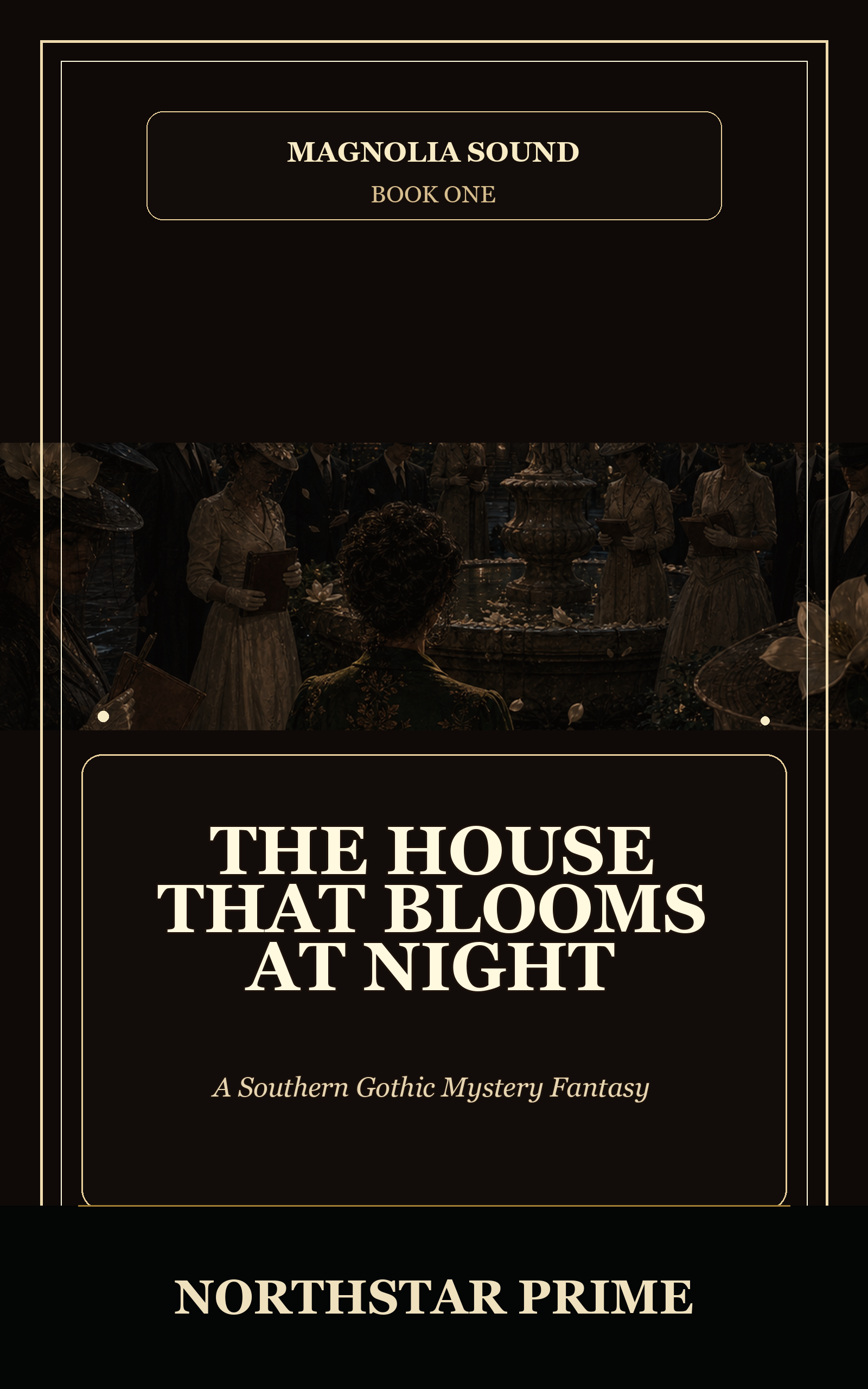
An original work of Southern Gothic mystery fantasy. Its characters, towns, archives, records, broadcasts, weather events, and supernatural procedures are imagined.
Chapter 1 - The House That Blooms at Night
The first magnolia opened at 12:07 in the morning, three minutes after June Avery unlocked her grandmother's front door and one minute before the dead woman called the kitchen phone.
June did not answer it.
She stood in the hall with Etta Vale's key still pinched between two fingers, listening to the ring travel through the old house like a spoon struck against bone china. The sound came from the kitchen, but the hallway gave it extra rooms. Ring in the parlor. Ring above the stairs. Ring under the floorboards where the roots had lifted the house just enough to make every step complain.
The phone rang a fourth time.
June set down her overnight bag.
No one had used that number in years. Etta had kept it for emergencies, which in Magnolia Sound meant hurricanes, kin, and the county clerk. June had meant to cancel it after the funeral. She had meant to do many clean, adult things: cancel the phone, sort the recipes, box the clothes, call a realtor who did not know the house well enough to be afraid of it.
The fifth ring cut off.
In the sudden quiet, something tapped the parlor window.
June turned.
At first, she thought a moth had thrown itself at the glass. Then the shape outside unfurled, white against the dark, broad as a hand and too slow for any insect. A magnolia petal slid down the windowpane, leaving a wet mark like breath.
No magnolia stood close enough to touch the parlor window.
There had not been, anyway.
June crossed the hall and pulled the curtain aside. The yard was full of bloom.
Etta Vale's front garden, which June had last seen as a knot of winter-brown shrubs and ankle-high weeds, had become a white canopy in the moonlight. Branches leaned over the porch rails. Buds opened and opened, too many for one tree, too many for one yard, each flower turning its pale face toward the house as if waiting for testimony to begin.
June pressed her palm to the glass. It was cold.
"No," she said, because archivists were allowed one denial before they began documenting.
She found the light switch by memory. The parlor lamp clicked on, yellow and ordinary, and the flowers outside did not vanish. They looked worse in lamplight. More deliberate. Their petals were not flat white after all. Each held a bruise of color at the base: rose, blue, old gold, the green-black of a storm drain after rain.
The kitchen phone rang again.
June left the curtain open.
The kitchen smelled of dust, lemon oil, and the ghost of coffee. Etta's wall calendar still hung beside the back door, stopped at April though it was October. The page showed a recipe clipped from the church newsletter: funeral potatoes for a crowd. Etta had circled "for a crowd" twice, as if warning June that grief scaled badly.
The phone sat on the wall beneath it, beige, cord coiled tight.
It rang once more while June looked at it.
She lifted the receiver.
At first there was only weather.
Not static exactly. Rain. The hollow rush of water in gutters. A radio voice somewhere behind it reading numbers too softly to parse.
Then Etta Vale said, "Do not let Miriam file the death certificate clean."
June closed her eyes.
She had spent the last two days receiving condolences from people who said grief did strange things. It made you hear footsteps. It made you smell perfume in empty rooms. It made you keep a place set at the table. Grief had not, in June's professional experience, called the landline with procedural advice.
"Grandma?" she said.
The line crackled once.
"There is a red folder behind the flour bin. Not the sugar. The flour. You always did reach for sweet first."
June opened her eyes.
The receiver pressed hard against her ear. Her hand had gone numb around it.
"This is not funny."
"No," Etta said. "It was not funny when they did it, either."
The weather on the line grew louder. June heard wind shove itself against a door. She heard, beneath it, the tiny metallic clack of typewriter keys.
"Who is this?"
Etta laughed once, breathless and annoyed. It was exactly her laugh. The laugh that meant a pie crust had torn, a deacon had lied, or the mayor's wife had used store-bought frosting and called it old family buttercream.
"June-bug," Etta said, and the old name put a child's ache under June's ribs, "the flowers are going to show you things. Write them down before the Court clips them."
"What court?"
"White petals. White gloves. White lies."
Then the line went dead.
June held the receiver until the dial tone began.
She replaced it carefully, as if the phone had become evidence and evidence could be frightened away.
The red folder was exactly where Etta said it would be. Behind the flour bin, wrapped in a plastic grocery bag from a store that had closed before June left for college. Dust coated the bag. Flour coated June's wrist. The folder inside was clean.
On the tab, in Etta's square handwriting, were three words:
MIRIAM GLASS - DELAY
June opened it on the kitchen table.
The first page was a copy of Etta Vale's death certificate. Not the final one. A draft. In the margin, written in a hand June did not recognize, someone had penciled: hold until bloom clears.
The second page was a map of the property. Etta had marked the yard in red: porch tree, east root, old well, false stump.
The third page was a photograph.
June knew it before she wanted to. Her mother at twenty-seven, hair pinned back, one hand lifted as if to block the camera. Behind her, the courthouse steps. Beside her, Miriam Glass in a white dress and white gloves. Between them, on the stone, a scatter of magnolia petals arranged in a circle.
June's mother had disappeared two months after that photograph was taken.
Everyone in Magnolia Sound had a different way of saying disappeared. Went upstate. Took the bus. Needed air. Could not settle. Was always restless, poor thing. June had heard every version, filed every contradiction, and built a private archive out of what adults chose not to say in front of her.
Now a dead woman's red folder told her one more thing.
Her mother had not left clean.
Outside, the house groaned.
June looked up.
At the kitchen window, a magnolia flower opened against the glass. It had no stem she could see. It grew from a black thread of root that had climbed the siding like handwriting.
The petals spread one by one.
Inside the flower, color gathered.
Not color. Image.
June backed away from the table.
The bloom showed the kitchen as it had been twenty years earlier. Same table. Same calendar wall. Same phone. Etta younger by a decade, standing with both hands braced on the counter. June's mother beside her, soaked to the knees, holding a white petal in her palm.
There was no sound, but June could read her mother's mouth.
They are making the town forget me.
The image shivered.
A pair of white-gloved hands entered the frame and closed around the petal.
The flower outside browned at the edges.
June grabbed Etta's folder, a pencil, and the back of an old church bulletin. Her pulse was a hard, stupid thing. Her training came up anyway: date, time, location, condition of record, visible parties, material changes.
She wrote:
12:19 a.m. - kitchen bloom - possible witness memory - mother present - unknown white gloves - petal damaged during viewing.
The flower blackened.
In the yard, something clipped shut.
June went still.
One clean metallic snip.
Then another.
She turned off the kitchen light.
Through the dark glass she saw them at the edge of the yard: three figures under the magnolia canopy, their clothes pale, their hands paler. One held pruning shears. One held a ledger. One looked directly at the kitchen window.
June should have stepped back.
Instead, she lifted Etta's red folder where they could see it.
The figure with the ledger bowed its head.
Not greeting.
Acknowledgment.
The kitchen phone rang once.
Chapter 2 - Documenting the Bloom
June Avery had cataloged flood-damaged diaries, war letters with mold in the seams, a mayor's private appointment book that had survived three courthouse fires, and one family Bible with a bullet lodged between Exodus and Leviticus.
None of them had ever watched her back.
The magnolia flower outside the kitchen window had gone black at the edges, but the color in its throat remained, a bruise of storm-blue and old gold pulsing as if memory had a heartbeat and resented being observed. June stood at the table with Etta's red folder under one hand and the church bulletin under the other, trying to keep her handwriting legible while three pale figures waited beneath the trees.
Date. Time. Location. Condition of record.
She wrote the words because the words had saved her before. They had saved her from rumor. They had saved her from relatives who treated feeling as evidence when it served them and dismissed evidence as feeling when it did not. They had saved her from becoming the kind of person Magnolia Sound preferred: polite in public, hungry in private, and grateful when the official story arrived wearing perfume.
12:23 a.m. - exterior witnesses present at north yard edge.
She paused.
Witnesses was too generous. Intruders was too dramatic. Figures was accurate but useless.
12:23 a.m. - three unidentified persons present at north yard edge. Clothing pale. One ledger. One shears. One observer.
The kitchen phone rang again.
June did not answer it.
The figure with the pruning shears lifted one hand and clipped empty air. The sound reached the kitchen a second late, clean and small and final. The blackened flower dropped from the glass. It hit the sill outside with a wet tap.
Every bloom in the yard turned toward the house.
June's training offered several possible responses. Photograph the scene. Preserve the document. Secure the location. Avoid contaminating evidence. Notify the appropriate authority.
The appropriate authority, according to Etta's red folder, might be the problem.
She took out her phone.
No service.
Of course.
The house had always hated phones that did not belong to it. When June was thirteen, she had accused Etta of living in a dead zone on purpose. Etta had said dead zones were useful if a person knew what needed to stay buried. June had written the line down at the time in a notebook titled Things Grandma Says Like They Are Normal. She wished she still had it.
The landline kept ringing.
June opened the camera anyway. The screen showed the kitchen, then the window, then the yard beyond it: pale canopy, black glass, no figures.
She lowered the phone.
Three figures stood exactly where they had been.
She raised it again.
Empty yard.
"No," June said.
The phone rang.
She turned the camera toward the table. Etta's folder appeared clearly. The draft death certificate appeared clearly. The photograph of Lila Avery and Miriam Glass appeared clearly enough that the white gloves looked almost luminous.
June photographed every page.
Then she put the phone facedown and answered the landline.
For a moment there was only the sound of rain in gutters, though the night outside was dry.
"If you can make them disappear from a camera," June said, "you can leave a message. Use nouns. Start with who."
The line clicked twice.
Not Etta this time.
A man's voice came through under a thread of static. Tired. Local. Amused in the way people sounded when they had learned fear could be scheduled.
"This the Vale place?"
June looked at the receiver as if it had switched languages.
"Who is this?"
"Cal Rook. You called about a radio."
"I did not."
"Somebody did. Work order says kitchen wall unit, storm bleed, dead channel repeating family names." Paper rustled on his end. "And a note that says do not come before she sees the first bloom. Which is unusual as service notes go, but not the strangest thing I've read on a Thursday."
"It's Monday."
The line went quiet.
Outside, the three figures began to step backward into the trees.
Cal said, "Then your house is ahead of me."
June closed her eyes once, hard.
"Mr. Rook, if this is someone's idea of a grief call, I am documenting it."
"Good. Document the line noise too."
"The what?"
"Put the receiver near the window. Not outside. Near."
June did not move.
Cal sighed. "Listen, I know how this sounds. I repair radios, not people. I got a work order from Etta Vale three weeks ago. Paid in cash. She told me her granddaughter would answer after the first night bloom and threaten me with documentation. She said I should ask you whether the petals had bruises."
June's mouth went dry.
The yard breathed white.
"They do," she said.
"Then don't touch them barehanded."
"Why?"
"Because if the Court has already clipped the edge, the memory will try to finish in whoever picks it up."
It was an absurd sentence. Worse, it had the shape of a rule.
June hated rules that arrived before evidence. They were how families excused cruelty, how churches excused silence, how county offices turned a missing woman into a line item with insufficient signatures.
"What Court?" she asked.
Cal did not answer right away. She heard a radio in the background, low and warbling. A weather voice counted counties. One number repeated too softly to catch.
"White Petal," he said at last. "If Etta put Miriam Glass in a red folder, you're already in it."
The kitchen seemed to narrow around the name.
June looked at the photograph again. Her mother on the courthouse steps. Miriam in white gloves. Petals arranged in a circle between them like someone had tried to make evidence look decorative.
"Miriam is county clerk," June said.
"Miriam is many things that are easier to file than prove."
"That is not an answer."
"It's the safest true sentence I can give a stranger on a line that may be listening to both of us."
The phone clicked again.
June heard something beneath Cal's voice now. Not static. She had been wrong before. Static was random. This had pressure in it, a tide worrying a pier. Under the tide, very faint, a woman said June.
Not Etta.
June gripped the receiver.
"Did you hear that?"
Cal's voice changed. The tiredness remained, but the amusement left.
"Hear what?"
"A woman."
"Do not say her name if you know it."
June had not known she was about to until he stopped her.
Outside, the observer beneath the trees raised a hand to the brim of a pale hat. The gesture was almost courteous. Then the figure turned away. One by one, the three shapes folded into the magnolia canopy and were gone.
This time the phone camera saw the branches move.
June took three photographs before the leaves stilled.
"I need you to come here," she said.
"That would be unwise."
"I am not asking for wisdom. I am asking for the radio repairman my dead grandmother apparently scheduled before she died."
"Death certificate filed yet?"
June looked at the draft on the table. Hold until bloom clears.
"No."
"Then she's not all the way dead in the records. That gives you a little room and makes the house louder. Miriam will want that fixed by noon."
"Noon today?"
"Noon official. Sometimes that's today. Sometimes that's the year everyone agreed to remember."
June wrote it down despite herself.
Noon official - term? Ask Rook.
"What do I do before noon?"
"Make copies. Paper copies if you can. Digital if you must. Photograph the blooms with something older than a phone if Etta kept a camera. Do not give the red folder to anyone who says they're helping you clean up. Do not let a neighbor take food containers out of the house."
"Food containers?"
"Recipe cards travel under casserole lids around here. So do apologies, threats, and notarized lies."
June thought of Etta's calendar. Funeral potatoes for a crowd.
"And Mr. Rook?"
"Cal. If you call me mister, I'll assume you're about to accuse me of something."
"Cal. Why would Etta call you?"
"Because I can make old broadcasts replay."
"That is not radio repair."
"Around here it is."
The line hissed.
This time the voice beneath the weather was clearer. Not a word. A breath. Then a small sound June remembered from childhood: her mother humming through a closed door while rain worried the roof.
June sat down hard.
The chair legs scraped the floor. The house answered under her feet with three slow knocks.
Cal said, very quietly, "How many?"
"Three."
"East root. Old well. False stump."
The same words Etta had marked on the property map.
June spread the map beside the phone.
"You have ten minutes before someone knocks on your front door," Cal said. "They'll be kind. That's the first sign you shouldn't let them in."
"Who?"
"Public version."
"That is not a person."
"It will be wearing one."
The line died.
June kept the receiver to her ear until the dial tone returned, then replaced it in its cradle with the same care she had used before. The kitchen seemed too ordinary after the call. Flour bin. calendar. folder. phone. A dead woman's plan laid out in domestic objects because nobody searched grief if it smelled like lemon oil and old sugar.
She found Etta's camera in the hall closet, behind a shoebox of batteries and a raincoat that still held the shape of her grandmother's shoulders. It was a blunt little digital thing from a decade ago, silver, scratched, stubborn. The battery light came on green.
"Thank you," June whispered, then resented herself for whispering.
She photographed the folder. The map. The draft certificate. The photograph of her mother and Miriam. The blackened bloom on the sill. The yard. The phone. The flour on her wrist.
Evidence liked context. Lies liked cropping.
At 12:34 a.m., someone knocked on the front door.
One soft tap.
Then two.
Then a pause shaped exactly like patience.
June stood in the hall without turning on the light. Through the narrow glass beside the door, she saw a woman holding a covered dish.
The woman wore a raincoat though the night was clear. Her hair was pinned neatly. Her face held the practiced sympathy of someone who had reheated it in the car.
"June, honey?" the woman called. "It's Miriam Glass. I know it's late. I brought something for breakfast, and I wanted to spare you a little paperwork before the morning gets cruel."
In the kitchen, the phone rang once.
June lifted Etta's camera.
This time, when she looked through the screen, Miriam Glass disappeared.
The covered dish remained, floating at chest height in the porch light.
June took the picture.
Chapter 3 - County Records Bloom Inside
June reached the county records office at 8:02 a.m., which was early enough to prove she respected procedure and late enough for Magnolia Sound to have arranged itself against her.
The courthouse stood three blocks from the water, cream stone darkened at the corners by salt and hurricane seasons. Two magnolias flanked the front steps. They had been pruned into civic obedience: rounded crowns, clean beds, brass plaques at their roots naming donors who had died with excellent reputations. In daylight their flowers looked almost innocent.
June photographed both trees before she went in.
Inside, the air smelled of floor wax, old paper, and lilies from a funeral arrangement someone had left beneath the portrait of a former judge. June signed the visitor log with her full legal name, added the time, and wrote Records request: Etta Vale death certificate, pending or filed; property transfer history; burial permit. She pressed hard enough for the carbon sheet to catch.
The woman behind the counter watched the pen.
"Ms. Avery," she said. "Miriam Glass is expecting you."
Of course she was.
Miriam did not sit behind the public counter. She occupied the office beyond it, where frosted glass made her name look as if it had been etched in weather. MIRIAM GLASS, COUNTY CLERK. The door opened before June knocked.
"June," Miriam said warmly. "You poor thing. You should not be here today."
"That is true of most offices before coffee."
Miriam's smile accepted the answer and filed it somewhere unfavorable. She wore cream linen, pearl earrings, and the same raincoat from the night before folded over the back of her chair. In daylight her face appeared perfectly ordinary. June noted the fact without trusting it. Cameras lied less when they were old, Cal had said. Eyes lied for free.
"I need copies of my grandmother's death certificate," June said.
"The clean copy is not ready."
The word clean landed between them like a utensil dropped during prayer.
"I need the pending copy."
"Pending documents are not public."
"I am next of kin."
"Still not public."
"Then I need the filing log showing receipt, delay, correction, and authorizing official."
Miriam folded her hands. "You work in archives, don't you?"
"That is why I know logs exist."
"And that is why I know you understand custody. Grief makes people impatient with custody."
June looked past her at the wall of cabinets. Every drawer wore a label in Miriam's careful hand: BIRTHS, DEEDS, BURIALS, ELECTIONS, AMENDMENTS. The last drawer had a brass lock newer than the others.
"My grandmother called me last night," June said.
Miriam did not blink.
"Dead people do many things after a funeral," she said. "They take up room. They rearrange sleep. They make houses sound inhabited. Magnolia Sound has always been kind about those first weeks."
"She told me not to let you file the certificate clean."
At the front counter, a typewriter bell rang though no one was typing.
Miriam's smile thinned. "Etta loved dramatics."
"Etta loved receipts."
"Then you know better than to mistake a receipt for authority."
June took out her notebook. "Refused pending certificate. Refused filing log. Clerk acknowledges contact from decedent as grief phenomenon."
"I did not acknowledge contact."
"You acknowledged category."
The room cooled.
Miriam stood. "I can give you a public death notice and a certified statement that final filing is under routine administrative review. That will be enough for banks, utilities, and any realtor sensible enough to wait thirty days."
"I didn't ask what was convenient for liquidation."
"No," Miriam said softly. "You asked for a door the town keeps shut because some families do not survive what blows through."
Something brushed the frosted glass.
June turned.
The hallway outside Miriam's office had no windows. It ran through the middle of the courthouse, sealed from the front doors by two turns and a security desk. No branch should have been able to reach it. No petal should have appeared against the glass like a white ear listening.
Another petal slid down.
Then another.
Miriam's face did not change, but her right hand moved toward the locked drawer.
June lifted Etta's camera and took one photograph through the office door. The flash bounced against the glass. On the screen, Miriam's office remained ordinary, but the hallway beyond bloomed with magnolia flowers hanging upside down from the ceiling seams. Each petal held a bruise of ink.
A word formed where three petals overlapped.
AMEND.
The security guard at the front desk called, "Ms. Glass?"
"The hallway is closed," Miriam said without raising her voice.
"It is not closed," June said. "It is evidence."
Miriam unlocked the new brass drawer.
"Evidence belongs in the record," she said. "Not in your grandmother's kitchen, not on your phone, not in a frightened little notebook."
June took another photograph.
The courthouse magnolia dropped one final petal against the frosted glass. This one was bruised old gold at the center, and in the gold June saw the corner of a form: Etta Vale, deceased; certificate held; reason for delay.
Under reason, someone had typed one word.
Witness.
Miriam stepped between June and the glass.
"Go home," she said. "Before the house teaches you a record is not the same thing as a rescue."
June put the camera in her bag and zipped it shut.
"That," she said, "is the first useful thing you have said all morning."
Chapter 4 - Recipe Cards for the False Stump
Etta Vale had kept recipes the way other women kept ammunition.
June discovered this at 10:16 a.m., after the courthouse refused her twice, after Miriam's assistant handed over a death notice so empty it might as well have been a sympathy card, and after a man from Blackwell & Sons Realty left a voicemail using the phrase get ahead of the estate as if grief were a delinquent account.
The recipe box waited on Etta's kitchen table.
It had not been there when June left.
June photographed it from the doorway. The box was cedar, scarred at the corners, with FLOUR HANDS ONLY written on masking tape across the lid. Etta's handwriting. A joke and a command. June washed her hands, dried them, dusted her fingertips with flour from the bin, and only then opened the latch.
The first card read Funeral Potatoes For A Crowd.
June almost laughed.
The ingredients were ordinary until they were not.
Two cups shredded potatoes. One cup sharp cheese. One can cream soup. Three knocks east root. Salt. False stump. Butter enough to make a mourner answer.
The card smelled faintly of smoke and nutmeg. At the bottom, in Etta's tight script, someone had written: if Miriam comes with breakfast, do not eat what she carries.
June set that card aside and found six more behind it.
Buttermilk Biscuits For Bad Weather. Peach Jam For Receipts. Church Coffee Cake With No Apology. Cornbread For The Woman Who Saw Lila Last. Pickled Green Tomatoes Under Seal. Chocolate Pie When The Clerk Lies Twice.
Each card hid a line that did not belong to food. Directions became coordinates. Baking times became filing dates. Oven temperatures mapped to parcel numbers when June arranged them in sequence on Etta's oilcloth tablecloth.
Her archive training took over. First arrangement. Then duplication. Then interpretation.
She numbered the cards in pencil on removable slips. She photographed front and back. She copied every odd phrase into a fresh notebook page titled Recipe Archive: Etta Vale, posthumous instructions. She did not call them magic. Magic was what people said when they wanted to stop asking who benefited.
The house knocked once beneath the pantry.
"I know," June said. "I'm working."
The property map from the red folder showed the yard as it had been thirty years earlier. Etta had circled a place east of the house and written OLD WELL / FALSE STUMP / DO NOT PRETTY THIS UP. June had assumed false stump meant a stump that hid the well.
The recipes suggested the opposite.
False stump meant a lie about a tree.
She took the map, the camera, and a garden trowel from the mudroom. The morning had warmed into the kind of coastal brightness that made bad things look well maintained. Etta's yard showed no sign of the midnight canopy except petals in the grass, already browning at the edges like old letters.
East of the house, beyond the kitchen window, stood a magnolia stump cut flat and painted with sealant. June remembered it from childhood. Etta had called it the old trouble and refused to let anyone grind it out. The stump was too smooth now. Too official. A brass tag had been nailed into the wood.
MAGNOLIA SOUND HERITAGE TREE 12-B. REMOVED FOR HEALTH AND PUBLIC SAFETY.
June photographed the tag.
Then she noticed the screws.
No one nailed brass with Phillips-head screws and called it heritage.
She worked the trowel under the tag until the sealant cracked. The plate came away with a wet sigh. Under it, the stump was not cut wood at all. It was plaster over a hollow form, painted and grained to look like a wound that had healed.
Inside lay a glass jar.
June did not touch it immediately.
She photographed the hollow. Photographed the jar in place. Photographed the wax seal bearing Etta's thumbprint and a second print smaller than Etta's. Then she lifted it free.
The jar held recipe cards curled around a roll of old microcassette tape.
The top card read Cornbread For The Woman Who Saw Lila Last.
Ingredients: One daughter. One clerk before pearls. One radio turned low. One witness who mistook silence for safety. Bake until somebody confesses.
On the back, Etta had written a name.
Agnes Pike.
June knew Agnes. Everyone did. Agnes ran the church kitchen, corrected hymn numbers before the organist could, and made ambrosia salad that adults praised with the seriousness of diplomacy. She had kissed June on both cheeks after the funeral and said, "Your mama would have hated all these lilies."
June had not told Agnes there were lilies.
Behind the stump, the old well cover shuddered.
Not open. Not yet. Just enough to let out a breath of cold root air.
June slid the jar into her bag.
From the road came the slow crunch of tires on gravel.
She looked up.
A county maintenance truck idled at the edge of the yard, although the house sat outside town limits and no work order should have existed. Two men in green shirts watched her from the cab. The driver raised one hand in neighborly apology.
June raised Etta's camera instead.
The men drove away.
The false stump smelled of wet paper.
In the hollow where the jar had rested, root script had begun to rise through the plaster in black hairline strokes.
NOT ALL WITNESSES ARE BRAVE.
June copied it exactly.
Chapter 5 - The Broadcast Names June
Cal Rook's shop occupied the ground floor of a bait store that had stopped selling bait during the recession and started selling weather instead.
ROOK RADIO & SMALL REPAIR hung over the door in hand-painted letters. Under it, someone had taped a paper sign: NO WARRANTY ON GHOSTS, FLOOD DAMAGE, OR FAMILY SYSTEMS. June stood on the sidewalk long enough to decide whether she disliked the joke, then went inside before the answer mattered.
The shop smelled of solder, dust, hot plastic, and coffee left too long on a burner. Radios lined the walls in every decade of beige and chrome. Emergency receivers, marine sets, kitchen clock radios, one wooden cathedral radio with its grille cloth patched in two places. Each had a paper tag tied to its handle.
Dead after Agnes Pike's porch flood. Repeats 1998 evacuation notice. Screams only during barometric drop. Mrs. Halloway swears husband inside, low priority.
Cal emerged from behind a workbench with a screwdriver tucked behind one ear.
"You brought the camera," he said.
"You told me to."
"People rarely do what I say. It is one of my charms."
He was younger than June had expected from the voice. Late thirties, maybe. Salt-dark hair, tired eyes, hands nicked by wire and small machinery. He looked at her bag, not her face.
"You found the false stump."
June set the microcassette jar on the counter. "You know about that?"
"I know Etta hid things in places no landscaper could explain without sounding drunk."
"Did she call you before she died?"
"Several times."
"Did she tell you to answer questions plainly?"
"No. She knew me."
June took out her notebook.
Cal sighed, then reached under the counter and produced a recorder the size of a deck of cards. "The tape from the jar will be brittle. I will make a copy before we play it."
"No."
He paused.
"No?"
"First you tell me what I am listening for. Then you copy it in front of me. Then we play the copy. I keep the original."
Cal smiled despite himself. "Archivist."
"Mechanic."
"Fair."
He cleaned the tape housing with a brush, spoke every action aloud as if narrating for a deposition, then ran a cable into an old computer that looked held together by stickers and contempt. June filmed the transfer with Etta's camera. Cal did not object.
When the digital copy finished, he turned the shop sign to CLOSED.
The recording began with storm static.
Not rain, not exactly. Rain had rhythm. This was pressure. A low shove of air against a microphone, then the automated emergency voice every coastal child knew from hurricane drills.
This is a civil weather relay for Magnolia Sound and lower bell region. Do not treat memory as shelter. Repeat. Do not treat memory as shelter.
June looked up.
Cal did not move.
The voice continued, clipped and official.
At 12:07 a.m., June Avery will enter Etta Vale's house carrying a key, an overnight bag, and refusal. At 12:08 a.m., the first witness bloom will open on a tree filed as removed. At 12:34 a.m., Miriam Glass will arrive with breakfast and a form no grieving heir should sign.
The date stamp crackled.
October 3, 2004.
June had been twelve in 2004. Etta had still been alive. Lila had already been gone for two years, according to the official story. Miriam had not yet worn pearls in public.
The broadcast went on.
If Ms. Avery rejects the supernatural explanation, preserve that rejection. It will keep the evidence honest. If Mr. Rook attempts rescue, ignore him until he remembers radios repeat; people decide.
Cal reached for the volume and missed the knob.
June stopped the playback.
"When did you first hear this?"
"Last year."
"Last year."
"After the Bellwether drill. The town tests sirens every September. One of the receivers replayed that instead."
"And you didn't call me?"
"Etta told me not to."
"Etta was alive last year."
"Yes."
"So you took instructions from my grandmother not to warn me about a recording that names me twenty-two years early."
"I took instructions from your grandmother because she was the only person in town trying to build a case instead of a legend."
June wanted to object. The trouble was that the sentence sounded like Etta.
She restarted the tape.
The final voice was not the automated relay. It was a woman breathing close to a microphone, trying not to cry.
June-bug, if this finds you before I do, listen to the roots, not the flowers.
The voice ended before June could decide whether it belonged to Lila.
She sat with both hands flat on Cal's counter.
"I do not believe in prophecy," she said.
"Good."
"I do not believe the dead make phone calls."
"Better."
"I believe someone made this recording. I believe someone had access to facts before they should have been facts. I believe Etta preserved it because she thought records could survive what people could not say."
Cal nodded. "That is enough belief for today."
June labeled the copied file in her notebook: Rook Radio transfer, microcassette from false stump, unknown origin, includes predictive emergency relay, possible Lila Avery voice. She added chain of custody, equipment, time, and Cal's full name.
Then she wrote one more line.
Rule: storm archive speaks in dates the town has not admitted yet.
Outside the shop, the two courthouse magnolias shed three petals into the street though no wind moved.
Cal looked at the tape.
"There's more," he said.
"There is always more."
"No. I mean, the tape has a second side."
June closed her notebook.
"Then we copy that too."
Chapter 6 - Kindness at Church
The first direct warning came with a casserole list.
June had intended to avoid First Magnolia Methodist until Etta's memorial committee stopped using the words reception flow, but Agnes Pike called at 4:40 p.m. and said, "If you want to know why your grandmother kept a separate recipe for church coffee, come before choir."
Then she hung up.
The church stood beside the oldest public magnolia in town. The tree had a stone ring around it, donor bricks, and a plaque claiming it had sheltered soldiers, brides, and hurricane refugees with equal civic generosity. Its roots had lifted the sidewalk in four places. Each lift had been paved over rather than corrected, so the approach to the church felt like walking across a polite warning.
June brought the camera, the microcassette copy, and the Cornbread card naming Agnes.
Inside, the fellowship hall smelled of bleach and sugar. Women moved between folding tables with the organized mercy of a small army. Aluminum pans waited under foil. A whiteboard listed assignments: HAM ROLLS, TEA, CONDOLENCE BOOK, FLOWER ARRANGEMENT, DISCREET PRESS RESPONSE.
June photographed the whiteboard.
"Do not do that in here," someone said.
Miriam Glass stood by the coffee urn.
She wore navy now, not cream. Her pearls were gone. Without them she looked less ceremonial and more efficient.
"It is a public room," June said.
"It is a room full of people trying to help you."
"Those are not mutually exclusive."
Miriam poured coffee into a Styrofoam cup and handed it to a woman June did not know. The woman took it without meeting June's eyes.
"Everyone understands you are overwhelmed," Miriam said. "The house is old. Etta was eccentric. Cal Rook likes to make broken equipment sound profound. But if you keep treating neighbors like suspects, people will stop being gentle."
The fellowship hall quieted by degrees.
June felt every face turn toward work that no longer needed doing.
This was the threat, she realized. Not a curse. Not a knife. Procedure first, threat second, and before both of them: kindness withdrawn in public.
"Is that official advice from the county clerk," June asked, "or personal spiritual care?"
Miriam smiled. "You always did speak like a file cabinet."
Agnes Pike entered from the kitchen carrying a tray of lemon bars. She was short, square, and visibly furious in a lavender cardigan.
"Miriam," Agnes said, "if you scald that coffee one more minute, even the dead will complain."
The room breathed again.
Miriam moved away from the urn.
Agnes set the lemon bars down hard enough to rattle the tray. "June, with me."
She led June into the church kitchen, shut the swinging door, and turned on the faucet so hard water splashed the basin.
"You found Etta's card," Agnes said.
June took out the photograph instead of the card. "It named you as the woman who saw Lila last."
Agnes closed her eyes.
The pipes knocked beneath the sink.
"I saw your mother on the courthouse steps," Agnes said. "Not last in life. Last before town life split into version and fact."
"What does that mean?"
"It means if I say it wrong, I will remember it wrong by morning."
"That is convenient."
"It is terrifying."
Agnes gripped the counter. Her knuckles had flour in the creases. "Lila came out of the clerk's office with a sealed envelope under her blouse. Miriam followed her. Miriam was younger. No pearls yet. Hair loose. She said, 'You cannot keep a child safe by making her remember.' Lila said, 'Watch me.'"
The faucet sputtered.
"Then?"
"Then the magnolia outside dropped flowers all over the steps. In August. Everyone laughed because it was pretty and strange. By supper, nobody remembered why Lila had gone to the courthouse. By Sunday, people said she had always been restless. By the next week, I heard myself say it."
Agnes covered her mouth.
June wrote quickly.
"Why do you remember now?"
"Etta made me write it into cornbread."
For one absurd second June almost smiled. Then the floor under the kitchen knocked twice.
Agnes looked down. "West root. Public room."
"What does that mean?"
"It means they are doing something under the sanctuary."
The choir began in the next room. A hymn rose, familiar and soft, but the notes snagged as if something beneath the building had caught them by the hem.
Agnes lowered her voice. "Do not ask old questions at church where people can answer out of habit. Ask on paper. Ask in duplicate. And never let Miriam make you feel cruel for wanting a record."
The swinging door opened.
Miriam stood there with her cup of overcooked coffee.
"Agnes," she said, gentle as a folded program. "They're asking for you."
Agnes straightened.
June lifted the camera.
This time Miriam did not disappear in the screen. But behind her, through the fellowship hall window, the public magnolia had opened one black-centered flower.
Every person in the room turned away from it at once.
June took the picture before she could learn the habit.
Chapter 7 - Lila in the Courthouse Photograph
Etta's house did not sleep that night.
It settled, knocked, sighed through vents, and made the wallpaper click where roots pressed close behind plaster. June slept for ninety minutes in an armchair with the camera strap looped around her wrist. At 3:12 a.m. the pantry door opened by itself.
"No," she told the house. "I am not rewarding drama before sunrise."
The pantry door remained open.
June turned on the kitchen light and saw flour footprints leading from the pantry to the hallway. Not human feet. Not animal. Round impressions, petal-shaped, each dusted print pointing toward the staircase.
She photographed them, then followed.
At the top of the stairs, the prints stopped before the linen closet. June had searched it the day before and found towels, mothballs, three boxes of Christmas ornaments, and a stack of quilts Etta refused to call heirlooms because heirlooms made people greedy. Now one quilt lay folded on the floor.
Inside the fold was a courthouse photograph.
The image was black and white, glossy, eight by ten. It showed a ribbon-cutting ceremony on the courthouse steps. A younger mayor held oversized scissors. Donors lined the railing. Magnolia blossoms framed everyone like a blessing.
Lila Avery stood at the far left.
June sat down on the hall floor.
She knew her mother's face from school photos, from one beach snapshot, from the driver's license Etta had kept behind her Bible. Lila had been pretty in a way family members described as trouble when they were trying to sound affectionate. In this photograph she looked scared.
Miriam Glass stood behind her.
No pearls. Hair loose. White gloves folded in one hand.
June turned the photograph over.
Written in Etta's hand: Courthouse rededication. Year they said Lila had already left. Ask why Miriam wore gloves in heat.
June copied the inscription. Then she examined the image with a magnifying glass from Etta's sewing basket. Archivists loved objects that made them look theatrical while doing reasonable work.
The photograph had been cropped.
At the right edge, half a hand remained visible beside the donor line. The hand held pruning shears.
June scanned the photograph with Etta's old printer, which objected twice and obeyed on the third try. She saved the file to two drives, printed a copy, and marked the crop line in pencil. Then she called Cal.
He answered on the second ring. "If the house knocked before dawn, do not answer with sarcasm. It stores tone."
"Can you identify an event from a courthouse photograph?"
"Good morning to you too."
"Lila is in it."
Silence.
"Bring it," he said.
"No. You come here. The original stays."
He arrived twenty-two minutes later with a portable scanner, two coffees, and a plastic case full of adapters. He did not comment on the flour footprints still visible in the hall.
June appreciated that and resented appreciating it.
At the kitchen table, Cal studied the scan. "Rededication was 2005."
"Official story says Lila left in 2002."
"Official story says many things in a voice that hopes you are tired."
"Can you match the event to a broadcast?"
Cal hesitated.
"Cal."
"The rededication ceremony was interrupted by a weather alert. Clear day. No storm. Sirens went off for six minutes. Everyone laughed afterward and called it a malfunction."
"Was it?"
"No."
He pulled a small receiver from his bag and set it between the photograph and the recipe cards. "Some events leave static. Some leave repeats. The courthouse steps are loud."
The receiver hissed.
At first June heard only the ocean, though Etta's house sat half a mile inland. Then applause. Ribbon scissors. A mayor clearing his throat. A woman's voice under everything, close to panic.
Miriam, you cannot put her childhood in a drawer.
Lila.
Another voice answered, younger but unmistakable.
We are not taking her childhood. We are correcting the parts that would harm her.
The receiver popped.
June wrote until her hand cramped.
In the photograph, Lila's mouth was open. June had thought the image caught her mid-smile. Now she knew it caught a warning.
"I want the uncropped original," June said.
"If it exists, it is not in a public box."
"Then where?"
Cal looked at the photograph again. "Miriam's office wall has a framed print of the rededication."
"I saw cabinets. I did not see a photograph."
"Not public office. Back room. Staff only."
June stood.
Cal stood too.
"No," she said.
"I did not say anything."
"You stood like someone about to be useful in a way that complicates custody."
He sat back down.
The house knocked once in approval.
June placed the courthouse photo beside Etta's death certificate draft, the false-stump recipes, and the radio transcript. Lila had not vanished cleanly. Miriam had known her after the supposed disappearance. The town had celebrated an event that contained a woman it later agreed had been gone.
That was not a ghost story.
That was a contradiction with witnesses.
In the corner of the photograph, under the half-visible hand with pruning shears, a magnolia petal had blurred during exposure. June enlarged it on the scanner bed.
The bruise at its center shaped three letters.
LIE.
Chapter 8 - The Bloom Refuses the Leaving Story
The town said Lila Avery left voluntarily.
It said this in the way towns say things when nobody remembers the first person to say them. At the grocery store, Mrs. Halloway said, "Your mama always did need more road than Magnolia Sound could offer." At the gas station, a man June did not know said, "Some women are born with leaving in them." On the church steps, a teenager holding a tray of memorial napkins said, "Wasn't your mom the one who ran off?"
By sunset June had counted eleven variations.
She wrote them on index cards and pinned them to Etta's dining-room curtains because the table had run out of room. Then she sorted them by speaker, location, and degree of sympathy. Sympathy, she was learning, often carried the cleanest lie.
At 9:03 p.m. the first upstairs bloom opened.
June heard it before she saw it: a soft wet clap from her mother's old bedroom.
She took the camera, the notebook, and a flashlight. The room had been kept too clean. Etta had never used it for storage, never repainted, never changed the curtains with their small blue flowers. June had avoided it since arriving because grief had architecture and this room was load-bearing.
A magnolia branch had pushed through the closed window without breaking the glass.
It stood inside the room as if the wall had remembered a doorway. White flowers opened along the branch, but each center burned storm blue. Moths circled them in slow, exact rings.
June turned on the camera.
The first bloom unfolded a memory.
Not a vision exactly. More like a scent arranged into light. June smelled rain on hot pavement, hair spray, courthouse dust, and Lila's old vanilla lotion. The room tilted. The blue curtains became the courthouse steps. Lila stood there younger than June was now, one hand pressed to her stomach as if hiding an envelope beneath her blouse.
Miriam faced her.
You cannot keep a child safe by making her remember, Miriam said.
Watch me, Lila answered.
The memory skipped.
Etta's kitchen. Night. Lila stuffing something into the hem of a blue dress while Etta stood at the door listening.
If they ask, Lila said, you did not see me.
I am old, Etta said. Not decorative.
Mama, please.
The memory blurred. Magnolia petals filled the room, and under them June heard herself as a child laughing somewhere outside the frame. Six years old. Maybe seven. A sound from before her life learned to divide into before and after.
Lila looked toward the laughter.
I am not leaving her, she said.
The words struck the room hard enough to rattle the window.
June lowered the camera without meaning to.
"No," she whispered.
The house knocked twice.
June lifted the camera again.
The branch showed another piece. Lila in Etta's pantry, sleeves rolled, writing on recipe cards while Etta measured flour. Lila's hands shook.
If they prune me out, Lila said, recipes survive church ladies.
Etta snorted. Church ladies survive weather.
Then the kitchen door opened behind them and a shadow fell across the floor. June could not see the face, only white gloves.
The bloom closed.
June stood in her mother's room with the camera recording the aftermath: branch, flowers, moths, her own breathing too loud. She sat on the bed only after she confirmed the file had saved.
The leaving story was dead.
Not solved. Not explained. Dead.
She went downstairs and pulled down every index card containing the phrase ran off, restless, needed road, city girl, couldn't settle, or left clean. She stacked them in a pile and wrote Official contagion across the top card.
Then she called Agnes Pike.
Agnes answered with no greeting. "Did you see her?"
"Yes."
"Did she say she left?"
"She said the opposite."
Agnes made a sound like a chair scraping back. "Write that in ink."
"I recorded it."
"Good. Then write it in ink anyway. Machines get lonely around here."
June wrote: Bloom memory contradicts voluntary departure narrative. Lila Avery states, "I am not leaving her." Context: courthouse envelope, recipe-card preservation, white-glove interruption.
Her hand steadied as she wrote.
At 10:11 p.m., the kitchen phone rang.
June answered.
This time there was no Etta. Only storm static and a chorus of voices saying the same sentence at different distances.
She left. She left. She left. She left.
June set the receiver on the table and let the lie exhaust itself while she labeled evidence.
At 10:13, the voices stopped.
A child's voice came through the line.
June did not recognize herself immediately. Children in recordings always sounded like strangers wearing family bones.
Mommy said trees remember better than people.
June sat very still.
Then Lila's voice, close and urgent:
They do if nobody cuts them in time.
The line died.
Outside, every magnolia in Etta's yard opened at once.
Chapter 9 - The Property Transfer That Happened in Weather
Cal arrived the next morning with three storm radios, a folding table, and the expression of a man who had decided not to ask permission from his own caution.
June let him set up on the porch instead of the kitchen. The house had endured enough men with tools, and the porch gave the magnolias a chance to object in public.
"We need dates," Cal said.
"We have too many dates."
"No. We have story dates. We need weather dates. Magnolia Sound lies in minutes, but storms leave hour marks."
He lined the radios along the rail: marine band, civil emergency, one old battery receiver with a cracked handle. June placed the property map beside them. Etta's recipe cards anchored the corners against the breeze.
They began with Lila's courthouse photograph. Rededication, 2005. Clear sky. False weather alert. Cal tuned through static until the porch filled with the flat voice of an emergency relay.
This is not a drill. This is not a storm. This is a correction.
June wrote the timestamp.
Next they played the microcassette's second side. It contained mostly rain, then a clerk reading parcel numbers so fast June had to slow the recording twice. One number matched Etta's property. Another matched the courthouse magnolia. A third belonged to a parcel marked PRIVATE ROAD - NO ACCESS on the county map.
"Who owns that road?" June asked.
Cal checked his laptop. "White Petal Heritage Trust."
"That sounds like a tax shelter with stationery."
"It is also the charitable arm of the Court."
June drew a line between Etta's house, the courthouse, and the private road. The shape was not a triangle. The lines bent around the old well as if avoiding it.
At 11:40 a.m., the marine radio began speaking though Cal had not touched it.
Deed transfer accepted under emergency exception. Witness tree health adverse. Public safety removal authorized. Memory hazard contained.
"Date," June said.
Cal leaned close to the display. "September 18, 2002."
June knew the date because everyone knew the date Lila supposedly left. The story had a day the way a grave had a marker.
"Was there a storm?"
"No named storm. There was a barometric drop from one offshore system. Not enough for an emergency exception."
"But enough for paperwork if the paperwork wanted weather."
The old receiver crackled.
A woman's voice emerged, young Miriam again.
If the transfer is filed before bloom, the child remembers leaving as mercy.
Another voice, male, older:
And the mother?
Pruned from custody. Preserved under root until stable.
June's pen tore through the page.
Cal reached toward her, then stopped himself. Good.
She wrote the words again on a clean sheet. Then she copied the parcel number. Then she made herself breathe.
"What does preserved under root mean?"
Cal looked toward the yard. "I do not know."
"That was too quick."
"Because every answer I can think of is worse if I say it without proof."
The porch boards knocked once beneath their feet.
June looked at the map. The private road ran behind the courthouse, past the church, then disappeared into marshland labeled Bellwether Drainage Reserve. The same word lived in the series bible Etta had never seen and in the storm drills Cal distrusted.
"We go there," June said.
"Not today."
"You do not get to decide that."
"No. The weather does."
He pointed beyond the yard.
Clouds had gathered above Magnolia Sound in a ring, leaving Etta's house under a circle of hard sun. At the courthouse end of town, rain fell in a narrow silver column. At the church, no rain. At the private road, dark.
"Selective weather," Cal said. "Court trick."
"Weather is not a trick."
"It is when someone has spent generations learning how official emergencies feel."
June photographed the sky in four directions. East: courthouse rain. West: clear. South: church sun. North: private-road dark. She logged each angle, time, and visible landmark.
Then she called the county records office from the porch.
Miriam answered personally.
"I need the 2002 emergency exception packet for parcel transfers involving White Petal Heritage Trust," June said.
There was a pause.
"Those records are sealed."
"Under what authority?"
"Public safety."
"Current or expired?"
"June."
"That is not a statute."
The marine radio spoke again.
Child custody memory amendment accepted.
Miriam heard it through the phone. June knew because the clerk inhaled like someone had opened a drawer in her chest.
"Do not go to the private road," Miriam said.
"That is not a statute either."
"It is advice from someone who has seen what your family looks like when it insists on being right."
June looked at the weather ring.
"Then you should know," she said, "we are consistent."
Chapter 10 - The Witness Recants on Root Script
Agnes Pike agreed to give a written statement if June came alone.
That was the first mistake.
The second was believing alone meant without the Court. In Magnolia Sound, privacy was not absence; it was a room where everyone had agreed not to admit the walls listened.
Agnes lived in a yellow house behind the church, with hydrangeas trimmed into disciplined blue globes and a porch swing that complained in three notes. She met June at the door wearing an apron over church clothes.
"No camera inside," Agnes said.
"Agnes."
"No camera. I know what I am asking you to risk. I know what I am risking. But some things need paper first because paper makes cowards hear themselves."
June hated the rule and respected it enough to comply. She left the camera in her bag by the door but kept her notebook.
Agnes had set out coffee, cornbread, and a legal pad. At the top of the pad she had written Statement of Agnes Leona Pike, Witness. The handwriting was strong for three words, then weaker under date.
"I will say what I remember," Agnes said. "You write. Then I copy it in my own hand. Then you take both."
June sat.
For twenty-three minutes, Agnes spoke.
She described Lila on the courthouse steps in 2005. She described Miriam's white gloves. She described the envelope under Lila's blouse and the magnolia bloom that made everyone laugh until they forgot why they were afraid. She described carrying cornbread to Etta's house two days later and finding Etta burning index cards in a skillet.
"She said paper was loyal until it got subpoenaed," Agnes said.
June wrote exactly.
Then someone knocked at the back door.
Agnes stopped mid-sentence.
Three knocks. A pause. Two.
"Expecting someone?"
Agnes's face emptied.
"No," she said, but her voice had changed.
The back door opened. Miriam did not enter. She stood on the threshold holding an umbrella though no rain fell.
"Agnes," Miriam said. "Choir folders are missing."
Agnes rose.
"Sit down," June said.
Agnes looked at her as if from a long distance. "I should check."
"The statement is not finished."
"I must have misunderstood some things."
June stood too. "No."
Miriam's expression softened with counterfeit pity. "Witness memory is fragile under stress. You know that professionally, June. It would be irresponsible to pressure an elderly neighbor into certainties."
"She is not elderly when she remembers something you dislike."
Agnes pressed both palms to the table. "Lila left because she wanted to."
The sentence came out flat, borrowed, and wrong.
The legal pad curled at the edges.
"Agnes," June said.
"She was restless."
Under the table, something scratched.
June stepped back. Black root script rose through the painted floorboards, letter by letter, as if a pen moved beneath the house.
PRICE PAID.
Agnes began to cry silently.
"What price?" June asked.
Miriam closed her umbrella. "Do not make her perform distress for your archive."
June picked up the legal pad. The first page held Agnes's original statement through the words burning index cards. The second page, blank a moment ago, now showed root script bleeding up in a dark, woody hand.
SHE FED THEM ONE NAME TO KEEP THREE.
Agnes made a small sound.
"Who?" June asked her. "What name?"
"Mine," Agnes whispered.
Miriam's eyes hardened.
Agnes covered her mouth, then forced the words through her fingers. "I told them Etta had a copy. I told them because they said they would take my boys' memories of their father. He died ugly. I wanted them to remember him kinder."
The room smelled of wet soil.
June understood the shape of the trap then. The Court did not only threaten pain. It offered curated mercy. It made people trade a damaging truth for a gentler lie and then called the debt tradition.
"Agnes," Miriam said. Not warning. Command.
Agnes straightened.
"Lila left voluntarily," she said again. "I was confused."
The root script on the legal pad darkened.
NOT CONFUSED.
June took out her phone because the camera was by the door and procedure had to survive compromise. She photographed the pad, the floor, Agnes's first-page statement, Miriam in the threshold, the umbrella, the dry porch behind her.
Miriam did not disappear.
She wanted to be seen now.
"If you use that," Miriam said, "you will hurt her."
"If I do not use it, you already have."
Agnes reached for the pad. June did not move away. Agnes tore off the first page with shaking hands and pushed it across the table.
"Take what I said before I became useful to them again."
June folded the page into an evidence sleeve from her bag.
Miriam stepped aside as June left. On the porch, the hydrangeas had turned white at the edges, each blue globe clipped into pale silence.
June retrieved Etta's camera from her bag and photographed them too.
Behind her, Agnes began singing a hymn in the kitchen, but every third word dropped out.
Chapter 11 - The Pruning Ritual
Civic beauty in Magnolia Sound began at dawn.
June learned this by following the maintenance truck.
It came past Etta's house at 5:18 a.m., lights off, tires slow on gravel. June was awake because sleep had become an unreliable witness. She took the camera, a rain jacket, the copied evidence drive, and Etta's smallest recipe knife because grief made people practical in strange ways.
The truck rolled toward town, then behind the courthouse, then through a gate marked PARKS DEPARTMENT AUTHORIZED ONLY. Cal would have told her not to follow alone. Etta would have asked whether alone meant unwitnessed. June parked two blocks away and walked.
Behind the courthouse lay a garden the public rarely saw. It was too manicured to be neglected and too hidden to be decorative. Twelve magnolia trees grew in a ring around a brick circle. Each trunk bore a small brass tag. Some tags matched donor names from the courthouse steps. Some had parcel numbers. One had no name at all, only LILA A. scratched by hand beneath official engraving.
June's throat tightened.
People stood around the circle in pale coats.
Not robes. Coats. Garden-club respectability. Miriam was among them, hair pinned, sleeves rolled, white gloves on both hands. Beside her, a man June recognized from the maintenance truck held a canvas bag of pruning shears.
Someone rang a small bell.
"For health," the group said.
Snip.
"For safety."
Snip.
"For heritage."
Snip.
Each cut removed a bloom before it fully opened. The flowers dropped into metal bins lined with black cloth. A woman with a clipboard marked each drop. A man in a county vest sprayed the exposed stems with something that smelled sharp and clean.
June filmed from behind a hedge.
The first clipped bloom hit the bin and showed a flash of memory across its petal: Lila running through rain with one shoe in her hand.
The second: Etta signing a form while Miriam watched.
The third: Agnes Pike at a church stove, crying into cornbread batter.
The memories vanished as the spray touched them.
Evidence control, June wrote. Not metaphor. Physical suppression of bloom witness output through pruning and chemical treatment. Participants use public safety language.
Miriam took the shears.
The group quieted.
She stood before the tree tagged LILA A. The tree was younger than the others and badly scarred. Its bark had grown over old cuts, making each wound look like a closed eye.
"For the child," Miriam said.
The group repeated it.
"For the child."
Miriam reached for a blue-centered bloom.
The ground knocked beneath June's feet.
Once. Twice. Three times.
East root. Old well. False stump.
The tree tagged LILA A opened all its flowers at once.
The garden filled with the smell of vanilla lotion and hurricane rain.
Miriam froze.
June stepped out from behind the hedge with the camera raised.
"Do not stop on my account," she said.
The maintenance man lunged toward her. June lifted Etta's recipe knife, which was small, dull, and not very threatening unless a person feared symbolism.
"I am recording," she said.
He stopped.
Miriam lowered the shears. "You are trespassing."
"You are destroying evidence."
"We are maintaining diseased trees."
"Then you will have work orders, treatment logs, chemical labels, disposal manifests, and authorization."
The clipboard woman clutched her papers to her chest.
June photographed her.
"Those documents are internal," Miriam said.
"Everything is internal until someone opens it."
For a moment no one moved. The ring of magnolias trembled without wind. A clipped bloom rolled from one bin and unfolded at June's feet.
It showed Etta, younger and angrier, standing in this same garden.
You cannot prune a witness and call the stump pretty, Etta said.
Miriam, younger too, answered from outside the petal frame.
Watch us.
June filmed until the bloom blackened.
Miriam's face had gone very still.
"Your grandmother forced us into cruelty," she said. "She could have accepted a clean town."
"Clean towns do not need chemical bins before breakfast."
From the far side of the garden came sirens.
Not police. Storm sirens. They rose over the courthouse roof under a clear pink sky.
The Court members looked up in unison.
Cal's voice crackled from the marine radio June had forgotten in her jacket pocket.
"June," he said. "If you are where I think you are, leave by the west gate. Now."
Miriam heard him and smiled for the first time all morning.
"Mr. Rook still mistakes warning for rescue."
June backed toward the west gate, filming as she went.
At the threshold, the LILA A tree dropped one uncut bloom into her path. June picked it up with an evidence envelope, sealed it, and wrote the time across the flap.
Behind her, the Court began cutting again, faster now.
But the sirens kept climbing, and for once the town heard something before Miriam could make it sound routine.
Chapter 12 - Etta's Delay
The proof that Etta delayed her own death certificate was filed under pie.
Not metaphorically. Literally.
June found it in a recipe binder labeled HOLIDAY PIES, which Etta had stored in the freezer wrapped in butcher paper and three plastic bags. The house led her there by turning the freezer light on and off until June threatened to unplug it. Inside, between Chess Pie and Apple For People Who Apologize Properly, lay a notarized affidavit in a sleeve.
I, Etta Mae Vale, being alive enough to irritate everyone concerned, instruct that my death certificate shall not be filed clean until the following attached contradictions are entered, copied, and made available to June Lila Avery.
Alive enough was underlined twice.
The affidavit was dated six weeks before Etta died.
Attached were copies of records June had spent days trying to pry from the courthouse: a draft death certificate with Miriam's initials, a delayed filing notice, an amendment request, a tree-removal work order, and a handwritten list titled People Who Will Lie Kindly Unless Cornered.
Agnes Pike appeared third.
Cal Rook appeared seventh, with the notation useful if he stops apologizing with machines.
June read the affidavit three times before she called Cal.
He arrived with no jokes.
"She planned this," June said.
"Yes."
"Not the dying. The delay."
"Maybe both, if she thought timing mattered."
"Do not say mystical things in my kitchen."
"That was procedural pessimism."
June spread the affidavit across the table. "She used her own death as a records hold."
Cal looked at Etta's signature. "That sounds like her."
"It sounds like a woman who could have told me while alive."
The house knocked once, offended.
June pointed at the floor. "No. You do not get a vote."
The knock did not repeat.
She scanned every page. Then she drafted a formal records letter on Etta's old stationery because official cruelty deserved to be inconvenienced by embossed magnolias. The letter cited the affidavit, demanded entry of attached contradictions into the death-certificate record, and requested certified copies of all documents referenced in the delayed filing.
Cal read over her shoulder.
"Miriam will reject this."
"Then she has to reject it in writing."
"And if she does not?"
"Then tomorrow's memorial becomes a filing deadline."
Etta's kitchen phone rang.
June answered on speaker.
Rain breathed through the line.
Etta's voice said, "Pie binder?"
June closed her eyes. "You are in trouble."
"Dead women are hard to punish."
"You could have told me."
"I told you to learn paper."
"You told me that when I was eight and angry about thank-you notes."
"And look how useful it became."
June pressed both palms to the table. "Did you delay the certificate so I would investigate?"
"I delayed it so the first official lie about my death would have to drag all the older lies behind it."
"Why me?"
The line crackled.
For once Etta sounded tired.
"Because Lila built the first archive for you, June-bug. I kept it. That does not mean I knew how to open it without hurting you."
June looked at the affidavit. Alive enough to irritate everyone concerned.
"Are you in the roots?" she asked.
Cal went very still.
Etta laughed softly. "I am in the parts of the record they did not understand how to destroy."
"That is not an answer."
"It is the only one that will fit through the phone."
The line filled with distant bells. Church bells. Courthouse bell. Storm warning.
"Tomorrow," Etta said, "Miriam will try to make my memorial a clean story. Do not let grief behave."
"That is terrible advice."
"It is family advice."
The phone clicked off.
June set down the receiver.
Cal waited.
"Say nothing useful," she told him.
"I can do that."
They worked until midnight. June built the packet in duplicate: affidavit, attachment copies, bloom photographs, pruning ritual stills, Agnes partial statement, radio transcripts, courthouse photograph, recipe-card index. She labeled one set Formal filing and one set If stolen.
Then she made a third set because Etta had raised no fools.
At 12:07 a.m., exactly one day after the first bloom, the red folder on the table opened by itself.
Inside, under documents June had already cataloged, was a page she had missed.
It was a blank death certificate form.
At the top, Etta had written:
Make them tell the truth badly if they will not tell it well.
June placed the form at the front of the packet.
That was the midpoint, though she did not call it that.
She called it leverage.
Chapter 13 - Procedure at the Memorial
Etta Vale's memorial began with soft organ music and a table of desserts arranged like a settlement offer.
June arrived carrying a banker box.
Miriam noticed immediately.
So did everyone else, which was the point. The church had been dressed in white flowers, white cloth, white sympathy. Etta's portrait stood near the pulpit, smiling as if she had just caught the photographer misusing a semicolon. Beneath it, someone had placed the condolence book, two pens, and a stack of preprinted programs that described Etta as beloved grandmother, faithful neighbor, and lifelong steward of local tradition.
June read the program once.
It did not mention archives, recipes, trouble, death-certificate delays, or the fact that Etta had once called the mayor's wife a decorative emergency.
Miriam approached in black.
"June," she said, "not today."
"Today is when records get read aloud."
"Today is when people mourn."
"Then they can mourn someone accurate."
Miriam glanced at the banker box. "You will embarrass yourself."
"I have survived worse cataloging errors."
Agnes Pike stood by the piano, pale but upright. Cal sat in the back row near an exit, hands empty, radios absent. June had made him promise. He could witness. He could not turn the memorial into equipment.
The service began.
Two hymns. One prayer. Three speakers who made Etta sound warm in a way that would have annoyed her. June let them finish because grief deserved room even when procedure waited at the door.
Then Miriam stepped to the lectern.
"As county clerk," she said, "and as a friend of the Vale family, I want to assure everyone that Etta's affairs are being handled with dignity, care, and respect for privacy."
June stood.
The room turned.
"I have a filing," she said.
Miriam's smile did not move. "This is neither the time nor the venue."
"You are the county clerk making a public assurance about a pending death certificate at a memorial for the decedent. You created venue."
Someone coughed.
June walked down the aisle with the banker box. Her hands did not shake. That surprised her until she realized anger could do temporary clerical work.
"Etta Vale executed an affidavit six weeks before her death," June said. "It instructs that her death certificate not be filed clean until attached contradictions are entered, copied, and made available."
Miriam stepped away from the lectern. "This is exploitation of a confused elderly woman."
June opened the box. "Then you will want that objection in writing."
The church doors swung open.
Wind entered without weather.
Programs lifted from laps. White flowers trembled in their vases. The public magnolia outside scraped one branch against the stained glass, slow and deliberate.
June placed the affidavit on the communion table.
"I am submitting a formal request for entry, copy, and amendment review. I have three duplicates, a witness list, and a chain-of-custody log. If you refuse receipt, state the authority."
Miriam looked at the congregation.
This was where she was strongest: in rooms trained to admire composure. June saw the calculation happen. Refusal looked cruel. Acceptance looked dangerous. Delay looked kind.
"I will receive the packet," Miriam said, "for administrative review."
"Date stamp."
"The office is closed."
Cal rose in the back. He did not speak.
Agnes Pike did. "Church office has a date stamp."
Every head turned toward her.
Agnes walked to the side table where volunteers had assembled name tags and meal tickets. She opened a drawer and removed a small stamp pad, a red date stamp, and the serene expression of a woman who had run enough church bazaars to know bureaucracy was portable.
She handed them to Miriam.
The congregation watched.
Miriam stamped June's receipt copy.
JUN 29 2026.
The sound echoed louder than the organ.
From outside came a soft rain of petals against the church windows.
June did not smile. She logged the receipt number, the time, the witness count, and the fact that Miriam's hand left a trace of black root dust on the stamp handle.
Then the memorial escalated.
The public magnolia bloomed through the stained glass.
Not physically. Not breaking. Its flowers appeared in the colored panes, white layered over saints and storm clouds, each petal carrying a name written too briefly to read. The congregation gasped as one body.
Miriam turned toward the window.
For the first time, June saw fear outrun procedure on her face.
"Service is adjourned," Miriam said.
Nobody moved.
Etta's portrait fell from its easel and landed faceup.
On the back, in letters June had not seen before, someone had written:
GOOD. NOW MAKE IT PUBLIC.
Chapter 14 - Lila's Storm Warning
Cal kept the storm archive in a storage unit because his shop had flooded twice and because, he admitted, some recordings behaved better when they thought nobody loved them.
June did not ask how a recording knew.
After the memorial, after the date-stamped receipt, after half the congregation pretended not to have seen flowers inside stained glass, Cal drove her to a row of blue metal doors near the marina. Unit 17 smelled of dust, plastic bins, and trapped heat. Every shelf held labeled tapes, receivers, notebooks, and weather maps.
"You built this alone?" June asked.
"No. Etta bullied me for years."
"That sounds more plausible."
Cal pulled a bin labeled BELLWETHER / FALSE ALERTS / LILA POSSIBLE. He set it on a worktable and did not open it immediately.
"Before we do this," he said, "you should know I kept some things because Etta asked. Not because I understood."
"That is a confession with padding."
"Yes."
"Proceed without the padding."
He opened the bin.
Inside were seven tapes, three printed transcripts, one cassette adapter, and a photograph of a younger Cal standing beside Etta in front of his shop. He looked nineteen and furious. Etta looked victorious.
"She found me after my father died," he said. "The radios in my house kept replaying his last Coast Guard call. I thought I was haunted. Etta told me haunting was a rude word for unfinished evidence."
June softened despite herself. "She collected strays."
"She collected tools."
"Both can be true."
Cal threaded a tape into a deck older than June's first computer. "This recording came through during the 2009 Bellwether drill. The date embedded in the signal is 2002."
The tape began with sirens, then rain, then Lila.
June knew the voice now.
If June hears this before the public bloom, she will trust the first version because it hurts less. Do not let her.
June gripped the table.
Lila continued.
The Court will offer her a clean mother. They will say I left to spare her. They will say I chose absence. They will produce receipts because they made me sign some and forged others. Tell her I was afraid. Tell her fear is not consent.
Static swallowed the next words.
Then:
Miriam believed the story she sold herself first. That is why she is dangerous. She does not think she edits memory. She thinks she prevents collapse.
Cal stopped the tape.
"Why did you stop?"
"Because the next part says my name."
"Then press play."
He did.
Mr. Rook, if you are older when this finds you, do not confuse repair with redemption. You cannot fix what happened to my family by making machines confess. Help June get the record into daylight. Then let her decide what to forgive.
Cal looked down.
June listened to the tape run under silence. She wanted to comfort him and did not. Lila had been right. Redemption was not a service Cal could solder into functioning.
The final section was barely audible.
June-bug, there is a stump that is not a stump. There is a road that is not a road. There is a clerk who will offer you me. Say no to the first mother. Find the one who fought badly and loved you anyway.
The tape ended.
June turned away from the table. The storage unit door was cracked open, and beyond it the marina glittered in late afternoon. Boats moved on clean water. Somewhere nearby a gull argued with the world. Ordinary life continued with indecent confidence.
"Copy everything," she said.
Cal did.
They worked methodically because method was how June kept herself from breaking where the Court could use it. She labeled each file, photographed each tape, checked transfer logs, and placed one copy in her bag and one in Cal's fireproof box.
At the bottom of the bin, under the photograph, June found an envelope addressed to her in Lila's handwriting.
She did not open it.
Cal waited.
"If I open it now," she said, "I will read like a daughter instead of an archivist."
"You are allowed to be both."
"Not simultaneously."
"That seems exhausting."
"Yes."
She sealed the envelope in a clear sleeve and wrote: unopened personal correspondence, Lila Avery to June Avery; context: Bellwether storm archive. Review when procedural need or emotional capacity permits.
Outside, a weather radio in the next storage unit clicked on by itself.
The automated voice said, Bellwether advisory issued for a hurricane not yet formed.
Cal reached for the unit door.
June stopped him.
"No rescue," she said.
He lowered his hand.
Together they listened until the advisory named a date one year in the future.
Chapter 15 - The False Stump Opens
The false stump opened only after June read it a recipe.
She tried every reasonable method first. She photographed the hollow, mapped the roots, checked for latches, tapped the plaster, measured the old well cover, and refused twice to let Cal use a pry bar. The stump remained a stump, which was to say a lie shaped like damage.
At 6:06 p.m., Agnes Pike arrived carrying cornbread and a face full of decision.
"Etta said you would overthink the door," Agnes said.
"Etta is dead and still smug."
"That was her main form of exercise."
Agnes set the cornbread on the ground beside the stump. Cal opened his mouth, then closed it when June looked at him.
"There is a recipe," Agnes said. "Not one from the box. One we all knew and nobody wrote down."
"Who is all?"
"Women who delivered food after storms. Women who saw paperwork under casserole lids. Women who did not ask why Etta's porch light flashed twice before she accepted a dish."
Agnes knelt with difficulty. June helped her down, then joined her. Cal stayed back, useful by not being central.
Agnes began:
"Cornbread for a witness who waited too long. Heat the pan before you confess. Use bacon grease if you have courage, butter if you need forgiveness, oil if you are lying to yourself. Stir only until combined. Overmixing makes it tough. So does fear."
The stump clicked.
June wrote while Agnes spoke.
"Bake until the top cracks. Listen. If the crack runs east, the dead are impatient. If west, the living are. If straight through the middle, serve before anyone can change their story."
The old well cover shifted.
The false stump split down its painted grain and opened like a drawer.
Inside lay a metal box wrapped in oilcloth.
June photographed every stage, then lifted the box onto a tarp. The lock had rusted through. Inside were recipe cards, courthouse carbon copies, a child's bracelet with one broken clasp, and four envelopes labeled by Etta:
RECORDS THEY CLEANED. WITNESSES THEY FED. RULES THEY PRETEND ARE WEATHER. LILA, IF JUNE IS READY.
June did not touch the last envelope.
She opened records first.
The carbon copies documented amendment requests denied without hearing. Birth certificates corrected for children whose parents had challenged the Court. Death certificates delayed, then filed with causes softened into phrases like natural decline, accidental drowning, family relocation. Property transfers executed during storm advisories that did not match recorded weather.
Cal made a sound low in his throat.
"What?"
He pointed to one transfer. "My father's boat shed."
June did not apologize. The record deserved more than reflex.
"Do you want to stop?"
"No."
She opened witnesses next.
Agnes appeared. So did the maintenance driver, the church organist, two retired deputies, a funeral director, and Mrs. Halloway from the grocery store. Beside each name, Etta had written a food route: who carried what dish, where a card could hide, what story the person repeated after eating with the Court.
Rules came last.
This packet was not official, but it was consistent. Court customs disguised as public safety. Pruning before bloom. Filing during weather. Offering grief correction. Removing witness trees under health authority. Preserving difficult people under root until "stable." Teaching children a clean version before memory matured.
June copied the phrase preserving under root onto a separate page.
"Agnes," she said. "What does this mean?"
Agnes looked toward the well.
"I do not know if knowing helps."
"That is not your decision."
Agnes nodded once, accepting the rebuke. "Some people did not die when the records say. Some did not leave when the town says. The Court kept them in the root archive. Not alive cleanly. Not dead cleanly. Waiting until memory could be filed without tearing the town open."
June's hand went cold.
"Lila."
Agnes did not answer.
The well cover groaned.
Cal stepped forward. "June."
"No rescue."
"Not rescue. Witness."
He pointed at the well.
Root script had appeared across the cover.
FIRST MOTHER IS A FILE.
June understood Lila's warning then. The Court would offer a version: signed, sealed, comprehensible, maybe even kind. A mother who left for reasons that hurt less than being taken. A mother who chose absence because choice made clean paperwork possible.
The oilcloth box held the older, messier proof.
June closed every envelope except Lila's. She placed that one in an evidence sleeve, unopened, and labeled it deferred by recipient for capacity, not relevance.
Agnes touched the cornbread.
"Should we eat it?" Cal asked.
Both women looked at him.
"Right," he said. "No."
June packed the box.
From the road came the sound of a car stopping.
Miriam's voice carried through the dusk.
"June. We need to talk about what your mother wanted."
The well cover knocked once beneath June's hand.
Not warning.
Permission.
Chapter 16 - A Clean History
Miriam arrived without a covered dish.
That frightened June more than the casserole had.
The county clerk stood at the edge of Etta's yard in plain clothes, no pearls, no raincoat, no gloves. In one hand she carried a folder. In the other, nothing. Behind her, no maintenance truck idled. No Court members waited. The dusk made her look almost human.
Agnes left by the kitchen door because she said she had already been brave once that day and did not want to confuse habit. Cal stayed on the porch, visible, silent.
June met Miriam beside the false stump.
"If that folder contains a statute, lead with it," June said.
"It contains your mother."
The yard seemed to draw in breath.
Miriam held out the folder.
June did not take it.
"You heard the warning?"
"I have heard many warnings from women in your family."
"Then you know I should say no to the first mother."
Miriam's expression changed. Not surprise. Grief, maybe, or the performance of it so old she no longer knew the difference.
"Lila loved you," she said.
"That is not an answer."
"It is the only part nobody edited."
June hated that the sentence hurt.
Miriam opened the folder herself. Inside were photographs: Lila in a motel room, Lila signing a form, Lila holding a bus ticket, Lila looking back at a camera with eyes swollen from crying. Receipts. A letter in Lila's hand. A custody waiver. A bank withdrawal.
Clean.
Beautifully clean.
The story assembled itself before June could stop it. Lila, overwhelmed by the Court's pressure, chose to leave June with Etta. Lila signed protections. Lila took money. Lila vanished to keep the child safe. No root prison. No preservation. No horror. Only a young mother making an awful choice badly.
June wanted it.
The wanting was so sharp she almost reached for the folder.
Miriam saw.
"You deserve a mother who made a choice," she said softly. "Not one trapped under the town. Not one turned into evidence by an old woman too proud to let pain stay private. Take this version, June. It is true enough to live with."
True enough.
There it was. The Court's whole theology in two words.
June looked at the photographs again. Her archivist mind began its work despite her daughter mind's protest. Too many documents from the same pen. Receipts without vendor stains. A bus ticket clean enough to have slept in a drawer, not a purse. A custody waiver with no coffee ring though every other paper from Lila's life seemed to have weather on it.
"Why now?" June asked.
"Because you are about to make the town choose spectacle over mercy."
"Mercy for whom?"
Miriam closed the folder halfway. "You think public truth heals because Etta taught you records are holy. Public truth also humiliates. It pulls decent families into old ugliness. It turns survival compromises into crimes. It leaves people with memories they begged us to soften."
"You say us as if you are a hospital."
"Sometimes we were."
"And when you were not?"
Miriam looked toward the old well. "Sometimes we were undertakers who got confused."
For a moment June saw the younger woman from the recordings: hair loose, gloves folded, afraid of collapse. Not innocent. Never innocent. But not a monster from outside the town. A person born inside a system that taught her cutting was care.
That made it worse.
June took one photograph of the open folder from a distance.
Miriam snapped it shut.
"No."
"Then the offer is not evidence. It is bait."
"It is a life you could survive."
The well knocked.
One. Two. Three.
East root. Old well. False stump.
June remembered Lila's voice: Find the one who fought badly and loved you anyway.
"I will not take the first mother," June said.
Miriam's face hardened by inches.
"Then you will take the town apart for a woman who may not be whole enough to thank you."
"I am not doing this for thanks."
"No. You are doing it because grief has made you righteous."
"Maybe," June said. "But righteousness photographs better than coercion."
She stepped back to the porch.
Cal opened the door without speaking.
Miriam remained by the false stump until full dark. When she finally left, she carried the clean folder like a child she had failed to raise.
June went inside, sat at Etta's kitchen table, and wrote:
Court offer: clean personal history in exchange for silence. Possible partial truths embedded in forged or curated packet. Emotional risk high. Evidentiary value limited unless acquired.
Then, because she was also a daughter, she added:
I wanted it.
Chapter 17 - The Public Bloom
June triggered the public bloom with church coffee cake.
It was not her first choice. Her first choice was a formal filing, a preservation injunction, three notarized statements, and enough duplicate packets to make Miriam's desk look like a paper levee. But Magnolia Sound had spent generations teaching records to disappear inside offices. Etta had spent the same generations teaching recipes to travel where offices could not.
So June baked.
She used Etta's card: Church Coffee Cake With No Apology. The ingredients included brown sugar, sour cream, cinnamon, two certified copies, one witness willing to shake, and enough pecans to distract a room.
Agnes supervised by phone because she refused to enter Etta's house before the public act. "If I stand beside you too early, I may lose my nerve or become useful to the wrong people again."
"You are allowed to be afraid," June said.
"I know. I am less practiced at being allowed."
Cal carried boxes but did not touch the recipe. He had learned.
The event was the Magnolia Sound Heritage Preservation Reception, scheduled at the civic hall two days after Etta's memorial. Miriam had not canceled it because cancellation would imply connection. The Court believed in continuity. It also believed no one could resist coffee cake under fluorescent lights.
June arrived with three pans.
The civic hall stood across from the courthouse, between two public magnolias pruned into submission. Folding chairs lined the room. A display of historical photographs showed ribbon cuttings, hurricanes, pageants, soldiers, weddings, and the courthouse rededication cropped exactly as June expected.
Miriam saw her at the dessert table.
"June."
"Miriam."
"This is unwise."
"You keep saying that as if wisdom has helped."
June set the coffee cake beside a platter of grocery-store cookies. Agnes entered through the side door carrying paper plates. Cal took a seat near the back wall. Mrs. Halloway from the grocery store stood by the punch bowl, eyes fixed on the cakes like they might testify first.
At 7:00 p.m., the mayor began welcoming everyone to an evening of heritage, healing, and shared memory.
June cut the first slice.
The smell moved through the room: cinnamon, butter, old paper, storm air.
Every magnolia outside opened.
People turned toward the windows.
This time they did not turn away fast enough.
The blooms struck the glass in white flashes. Petals slid down the panes, each carrying a scrap of witness: Lila on courthouse steps, Etta signing alive enough, Agnes writing and recanting, maintenance men clipping dawn flowers, Cal's father at a boat shed, Mrs. Halloway handing over a grocery receipt with a folded note under the eggs.
The mayor stopped mid-sentence.
A woman screamed once, then clapped both hands over her mouth as if the scream had been impolite.
June stepped onto the low stage with a plate of coffee cake in one hand and Etta's affidavit in the other.
"My grandmother left instructions," she said.
The microphone carried her voice too loudly.
Miriam moved toward the stage.
Agnes blocked her with the dessert cart.
"Not yet," Agnes said, trembling.
June read the first paragraph of Etta's affidavit. Then the attached contradictions. Then Lila's line from the bloom memory. I am not leaving her.
At that sentence, the civic hall doors blew open.
Not with wind. With scent. Magnolia, vanilla, floodwater, church coffee, printer ink, lemon oil, and the metallic cold of filing cabinets. The smell entered every person differently. June saw it happen. Faces changed. People remembered through their own bodies before they could consult the town's approved version.
Mrs. Halloway staggered.
"I put the receipt in her bag," she said.
The maintenance driver sat down hard. "We cut them before sunrise."
The church organist whispered, "The hymn lost words because Agnes told the truth."
Miriam reached the stage.
"Stop," she said.
June turned the microphone toward her. "Under what authority?"
The room waited.
Miriam's mouth opened.
The public magnolia nearest the courthouse dropped an entire branch of blooms against the civic hall windows. In the petals, the crowd saw Miriam younger, holding white gloves, saying, We are correcting the parts that would harm her.
Someone in the back said, "Harm who?"
Miriam looked at the room she had spent a lifetime managing.
For once, procedure had no kind way to stand between witness and question.
June held up a stack of copies.
"Anyone who wants the packet can take one. Anyone who remembers something after tonight can write it, sign it, or leave it anonymously in Etta Vale's mailbox. If you are afraid, write that too. Fear is context."
People moved toward the stage.
Not all. Some left. Some wept. Some looked furious at June for making them know. Public truth did not heal cleanly. It did not behave.
But it bloomed.
Outside, sirens began.
Miriam looked toward the courthouse.
The Court would cut soon.
This time, half the town was already holding copies.
Chapter 18 - The Record No One Clips
By 8:11 p.m., the courthouse lights were on in every window.
By 8:17, the public magnolias had shed so many petals into the street that cars could not pass without dragging memory under their tires.
By 8:23, June stood inside the records office with sixty-three people behind her and one banker box in her arms.
Miriam stood behind the counter.
No pearls. White gloves on.
"The office is closed," she said.
The room murmured.
June set the banker box on the counter. "Emergency public record submission."
"No such procedure."
"There is if the emergency is false paperwork."
Miriam looked past her at the crowd. Agnes. Cal. Mrs. Halloway. The maintenance driver. The organist. A deputy who had not yet decided which way his uniform leaned. People with petals in their hair and old lies loosening in their faces.
"You do not understand what happens if every grief opens at once," Miriam said.
"Neither do you," June said. "You only understand what happens if you keep cutting."
Behind Miriam, the AMENDMENTS drawer rattled.
The brass lock snapped.
Every cabinet in the office began opening.
Births. Deeds. Burials. Elections. Amendments. The drawers slid out with the patient force of roots under sidewalks. Papers lifted. Not flying. Filing themselves. Forms crossed the room in orderly streams and arranged on the long public tables.
Someone laughed once, hysterical and delighted.
Miriam turned toward the cabinets. "No."
The White Petal Court entered through the side door.
They wore pale coats, garden gloves, civic pins. The mayor. Two donors. The clipboard woman. A retired judge. People whose portraits hung in halls, whose names marked benches, whose families knew where every old tree had been cut.
The maintenance driver stepped back.
Agnes did not.
June opened the banker box and removed Etta's affidavit.
"I am submitting this into the public record," she said. "Attached contradictions concern the death certificate of Etta Vale, the disappearance of Lila Avery, emergency parcel transfers dated September 18, 2002, unauthorized witness-tree destruction, and memory alteration practices disguised as public safety."
The retired judge snorted. "Fantasy."
June placed the pruning ritual photographs beside the affidavit.
The judge stopped smiling.
Cal connected a small speaker to his phone. Not rescue, June thought. Exhibit.
He played Lila's storm warning.
The room heard her say fear is not consent.
Miriam closed her eyes.
The Court moved.
Not violently at first. Procedure had muscle memory. The retired judge ordered the deputy to remove June. The mayor declared a temporary records emergency. The clipboard woman began collecting loose papers from the table.
Then the courthouse magnolia bloomed inside the ceiling.
Its roots cracked through tile in black lines. Its branches did not break the walls; they remembered through them. Flowers opened from the light fixtures, from the transom, from the portrait frames. Every bloom faced the public counter.
In each flower, a record appeared.
Not vision. Document.
Certified copies made of scent and light: Lila's custody waiver with duplicate signatures layered over each other. Etta's delayed certificate. Agnes's first statement. Work orders for dawn pruning. Parcel transfers filed during invented weather. Receipts from clean-history offers. Names. Dates. Initials.
The clipboard woman dropped her papers.
June read the clearest bloom aloud.
"Emergency exception transfer, parcel 12-B, witness tree health adverse, signed M. Glass."
"I was twenty-six," Miriam said.
"That is context," June said. "Not erasure."
The Court's oldest member lifted pruning shears from inside his coat. He stepped toward the nearest bloom.
Sixty-three people moved first.
Not as a mob. As witnesses. Phones rose. Notebooks opened. One woman took the shears from his hand the way she might take matches from a child.
The bloom stayed open.
Miriam looked at June.
"If you file this," she said, "you file all of us."
"Yes."
"Good people."
"Yes."
"Dead people."
"Yes."
"Your mother."
June's voice almost failed. She let it almost fail. That too was part of the record.
"Yes."
Miriam removed her gloves.
Her hands were stained black at the fingertips, root script embedded beneath the nails.
She took Etta's affidavit, placed it on the counter, and stamped it RECEIVED.
Then she stamped the Lila packet.
Then Agnes's statement.
Then the pruning photographs.
Then the storm archive transcript.
The sound of each stamp struck the room like a nail being driven into a door nobody could close again.
Outside, every siren in Magnolia Sound stopped at once.
The courthouse magnolia released one final bloom above the public table. It opened over the crowd, huge and white and bruised old gold at the heart.
Inside it, Lila Avery looked directly at June.
Not saved.
Not whole.
But no longer edited out.
Chapter 19 - Truthfully Enough
Etta Vale's death certificate was filed three days later.
It was not clean.
June read it at the kitchen table with coffee gone cold beside her and three magnolia petals pressed between evidence paper. Cause of death remained ordinary enough for banks and utilities: cardiac arrest, age, complications. But under delayed filing notes, the certificate now stated: Decedent requested administrative hold pending attached witness-record contradictions related to family-history amendment and public-record suppression.
It was ugly.
It was bureaucratic.
It was truthfully enough to open the next door.
Miriam signed it.
Not alone. The form carried two additional witness receipts, one from Agnes Pike and one from a deputy who had stood in the records office with his uniform sweating through. The Court had not confessed. The town had not transformed into justice overnight. But a public document now admitted the existence of contradiction where a clean record had been expected to bury it.
June placed the certified copy in Etta's red folder.
The house knocked once.
"Do not sound pleased with yourself," June said.
It knocked again anyway.
Outside, Magnolia Sound behaved like a town after a storm. People cleared streets. People avoided eye contact. People showed up with food and did not know whether the food was apology, habit, or surveillance. The maintenance truck sat idle behind the courthouse, its tires full of petals. The public magnolias had been roped off for health assessment by an arborist from two counties away, which was the closest thing to outside oversight anyone had managed.
Agnes delivered a new statement in her own hand.
It contradicted the recantation.
It also admitted the betrayal.
"Both have to stay," she told June.
"Yes."
"I hate that."
"Yes."
Agnes nodded and left without asking for absolution.
Cal brought the storm archive index. He had rebuilt it with file hashes, transfer notes, dates, and a column labeled emotional hazard, which June pretended not to appreciate.
"The Bellwether advisory repeated last night," he said.
"Future date?"
"Next hurricane season."
"Of course."
"It named you."
"Of course."
"It named Lila too."
June looked up.
Cal placed a transcript on the table but did not push it toward her.
Good.
She picked it up when she chose.
The transcript contained one line from Lila's voice:
The first record is open. The second is under water.
Below that, the automated relay had listed coordinates in the Bellwether Drainage Reserve, then cut into static.
June added the transcript to a new folder labeled Book 2 / Storm Archive / Do Not Pretend This Can Wait Forever.
"Catchy," Cal said.
"Accurate."
That evening, June finally opened Lila's envelope from the false stump.
She did it alone, though the house objected with two floor knocks and the refrigerator light. The letter inside was not long.
June-bug,
If you are reading this, your grandmother found a way to make truth inconvenient enough to survive us. I am sorry for every version of me you were handed before this one. Some may contain pieces of fact. None contain permission. I fought badly. I was afraid. I loved you through the fear, which did not make the fear noble or the damage smaller.
If they offer you a clean mother, know that she may be easier to hold. I will not be angry if you need her sometimes. But find the record that hurts. That one is closer to me.
The second archive is under Bellwether water. Do not go during clear weather. Clear weather is when they choose what people see.
Love, Mama
June read the letter twice.
Then she made a copy, sealed the original, and cried with her forehead on the kitchen table because no filing system worth having should require pretending paper was not sometimes a body.
The house did not knock.
For once, it kept witness by being quiet.
At dawn, June carried Etta's filed death certificate to the old well. She did not bury it. She did not burn it. She held it in both hands while the yard's magnolias opened one flower at a time.
"It is not enough," she told them.
The east root knocked once.
June understood.
Enough was not the same as finished.
Chapter 20 - Broadcast from the Next Hurricane
The next hurricane announced itself on a day without clouds.
June was cataloging the kitchen archive into banker boxes when every radio in Etta's house turned on.
There were only two radios, technically: the little weather receiver Cal had left on the counter and an old clock radio in the guest room that had not worked since June was fifteen. But the house expanded sound the way it expanded grief. The broadcast came from the kitchen, the stairs, the pantry, the floorboards, the unplugged phone, and the walls where roots had learned to listen.
This is a Bellwether advisory for Magnolia Sound and lower root districts.
June set down her pencil.
The voice was automated, calm, and impossible.
Hurricane Bellwether is expected to make landfall September 18 of next year, last year, and the year Lila Avery did not leave voluntarily. Residents are advised to secure loose records, elevate storm archives, and distrust clear skies.
The kitchen phone rang.
June did not answer immediately.
She photographed the radios first. Then the clock. Then the receiver display showing no active weather alert. Then she answered.
Rain filled the line.
Not Etta this time.
Lila.
"June-bug?"
June held the receiver with both hands.
"I have the record," she said.
"The first one."
"Yes."
"Good."
"Where are you?"
Static moved like water over stones.
"Under what they called preservation. Near the road that is not a road. Not body enough for rescue. Not ghost enough for leaving."
June closed her eyes, then opened them because evidence deserved witnesses awake.
"Are you alive?"
Lila breathed.
"That is one of the questions they cut into smaller questions."
June wrote it down with the phone wedged between shoulder and ear.
"What do you need?"
"Do not come during clear weather."
"Your letter said that."
"Letters are slower than storms."
The wall calendar flipped from October to September without a hand touching it. Funeral potatoes became hurricane supply list. Etta's handwriting appeared under the printed recipe.
WATER TELLS WHAT PAPER HIDES.
Lila's voice thinned. "Bellwether opens the drainage archive. Cal can hear the road when rain moves over it. Miriam knows the first gate. Agnes knows who brought food there. Etta knows where she is not allowed to go."
"Etta is dead."
"Etta is filed creatively."
Despite everything, June laughed once.
The sound broke something in the line. For a moment the static cleared.
"I heard that," Lila said.
June pressed her fingers against her mouth.
"Are you really my mother?"
"I am the record that hurts."
Not clean. Not enough. True enough to open the next door.
Outside, the yard magnolias began dropping petals upward. They rose from the grass, white against blue sky, carrying beads of water that had not fallen yet. Each petal turned toward the north, toward the private road and the Bellwether Drainage Reserve.
The broadcast voice returned:
All residents with amended memory should report to shelter. All residents with unfiled grief should avoid shelter staff wearing white gloves. This advisory will repeat until believed or archived.
The line crackled.
"June," Lila said. "When the hurricane comes, Miriam will try to help you."
"Should I let her?"
"Make her file the help first."
That was definitely family advice.
The call ended.
June stood in Etta's kitchen listening to every radio in the house go silent one by one. When the last hum faded, the room felt larger and poorer.
She called Cal.
He answered, "I heard it."
"Of course you did."
"I also recorded it."
"Good."
"Are we going to the drainage reserve?"
June looked at the banker boxes: Etta's death certificate, Lila's letter, Agnes's statements, pruning photographs, storm transcripts, recipe cards, public bloom copies, clean-history offer notes, and a new empty folder waiting for whatever came next.
"Not during clear weather," she said.
"It is aggressively clear."
"Then we prepare."
At noon, June carried the new folder to the porch and wrote its label in black ink.
BOOK 2: BELLWETHER MAGNOLIA.
Under it she added:
First rule: weather is a witness with a delayed filing system.
The east root knocked once.
The old well answered.
Somewhere under the town, water began moving toward a storm that had not formed yet.